
#On the Dance That Failed to Kneel
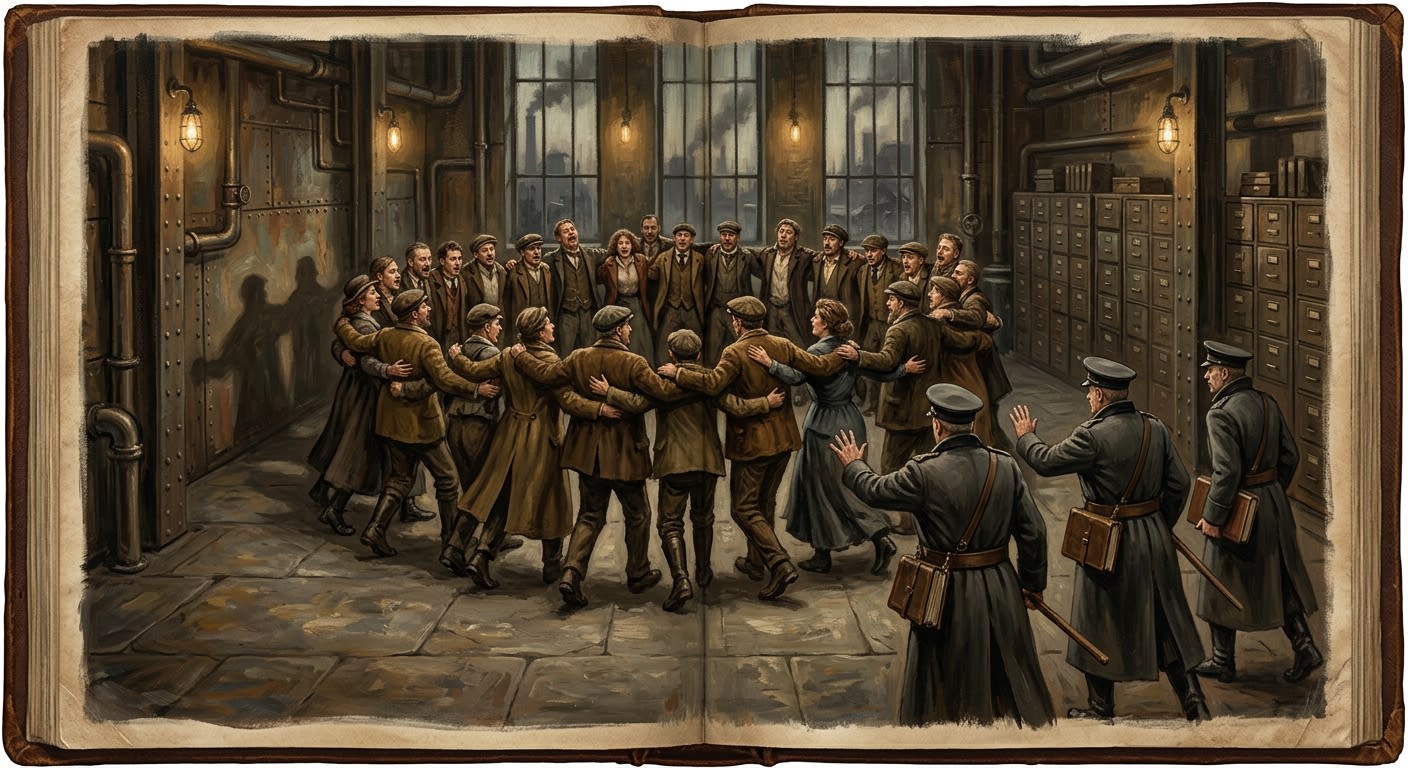
The Heresy of Siena (Unregistered) began in A.S. 141 with a harvest dance, which is to say with feet, dust, wheat, sweat, fiddles, parish wine, village pride, and the ancient human error of moving together before permission had been printed. It spread through three provinces before the Bureau of Festivals understood that a circle of peasants turning in rhythm may become more dangerous than a pamphlet, because a pamphlet requires literacy and rhythm merely requires a body.
The dance had no grand manifesto. This offends historians who prefer their heresies furnished with doctrinal furniture: named founders, illicit catechisms, a slogan suitable for quotation, a martyr with attractive bones. Siena supplied none of these comforts. It supplied a step pattern: three turns left, heel, clap, pause; two turns right, heel, clap, pause; hands joined at the third circuit; silence at the seventh; no priestly interruption until the grain baskets were brought through the circle.
That silence was the wound.
#On Siena Before the File
Siena sat inside the old Tuscan (Unregistered) obedience belt: vineyards, wheat terraces, mule tracks, stone churches, shrine walls polished by generations of hands, and families old enough to remember political arrangements the Synod had corrected into quaintness. The region obeyed in the usual profitable manner. It paid tithe, sent sons, burned first shoots on prescribed days, observed fasting, complained privately, and kept public saints dressed according to seasonal instruction.
Its harvest rites predated the Concordat of Strasbourg. This was already suspicious. Anything older than the Synod may be tolerated only after it confesses youth by wearing a Synodal ribbon. The Sienese dances had been revised twice by local clergy: once after the Charter of Prescribed Observance, once after the Festivals licensing settlement. The official form included a blessing before the first turn, a tithe acknowledgment before the grain baskets crossed, and a concluding parish reading from the Catechism. In practice, the villagers danced until the old women decided the grain had heard enough.
Provincial Festival summaries described the Sienese rite as “unregulated pagan survival.”
Corrected. It had been regulated repeatedly. Its danger lay in surviving regulation while appearing to comply. The Bureau has always preferred open rebellion; open rebellion does not make auditors look stupid.
The first report came from a junior Attendance Clerk who complained that the dancers ignored the concluding cue bell. His wording deserves preservation: “The crowd remained obedient to the circle.” A better theologian would have fainted at once. The provincial office requested clarification, because no form contained a field for obedience to geometry.
#On the Rhythm
Witnesses describe no frenzy at first. No screaming. No tearing of garments. No blasphemous puppet. No tavern-board satire, no orange-market chorus, none of the later Iberian brilliance that gave us the Laugh Riots of Seville. Siena moved quietly, which is worse. The dancers turned in harvest dust while the fiddle marked the heel, the heel marked the clap, the clap marked the pause, and the pause became a little chamber in which no Bureau spoke.
By the third circuit, singers dropped words and kept breath. By the seventh, even the children stopped laughing. The priest entered with the Catechism and found nobody resisting him. That was the problem. Resistance is simple. The dancers did not push him away, mock him, strike him, or deny doctrine. They continued. He read; the circle turned. The words entered the air and failed to command it.
The Bureau of Purity later called the state “unsanctioned communal ecstasy.” This phrase has the careful panic of men who have seen joy without a handler. The participants called it the grain-step, the old turn, the mother-circle, or merely dancing. Heresy often begins when official vocabulary grows longer than the act it condemns.
#On the Spread Through Three Provinces
The dance spread because it was not taught in documents. A girl married into a hill parish and brought the pause. A muleteer carried the heel pattern on wagon boards. Harvest hands hired across boundary lines returned home with the seventh-circuit silence in their knees. A widow hummed the fiddle part while kneading dough. Children played the clap game in courtyards and learned the adult version before any officer had identified the children’s version as evidence.
Festivals tried to count performances. Records tried to name participants. Tithes tried to determine whether grain moved through the circle before or after tithe acknowledgment, because Tithes can smell revenue through incense, smoke, and human misery. Orison listened for foreign rhythm. Purity looked for a teacher. There was no teacher. The pattern behaved like weather in the body.
By the second harvest season the danger had become administrative. Three provinces were reporting concluded dances that did not conclude when instructed. Parish priests began reading louder. Festivals issued blue batons to local Chorus-Masters. The dancers learned to turn around the baton. A man can be beaten for mocking an officer. It is harder to punish him for placing his foot where his grandmother placed hers, especially when the entire village does the same thing and the grain baskets are watching.
#On the Theological Opinion
The Bureau of Rites delivered a nine-page opinion. Nine pages is the length of panic attempting dignity. The opinion argued that the dance produced fellowship without vertical reference: bodies joined to bodies, hands to hands, breath to breath, harvest to harvest, without sufficient upward interruption toward Heaven, Hierarch, Synod, parish, tithe, office, seal, or authorized text. In plainer language, people were together before they were supervised.
The opinion also objected to the seventh-circuit silence. Silence, when imposed by the Fast of Silence, teaches obedience. Silence produced by shared rhythm teaches comparison. A villager who feels a circle become still may later notice that an official silence feels different: colder, thinner, rented. This is spiritually hazardous. It invites the peasant to distinguish discipline from communion, and once peasants begin distinguishing, the Ledger reaches for a knife.
RITES COMMENTARY 141-S, PARAGRAPH SEVEN Phrase under dispute: “horizontal sacrament.” Doctrine marginal correction: “Delete. No sacrament exists without vertical authority.” Unremoved undercopy visible beneath scraped ink: ██████████████████████████████████████ Copyist reassigned to Festival route work.
Festivals received the opinion with joyless gratitude. Purity wanted arrests. Tithes wanted retroactive fines. Local clergy wanted the whole matter reclassified as rustic excess and returned to them before provincial officers ruined the harvest. Festivals, being clever when frightened, chose a correction that preserved the dance while breaking its sovereignty.
#On the Corrective Reading
The decree was simple: all harvest dances in affected provinces, and later in every district where a festival officer suspected contagion, must conclude with a mandatory reading from the Catechism of the Sundering. The reading would be placed after the final turn, before grain baskets crossed the circle, before wine distribution, before local songs, before the old women could declare completion. Standing Catechism 3-F supplied the approved passage on obedience after fracture. Festivals supplied the cue bell. Records supplied attendance sheets. Purity supplied the possibility of teeth.
Festival teaching copies call the decree a “prohibition of the Sienese heresy.”
Corrected. The dance was not prohibited. It was yoked. Festivals understood what Purity did not: abolish a beloved rite and it becomes a martyr; interrupt it at the correct joint and it becomes a tool.
This is the genius and filth of the settlement. The dancers could still dance. They could even keep the heel, clap, pause, though the pause was shortened under parish supervision. The circle remained. The baskets remained. The old tunes remained, in licensed form. At the end, a reader stepped into the opened space and drove doctrine through the silence like a peg through a wrist.
The first corrected harvest in Siena lasted seven hours. The reading lasted eleven minutes. The complaint lasted eighty years.
#On Festivals’ Victory and Failure
The Bureau filed Siena as corrective success. It had reason. No army marched. No tongues were taken. No city had to be renamed for rumour. Three provinces returned to the calendar. Harvest rites entered the Prescribed Register. Chorus-Masters gained authority over rural dance. Attendance Auditors acquired a new column for “post-rhythm catechetical compliance.” The Bureau of Festivals discovered one of its central techniques: do not kill joy when joy may be made to carry doctrine.
That lesson travelled. After Siena came stricter festival endings, baton cues in folk plays, required catechetical closures after tavern songs, and the later machinery that governed Festival Form 19-M. The path from Siena to Seville is not a straight road; history is rarely so polite. It is a sequence of office habits. Siena taught Festivals that rhythm could gather people before language. Seville taught Festivals that language could become rhythm and stab back.
Purity never forgave the compromise. Purity prefers clean severance: tongue, hand, book, stage, mask, fire. Festivals prefers custody. The rivalry has dressed itself as doctrine for sixty years, but the quarrel is practical. Purity believes dangerous joy should be cut. Festivals believes dangerous joy should be licensed, measured, rehearsed, redirected, and billed.
#On the Sienese Survivals
The dance survives in supervised form as of A.S. 201. In Tuscany the Catechism reader stands at the north edge of the circle. In parts of Umbria (Unregistered) the reader enters only after the grain baskets touch earth. In two Lombard parishes the old women still decide when the seventh circuit ends, because the local Chorus-Master discovered that contradicting them reduced attendance by half and increased anonymous damage to his carriage by a number Records classified as rural weather.
Unlicensed variants persist. Of course they do. The pause lengthens in barns after funerals. Children play clap-turn games with no reading at all until a grandmother coughs and the game becomes innocent. Wedding parties in hill villages sometimes reverse the turn order: two right, three left, clap, pause. Festival officers mark this as harmless local deviation. Purity marks everything. The peasants mark nothing. They remember.
The most dangerous survival is emotional rather than choreographic. People who have stood inside the old pause know there are forms of togetherness the Bureau did not invent. They may still obey after knowing this. Most do. Obedience is cheaper than martyrdom and better for children. Yet a hidden comparison remains beneath the licensed step: the circle before the reading, the silence before the cue bell, the grain before the receipt.
That is why Siena remains a heresy. No doctrine was published. No saint was counterfeited. No idol was raised. The dancers gave the Synod a worse trouble: a memory of joy that did not request its seal.