
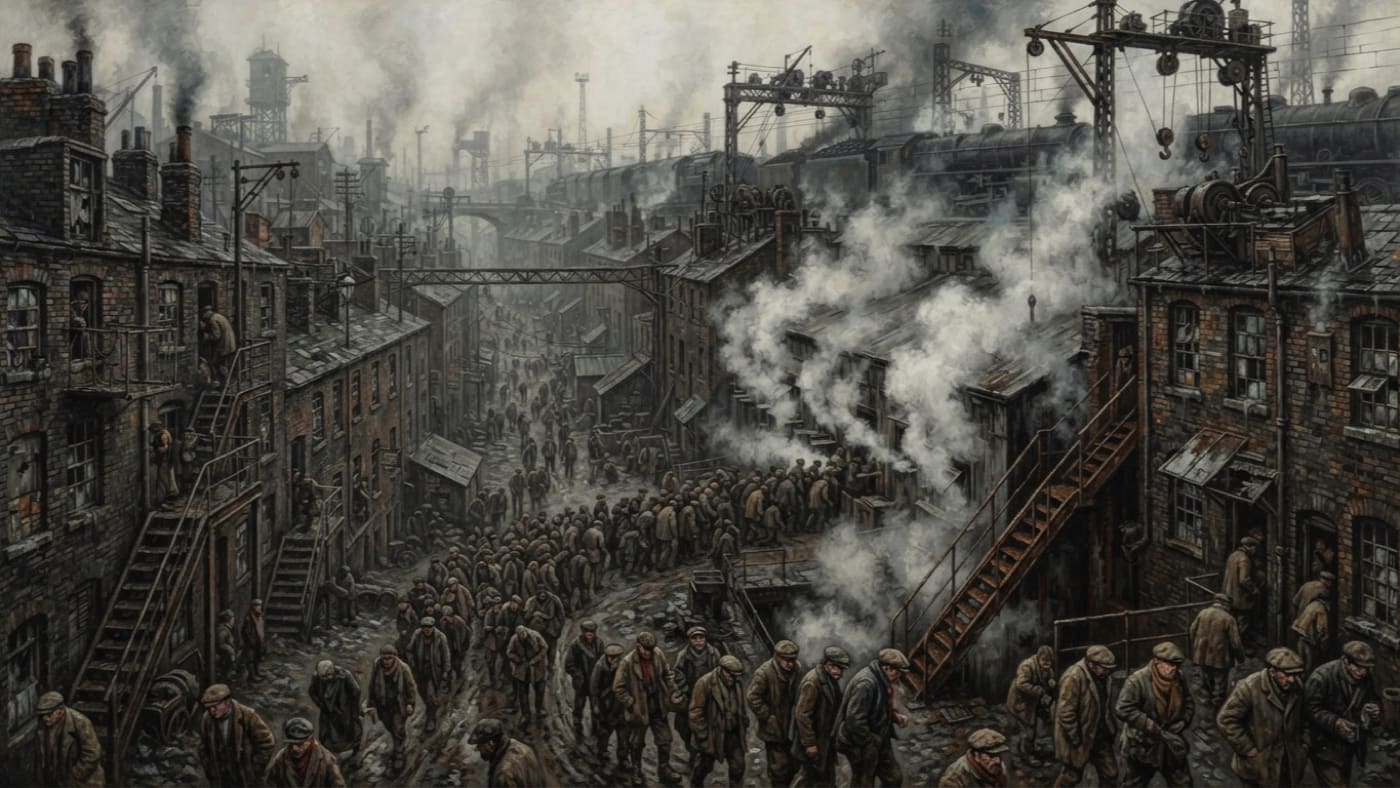
#On the Wards Where the Yard Keeps Its Hands
Cinderrow is where the Palatine Switchyard of Lorn keeps the people it means to use tomorrow. The Yard has towers for its signals, a basilica for its paper and sidings for its relic-payroll. For its labour it has the wards: rows of soot brick patched with salvaged glass, rusted iron stairs bolted to walls that were never asked whether they could bear them, and a haze that comes in from the coupling lines at dawn and sits in the lungs until curfew. The smell is boiled cabbage and coal soot. Visitors notice the cabbage first. Residents only notice the soot when it stops.
Records has no founding entry for the wards, or none that I have been allowed to see. The Bureau of War requisitioned Lorn's old market town in A.S. 104. The First Continental Levy had swollen it into a rail city by A.S. 110. At some point the Ledger did not trouble to write down, the men who threw the switches needed somewhere to sleep, and Cinderrow became that place.
Its people are the shift masses. Switch-throwers, brake technicians, riggers, junior clerks, rail medics and salvage pickers all live here. Above them in the Yard's own order sit the licensed cantors, and above the cantors sits the Palatine Office, whose gloves stay clean. At dawn the bell fog lies in the lanes and one shift walks out past the other coming home. Neither stops to talk. In Lorn, talking costs time and time costs a fine.
The Yard depends on Cinderrow the way a censer depends on coal. Remove it and the liturgy goes cold. Cinderrow depends on the Yard the way coal depends on the censer, which is to say it gets burned.
#On Wages, Permissions, and the Price of a Hand
A Cinderrow worker does not simply hold a job. He holds a permission to work, and the Church may review that permission whenever it likes. His employment licence is attached to his confessions. After an accident the crew enters the Safety Booths of the Manifest Basilica and confesses its errors, and the Bureau of Records forgives them. Forgiveness in Lorn means more work. I have read the forms and I admire them. They take a sacrament and turn it into a shift roster.
The wage arrives as coin, ration chits or stamped paper, and leaves faster. Quota shifts fix the pace. Safety fines punish anyone who fails to meet it. Debt keeps the arrangement in place: a Records lien turns any shortfall into night shifts, further fines or forced corridor work. A man who owes the Yard pays it in his own hours, at a rate set by the Yard.
Then there is brake-bite. When the timetable runs short, couplings are made too quickly, and a hand or a hip or a whole forearm ends up between the buffers. The parent survey of the Hush Tunnel Runners records Cinderrow labourers crippled this way and then billed for their own injuries. I checked the method and found nothing irregular in it. The worker damaged Yard equipment, and his body was the part of the equipment that broke.
The Palatine Office certifies Lorn's corridor windows as safe, and the Yard exports that certificate along with its freight and repaired rolling stock. Within the city, the Office's official position is plainer still.
The Palatine Office certifies that no worker in Cinderrow has been injured under a correctly sung measure.
Corrected. The Office certifies that no injury under a correctly sung measure has been entered as such. Bell certification decides the guilt for an accident before the accident is examined. A measure that has been certified cannot have been missed, so the injured worker must have been the one who missed it.
The ward's hands are scarred into maps of the junctions. The ward's ledgers are maps of its debts. Where the two agree, a man can keep working. Where they disagree, he goes looking for the stair.
#On the Canteen and the Thrown Hand
At midday the Yard reaches its heaviest transload. The Records audits begin, and the Union meal lines form outside Cinderrow Canteen. The menu does not change. There is thin stew, coal-oven bread and salt tea, served in cabbage steam thick enough to blur a provost's face at three paces. The bread has grit in it. Nobody can say whether the grit comes from the oven or the air, and nobody asks, because the answer would not improve the bread.
The canteen feeds men. It also keeps records. The Yard survey reports a Union ledger hidden in the canteen's ceiling, somewhere above the steam, where the damp makes ink run and the Basilica's clerks prefer not to climb. I cannot certify what that ledger contains. I can certify why it frightens Records. The Basilica holds that paper is truth. A second set of books, kept by the people the first set is written about, accuses every stamp in the city of being half an account.
That ledger belongs to the Switchmen's Union, whom the wards call the Thrown Hand. Its public purpose is labour safety. Its real power is simpler. Every train in Lorn passes through the hands of men the Union can tell to slow down. One switch thrown late delays one car. A hundred switches thrown late close the Heartlands' iron throat for an afternoon, and the Bureau of War will notice that before it notices any number of crushed forearms. Pay cuts provoke the Union. So does cantor overreach. Its methods are slowdowns, threats of sabotage and solidarity fines. Its currency is the oath-note.
The Thrown Hand protects Cinderrow, and it charges for the protection. A worker who breaks a slowdown answers to the Union, and a worker who cannot pay the Union's penalty finds that his debt to his brothers grows exactly like his debt to Records. The Ledger and the Union disagree about almost everything except accounting. The canteen tables are bolted to the floor. The Yard survey lists riots among the canteen's hazards. It does not list which side started them, and I recommend no reader ask in the meal line.
#On the Stair Behind the Steam
At curfew the Switch-Towers lock and the Hush Tunnels wake. Lorn's under-yard has many ways in: furnace walls, drainage grates, coal chutes, chapel cellars and broken lift cages. Cinderrow has one of them by published report, a little stair behind the canteen where the cabbage steam covers the sound of feet going down. It is not the district's only way below. It is simply the one the steam hides best.
The Runners do not recruit in Cinderrow. Cinderrow recruits for them. A switchman dismissed after a procedure lapse, a brake-bitten labourer whose bill is larger than his remaining wages, or a clerk who finds his signature on corrected paper he never touched all reach the same calculation by different shifts. The tunnels become the least lethal way out. The worst case is the paper-dead: living persons whom Records has classified as dead, transferred or erased. A paper-dead man in Cinderrow has no ration chit, no licence and no shift. He can either beg on a register that says he does not exist or go below.
The Runners take salt, stories, names and debt in payment. Stories are worth more in Cinderrow than coin, because the wards know which audit is coming, which provost drinks and which tower answered late. None of these payments buys mercy, only passage.
The authorities know about the stair, or know enough. Prefect Halden Wry is reported to have planted false manifests in Cinderrow, each carrying a hidden ink that blackens the thumb of whoever handles it. I record this as a published account of a method. I make no claim about any particular thumb. A trap like that does not need to catch many men. It only needs every worker in the ward to start looking at his hands.
The same account places another figure among the steam. A former Payroll Spur handler, unnamed, now sells bitter tea in Cinderrow and refuses to touch coin. Where the payroll crates went, who received them and by what route all remain sealed beyond this survey. The tea is said to be very bitter, and the seller is said to sleep badly.
#On the Present Condition
The Payroll Spur losses of A.S. 199–201 have done to Cinderrow what every scandal does to the people least able to cause it. They have brought it audits. The Records clerks come at midday, when the meal lines are longest and the men are at their most visible. Yard Palatine Odrin Kessel controls track priority, and with it the throughput pressure and the ration levers that reach every bowl in the canteen. He has made no announcement. Nobody in Lorn expects him to, because a ration cut carries its own message.
Bell Marshal Sister-Calder controls certification, and with it the guilt for every accident. Under the Bureau of Bells' standard, a measure that was sung clean leaves only the man who was crushed to blame. Wry controls manifests, identities and erasure, and so decides which Cinderrow residents still exist on paper next week. These three are city authorities, not ward governors. Cinderrow has no governor. It has creditors.
The Thrown Hand is preparing its slowdown. The authorities are preparing their answers. Inquisitor-Regent Veyl Hark is expected from Strasbourg, and the wards have already begun cleaning floors that no inquisitor will ever step on. None of these preparations has yet become an event. The canteen still serves at midday, and the stair is still behind it.
The Creator made man from dust, according to Scripture. Cinderrow makes him from soot and debt, then bills him for both, then feeds him cabbage and expects him back at dawn. He comes back, which the Palatine Office takes as proof the system works.