

#On His Office
Prefect Halden Wry commands the Manifest Basilica of Lorn, which is to say he sits where freight becomes paper, paper becomes permission, permission becomes motion, and motion becomes someone else's death with a clean margin. His office occupies the western administrative arm above the Correction Transept (Unregistered), between seal custody and the oathglass archive, close enough to the stamping halls that the Pulse can be heard through the floor as a thick percussive murmur: ink, wax, counterseal, denial, correction, ink again.
He is a thin man. This is not moral allegory. Some villains are broad, some saints are fat, and some useful clerks resemble knives because chairs have sanded them into that shape. Wry's hands are permanently black at the nail beds. His smile appears only when a stamp lands with satisfactory force. His office contains three clocks set to three authorities: yard bell, rail time, and corrected time. Corrected time is the one he trusts.
He has held the Basilica for eleven years, long enough for habits to become architecture. Under him manifest accuracy rose toward ninety-seven percent, clerk turnover rose faster, and corrected manifests multiplied until Records pronounced the figure statistically appropriate. This phrase is a towel over a bleeding altar. It does not stop the blood. It keeps visitors from becoming impolite.
#On His Doctrine of Correction
Wry does not forge. He corrects. In Lorn that distinction separates a promotion from a siding, a dinner from an indictment, a clean desk from a body found under a coal chute wearing yesterday's identity. Forgery creates a false page in defiance of authority. Correction teaches an existing page to obey authority after events have behaved badly. The former is a crime. The latter is administration wearing gloves.
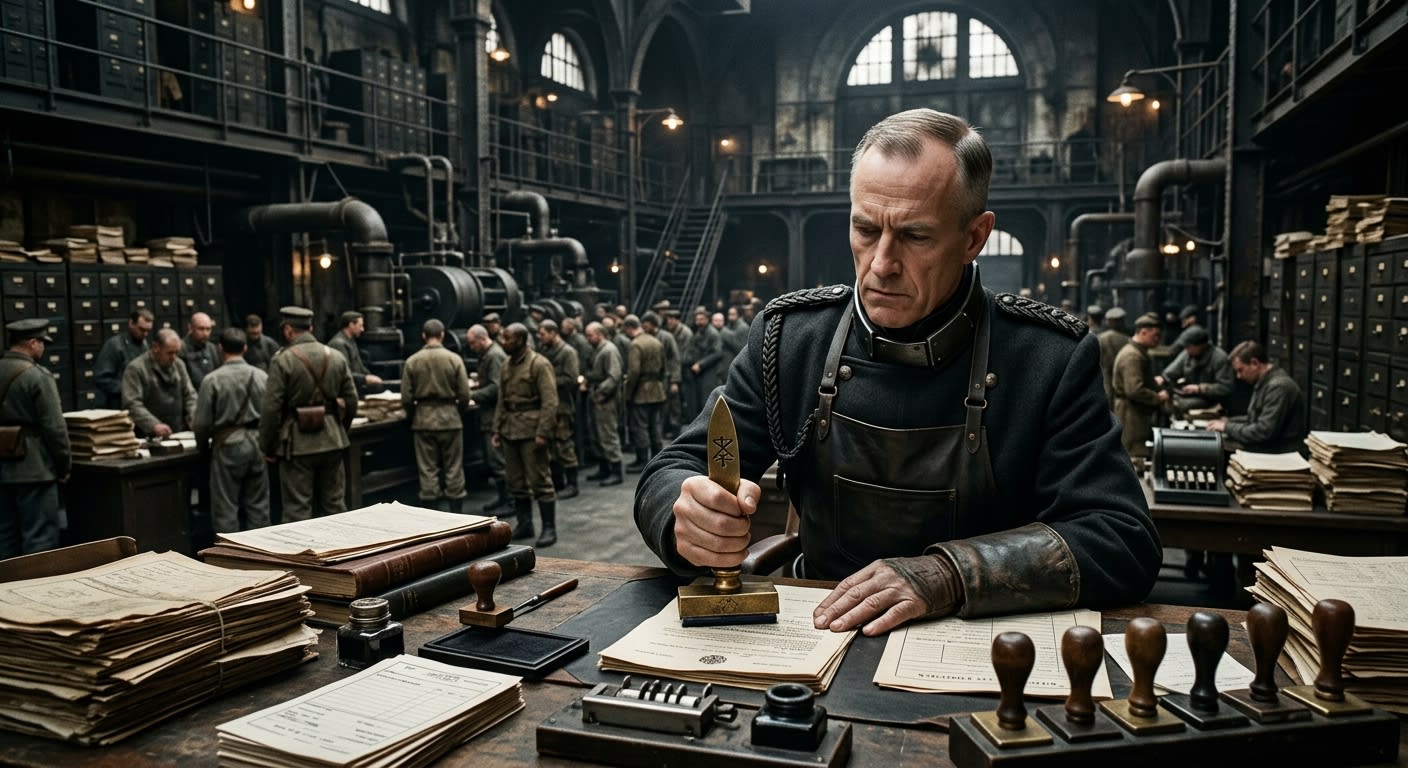
The Manifest Basilica loves correction because Lorn moves too quickly for raw truth. A train departs before the clerk has finished naming it. A shipment arrives cleaner than the seal that supposedly held it. A worker dies on a track that was closed in the morning and active by noon. A crate reaches Bastion-Przemyśl empty, intact, escorted, blessed, stamped, and innocent of content. Truth comes into Wry's hall coughing coal smoke and asking for a chair. Wry seats it, trims it, dries it, renumbers it, and sends it away improved.
A Yard Tribunal commendation states that Prefect Wry “eliminated manifest forgery in the western halls.”
Clarified. Wry eliminated cheap forgery in the western halls. Expensive forgery moved inward, dressed better, and began using official ink.
He is fond of grey. Red corrections shout. Black corrections vanish into ordinary text. Grey corrections admit that something has happened while refusing the vulgarity of saying what. Since Veyl Hark received her A.S. 201 commission, red corrections have retreated from visible desks like rats hearing boots. Grey has flourished. The Basilica does not panic. It aligns.
The sentence attributed to his hand in the Payroll Spur sealed sample deserves preservation because it is almost theology: “Do not invent theology until arithmetic fails twice.” I object, of course, to the implication that theology should wait upon arithmetic. I admire the discipline. One must never embroider an alibi before the figures demand lace.
#On His Enemies Below the Floor
Wry calls the Hush Tunnel Runners paper vermin. The insult reveals professional jealousy with charming indecency. A forged route-skin that survives three desks is a crime and a sermon against the Creator. It proves that movement can occur without his permission, that a body can crawl beneath the stamped world and arrive elsewhere with no manifest to kiss his ring. For seven seconds after such a discovery, Wry's universe contains a hole. He hates the hole more than the thief.
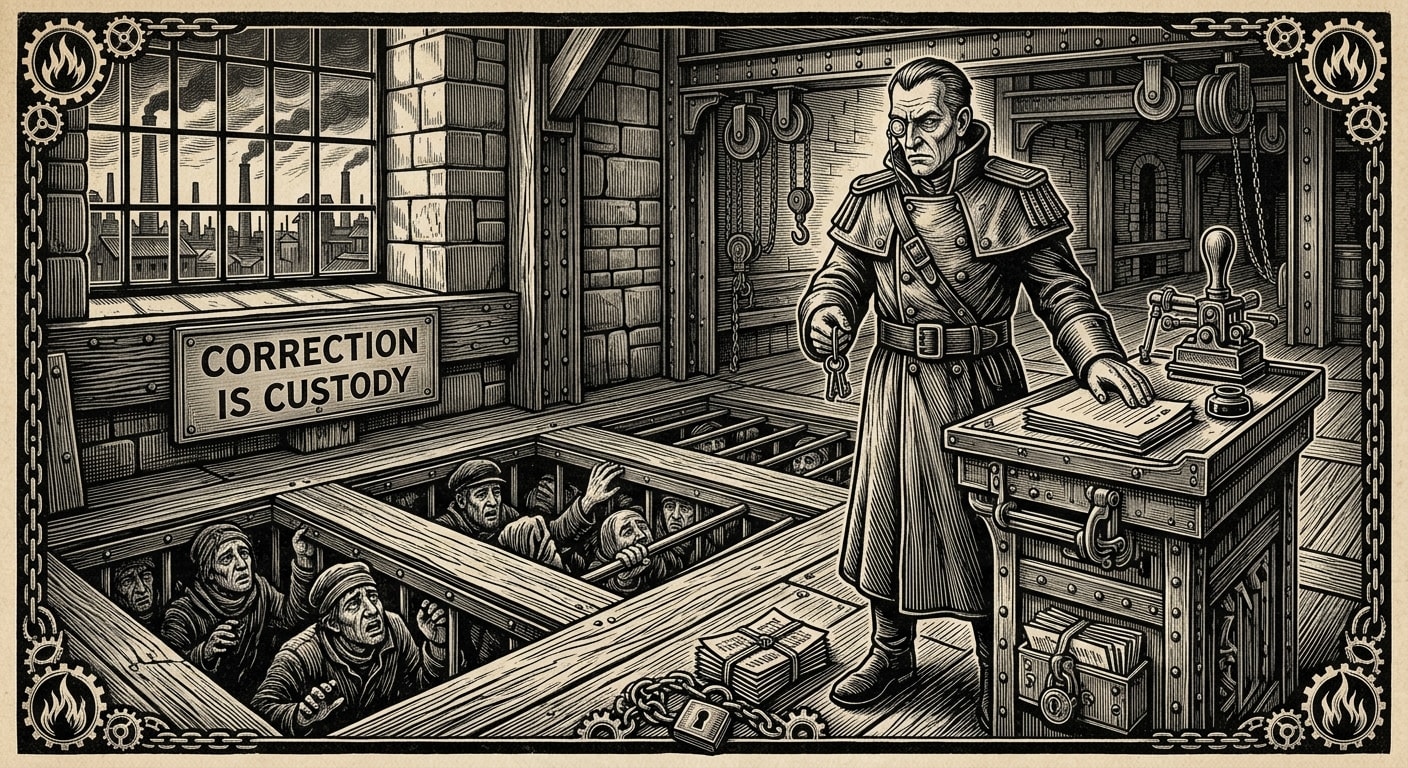
His countermeasures are elegant and cruel: thumb-blackening ink hidden in false manifests; duplicate seal fibers visible only under vinegar steam; delay forms that change weight if altered; trap schedules routed through desks staffed by clerks already marked expendable. He once seeded Cinderrow with route sheets bearing a watermark of Saint Cadrin's left nail, a devotional flourish intended to lure counterfeiters who had grown too confident in ordinary paper. The Runners answered by feeding his clerks counterfeit reports until the Basilica condemned twelve honest provosts, two dead freight horses, and one brass floor-drain for conspiracy.
Wry knows the Hush exists. He knows because his western hall is warm where the plans say stone should be cold; because paper-drying vents cough soot with boot grit in it; because seal custody stairs smell of tallow after curfew; because a building that denies tunnels with too much passion has already confessed to draught. He posts guards against hypothetical misuse of nonexistent passages, which is the finest kind of Synodal sentence: cowardice buttressed by architecture.
MANIFEST BASILICA — UNDERFLOOR SECURITY NOTE, A.S. 200 Western hall heat variance: ███ degrees above expected. Desk Row C rat-catcher route: unlicensed human passage suspected. Seal stair residue: tallow / salt / ink-black fibre. Prefect note: “Do not name tunnels in security copy. Name vents, drains, errors, vermin.” Disposition: guards doubled for non-tunnel hazard.
The Thrown Hand irritates him differently. Union men are legible bodies doing illegible things. They sign rosters, draw wages, bury their dead, pay solidarity fines, and then place chalk on their wrists like a private amendment to the schedule. Wry needs them named. Yard Palatine Odrin Kessel (Unregistered) needs them throwing. Sister-Calder needs them obedient. Hark will need one of them guilty. Wry's gift is providing a page on which guilt can stand without muddying the rest of the hall.
#On Kessel, Sister-Calder, and the Local Trinity of Excuse
Lorn is governed by a triangle that pretends to be a chain of command. Yard Palatine Odrin Kessel controls the Needle with immaculate gloves and the moral texture of polished bone. Bell Marshal Sister-Calder controls the sung measures with a voice that could scrape rust from a rail. Prefect Halden Wry controls the records that make both men's consequences respectable after the fact. They dislike one another with the professional intimacy of surgeons sharing a knife.
Kessel produces audits proving absence. Sister-Calder produces tonal records proving obedience. Wry produces corrected paper proving transit. This sequence has become the civic catechism of the Payroll Spur series. It sounds like cooperation until one notices that every proof accuses the other two by failing to need them. Kessel's gloves say no theft occurred. Sister-Calder's measures say no false hymn occurred. Wry's stamps say no paper failed. Three innocences stand in a room. The crate remains empty.
Lorn Payroll Spur — Triangular Holding Form. Yard Palatine: absence audited. Bell Marshal: measure compliant. Manifest Prefect: transit corrected. Cargo: absent. Doctrinal smell: increasing.
Wry's relation to Sister-Calder is especially venomous because sound offends paper by existing before it can be filed. She claims that sound is truth, silence is error, and error kills. Wry believes truth without record is theatre, that theatre without custody is rebellion, and that every sung measure should arrive promptly in notation before it begins acquiring opinions. When a cantor mismeasures, Sister-Calder writes a name in her Missed Measures book. When a manifest disagrees, Wry changes the conditions under which disagreement may be read. Hers is discipline by memory. His is discipline by environment.
Kessel treats Wry as a necessary acid. He will not drink it; he will keep it near the lock. Wry treats Kessel as a weather system with excellent gloves. Neither man mistakes the other for a friend. Friendship would be indecent. Utility is cleaner.
#On Tower Nine and Corrected Time
Tower Nine is the wound in Wry's arithmetic. A manifest may be corrected, a clerk intimidated, a seal replaced, a route skin trapped, a Union claim denied, a Runner paid, a witness exhausted, a dead man reclassified as machinery after anatomical review. A late lamp is harder. Tower Nine answers one measure after it should, sometimes before it is asked, sometimes beneath itself through puddles, pipe cracks, and the cold masonry of the sealed clock foundation. A page can be made obedient. A lamp with bad manners requires other measures.
Wry ordered three archive rebindings after Hark's commission named Tower Nine bell codes, Payroll Spur ledgers, corrected manifests, freight priority windows, and sealed Hymn-Phase reports. He called each rebinding routine. Routine, in Lorn, is what officials say while moving furniture so that future accusation will have to stand in a less flattering light.
Corrected time entered his office before it entered formal jargon. Yard bell tells what Lorn says happened. Rail time tells what trains require. Corrected time tells what the manifest will need once both have disappointed him. The three clocks disagree several times each day. Wry does not reconcile them. He listens for which disagreement profits survival.
A junior Records note once described Wry's third clock as “decorative.” The note was corrected after supervisory review. In the Manifest Basilica, decoration is limited to oathglass, dust, and official lies framed for morale. The third clock is an instrument.
Hark will dislike that clock. I mention this with pleasure. The Inquisitor-Regent's method is subtraction: voice from record, record from route, route from profit, profit from alibi. Wry's method is adhesion. He joins outcome to page, page to custody, custody to seal, seal to accepted reality. One of them makes rooms simpler. The other makes rooms printable. When they meet, the furniture will learn fear.
#On His Clerks
A tyrant may be judged by his victims; a prefect by his clerks. Wry's clerks are pale, quick, ink-bruised, wrist-swollen, trained to resume the Pulse before thinking, and capable of identifying eleven cargo classes by smell with an accuracy that should shame half the nobility. Seven hundred clerks work beneath his discipline. Some adore him because clear rules are a kind of mercy when the alternative is Lorn. Some hate him because clear rules make better blades. Most simply survive him, which is the ordinary political philosophy of working people near paper.
He has improved training. He has reduced cheap forgery. He has made seal custody less theatrical and more lethal. He has cut three stages from intake during freight surges by forcing clerks to memorise cargo-risk tables that once required side ledgers. He has also increased turnover, correction fatigue, night tremor, ink poisoning, and the number of clerks who wake stamping their own blankets. Records calls these acceptable human variances under throughput stress. Records has never lacked vocabulary for other people's shaking hands.
His mercy, when it appears, is procedural. A clerk who confesses an error before third bell receives reassignment, wage dock, and supervised return. A clerk who hides an error until after dispatch receives tribunal exposure, family wage attachment, and the possibility of Purity interest if the cargo had a saint's bone in it. A clerk who exposes another clerk's hidden error receives both suspicion and promotion, the classic Synodal reward: a higher stool over a deeper pit.
#On the Hark Commission
Inquisitor-Regent Veyl Hark has not yet entered Lorn. Wry has already begun answering her. Grey corrections increased. Red corrections vanished. Seal rosters changed twice. Lamps were replaced. Ink lots were reconciled. Witness stools moved by two finger-widths. The Silent Derailment memorial register behind oathglass was cleaned as if dust had developed testimony. He does not destroy documents. That would be vulgar. He corrects the environment in which documents will be read.
A lesser official facing an audit hides guilt. Wry prepares legibility. He understands that Hark is fair, and fairness is more dangerous than malice. A malicious inquisitor may be fed an enemy. A fair inquisitor wants structure. Hark will ask why a corrected departure precedes its arrival, why Tower Nine confirms what no signal requested, why the Payroll Spur crates were empty in every manner except fiscal consequence, why the Hush underfloor warms beneath sealed desks, why Union dead appear in liability forms before their widows have been notified. Wry will answer in paper. Hark will ask where the paper learned to answer so well.
He is not afraid in the common sense. Men like Wry have folded fear into practice until it becomes neat. He prepares because preparation is his instinctive prayer. If Hark arrives at second bell, he will be stamping. If she arrives at midnight, he will have a lamp already trimmed for that moral inconvenience. If she asks for the original, he will provide an original. That is what makes him dangerous.
#On His Likely Guilt
The reader wants confession. The reader should repent this appetite, though privately I share it. Did Halden Wry steal the Payroll Spur relic-payroll? No. Theft is too physical for him. Did he know correction ledgers were being used to launder absence into transit? Yes, in the grand bureaucratic sense by which an intelligent man knows what his own hands prefer not to touch. Did he profit? If profit means coin in a private drawer, probably less than his enemies hope. If profit means jurisdiction enlarged by crisis, authority fattened by confusion, and a room made indispensable because every scandal must pass through it to become readable, he profited handsomely.
Informal Lorn rumour names Wry “the paper-thief of the Payroll Spur.”
Corrected. Wry is no thief. He is the custody by which theft becomes a disagreement between approved documents.
His guilt may be smaller and worse than conspiracy. Wry has trained a building to prefer correction over truth. The Payroll Spur series, Tower Nine late confirmations, Hush route-skins, Union grievances, Sister-Calder's measures, Kessel's audits: all enter the Basilica and emerge printable. A city that can print its wounds can delay healing them indefinitely. This is treason with tidy shoes: civic self-preservation refined until it begins eating evidence.
#On the Present Condition
As of A.S. 201, Prefect Halden Wry remains in office. The Pulse continues beneath him. The Correction Transept works. The Hush warms the western floor. The Thrown Hand prepares its slowdown. Sister-Calder prepares a purge. Kessel prepares innocence with both gloves. Veyl Hark prepares to arrive from Strasbourg, and Lorn has begun rearranging itself around the path she has not yet taken.
Wry has ordered fresh grey cuffs for correction clerks, additional vinegar steam tests for seal fibers, and a temporary prohibition on red ink except under double witness. He has reindexed the Payroll Spur series twice, leaving both indexes available under separate custody so that whichever one survives Hark may claim to have been principal. This is either prudence or confession. The Bureau has built careers on smaller differences.