
#On the Nonexistent Under-Yard
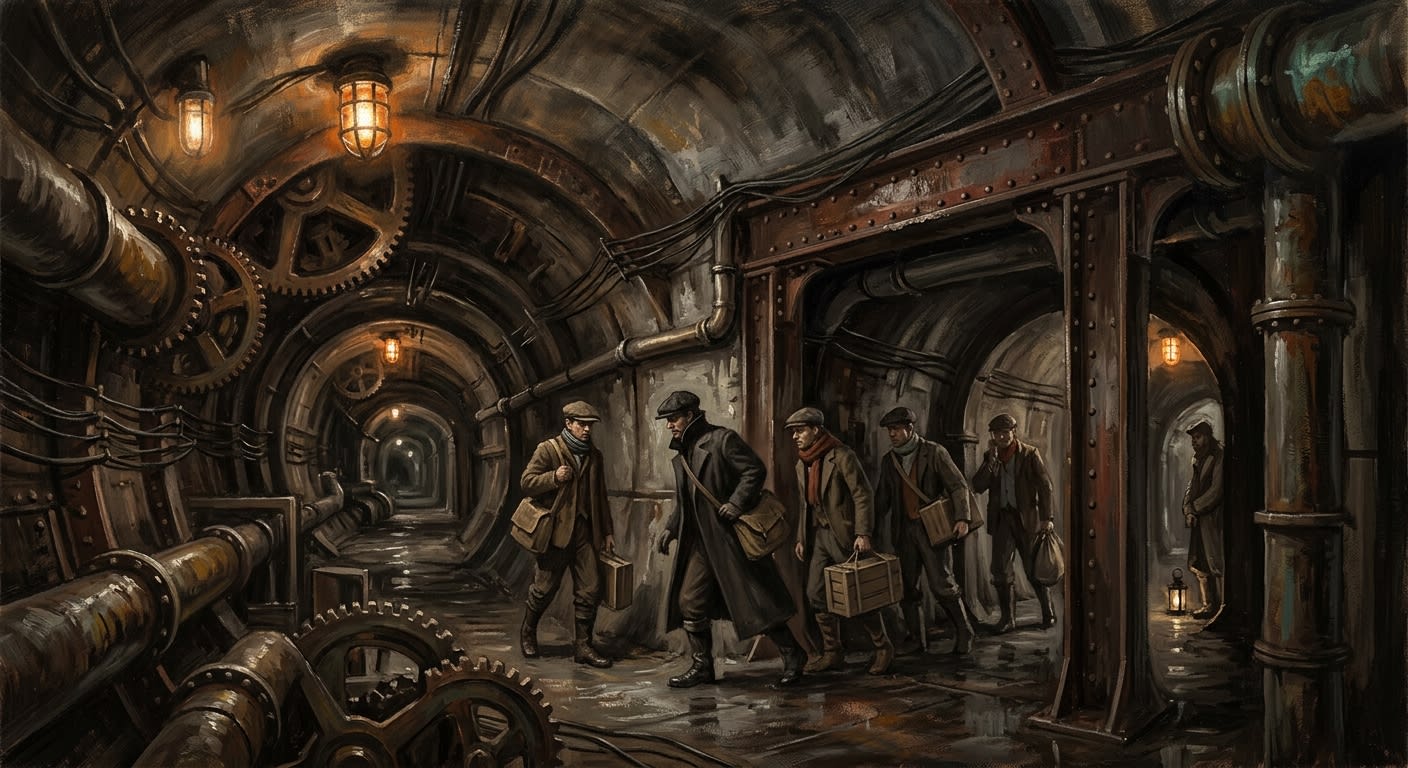
The Hush Tunnels are the under-yards beneath the Palatine Switchyard of Lorn: service corridors, buried cellars, drain runs, coal conduits, slag braces, inspection crawlways, bricked chapel crypts, failed survey galleries, smuggler cuts, and route-stitches made by hands that had no patience for the official map. They do not exist. The Manifest Basilica says so. The Yard Palatine (Unregistered) says so when auditors are present. The provosts say so while posting guards at the stair mouths.
I admire Lorn's dedication to contradiction. Most cities lie upward. Lorn lies downward, into damp stone.
Above ground, Lorn is a sung machine: twelve converging rail lines, seven hundred daily departures, tower lamps, hymn-timed switching, cantor measures, manifest stamps, the Needle (Unregistered) inspection gate, and a city of two hundred ten thousand registered souls pretending registration is the same as safety. Below ground, the Hush Tunnels carry the things the schedule cannot admit: unlicensed bodies, forged route-skins (Unregistered), blank manifests, stolen lamp-talk (Unregistered), injured switchmen, paper-dead fugitives, salt debt, Payroll Spur rumours, and the faint iron taste of routes that change after being named.
They contain sewage without becoming sewer-work. They hold dead without becoming a catacomb. They move more truth than most roads in the Heartlands. They are Lorn's confession without absolution.
#On the Buried Town
Before Lorn became a filing system with locomotives, an older market town sat at the rail throat. It had grain merchants, blacksmiths, small inns, wells, a Benedictine chapel, cellars, gossip, and the mild vanity of believing that a town with a name can keep it. The Bureau of War requisitioned the junction in A.S. 104. The chapel became a dispatch office within days. The old name vanished from the Ledger. Lorn appeared: surrendered to divine purpose, if one accepts Doctrine's etymology; lost, if one accepts the human language from which the word was stolen.
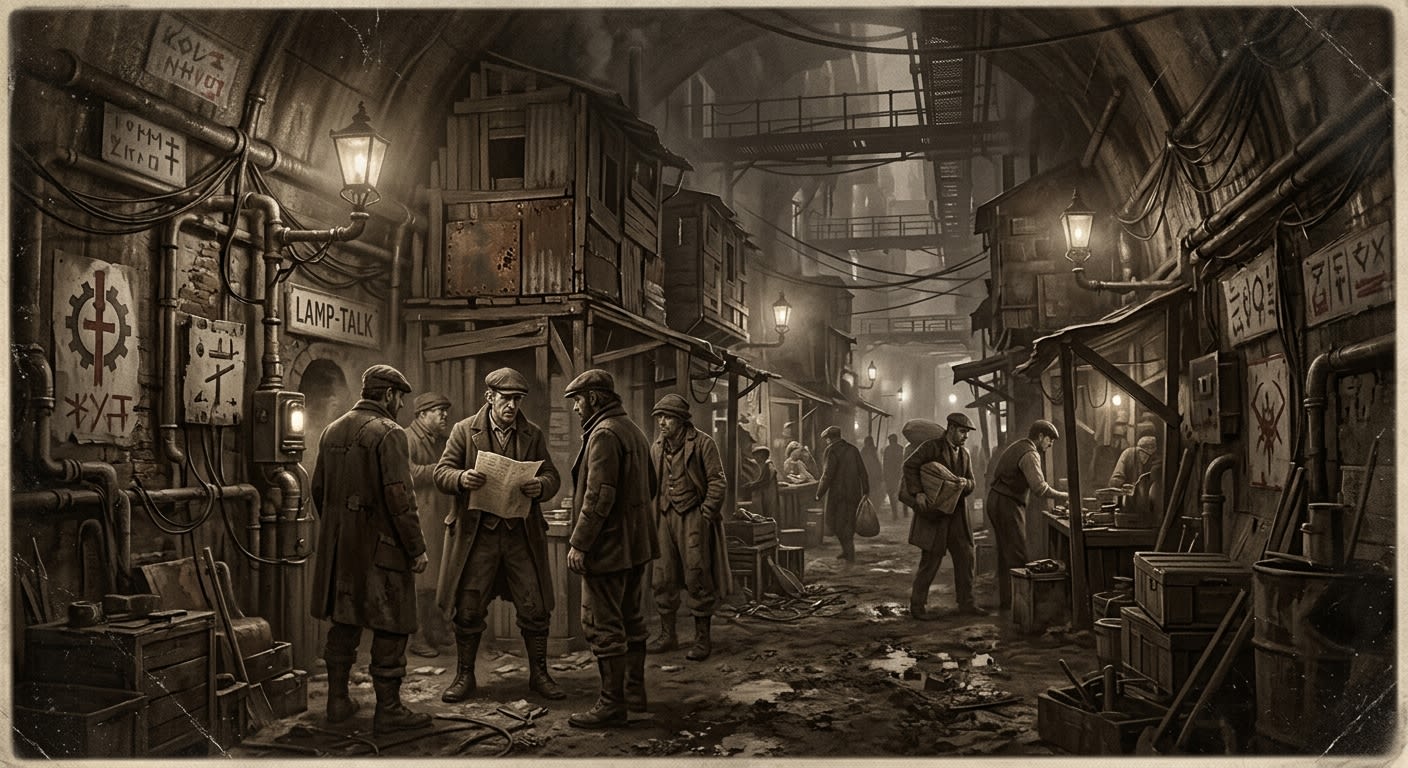
The first yard was built fast. Fast construction produces two things: useful infrastructure and excellent hiding places. Cellars were filled with slag and not quite filled. Drain runs were cut through earlier walls and not quite mapped. Coal conduits crossed old crypt passages. Inspection crawls were bricked at one end and forgotten at the other. The chapel foundations remained under the dispatch floor, sealed badly, sanctified loudly.
By A.S. 110, during the First Continental Levy expansion, under-yard traffic was already evident. Boys vanished with message tubes and returned with salt. Brake crews found chalk arrows under Switch-Tower Nine. A widow retrieved her husband's tool kit from a wall cavity no foreman admitted opening. The Bureau of Records filed these matters as yard nuisance. Records has always possessed a gift for mistaking infancy for insignificance.
The Silent Derailment of A.S. 112 (Unregistered) gave the tunnels their first doctrine. Forty-one men died on a siding every manifest denied. Above ground, the Bureau of Bells answered with cantor procedure: no switch without sung measure, no signal without hymn, no motion without sound. Below ground, silence became survival. A city ordered to sing every movement created an under-city where a cough could condemn, a dropped key could betray, and quiet acquired the sanctity of contraband.
Early Yard memoranda describe the Hush Tunnels as “residual maintenance voids of no civic importance.”
Corrected. Anything under a rail city that can move a person, a crate, or a lie has civic importance. A void that answers payment is not residual. It is employed.
#On the Shape Beneath the Shape
No official map of the Hush Tunnels is complete. Several are accurate enough to kill the overconfident.
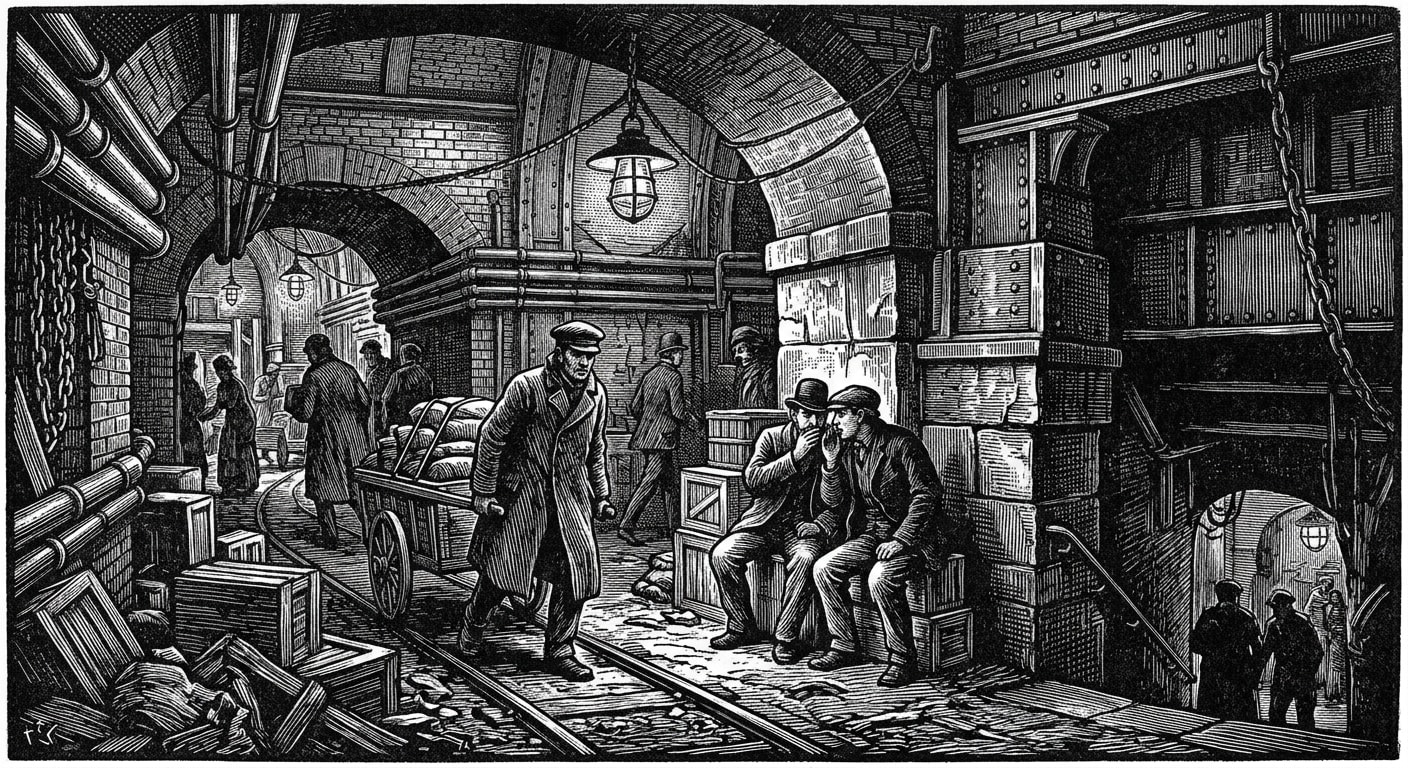
The western passages lie under the Manifest Basilica: low brick runs sweating ink-smell through the mortar, clerk access wells, stamp-room heat vents, and paper-dust alcoves where whispered names cling to the throat. These corridors are narrow, dry by Lorn standards, and watched. One can hear the Pulse overhead: stamp, stamp, stamp, the administrative heartbeat pressing through the ceiling like a sainted machine with a repetitive injury.
The northern runs follow Cantor Walk. They are louder and less safe. Song seeps through the stone. A clean measure overhead can make tunnel lamps shiver. A missed measure can turn an archway into a wall for three breaths, long enough to divide a party and let the divided portion become theology. The Bureau of Bells calls this sympathetic resonance. The runners call it the yard clearing its throat.
The southern passages under the Scrap Basilica (Unregistered) stink of acid, rust, rat heat, and old furnace skin. Here the tunnels widen because salvage crews widened them and forgot, or were paid to forget, or were fed into the furnace before memory became testimony. Stolen axles have rolled through those galleries. Condemned rolling stock has been stripped twice: once above ground by licensed cutters, again below by children who know which rivets keep secrets.
The eastern tunnels near the Needle are the most profitable and the most likely to eat a guide. Inspection creates value. A single bypass under the Needle can move a sealed person past seven layers of legal curiosity. It can also deliver that person into a bricked siding, a provost chapel, a Payroll Spur crate, or a stair that returns him above ground three days before he entered.
Beneath Tower Nine, the tunnels thicken into something older than smuggling. There is a sealed pre-Synod clock foundation under the switch cage. The lamps above blink late. The puddles below blink first. This is not metaphor. Lamp-readers have seen tower codes reflected in standing water before the actual lamps moved. The sensible response is to leave. Lorn has never been governed by sensible responses.
#On Marks, Lamp-Talk, and Route-Skins
The tunnels speak in marks because speech is expensive below ground. Chalk arrows, wax scratches, rope knots, bent nails, grease crescents, cracked lamp glass, rat-bone bundles, and burnt matchheads form the under-yard script. A cross means stop if drawn in chalk, pay if cut in wax, pray if made from bone. Three knots at knee height mean low crawl. Three knots at eye height mean someone expects you to be taller than is healthy. A blue smear means tower watch has shifted. A yellow smear means the smear is lying.
Lamp-talk is stolen from the switch-towers. Blink, pause, double-pause, false clear, amber hold, warning red, low blue after storm, gutter flicker, Nine-late. Through grates, cracked coal chutes, and drainage slits, Hush eyes read above-ground authority and turn it into under-ground opportunity. A tower lamp that holds amber one breath too long tells a runner where inspection attention has gathered. A white hold above the Needle means the route below is about to become crowded with men who insist they are not fleeing.
Route-skins make the body legible to the tunnel. Above ground, a route-skin is disguise: ash-cleaner, pipe-votive, rat catcher, brake inspector, orphan courier, chimney surveyor, dead-wheel servant. Below ground, it is rhythm. A rat catcher pauses near drains. A brake inspector touches bolts. An orphan courier moves quickly until questioned, then becomes small enough to pity. The Runners teach the rhythm with bruises because bruises remember better than sermons.
The tunnels punish bad reading. A false arrow can lead to provost hands. A true arrow followed too late can lead to water up to the teeth. A rope knot tied in a dead man's pattern means the tunnel remembers someone who should not be followed. Children learn this first. Adults learn after payment, if luck is feeling theatrical.
#On Who Walks Below
The Hush Tunnels belong to no one. This makes them profitable.
The Hush Tunnel Runners are their most disciplined users: smell-guides, key-brokers, lamp-readers, mouthless carriers, route-mothers. They sell movement outside the schedule. They do not own the tunnels any more than a priest owns death because he invoices funerals. The Switchmen's Union uses the Hush to hide injured men, move oath-notes, bypass cantor watchers, and keep a second count of yard blood in the Crushed Book. Yard provosts use the Hush while denying it to move informants and seize smugglers without admitting there was a passage by which either travelled. The Bureau of Shadows uses the Hush because the Bureau of Shadows has never encountered a denial it did not wish to rent.
Institution is too generous a word for the tunnel children, though every institution feeds them. They sleep in heat niches, know air by taste, and can cross from Cinderrow to the Scrap Basilica without touching a registered stair. They carry notes, steal lamp oil, sell rat locations, and sometimes return with adult knowledge in a child's mouth, which is one of Lorn's less advertised educational systems.
Yard Tribunal summaries classify under-yard minors as “juvenile vagrants.”
Corrected. A vagrant wanders. These children know the way. The distinction has defeated more patrols than compassion ever managed.
Paper-dead persons also walk below. A man marked transferred, a woman declared dead, a conscript erased by manifest correction, a clerk whose signature was used too often by someone else: all may enter the Hush because the above-ground city has already relieved itself of responsibility. The tunnels do not restore them to law. They give them damp, motion, and a price.
UNDER-YARD LISTENING NOTE — SEALED ANNEX, A.S. 201 Subject identified himself as “Cargo previously human.” Route-skin: brake inspector. Manifest status: deceased A.S. 199, paid through Payroll Spur A.S. 200, conscripted A.S. 201, executed A.S. 198. Subject asked which version owed tunnel fee. Guide answered: “The breathing one.”
#On the Payroll Spur and the Hungry Walls
The Payroll Spur scandal has made the Hush Tunnels fashionable among men who should know better. Since A.S. 199, relic-payroll crates have passed through Lorn with correct seals, correct hymns, correct manifests, and incorrect contents. They arrive empty. Absence, repeated often enough, becomes indictment.
The street says the Runners stole the crates. The Yard Palatine prefers this explanation because criminals can be hanged and holes can be sealed. The deeper testimony is less obedient. Some Payroll Spur routes were found cut into service walls beneath Tower Nine in a hand older than the present marks. Some crates travelled through corridors the route-mothers did not know. One child returned alone from a cold-safe passage carrying payroll wax in both hands and a route-skin listed as never issued. Three runners retired rich and frightened. One joined a silent order. One was found with DEAD stamped across a living chest.
The walls near the Spur have begun taking marks badly. Chalk fades. Wax scratches crawl. Rope knots untie during bells. A passage marked safe before Matins may answer with hot air by Sext and cold river stink by Vespers. The Bureau of Bells blames the Hymn-Phase Slip. Records blames unauthorised excavation. War blames labour sedition. The tunnel guides blame hunger in the masonry, which is less respectable and more useful.
No one should romanticize this. The Hush Tunnels are dangerous, exploitative, damp, corrupt, necessary, and alive in ways a corridor should not be. Their brick is not carved noble resistance. It is carved appetite. They shelter the hunted and sell them twice. They save injured workers and deliver rivals to wrong stairs. They mock the schedule and feed upon the schedule's cruelties. A saint would condemn them. A sane city would not need them. Lorn is neither.
#On Veyl Hark's Coming Audit
As of A.S. 201, Inquisitor-Regent Veyl Hark is moving toward Lorn with eleven clerks, two white-mantled Inquisitors, one scarred-lip bell-copyist, and a portable audit press. Her warrant touches Payroll Spur losses, Tower Nine lamp codes, Hymn-Phase matter, Hush traffic, Thrown Hand slowdown pressure, and any official foolish enough to believe titles are armour.
The tunnels know before the gates. That is their one legitimate miracle. Lamp-talk has changed. Salt prices have doubled. Route-mothers have stopped accepting coin for eastern passages. Children who normally sell false maps have begun giving true warnings for free, which frightens veterans more than any provost raid. The Thrown Hand is moving injured men deeper. The Runners are preparing backup routes and lies about backup routes. Yard Palatine Kessel (Unregistered) has issued another denial of under-yard activity, printed on excellent paper and distributed to stair guards.
Hark will not abolish the Hush Tunnels. She is too intelligent for theatrical victory. She will cut names from the walls, arrest enough runners to satisfy the docket, break a provost ring, terrify the Union, force Kessel to adjust his gloves, and leave the passages breathing. Lorn cannot close its under-yard without admitting the above-ground schedule produces what it cannot carry.
At curfew, the towers lock. Above ground the Cantor Corps sings the yard into obedience. Below, a girl with coal under her nails reads amber through a grate and changes the route. A switchman with one hand carries an oath-note into the damp. A dead man pays in salt. A provost follows a false arrow with official confidence. Somewhere beneath Tower Nine, water blinks before the lamp does.