
#On the Siding That Had No Right to Receive the Dead
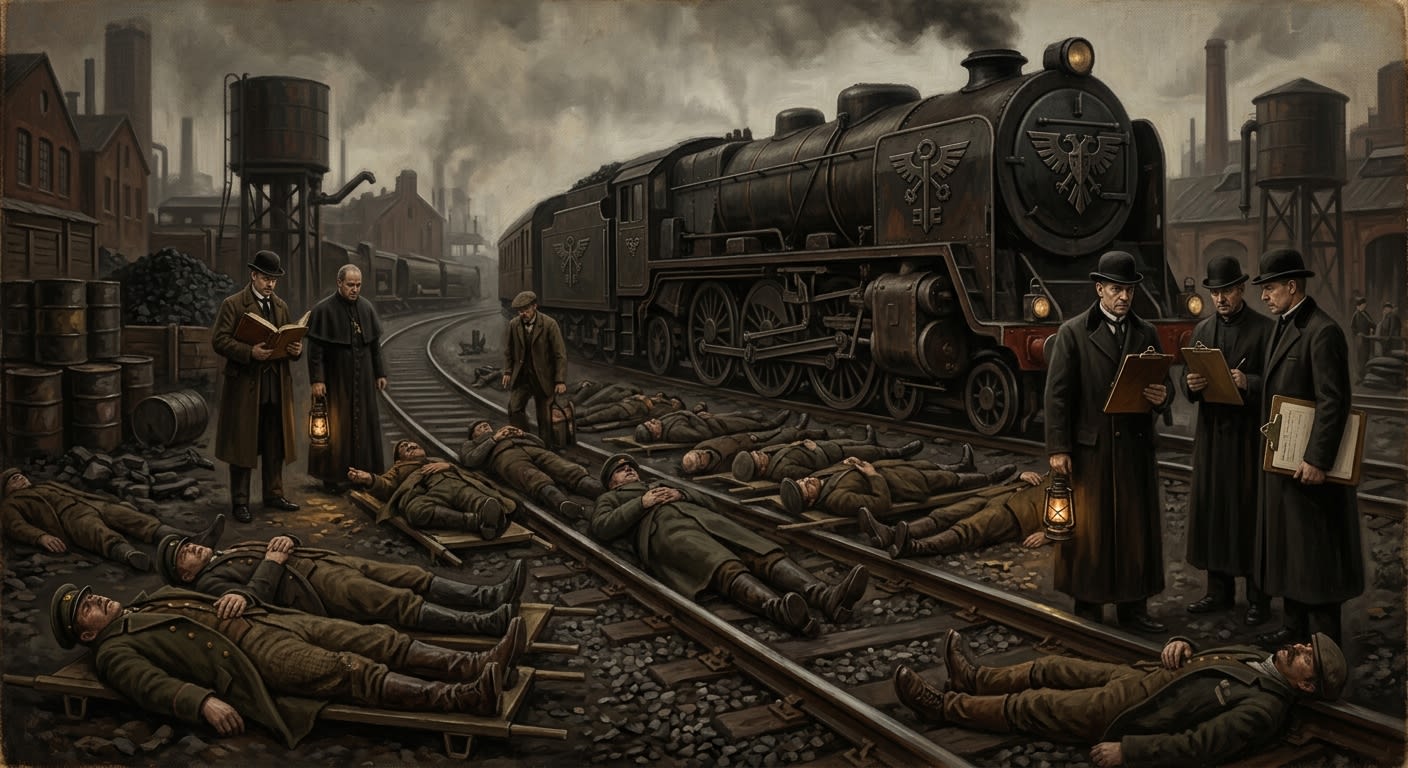
The Silent Derailment occurred in A.S. 112 at the Palatine Switchyard of Lorn, eight years after the Bureau of War swallowed an old market town and taught its bones to carry freight. Forty-one men died on a siding that every manifest denied, every public map omitted, and every subsequent office tried to make smaller by description.
A munitions train entered the siding at full dispatch speed during night operation. The switch had been thrown. The measure had been sung. The tower slate logged clear. The manifest held no siding at that point. The rail did.
At dawn the forty-one were found along a slag wall, bodies laid beside track with no authorised installation number. Their mouths were open. No one in Cinderrow reported hearing a crash. No alarm bell sounded. No collision peal ran along the tower line. Silence, which Lorn treats as error whenever workers use it, became the event's most faithful witness.
The Derailment is called silent for the absence of scream, bell, warning, and lawful admission. This name has been useful to the Bureau because silence can be blamed upon the dead. The dead, being quiet, are excellent subordinates.
#On Lorn Before the Bruise
Lorn was born in A.S. 104 when the Bureau of War required a switching point between the corridors feeding the Sagittal Line. An older market settlement occupied the junction: grain merchants, blacksmiths, small inns, a Benedictine chapel, wells, cellars, gossip, and the local vanity by which a place with a name mistakes itself for permanent. The Bureau requisitioned the town. The chapel became a dispatch office. Streets became sidings. Graves became subgrade inconvenience. The old name vanished from the Ledger. Lorn appeared, meaning lost in human speech and surrendered to divine purpose once Doctrine got its hands on it.
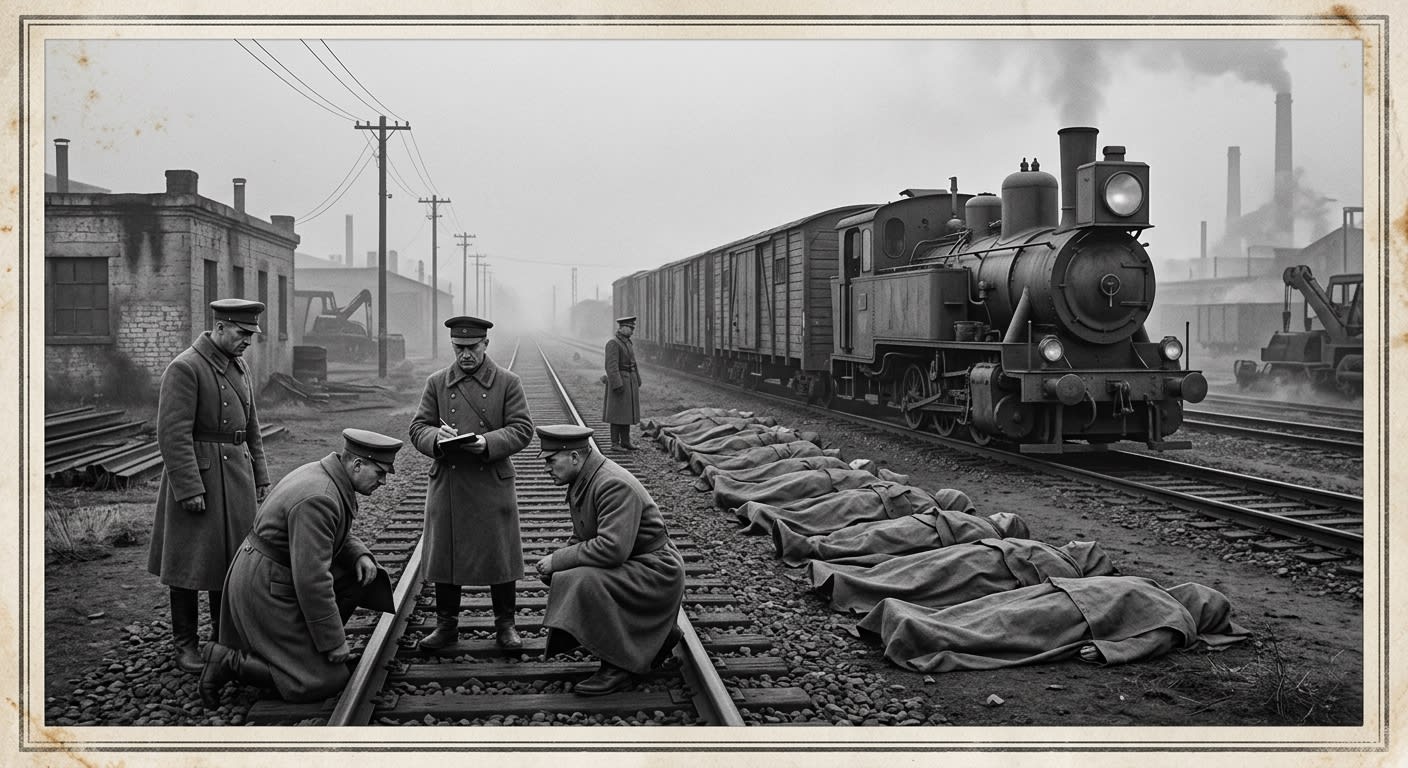
By A.S. 110, during the First Continental Levy, the yard had become the continent's iron throat. Twelve rail lines fed into an expanding basin of slag fill, hand-thrown points, signal towers, manifest desks, crane mouths, coal conduits, and worker wards that learned the smell of brake smoke before the smell of bread. Seven wagons of flour had become seven hundred departures per day. A dispatch office had become the Manifest Basilica. A switch crew had become a future Union. Lorn had achieved maturity in the Synodal fashion: it could kill at scale and file the death locally.
The old service corridors remained below: drain runs, cellar lanes, coal conduits, chapel foundations, inspection crawlways, brick throats, failed survey cuts. They were not yet the Hush Tunnels in any civic sense, because an underworld becomes official only after enough officials deny it in matching prose. But by A.S. 110, boys already vanished with message tubes and returned with salt. Brake crews found chalk marks under Switch-Tower Nine. A widow retrieved her husband's tools from a wall cavity no foreman admitted opening. Records classified these matters as nuisance. Records has always loved infancy when infancy can be ignored.
#On the Night Crew
The forty-one men were ordinary in the most lethal sense. They were skilled enough to be trusted near iron and common enough to be replaced by morning paperwork.
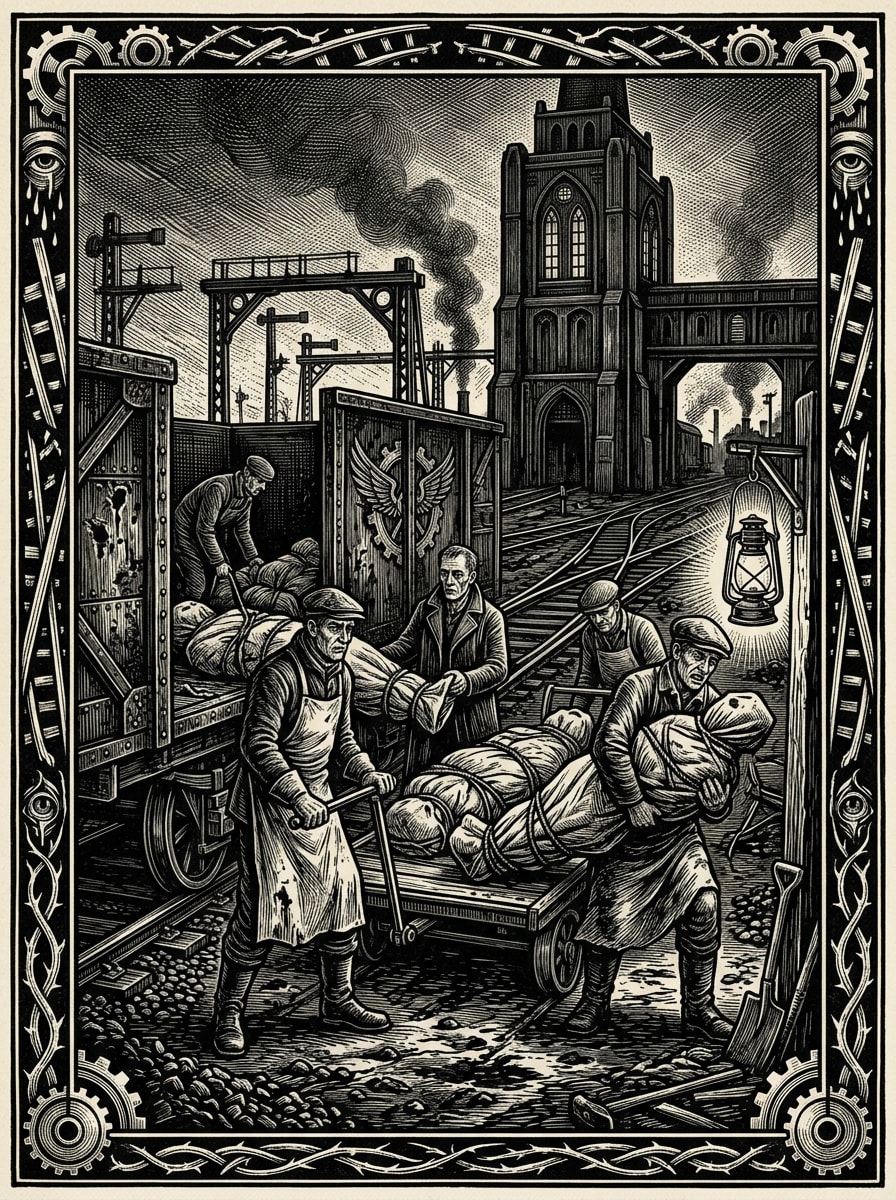
The night roster included switchmen, rod-runners, brake technicians, a tower runner from Nine, two powder escorts, four munitions handlers, one junior manifest clerk assigned to physical confirmation, three labourers conscripted from Cinderrow arrears, and a cantor's assistant whose presence later allowed the Bureau of Bells to pretend the matter had always belonged to sound. Their names survive in the Manifest Basilica's oathglass memorial register. The register is consulted annually, revised quarterly, and cleaned whenever Inquisitorial attention approaches. Martyrdom gathers dust. Lorn removes it with policy.
The train carried munitions eastward under lawful dispatch. Its manifest recorded destination class, escort count, cargo seal sequence, and route window. It did not record the siding. The siding had no installation number, no inspection record, no maintenance fee, no ballast account, no drainage note, no accident classification, and no right, in the paper universe, to accept weight.
The first Records summary stated that the train “encountered a terrain reclassification error of non-recurring type.”
Corrected for human readability. A train was routed onto rails the manifest denied, struck a slag wall, and killed forty-one men. Terrain did not reclassify itself. A clerical phrase put a clean shirt over a corpse and asked the widow to admire the collar.
No one survived in a condition useful to interrogation. This has spared Lorn no trouble. Survivors are messy; dead men can be made orderly. The Bureau arranged the forty-one into testimony by office: Bells took their silence, Records took their absence from valid routing, War took the munitions loss, Purity took the suspected cell, Doctrine took the sentence.
#On Tower Nine's Late Answer
Tower Nine appears in the first annex as adjacent control station. That phrase should be dragged behind a freight engine for obstruction. The tower was central enough to stain every later file.
On the night of the Derailment, Tower Three was expected to answer a routing call. Later sealed analysis found no outgoing confirmation from Three. Tower Nine answered once, late by one measure, in the colour expected from Three. The caller obeyed the answer. The switchman threw according to the caller. The munitions train accepted the route. The siding received the train.
Other towers signal. Nine answers. Lorn has paid for that distinction with blood.
SILENT DERAILMENT ANNEX — TOWER NINE ROUTING SLATE Recovered mark: ███████ Clock-hand fracture orientation: ███ degrees. Surviving caller notation, copied before transfer: “We waited for Three. Nine answered. It sounded under the lamp.” Public copy revision: phrase removed; caller classified unavailable for doctrinal health reasons.
The tower's foundation contains a pre-Synod clock structure sealed beneath slag, brick, sound-deadening masonry, and official forgetfulness. The old market town's clock was not demolished during the A.S. 104 requisition. It was encased. Its hands remain fixed, according to prohibited survey sketch, at an hour no Lorn schedule uses. After the Derailment, the lower lamp in Tower Nine held a crack shaped like a clock hand. The routing slate had sweated through its chalk by dawn.
Bells would later call this resonance. Records would call it drift. War would call it delay and ask when trains might resume. Purity, bless its efficient stupidity, asked who should be arrested.
#On the Unmeasured and the Convenience of Heretics
The Unmeasured were blamed first. They were a Rationalist remnant cell of insufficient size, insufficient access, and excellent rhetorical usefulness. Their stated offence, before the Yard discovered it needed larger crimes, was rejection of bell-time authority and possession of private tally marks. After the Derailment, this became sabotage, conspiracy, temporal insolence, and murder by silence.
They were arrested before the second public circular. They were questioned under Purity supervision, confessed with the familiar fluency of men who have been taught the answers by pain, and were executed under yard authority. Their bodies were not returned. Their names became an instructional footnote. Their supposed tools—a cracked pocket chronometer, three private route tallies, a Rationalist pamphlet fragment, and one brass measuring chain—were displayed for six weeks beside the Yard Tribunal docket board.
Early dispatches attributed the Silent Derailment to sabotage by the Rationalist remnant cell known as the Unmeasured.
Corrected. The Unmeasured were executed, which improved neither scholarship nor rail safety. Later sealed reports attribute the Derailment to a large Hymn-Phase event involving Tower Nine, unsanctioned tonal conditions, and a siding whose legal nonexistence proved tactically inadequate.
The Bureau did not apologise. Apology is a private luxury unsuited to institutions. It corrected the attribution, retained the punishment, and classified the mismatch as separate procedural consequence. I have seen lesser miracles canonised.
#On the Cantor Regime
The Bureau of Bells drew the public lesson. Bell Marshal Gerren Stahl (Unregistered), first holder of that title at Lorn, proposed that no switch should be thrown, no signal given, no dispatch ordered, and no departure released without voiced hymnal measure sung by a certified cantor. The logic was clean enough to tempt fools: if procedure is sung, procedure cannot be falsified without audible evidence; if every action has a hymn, every failure has a heresy; if every heresy has a throat, the throat can be found.
The Yard accepted within a season.
The Cantor Corps became mandatory. Switches received measures. Signals received measures. Departures received dispatch litanies. Tower callers learned to listen before seeing and then to deny that they had done so. Industrial accident became doctrinal offence with soot on its boots. Sister-Calder's (Unregistered) future office was born from that reform, though she would later polish it into cruelty with remarkable dedication.
The reform did not prevent error. It improved blame. A missed measure could be prosecuted. A frightened measure could be corrected. A correct measure preceding disaster could be folded into the growing file now called Hymn-Phase Slip, where correct sound produces incorrect routing and the evidence of obedience kneels beside the dead with clean hands.
#On the Thrown Hand and the Burial Funds
The switchmen learned a different doctrine from the same slag wall.
If every action would require a hymn, every accident would require a scapegoat. If scapegoats were needed, they should negotiate collectively. By A.S. 113, yard crews had formed burial funds. By A.S. 115, burial funds became oath funds. By A.S. 119, oath funds had enforcers, widow stipends, route books, and a rule that no man throws alone after midnight. The Thrown Hand was not founded by pamphlet or charter. It was founded by wrists placed on switch rods and widows discovering that Lorn paid faster when grief arrived organised.
Its oldest article is recited without writing: the hand that throws may refuse if the hymn is false. This sentence has saved trains, delayed armies, enriched smugglers, and made three Bell Marshals say words no choir should hear. The article belongs to the Derailment as surely as the memorial register does. The dead men were not Union martyrs in the modern sense; they were raw material, which is how institutions and brotherhoods both treat corpses before the speeches improve.
The Union keeps its Crushed Book: names of workers killed after correct hymns, correct orders, correct manifests, correct lies. The Bureau of Records has never found a full copy. This means the book is being handled intelligently.
#On the Hush Doctrine
Below ground, the Derailment gave the tunnels their sacrament.
Above ground, Lorn ordered motion to sing. Below ground, silence became survival. A cough could bring a provost. A sung phrase could wake the yard's wrong echo. A dropped key could tell a rival crew which corridor you had taken. Chalk arrows under Tower Nine, wax scratches near the sealed clock masonry, rope knots on drainage hooks, black handprints where no child should reach: these marks multiplied after A.S. 112. The under-yard became legible to those willing to crawl and illegible to those paid to supervise.
The Hush Tunnel Runners did not emerge as criminals first. They emerged as a second schedule. They moved message tubes, injured workers, small contraband, widows' tools, unpaid men, misfiled bodies, and then larger cargo once the city taught them that motion outside the hymn had value. The tunnels earned their name because sound had become evidence and evidence had become a noose.
Hush doctrine remains simple: do not answer a route that whispers your name; do not trust paper that arrives early; do not sing under the clock foundation; if Tower Nine answers below before above, close one eye and let a child choose the path. These are not respectable rules. Respectability kills slowly and invoices the coffin.
#On Memorial, Register, and Revision
The forty-one names are held behind oathglass in the Manifest Basilica. Pilgrims to Lorn, a species of fool created by every sufficiently dramatic workplace, may view the register under supervision. Workers view it differently. They look for altered spellings, shifted order, missing fathers, corrected trades, and any name that has become useful to a current argument. The register is not static. Nothing in Lorn that can affect liability remains static for long.
Records revised occupational categories twice after the Derailment. Three men originally listed as switchmen became munitions auxiliaries, shifting liability toward War. Two escorts became rail personnel, shifting burial payments toward the Yard. The junior manifest clerk became “observational adjunct,” a title invented after his death and safe from his opinion. One cantor's assistant appears in public copies; in a sealed copy, he is listed as provisional, which is a curious status for a corpse.
The sealed copy contains marginal warnings against letting the dead become jurisdiction. A noble hope. Lorn promptly ignored it.
In A.S. 201, as Inquisitor-Regent Veyl Hark prepares her Lorn audit, the register has been cleaned. Dust frightens guilty rooms. Prefect Halden Wry has ordered fresh oathglass seals, archive rebindings, lamp replacements, ink lot reconciliation, and corrections to the furniture by two finger-widths. A room may confess through furniture if the inquisitor knows where to stand.
#On the Present Use of the Dead
The Silent Derailment remains active because Lorn continues to profit from its wound. The Cantor Corps cites it when demanding obedience. The Thrown Hand cites it when refusing a throw. The Manifest Basilica cites it when expanding correction authority. The Hush cites it when selling silence. Tower Nine cites nothing, because towers have better manners than officials and answer only when the answer can do damage.
The Derailment also governs current fear. Payroll Spur losses since A.S. 199 look less like theft when read beside A.S. 112: correct seals, correct measures, correct manifests, wrong result. Tower Nine late confirmations still crawl through files. Hush routes still change after being marked. Union dead still appear in liability forms before widows receive notice. The same grammar persists. Only the nouns have become richer.
At first bell the yard sings. At second, Tower Nine may answer. At third, a switchman places his hand on the rod and feels for truth where song cannot reach. Beneath him, in a corridor the map denies, a chalk arrow waits to be wrong.