

I've finished reading the sources and am now writing the article.
#On the Gate and Its Situation
The Clean Line Gate stands in Marrowgate, near the Chapterhouse of the Sanitation Chapter. That is its entire address. Every file that names it puts it there, beside the whitewashed house where Prefect Salvius keeps his maps. No file says on which side of the house it lies, how many paces away, or which street leads to it. I have been asked for a plan and have refused. A surveyor who invents a street to tidy his page commits the same sin as an inspector who invents a clean finding to move his queue. I have seen what the second sin cost in A.S. 199. I am in no hurry to commit the first.
The city has many crossings of this kind. Marrowgate's own register of places lists the Clean Line Gates in the plural: whitewash boundaries, the sting of bleach, a cold wind, provost violence, and a tunnel hatch under one of them. The Stitchmarket uses lime-runoff culverts that run beneath others. Both details belong to the plural gates and stay there. This survey concerns the gate with the capital letter and the famous neighbour. Nothing in the record puts a hatch under it, and I will not dig one with my pen.
No record dates it. Marrowgate became a medical port in A.S. 72 / 1782 CE, by the usual reckoning. The Chapter was constituted in A.S. 78 / 1788 CE, under the Mercy administration of the emerging Church, twelve years before there was a formal Synod to claim it. Both are dates for the city and the office. The gate has no date of its own.
#On the White Boundary
Marrowgate is held inside two belts. The outer cordon is made of quarantine fences and lime trenches, and it is crossed only at inspection gates. Inside it lie the clean streets, divided by whitewash lines, and stepping over one of those lines without papers is a crime. A gate in this city is simply the place where a line has been given hinges and a guard.
The line is laid fresh every dawn, in limewash made from bone-lime out of the Lime Yards. The dead whiten the road the living are forbidden to cross. If this offends the reader's sense of propriety, I recommend Marrowgate as a cure for having one.
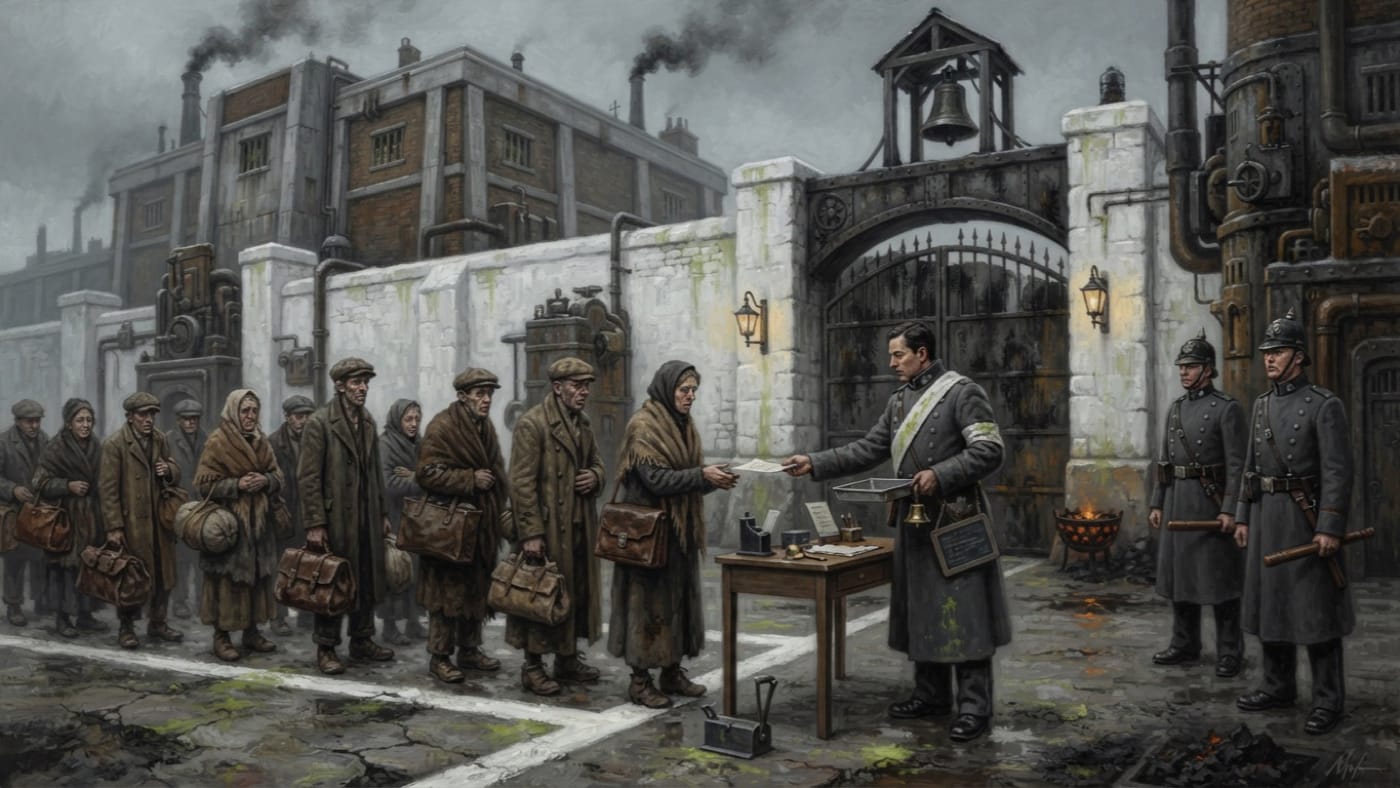
Clerks call a lawful crossing a whitewalk. A crossing that is not lawful has many names, and most of them are entered in provost reports. The Chapter's local regulation lists four things that change a line's status: the bell, an outbreak notice, an audit order, and Chapter discretion. Its inspectors carry handbells and use a published code. One ring halts a queue. Two open inspection. Three close a gate. Four summon provosts.
That code is Chapter practice across the city. Whether this gate has its own bell, a tower, a fixed peal or set opening hours, the record does not say. Marrowgate says its gates breathe open and shut with bell-time. The phrase is a figure of speech and should be read as one. It means a crossing can be open at one ring and closed at the next. It does not mean the masonry has lungs.
#On Papers and Inspection
Three kinds of paper and one counterfeit coin go to the gate, and anyone who confuses them pays for it at the line.
The clean paper is a health clearance. A current health docket is what lets a body cross the white line. The mouth receipt is the local name for a confession slip. Intake confession is required in Marrowgate even of healthy people passing through, so a pilgrim with a spotless pulse can still be stopped for an unconfessed tongue. The bed-window is a treatment slot assigned by allocation. The bed token is the black-market version of one. Neither gets a patient past Sanitation. The Tribunal promises the bed. The Chapter decides whether the body ever reaches it.
The inspector at the line wears a white sash stained with salt-lime. The Chapter's standard kit adds a wax tray, a crossing slate, fever sticks, a mouth hook, wax tags and the handbell. Papers go across on the tray. The regulation forbids passing them hand to hand over the line, and it forbids crossing backward. Provosts with truncheons enforce both rules, and they have little patience for theories of contagion.
What a delay means depends on which side of the tray you stand. To the inspector it is a stage of the procedure. To the patient it is a fever climbing under a blanket while the slate is read again. To the Ward-Sister waiting across the line, it is broth going cold, a dressing left unchanged, and a ward ledger that will record the patient as late. The ledger never records the inspector as slow.
#On the Authority to Refuse Passage
The Civic Triage Tribunal rules on beds, treatment windows, medical debt and the disposition of patients. The Sanitation Chapter, acting under Bureau of Mercy quarantine authority, rules on gates, cordons and movement. On paper these are two neat jurisdictions. At a gate they come down to whose word gets the patient across.
A Tribunal ruling is binding in the hearing room. Ten yards of white paint can keep it from ever getting there. A petitioner who cannot cross cannot be heard. A patient granted a bed may never reach it, if an inspector on the near side wants a fresh docket first. I do not say that this gate fronts the Tribunal, joins two named districts, or is the only road to treatment. The record says none of those things. It shows only that a line under Chapter control can override a court that has no control of the line.
A Marrowgate civic charter describes the Tribunal and the Sanitation Chapter as "coequal instruments of medical justice."
Corrected for application at the gate. Equality holds only while the line is open. When the handbell rings three times, the charter's word "coequal" means the Tribunal is equal to its own benches.
Fairness requires the other column as well, and I will fill it in, though it hurts my sense of drama. Under Salvius, Records concedes, mouth receipts have become harder to forge. Gate rosters match the guards who actually stand at the gates more often than before, and fever spread has slowed in two districts. An inspection line that turns away a coughing man also keeps him out of a ward full of the newly sutured. The Chapter prevents disease. That is what makes its hold on the city so strong. A useless office can be abolished. A useful one gets its budget renewed.
#On Clearance After the Scandal
The clean paper plague of A.S. 199 / 1909 CE was a failure of documentary clearance, and documentary clearance is what a gate of this kind exists to provide. Feverish people carried papers that looked valid. Counterfeit certificates circulated. The worst cases were genuine seals pressed onto false findings.
These were two different crimes, and the difference matters to the inspector with the tray. A forged impression is a lie about the wax, and a trained eye, a smell of new ink or a known flaw in a ring can catch it. A false finding under authentic wax is a lie about the patient. The seal on it is perfect, and so is the fraud. No inspection of the paper can expose it. Only the patient can, by being examined again.
The Stitchmarket sells forged clearances, and its smugglers call them "clean lies." That trade is documented. It does not prove the Stitchmarket organized the forgeries of A.S. 199, and the record names no organizer. It names no pathogen, gives no death toll, and records no first crossing at this gate or any other.
The Marrowwind comes into this file only as a disputed witness. Its first uncontested event took place in A.S. 194 / 1904 CE at White Ward Seven, nowhere near this survey's subject. Ward reports say its corrections pushed back against the clean tallies after the scandal. The Chapter's position is that such corrections are inadmissible without living corroboration. What the Marrowwind is remains unresolved. None of its reported effects is recorded at this gate, and I have put none there.
#On the Present Condition
The record does not show the A.S. 199 outbreak still active in A.S. 201. Its paperwork is still in force. Papers are checked against faces. Seals are checked against rings. The Chapter keeps tallies at several levels of secrecy, and every new crossing schedule leaves the Tribunal's clerks wondering which courtroom it is meant to empty.
The Chapterhouse wall near the gate holds three maps: public cordons, active cordons and desired cordons. The third is a proposal. A closure drawn on it is not a closure in force, and a citizen stopped at this gate has been stopped by the second map. Salvius has not declared a full lockdown of the city. He seeks permanent emergency authority and does not yet hold it. Until he does, the gate operates on discretion that has grown into habit and has not yet been written into law.
So the crossing stays what the documents show: lime laid at dawn, a tray, a slate, a bell, a provost, and a queue of the sick doing sums about their own pulses. It protects the city. It takes from the city. Each morning it is repainted where yesterday's feet wore it away.