

#On the Chapterhouse and Its Situation
What follows is a present survey, compiled in A.S. 201 / 1911 CE. It draws on the published dossier of Prefect Salvius, on the Codex account of the Sanitation Chapter, and on what I saw myself when I visited the premises after the clean paper plague. The year on this survey is the year I compiled it. Nothing was founded, rebuilt, consecrated or inspected in it, and any reader who quotes it as such will be corrected in a later edition with pleasure.
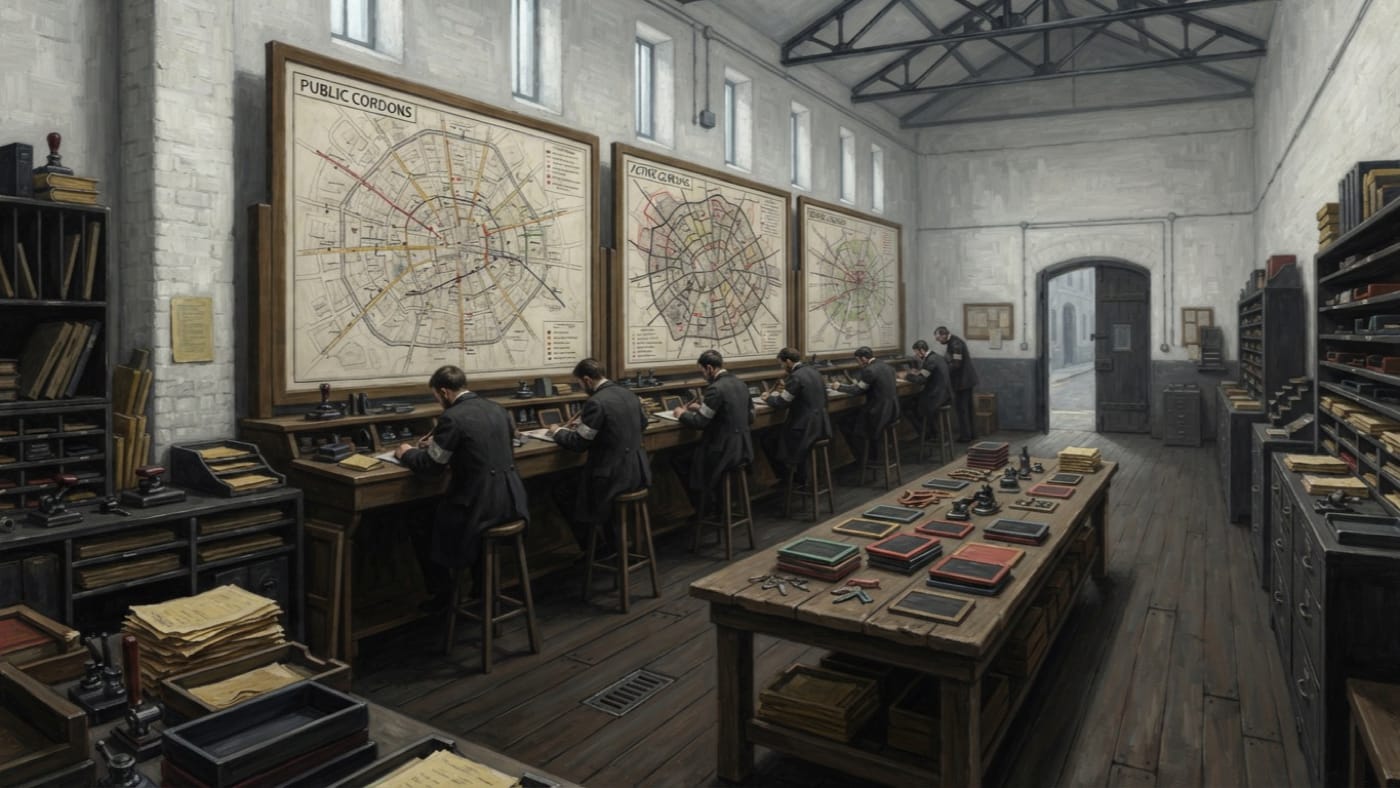
The Chapterhouse of Marrowgate stands near the Clean Line Gate, within smelling distance of the Lime Yards. It is whitewashed so heavily that its walls look less built than scoured into existence. The windows are narrow. The floors slope toward drains. The clerk benches face the maps and not the people. Every one of these details is an argument, and I report them as the house intends them.
The record does not give the architect, the year the foundations were laid, the number of storeys, the street number, or a full plan. I will not supply them. A Warden who invents a cornerstone to fill a column deserves to be filed under it.
One distinction must be fixed before anything else. The Sanitation Chapter is an organisation. It works under the quarantine authority of the Bureau of Mercy and has spread its method far beyond this city. The Chapterhouse is one whitewashed building, where Marrowgate's Sanitation Prefect keeps his maps, his slates and his confiscations. Mistaking the house for the Chapter is like mistaking the sacristy for the Church: a provincial error, and one that sacristans encourage.
#On the Three Maps
The main room holds three maps, and the three maps are the building's whole theology.
The first shows the public cordons. It is meant for visitors and auditors, and for the merchant who needs to know which street will still exist on Thursday. It is the city as Sanitation is willing to be seen governing it.
The second shows the active cordons, and inspectors keep it current. It is the city as Sanitation actually governs it this morning, a fact that may have changed by noon, because ropes are moved more easily than proclamations are reprinted. Whatever gap opens between the first map and the second is where an honest auditor would begin. Honest auditors are seldom shown the second map.
The third shows the desired cordons. It records the control Sanitation would like to have and does not yet hold.
I was shown the third map after the clean paper plague. What follows is my report of what was proposed on it then. Nothing here proves any of it was carried out, and nothing proves the map looks the same today. It had taken in a large share of the Tribunal approaches. It narrowed Mercy Market to a single inspected lane, and it ran white corridors through three alleys of the Suture Slums. The Tribunal kitchen sat inside a proposed isolation district. Salvius called this contingency planning, which is what a desire calls itself while it waits for a reason.
The benches explain the maps. A clerk who faces a petitioner sees a face, and a face has a mouth that may plead. A clerk who faces a map sees a marked square. The square may hold twenty mothers, and it will hold all twenty without any of them catching his sleeve. The furniture settles in advance whose gaze the room serves.
The record does not describe the legends, the colours, the district outlines, the mapmakers, or how often the active map is redrawn. I did not copy them, and I will not reconstruct them from memory and vanity.
#On the Business of the Clean Line
Marrowgate's clean lines are painted in lime and renewed at dawn. Everything else the Chapterhouse does follows from what that lime asks of it. The building's real work is movement: who crosses which gate, on what paper, with what fever mark, at what hour. Health is the public name for it.
The instruments are small. The lime brush draws the line. The fever stick goes under the tongue and is read by its colour mark. The wax tray takes the seal. The crossing slate takes the count. The handbell stops a queue with one ring and shuts a gate with three. These tools pass between the street and the house. An inspector's report changes the active map, the active map changes the next morning's line, and the next morning's line decides whether a cart from the Wagon Quays reaches a ward before its passenger stops needing one.
After A.S. 199 the tally work was split. Public slates carry confirmed cases. Inner slates carry suspected cases. Red slates carry the cases that would embarrass the Chapter if confirmed, and black slates carry the cases that must never be found by anyone above a clerk's grade. The four sets are kept in separate rooms. When I asked Salvius which slate held the truth, he answered, "All, under proper relation." I have rarely heard the administrative creed put more neatly.
A Sanitation circular issued after the A.S. 199 scandal promised "transparent plague accounting across all Mercy facilities."
Corrected. In this house the accounting is transparent only to the room authorised to see each slate. The windows are narrow for a reason.
It would be dishonest to stop there, and I am dishonest only on commission. The Chapter has made mouth receipts harder to forge. Its gate rosters agree with the guards on duty more often than they used to. Fever spread has slowed in two Suture Slums districts. The maps that allow coercion have also prevented deaths. The Synod may take some comfort in that if it likes, but it should not mistake the comfort for absolution.
#On the Tribunal Approaches
The Civic Triage Tribunal sits on Notary Row. Its business is allocation: beds, treatment windows, medical debt, work prescriptions, and rulings on whether a patient can be saved. Magistrate-Physic Toma and Clerk Vessa conduct that business with wax and Latin. The Chapterhouse has no claim on those rulings. What it controls is the ground between a petitioner and the bench.
When Vessa writes a legal review, an inspector can demand a fresh mouth receipt before the petitioner reaches the Row. When Toma grants access, a rope can still stop the body at a line. When Sanitation declares an outbreak, the Tribunal's authority shrinks to its benches and its ink. Each office accuses the other of endangering patients, and both accusations are well founded.
The proposed isolation of the Tribunal kitchen shows how this rivalry is actually fought. Nobody in Marrowgate will lay siege to a court. A court whose cooks cannot get in, whose bread is held for inspection, and whose stewards need clean papers to fetch water is a court learning to plead. Whether that proposal still appears on the desired map in A.S. 201, I do not know. I know it appeared once. I know Salvius did not seem embarrassed that I had seen it.
The Chapterhouse does not house the Tribunal and does not govern all of Marrowgate. Its power is narrower than either, and more useful to its holder: it can make another office's victories impossible to reach.
#On the Basement Evidence
Below the main room is where the Chapter keeps the things it has taken. The record lists confiscated true-name slips, counterfeit clean papers, plague tally slates, spare cordon ropes, broken fever sticks, mouth hooks, seal presses retired after fraud investigations, and jars of suspect dust. Objects recovered from the wards after Marrowwind events go into a locked cabinet lined with black felt. A clerk inspects it weekly. He has asked for a transfer six times, and each request was filed under occupational anxiety.
Each class of object answers one of the house's functions. The true-name slips are names that families refused to let intake overwrite. The counterfeit papers are crossings that were sold instead of granted, and the Stitchmarket trades in such papers, though the record does not make it the organiser of the A.S. 199 fraud and neither do I. The retired seal presses are what remains of the certification scandal. When a certificate can declare a feverish man healthy, the press that stamped it is retired, and the slate that recorded it is kept as evidence.
The trouble with this basement is that its records do not stay put. During the clean paper plague, sealed cabinets opened, slates turned white, and cleared names returned to the fever columns. Salvius ordered iron cabinets. They were white inside by dawn. The Chapter's position is that a wind-corrected record is admissible only with living corroboration. I record that position and leave the mechanism to the dead, who have not filed an account of it.
One jar of white dust is sealed under wax that has cracked from the inside. Salvius told me it was inactive. The jar tapped once after he said so. He did not turn his head.
#On the Present Condition
As of this A.S. 201 compilation the Chapterhouse is in daily use. The lines are repainted at dawn, the active map is still being redrawn, and the tally rooms are still kept apart. Its jurisdiction against the Tribunal is still contested at every approach to Notary Row. The Marrowwind's corrections have not stopped, and the iron cabinets have not won.
The Prefect has not declared the full lockdown. He wants permanent emergency authority, and he tightens a crossing schedule here and narrows a corridor there while he waits for a frightened enough city. Whether he gets that authority is not a matter this survey can settle.