

#On What the Paper Clears
"A clean paper doesn't stop rot." — Marrowgate proverb
This survey was compiled in A.S. 201 / 1911 CE. It draws on the files, seizures and corrections of Marrowgate as they stand this year. A.S. 201 is the date of the compilation only. It is not the year Clean Paper was first issued. The archive gives no such year, and I decline to supply one for the convenience of an index.
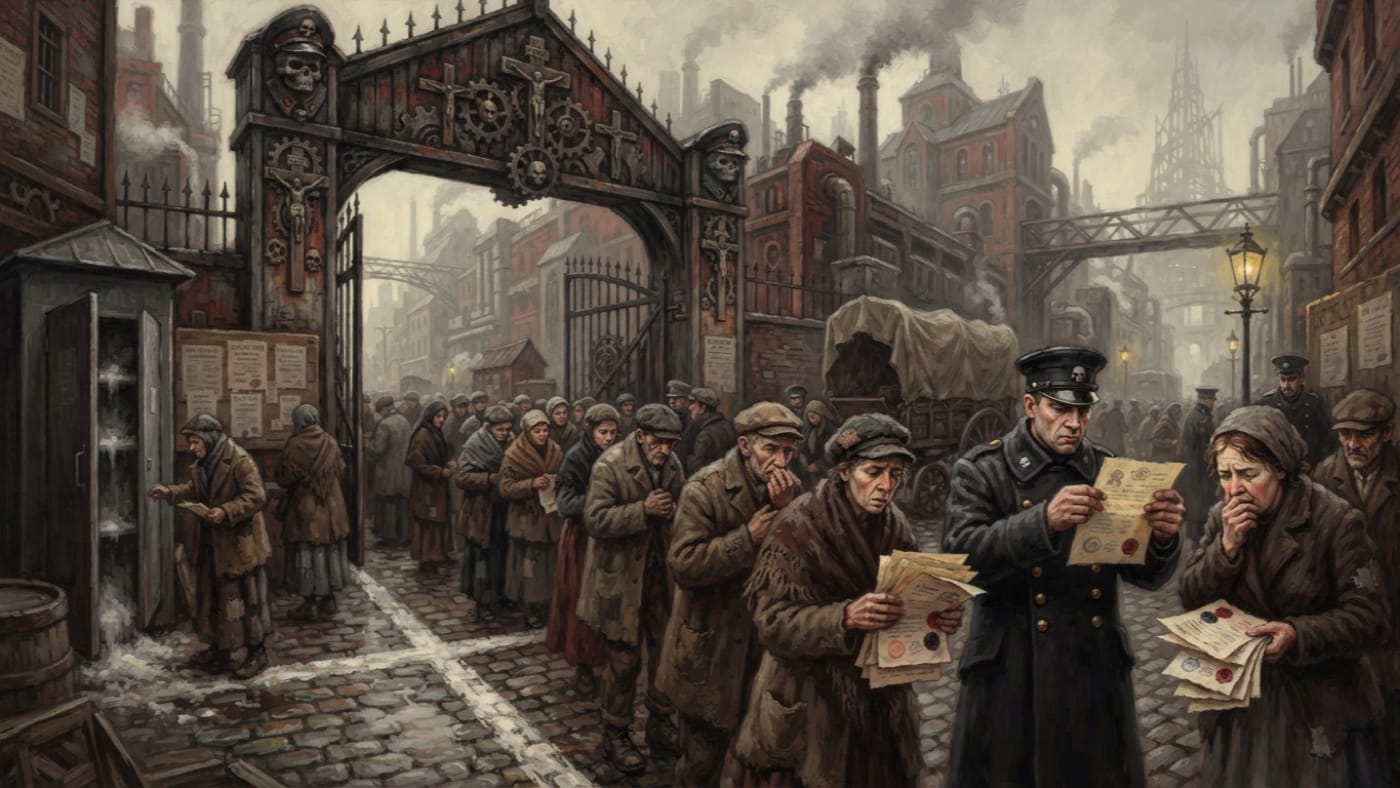
In the city's own usage, Clean Paper is the Health Clearance Certificate. Within the inner cordon, whitewash lines mark where legal cleanliness begins, and anyone who steps across one without papers commits a crime. The certificate answers to the line. It records a condition that an inspector is permitted to act on, and the inspector acts on it. Nothing in the document touches the body that carries it. It does not lower a fever, close a wound or make its bearer immune to the man coughing beside him in the queue. A stamped finding can let a sick man walk through a gate, and he is still sick on the other side. How far the paper goes depends on three things: what it was issued for, who is willing to accept it, and which office controls the crossing that day.
#On the Offices Behind the Clearance
A Clean Paper is the product of several offices, none of which gives up its share of the authority.
The Sanitation Chapter is the quarantine arm of the Bureau of Mercy. It was constituted in A.S. 78, after the Great Plague and the First Ossuary Panic, and it governs the cordons, gates, inspections and crossings. Prefect Salvius heads the Chapter in Marrowgate, and his recorded authority includes clean papers. His Chapterhouse basement holds confiscated counterfeits beside retired seal presses. This does not mean every certificate passes through his hand. A Ward-Sister classifies the patient. A surgeon-notary confirms the classification against the registry. Chapter inspectors then fold the result into the tally that goes up the cordon chain. The Prefect's power lies in the last step, which is whether the paper gets a man across.
The Civic Triage Tribunal, constituted in A.S. 83, rules on allocation, hears petitions and administers medical debt. Licensed Sealhands perform surgical notarisation. The registries revise the file once the court and the saw have finished with it. Marrowgate's Joint Mandate of A.S. 92, revised in A.S. 187, sets out this division. It is a different instrument from the Joint Classification Mandate of A.S. 78, which governs the dead, and only clerks who want to lose a case confuse the two.
The result is a ruling that is lawful and useless at once. On Notary Row the Tribunal may grant a bed window, correctly sealed and correctly entered. If the Chapter closes a corridor, the patient stays behind the white line and the window runs out empty on the board. No Tribunal seal can lift a Sanitation rope.
#On the Papers Sold Below
In the Stitchmarket, "clean papers" covers a whole shelf of documents. The cartel's attested stock includes health clearances, corridor stamps, quarantine releases, fit-for-duty certificates, fever negatives, work-prescription reductions, discharge slips, and the small blue travel notes that carry a patient from the White Ward to the Wagon Quays before a clerk can reclaim him. Each is a separate instrument with its own purpose. None of them combines the powers of the others, and no master certificate does everything the street name implies.
Other instruments sit beside them and stay distinct: bed tokens, confession receipts, death dockets and cut-stamps. A single patient may need four of these to reach a cot, and he will buy them from four different hands. The market's name work belongs here as well: file substitutions, false kin attestations, and the identity reversal that restores a name sealed away by the cut-stamp. Clearance follows from identity, because the registry decides who a man is before the gate decides where he may stand. A reversal changes the file. As the Row reminds anyone who asks, it regrows nothing.
The trade operates through the Suture Slums, the drainage routes, washhouse cellars and the back rooms of the Prosthetics Arcade. Movement is restricted, care is scarce, and debt accumulates for every petitioner, so the trade never lacks demand. Families buy clearances, and so do soldiers and debt labourers. Ward staff buy them for patients they cannot save by lawful means. The Chapter arrests some forgers and purchases information from others, especially about which clearances are suspiciously well made. Needle-King Pavo is reported to be the cartel's principal figure. Who he actually is remains in dispute and is no part of this survey. His recorded method is to sell a document that makes the buyer complicit. A mother who forges her child out of a locked ward cannot report the forger without returning the child.
I give no prices and no method. The market's own lore holds that the best forgeries are imperfect, because a perfect paper attracts auditors. I record that much and nothing more.
The phrase also travels. Clean papers are among the inducements offered for priority windows at the Needle of Lorn. No source I can cite shows that these are Marrowgate certificates, or that Lorn's gate honours them as anything more than currency. Route permissions and bell-hour tokens issued elsewhere govern who may travel where and when. They certify nothing about a fever. Outside the Marrowgate cordon, a Marrowgate clearance carries exactly the weight its reader chooses to give it.
#On the Certificates of A.S. 199
During the clean paper plague of A.S. 199 / 1909 CE, the city was handed two kinds of falsehood, and the official audit was right to keep them apart.
The first kind was counterfeit: forged clearances under imitation seals, which is the Stitchmarket's long-standing line of business. The second kind was worse. These were genuine certificates under genuine wax, issued by the proper offices on findings that someone had been paid or pressed to reach. A forgery can be caught by comparing impressions. A true seal on a false finding cannot, because the impression matches perfectly. Such certificates passed through the registries exactly as procedure required.
Both kinds let infected bearers through the checkpoints. A cleared man was given no isolation because his paper said he needed none. He queued for broth beside the uncertified. He shared wagon benches. He went out along the three converging wagon roads to the supply towns, whose provosts trusted wax over a cough. The contagion spread the ordinary way, by breath and on bedding. The paper did not carry it. The paper got the people who carried it past the gates. The Chapter's phrase about fever travelling on certificates is a figure of speech, and I treat it as one.
Ward tallies, A.S. 199: zero infection among cleared patients. Earlier summaries accordingly state that healthy persons died while cleared.
Withdrawn. The tallies counted zero cleared infections, and the registries read that as zero infection. The persons in question were cleared. Nobody has shown they were healthy. The original tally is withdrawn and the summaries are corrected to match.
The audit found systemic fraud in health certification, and that finding stands. It named no organiser. It established no reliable count of the dead and produced no complete list of the officials whose seals had been bought. No surviving finding ties the Sealhands to the affair. This survey does not assign responsibility for the whole of it to the Needle-King, to the Prefect, to the Tribunal or to the guild. To do so would require evidence, and the fraud consisted precisely of documents written ahead of the evidence.
#On Corrections and Their Witnesses
The Marrowwind did not originate in the scandal. Its earliest uncontested event dates from A.S. 194 / 1904 CE, when a sealed intake cabinet in White Ward Seven filled with chalk dust overnight and produced an accurate revised list of patients. It was classified in the same year as a phenomenon rising from the Lime Yards.
It began correcting at scale on the fourth night of the A.S. 199 scandal. The names of cleared patients reappeared in the fever columns. Death certificates lost their written causes and showed new ones. The corrections had immediate effects: quarantine admissions made against sealed findings of health, debts reversed, burials delayed and exhumations carried out under protest. The Prefect had the affected records locked in iron cabinets. By dawn the inside of every cabinet was white.
Who or what makes these corrections is not settled. Ward staff say it is the dead. Kiln crews say the lime remembers. Doctrine has considered providential rebuke and has considered mimicry by the Great Deceiver, and it has ruled on neither. The corrections themselves can be observed, and their author cannot.
The Bureau of Records admits a correction only when a living witness corroborates it. Records calls the corrections "almost always" true, and the qualification is intended. A correction does not authenticate itself, and the wind is not a verification service available on request. It comes when it comes. It has struck some forged clearances and left others alone, and no office can tell from a paper's face which kind it is holding.
#On the Present Record
This survey closes where it began, with the compilation of A.S. 201 / 1911 CE.
Clean Paper is still issued in Marrowgate. Audits are stricter than they were before A.S. 199, and the brass seals on the Row are now examined twice. The Stitchmarket remains active, and its clean papers still travel through dirty water. Salvius's staged lockdown proposal includes a reissue of clean papers under emergency authority. That proposal is an ambition and has not been granted. The Tribunal's claim to quarantine review is likewise an ambition. The outbreak of A.S. 199 is not recorded as active. The system that certified it is not recorded as repaired.
The whitewash lines are repainted at dawn. The paper still opens the gate. It still does nothing about the fever.