


#On the Quays Without Water
The Wagon Quays of Marrowgate are the lanes where the war is unloaded. No hull has ever tied up there. They run dry along the city's quay-road spine, slurry in the flood months, rutted clay in summer and iron-hard under frost. Every morning before light the wagons form up in them the way ships once waited on a harbour chain: horse to tailboard, canvas lashed down, the animals steaming, the drivers at the bridles with the patience of men paid by the load and docked for delay.
Then the intake bell rings, and the lanes start to move.
Stretcher runners go in under the canvas. They come out bent double, two to a pole, and run the load to the triage pens behind the whitewashed rails while the next pair is already climbing the wheel. The air smells of wet canvas, horse sweat and the iron of old blood, with lime from the rail paint over all of it. A driver shouts a count. A clerk shouts a different one. The horses, who have heard both numbers many times, keep their own counsel.
Marrowgate kept a harbour's vocabulary after it lost its harbour trade. A lane is a dock. Fresh arrivals are quay-blood. A treatment slot is a bed-window, granted and lost the way a ship's departure window was once granted and lost. Wagons dock, unload and depart, and the city is laid out on the same logic, with wards and yards branching off the quay-road like ribs from a sternum. Above the intake gate, in whitewash letters two feet high, the city has painted its creed: EVERYTHING HEALS OR IT GETS A FILE. The painters who refresh it are themselves patients, which keeps the lettering honest.
The Quays matter because of what they fail to promise. A man lifted down from a wagon has reached Marrowgate, and he has not yet been admitted to it. Admission means a bed, a legal identity the wards will recognise, a draught for the pain, and in time permission to leave. Arrival grants none of these. The Quays are where a casualty finds out how much paper stands between him and a surgeon, and how quickly his own body can use up that time.
#On the Conversion of the Port
Before the Quays there was a river-market town on the spur, with honest trade, unlicensed healers and cellars that still hold old shop signs under the waterline. Its river commerce failed under war requisition. Barges along the forward corridors became unreliable, which is the historian's polite word for vessels that arrived carrying corpses where grain had been ordered. Around A.S. 72 a logistics officer, whose name has not survived and whose office the Bureau of War would later claim as its own, took the town's port logic and turned it toward the roads.
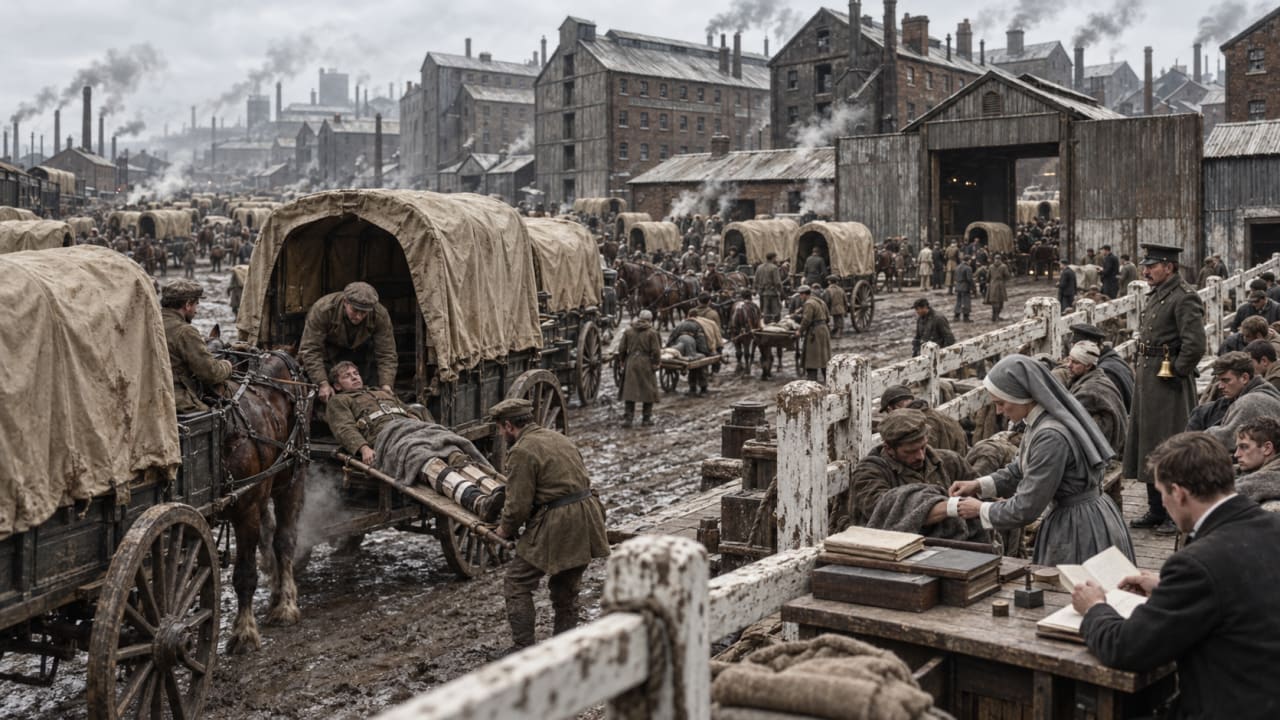
He did not need to invent much. A port already knew berth order, unloading turns, the bill of lading and the departure schedule. The officer kept all four and changed the cargo. The bill of lading became the Intake Manifest, a wagon list counted at loading and checked at the lane. Berth order became the queue. The departure schedule became the bed-window. The method that once moved grain sacks now moved men with their legs strapped together, and it did so with a competence his successors have never matched in sentiment.
The Synod's own descriptive survey of Marrowgate begins by calling it "an inland port with no sea — only roads."
Corrected. The sea is absent. The roads are three, converging on the city, and a rail spur comes in from the casualty railhead as well. The river spur also remains, and barges on it still carry lime, linen and sealed crates through the River Spur Ash Docks. The Wagon Quays are dry because they were built for wheels. Marrowgate has a working waterfront of its own.
The first decade ran on improvisation. Surgeons cut before anyone thought to ask for legal permission. Ward-Mothers traded bed space according to smell, pulse and bribe. Wagoners unloaded at whichever lane was least guarded. The dead lay too near the living, and the living stole tags from the dead. Practical crews of lime men and gate clerks painted the first lines because no one else would stand between a fever and a queue.
The institutions arrived afterward and built themselves around a working intake. A.S. 78 brought the Great Plague pressure, the Lull of Names and the First Ossuary Panic. In that year Marrowgate raised its first cordon and the Sanitation Chapter was constituted to hold it. The Civic Triage Tribunal followed in A.S. 83, because cordons could stop a body but could not put a value on it. In A.S. 92 the two offices signed a local Joint Mandate on intake. They revised it in A.S. 187, once tokens, receipts and debts had grown past what ward staff could falsify politely. The mandate governs the Quays today. It should not be confused with the mortuary Joint Classification Mandate of A.S. 78, which governs the dead and is older, colder and better obeyed.
#On the Passage from Wagon to Ward
The order of things at the lanes is not printed anywhere. Ask three clerks for the sequence and you will hear three sequences, each defended as ancient. What follows describes the functions that every version contains, and the order in which a body usually meets them.
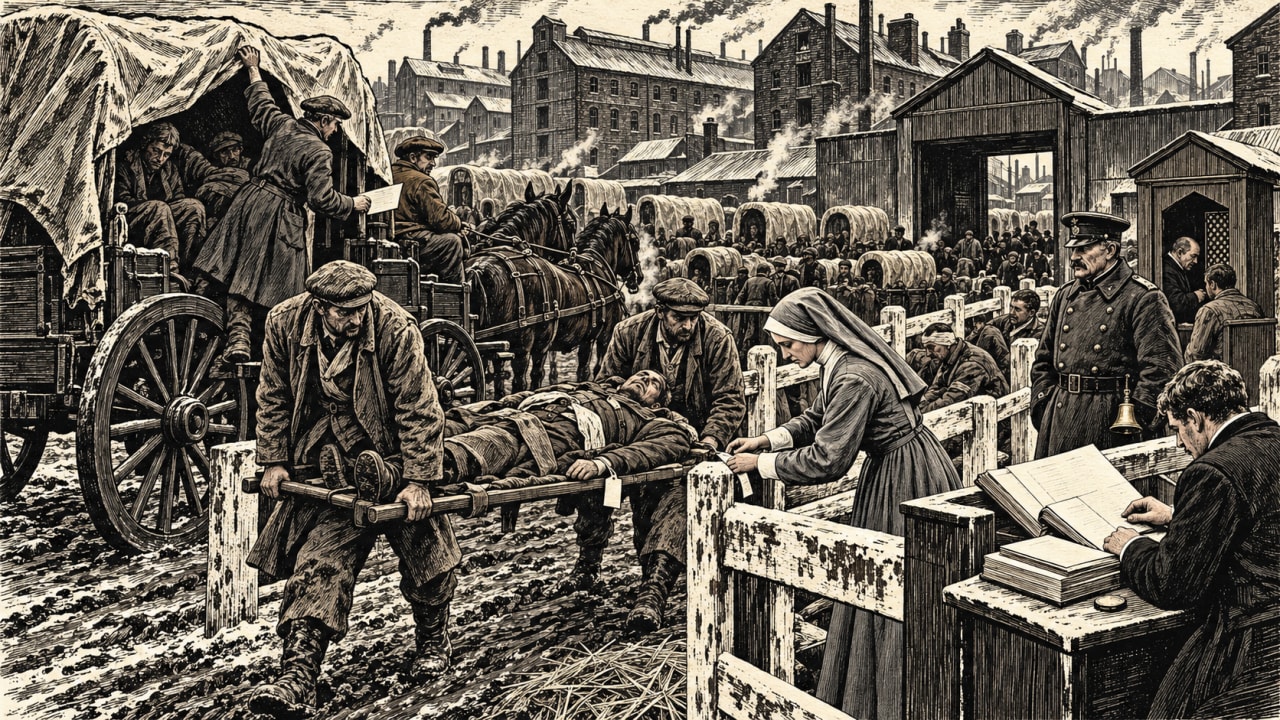
The wagon comes first, and with it the manifest. The driver hands up his Intake Manifest at the lane mouth. It records what was loaded at the railhead or the forward station: so many living, so many dying, so many dead, so many parcels of what the forms call remains, partial. It never matches the load as found, because men die on the road, men are added at the road's end, and some cargo has walked off in the dark. A Sanitation inspector climbs the wheel, folds back the canvas and counts. Where the count and the paper disagree, the paper is amended, and the person who amends it decides which of the two was wrong.
Next comes the mouth. Confession booths stand at the intake gates, and intake confession is required of everyone who passes, the healthy included. The penitent receives a Confession Receipt, which the refugees call a mouth receipt. Without it the wards will not open. A soldier with a severed artery must still be confessed, and his confession transcribed, before any ward will take him. The Chapter has a classification for deaths that occur while that transcription is under way. It calls them procedural.
Then the tag. The Ward-Sisters and Ward-Brothers work the triage pens with chalk, tag-string and a clerk at the elbow. Their assessment draws on three things: the symptoms, the papers, and what the manuals call behaviour, which covers everything from delirium to a habit of arguing with inspectors. The tag says treat, hold, isolate, transfer, release or ossuary. The zone says clean, grey or black. The decision takes a moment, and the patient spends every hour afterward inside it. Good Sisters make it quickly and remember it badly at night. The best make it quickly and then cheat it a little, moving a grey case one pen nearer the gate because his wife has come up the road and should see him breathe.
Through all of this the runners carry the stretchers.
Nothing at the Quays works without them. They run in shifts fixed by the bell, and the city's one universal courtesy is to step aside for them. Many are debt-bound labourers from the Suture Slums, carrying stretchers under a work prescription for the same wards that once billed them. Lifting a man with a broken pelvis from a wagon bed without killing him takes skill that no form records. The runners slide a board under the hips, roll him on a count, and keep the strap away from the wound. They do this in a lane where the man beside him has already died and is still taking up room. Their hands split in winter. Their shoulders carry the marks of the straps. When the flood months turn the lanes to slurry, the runners carry knee-deep, and the Chapter fines them for the mud they bring onto the clean side of the rails.
Paper goes missing, as it always has. A manifest lists a corporal who is not on the wagon. A man on the wagon has no receipt because the booth closed before the chaplain reached him. A tag has been tied to the wrong wrist, or cut from a dead man and tied to a living one by somebody who understood the system better than its authors. Every gap means a wait, and a body that cannot be matched to a file goes back to the pens. The pens hold people out in the weather. In winter men freeze in the queue lines, and in summer the waiting wounded rot in the heat. Beds stay scarce in every season, and every queue in the city starts here.
#On the Offices at the Line
Two offices command the lanes. Neither will admit the other does.
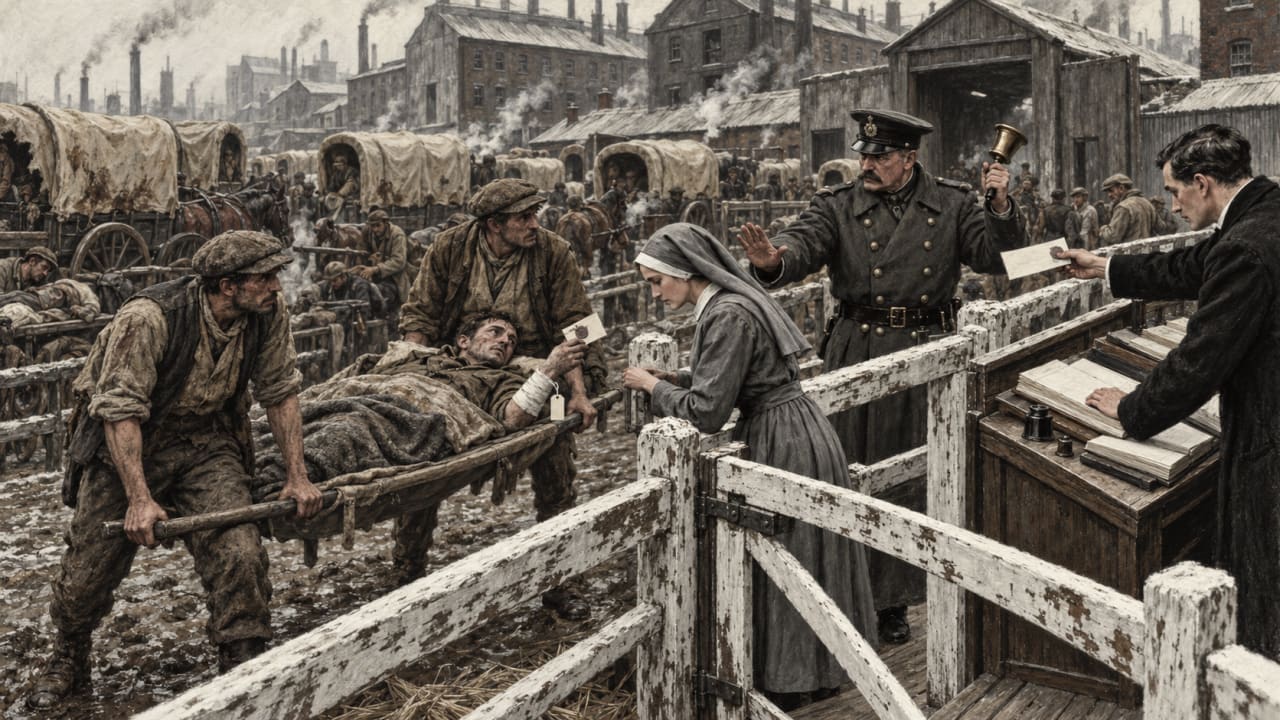
The Sanitation Chapter owns the ground. Its inspectors control the lane gates, the whitewash rails around the pens and the white lines that divide quay mud from clean corridor. A provost with a handbell can stop an unloading mid-stretcher. A crossing slate can halt a whole lane of patients until the inspector has looked into every mouth. The Chapter checks papers, wheels, ropes, bandages and breath, and it treats a cough on the wrong side of the rail as an offence before it treats it as a symptom.
The Tribunal owns the outcome. On Notary Row it allocates beds, rules on salvage, sets medical debt and licenses the surgery that the Sealhands perform. Its bed-windows are posted at midday, and its rulings are written in a hand built to survive appeal. In principle a patient tagged at dawn can have a lawful bed by noon.
In practice the ruling has to travel back across the line, and Prefect Salvius decides whether a body may cross it. The Tribunal can grant a bed while the Chapter refuses passage to it. A man may hold a valid window and watch it expire from the pen because an inspector has called for a fresh mouth receipt or a provost has rung a halt for a fever check two lanes away. The bed exists and so does the ruling, but the patient cannot reach either of them in time.
The Chapter's usefulness here is real, and an honest survey has to record it. A medical port where the crowd decides which wagon unloads first becomes a fever pit within a week. Separation saves lives. Under Salvius mouth receipts have become harder to forge, gate rosters agree more often with the guards actually standing at the gates, and the spillover queues at the Quays now kill fewer men where anyone can see them. Those lives were saved by guards, rails and the habit of making people wait in the right place.
The same rails carry the Chapter's ambition. Salvius tightens control by small adjustments: an extra inspection at the lanes, a revised crossing schedule, a closure that never quite expires, a corridor narrowed by the width of one cart. Each change can be defended on hygienic grounds, and all of them together amount to jurisdiction. The full lockdown he is thought to want, with the city sealed and governed by emergency order, has not been declared. As of A.S. 201 it exists only as intention and a map on a wall. The Quays would feel it first. Lanes that cannot unload back up onto the roads, and the roads have no rails to keep the sick apart.
The Ward staff work between the two offices. They tag under the inspector's eye and send their findings to the Tribunal's clerks. They are trusted with the decision and blamed for the result. A Sister who reports truthfully can be overruled from either side. A Sister who shades her report can save a man's leg and lose her own post. Most do both in the course of a week.
#On the Price of a Bed-Window
A Bed Allocation Token is a stamped time-window, a right to be admitted, examined and treated within a stated span before the window closes and passes to the next name. Lawfully issued, it is a ruling. Once it leaves the hand it was issued to, it is a commodity.
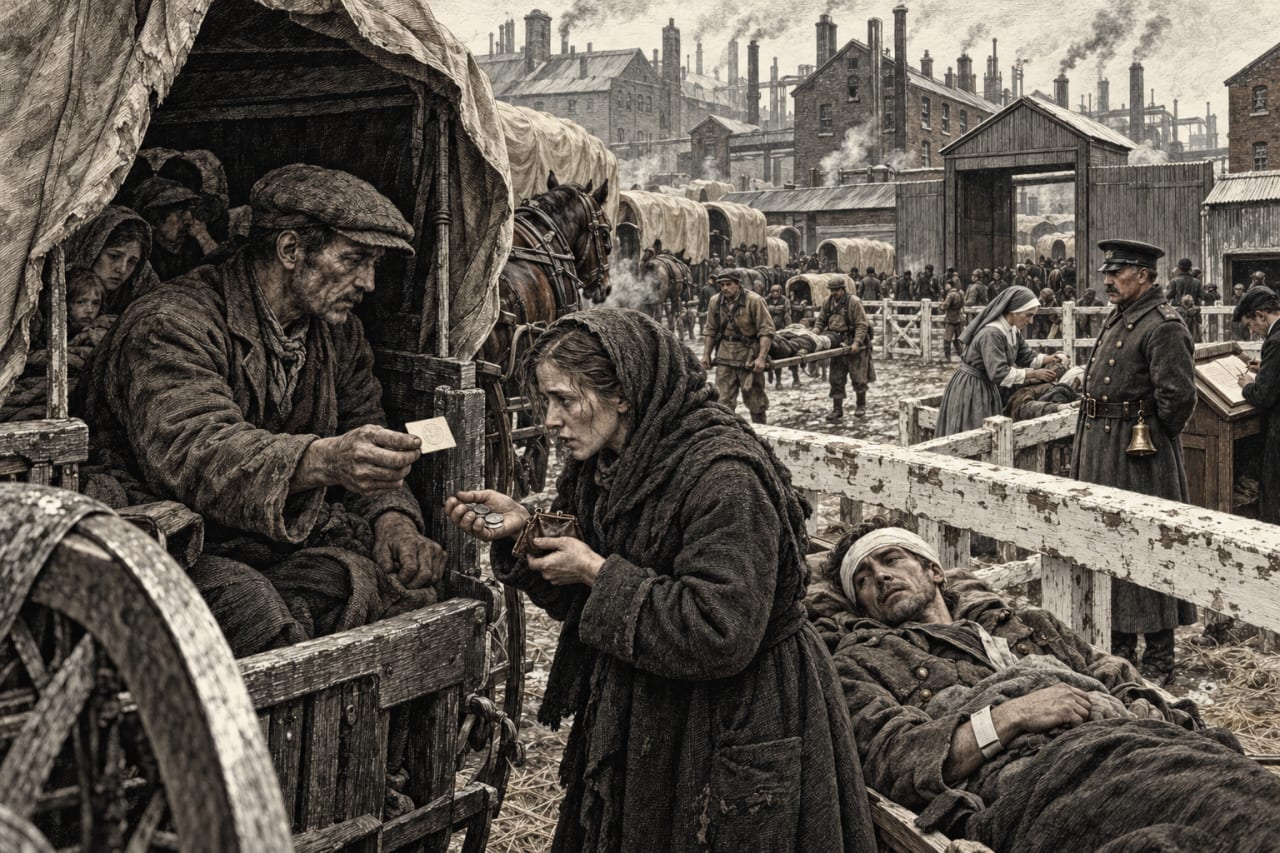
Marrowgate's own estimate holds that a bed-window at peak intake is worth more than a month's wages. Under lockdown it is worth whatever the seller asks, since the alternative is the Suture Slums and the long patience of debt. Value grows with the queue. When the lanes run three wagons deep and the board shows few beds, a token becomes the difference between surgery this afternoon and amputation next week. Families who have watched a wound change colour during a single bell will pay almost anything.
Tokens change hands during intake, under the canvas and along the queue, and the Chapter pretends not to see it. Tribunal correspondence says the same trade runs outside the Quays, on the approaches and in the alleys off Mercy Market. The city's descriptive survey records a hidden bed-token auction at the intake lanes and gives no further detail: no room, no auctioneer, no hour, no tariff. That is how an auction behaves when it wants to survive. Permit widows sell the priority stamps of dead spouses. Quarantine brides and grooms marry for the right to a clean corridor. All of them deal in the same thing, a place nearer the front of a line the Synod insists is ordered by need alone.
A legal allocation and a bought token can look the same at the gate. What differs is who can be blamed afterward. A lawful window carries the Tribunal behind it. A bought window carries only the buyer, who must still get past the inspector, the rail and the bell. The token buys time and does not buy passage, and many families have learned this at the gate after the money was gone.
All of this depends on the people who move the wagons. The Wagoners' Brotherhood holds the Quays and the outbound roads, and its public motto is we keep the flow moving. Its assets are wagons, draft animals and road intelligence: which bridge is out, which patrol charges tolls, which railhead is sending more casualties than it admits. Its methods are the slowdown, the route kept secret and the crate reported lost. A slow lane is a weapon in a city where every hour of queueing is paid for in rot. The Brotherhood knows this, and so does everyone who has to deal with it.
Road-Captain Mira is described as hard. Old Jannik is said to know every grave along the roads, and wagon crews treat that knowledge as more reliable than the maps. The record gives neither of them a biography or a date of appointment. It does record what the Brotherhood fears: an official seizure of its wagons for military priority, which would leave the drivers in debt to their own animals and the roads under War's control. It also records a threat. The Brotherhood has warned of a slowdown unless certain missing cargo is forgiven. The record contains no strike, only the warning and the price attached to it.
Some of that missing cargo ends up in the Stitchmarket. Crates disappear from the lanes with much expressed regret and reappear in the Suture Slums drainage routes, where the cartel trades forged tokens, forged clearances and pain relief to the patients the lawful queue has failed. The Stitchmarket keeps its centre in the Slums. At the Quays it works through intermediaries: a runner with a folded token in his cuff, or a driver who forgets to count one bale.
#On the Blank Folio
The Lull of Names was not a Marrowgate catastrophe. It struck the southern trench infirmary belt in A.S. 78, when the plague killed faster than clerks could write. Men died in borrowed beds under borrowed names, and their debts, their caches, their accusations and their heresies went with them. Fever carts came in with more bodies than tags. The Bureau's response took two more years. Standing Order 22-C, issued in A.S. 80, required that no soul leave a licensed ward without words taken, witnessed and sealed. The Deathbed Confession Harvester corps grew from that order. The Lull itself had none, only Ward-Sisters writing until their hands cramped and failing anyway.
Marrowgate learned the lesson secondhand and keeps it in its own way.
A blank folio is carried through the Wagon Quays and shown to every intake clerk. There is no sermon and no procession hymn. The bearer stops at each desk and holds the open page out, and the clerk looks at it. Then the bearer moves on to the next desk, the next booth, the next clerk at the next lane, and the wagons keep queuing behind.
The record gives no date for the first performance and no name for whoever devised it. Nor does it say how often the folio is carried, and I will not invent a feast day for it. What it records is the act.
The page frightens clerks because of what a name does at the Quays. A matched name brings the dead man's wages to his widow. It tells a creditor whom to pursue and a parish whom to pray for. It lets an inheritance close and allows an heir to prove his claim. For the Bureau of Records and its stricter neighbours it is also an instrument of surveillance: the soldier whose confession implicates his sergeant, or the dead man whose cache has to be found before his friends find it. An unmatched body breaks every one of those connections. Some of the people involved weep over the break and others profit from it, and the clerk at the intake desk is the last man able to prevent it.
Each clerk sees the same blank page and reads his own failures into it. Some look away. Old hands look properly, nod, and go back to the manifest. They know the next wagon will bring a man with no tag, and they know which way their pen will be tempted to go.
#On the Loads That Go Elsewhere
Not every load goes to the White Ward. The Quays are a sorting floor, and a large share of what comes off the wagons goes toward the dead, toward debt, or toward both.
The Death Docket governs the dead. In Marrowgate, moving a corpse without one can get a man shot, a rule enforced with more consistency than most of the city's mercies. The docket routes the body under the mortuary categories the Dead-Goods Tariffers maintain: Burial, Transport, Salvage, Ornamental, Contaminated. From the lanes the dead go to the tariff-chapel, to the coffin shelves of the Quiet Stacks, or to the kilns of the Lime Yards, where bone becomes the mortar, road powder and whitewash that later return to the Quays as rail paint. The runners carry the dead on the same poles they use for the living. Afterward the poles are washed in vinegar, and most of the time they are not mixed up.
Debt follows the living. A patient who cannot pay for his broth, linen, draught or witness fee receives a Work Prescription. It assigns him to labour in the laundries, the kilns, the carts and the stretcher crews. A soldier carried in through the lane in spring may be working the same lane by autumn. Nothing in the Quays' layout marks the difference between a runner and a patient who has not yet finished paying.
Gray Clearance showed what happens when the sorting breaks. In A.S. 157 the Plague Winter overran the mortuary system, and in practice the five categories collapsed into two, Cleared and Held. The Quays kept bringing the war in by cart, the White Ward kept losing patients by the bell, and the corpse bays filled faster than the kilns could empty them. Outside the Tariff-Chapel of Saint Morin, away from the lanes and apart from the ordinary petitioners, a left-hand rope formed. Families whose dead were Held queued along it, a clerk walked the rope at Prime, and some papers cleared before noon. The city called it the Mercy Line. It was abolished with the Clearance's revocation in A.S. 158.
The rope stood at the chapel, and the Quays were where its traffic began. Every Held body on that rope had come in through a wagon lane, and the market in speed that formed outside the chapel was the same market that later formed around the bed-windows. Marrowgate learned in that winter that delay can be sold. The lesson spread to the living by the same means it had spread among the dead.
#On Clean Departure
The Quays run in both directions, which casual visitors tend to forget. Wagons that come in loaded leave loaded, carrying the discharged, the fit-for-duty, the debt-transferred and the quarantine-released back along the three roads toward the railheads, the supply towns and the Sagittal Line. The departure lanes open to a Health Clearance Certificate, which Marrowgate calls Clean Paper, or to a Quarantine Release Writ. Show either at the outbound rail and the inspector waves you to a bench. Further down the road, quartermasters who will never meet the patient honour the same seal.
In A.S. 199 the clean paper plague used that route. Certificates issued in White Ward beds passed through the Mercy Market ration lines and the Notary Row registries to the Quays, and from the Quays they left the city on the backs of the people who held them. A man certified healthy needed no isolation, so he got none. He took his place on the wagon bench beside the uncertified, rode the same road and slept under the same blankets. At the depot that had sent him he showed his paper, and no provost had grounds to question it.
Two kinds of falsehood were at work, and the audit was right to separate them. The first was the counterfeit, the clean lie, a seal pressed with brass melted down in the Suture Slums and sold by people who had sold such seals for years. The second was worse. Genuine offices issued genuine certificates under genuine wax on findings that someone had been paid, pressed or merely encouraged to reach. A forgery can be caught by comparing impressions. A true seal on a false finding cannot, because the impression is flawless and every later office reads the earlier office's agreement as proof.
In an earlier tract on the Marrowwind, this office wrote that at Marrowgate "contagion travels by certificate first and breath second."
Withdrawn as a statement of mechanism. It stands as satire. The sickness of A.S. 199 travelled the ordinary way, on breath, bedding and a shared wagon bench. The certificate carried no contagion. What it carried was permission for the infected man to sit there.
The record supports systemic fraud in certification and a long-running counterfeit trade. It names no single organiser. The Chapter would be pleased to find the Stitchmarket behind it, the Tribunal would be pleased to find the Chapter behind it, and both would welcome a culprit outside their own walls. No finding names one, and the evidence does not reach that far.
For the wagoners the scandal meant something more concrete. The benches they had sat on all spring had carried fever out along their own roads, and the Brotherhood's men had driven it. Since A.S. 199 the departure lanes have stricter checks, longer waits and more questions for every certificate that comes to the rail. The audits continue. No active outbreak of the A.S. 199 sickness is recorded for the present year. The suspicion it left is still active, and it falls on everyone at the departure rail, including those whose papers are genuine.
#On the Present Intake
In A.S. 201 the Quays carry every pressure at once. Beds remain scarce. Crossing schedules are revised more often than they are posted. The Brotherhood's threatened slowdown is still unresolved, and the fear of military seizure persists. Forged papers circulate, and genuine papers are treated as forgeries until proven otherwise. All of it gathers at the lane mouth before dawn, when the wagons line up.
The Marrowwind has now reached the lanes as well.
Its first uncontested appearance was in the White Ward in A.S. 194, and for years it stayed close to the Lime Yards and the ward corridors. By A.S. 201 the dry chalk gust has been recorded at the Wagon Quays, in the Suture Slums washhouses, on the Mercy Chapel steps and twice in the Prefect's private chamber. At the Quays it arrives the same way it does elsewhere. The air dries, and vinegar smoke thins. Fine white dust settles on the intake desks, on the closed manifest books and along the whitewashed rails, and is soon thick enough to write in. Names that clerks had struck out appear again. Records that matched a body to a file now contradict each other.
That is a serious threat to the Quays. Their whole function depends on the assumption that a body and a file can be made to agree at a desk in a lane. Once a manifest changes overnight, a tag disagrees with its ledger, and an intake roll carries a name no clerk entered, every desk faces a choice. It can trust the body, the paper, or the dust. The record contains no named Quays victim, no dated first Quays incident and no specific Quays correction, and this survey supplies none.
This office's general survey of Marrowgate states that Marrowwind corrections "are always accurate."
Corrected to the standing classification. The corrections are almost always true, and that qualifier has already saved careers and damned patients. Under current doctrine they are not self-authenticating, and Marrowwind testimony is inadmissible without living corroboration. Whether the dead, the lime, the Great Deceiver or some property of processed remains is responsible is still under review.
The ambitions surrounding the Quays remain unfinished. Salvius has not sealed the city. The Tribunal has not absorbed the Chapter. The Stitchmarket's long-planned liberation of the unfiled, with forged clearances by the thousand, has not taken place. The Brotherhood has made a threat and has not acted on it. Every office waits for the event that would justify its plan. The wagons continue to arrive in the meantime and do not wait for any of them.
At dawn the painters freshen the rails. A Sister chalks the first tag of the day. The clerk at the third lane wipes white dust from his manifest with a sleeve, checks the count against the canvas and finds one more body than the paper lists. He amends the paper. Then the intake bell rings, and two runners climb the wheel.