
#On the Entry That Has Not Become History
This review was commissioned in A.S. 201 to settle the documentary standing of a single word. The word is Collapse. It is capitalised, numbered, and attached to the Sister Trenches by sources that cannot agree on what they saw, when they saw it, or whether anyone saw anything at all.
Two classes of witness carry it. The first is the older prophetic ledger, in which the Collapse appears as a future entry, a debit written into the book before the account fell due. The second is the corrupted field tradition, the mouth-to-mouth inheritance of coastal companies. There the Collapse survives as a date-mark passed between men who never served beside whoever first spoke it. Neither class supplies an author the Bureau can summon. Neither supplies a witness the Bureau can fine.
The Bureau of Doctrine has ruled the numbered form inadmissible as anticipatory historiography. The phrase is ugly and exact. History is entered after the fact. A ledger that enters it beforehand has committed either forgery against time or prophecy, and Doctrine declines to decide which from the edge of a coastal ditch. The ruling disposes of the number. The trenches remain wet, inconvenient and occupied.
#On Elder, Younger, and the Womb of Salt
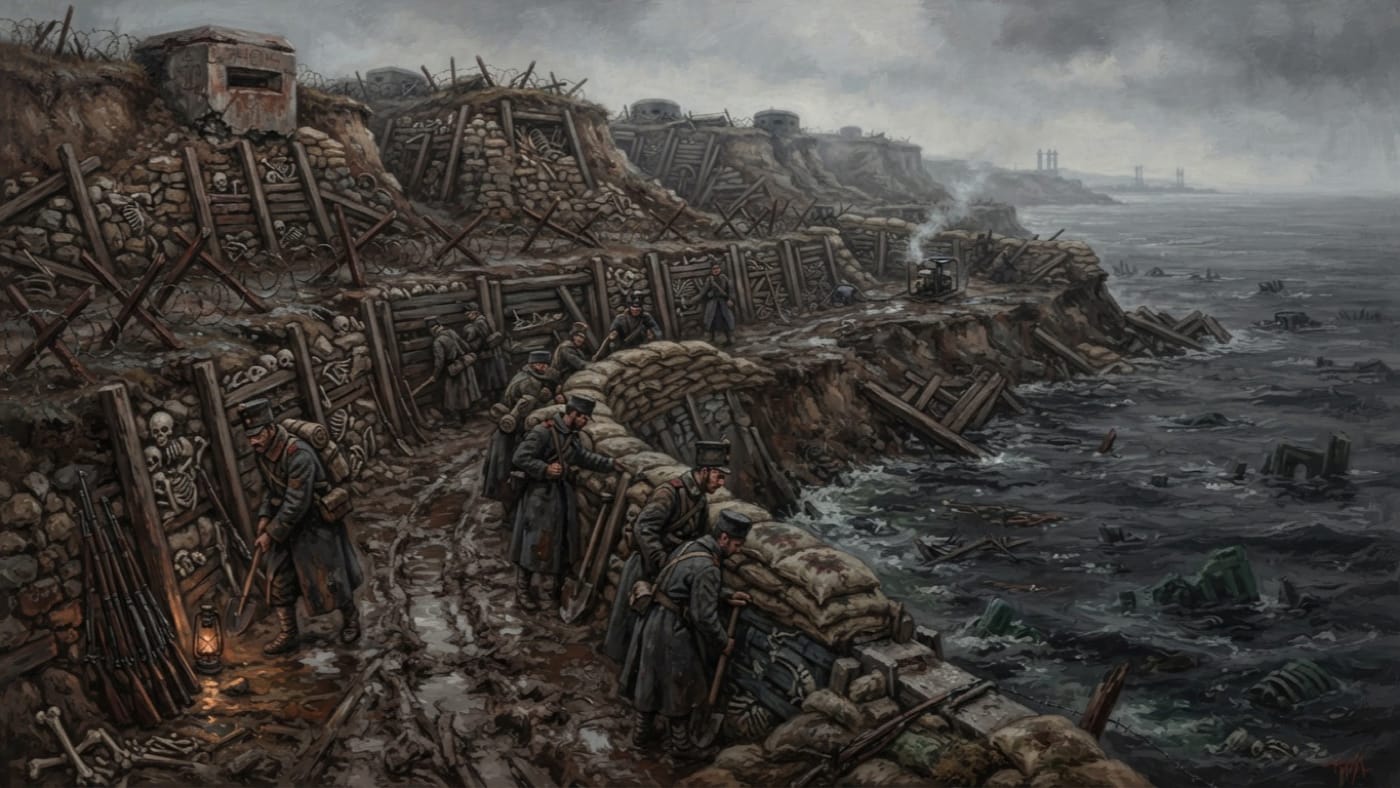
The works are twin forward cuts on the Aegean shelf, where the Thracian bluffs come down to surf and the Sagittal Line loses its argument with geology. They support the southern theatre. The Line's southern terminus belongs to Bastion-Constantinople. The Sister Trenches hold a flank, along with its bills.
Seawall alternates with sandbag along their faces. Reliquary timbers and drowned saint-bones brace firing steps that Engineering files as temporary. One cut is Elder and the other Younger. Which lies inland and which lies seaward depends on whose map survived the last washout. The parent survey declines to choose. This review, having no wish to be blamed by both cuts at once, concurs.
Between them lies the Womb of Salt, a tidal wash of No Man's Land that the soldiers call the Grave-Tide. Its colour changes with the week. Its appetite does not.
The names come from Thessaloniki, whose twin bells have taught the southern coast to speak in pairs. Rumour sends bronze down the coast road or tells a tale of sisters. This office certifies neither. The sibling habit travelled, and nothing in the file shows that any bell went with it. The Harbor-Chain Towers are the supply throat, one to two days by convoy road. Every shell, ration tin, brine-mask and reluctant conscript bound for Elder or Younger passes under that chain first. By the parent survey's account, the works were hardened alongside Thessaloniki's southern defences in A.S. 72. That year belongs to hardening. It has nothing to say about the Collapse.
#On the Failure That Repeats
The trenches collapse. They have always collapsed. This is what makes the tradition so persuasive in a dugout and so worthless in an archive.
Wrathforged raids come through the surf at low tide, when the wash thins into black channels, and the reports file them under Maldrake's pressure. Tide breaches undercut seawall footings. Sandbags slump, split and are refilled. Salt eats rifle springs, bolts, wire, hinges and the patience of sergeants. In second watch the Drowned Choir sings beneath the water and men dream toward it. That too is a maintenance problem, solved with filthy songs and a comrade's fist. Sections fail and are rebuilt, measured out by the Bureau of Engineering and resented by the Bureau of War. The parent survey states their condition without blushing: recurrently collapsed, recurrently restored.
The bones come back as well. Remains buried in the morning return on the dusk tide, along with remains that no clerk recalls recording. The companies collect them, sort them, bless them and bury them again. The soldiers speak of miracle and of duty, saying the dead return to their post. Such rationalists as remain within reach of a question say erosion. Both views are reported here. This office certifies neither, and neither one tells the hour of anything.
Evening brings the Hymn of Rust. Companies strip their rifles and chant, naming each flake of corrosion that falls as an hour added to the Line. The soldiers believe the sum. Engineering has never measured it, and Doctrine has never asked to see the figures. The rite began as cleaning. It became liturgy because the cleaning was necessary and the liturgy got it done on time.
The tradition feeds on exactly this. A company that has watched its own wall slide into the Womb of Salt three times in one season needs no prophetic ledger to believe in the Collapse. It has already seen the rehearsals. The corrupted field traditions take an ordinary failure, of which the coast supplies plenty, and nail a number to it. The number makes the failure feel foretold. Nothing in the accounts identifies the numbered Collapse with any single breach. Nothing identifies it with all of them.
Older catalogue material narrates the Collapse of the Sister Trenches as a concluded event, with a fixed year and a closed account.
Corrected. The Collapse is a disputed tradition preserved in prophetic ledgers and corrupted field talk. No completed event, year or outcome is established. As of A.S. 201 the trenches remain in service. They fail in the ordinary way and are restored in the ordinary way, which is to say badly and on schedule.
#On Doctrine's Admissible Portion
Inadmissibility is a narrow knife, and Doctrine has used it narrowly. The ruling strikes the number. It strikes any claim that the Collapse has a day, a toll or a conclusion that can be entered as history. It does not strike the sea.
Whatever the field record attests on its own authority stays standing. Seawalls fail. Sandbags fail. Bones return. Rust advances along every exposed surface the Creator saw fit to forge from iron. None of this needed a prophet. A sergeant with a lantern and a tide table can witness all of it.
The parent survey draws the useful lesson in a single sentence: alternating seawall and sandbag emplacements fail when maintenance becomes theology without engineering and engineering becomes arithmetic without fear. Doctrine has adopted that sentence as the admissible portion of the tradition. The adoption has not been peaceful. Engineering reads the first clause as an accusation against chaplains who bless a rotten footing and call it shored. Doctrine reads the second as an accusation against surveyors who calculate a wall's life on dry paper and have never slept beside one. War wants something that can be read aloud to a company in under a minute and still leave time to fill sandbags.
The review therefore separates three kinds of claim and gives each its own drawer. The first is the physical report: breach, return, corrosion, repair. It may be logged as fact once a witness and a tide stand behind it. The second is interpretation, whether miracle, erosion, or the sea's guilty conscience. It may be quoted, provided the speaker's name and Bureau go into the ledger with it. The third is prediction, the numbered Collapse itself. It may be preserved as tradition and quoted as tradition. It may not be filed as history, used to date a casualty, or cited to excuse a slack repair, as in why shore a wall the ledger has already drowned? The Bureau of Records has been instructed to keep the three drawers apart. Records has been given such instructions before.
This finding governs this entry. Other prophecies must find their own magistrates.
The tradition has one use that Doctrine will name and not endorse. A soldier who fears the Collapse inspects his wall. A soldier who believes it inevitable lets the wall go. The same superstition yields diligence in the first man and desertion in the second. A trench needs the first kind of soldier, and at the Sister Trenches the Church's chaplains have learned to tell the two apart by the state of their shovels.
#On the Works Still Held
As of A.S. 201, Elder and Younger are active coastal forward works in the southern theatre. Thessaloniki feeds them through the Harbor-Chain, and the convoy road turns to soup whenever the weather disapproves of logistics. The companies there fill sandbags in the morning, recover bones at dusk, strip rifles at evening hymn and stand second watch with oil under their nostrils against the singing. Sections fall. Sections are raised again. The register carries this as ordinary condition and gives it no number.
No final destruction is recorded, because none has taken place. No date for one is authorised, because Doctrine has authorised none. Whoever wishes to know when the Sister Trenches will fall may consult the prophetic ledgers, which are inadmissible. They may also consult the tide, which is punctual and has never yet agreed to stop.