
#On the Trenches That the Sea Keeps Auditing
The Sister Trenches are the Synod's daily humiliation ritual against the Aegean, which is to say they are a military success according to every report that has survived contact with spray.
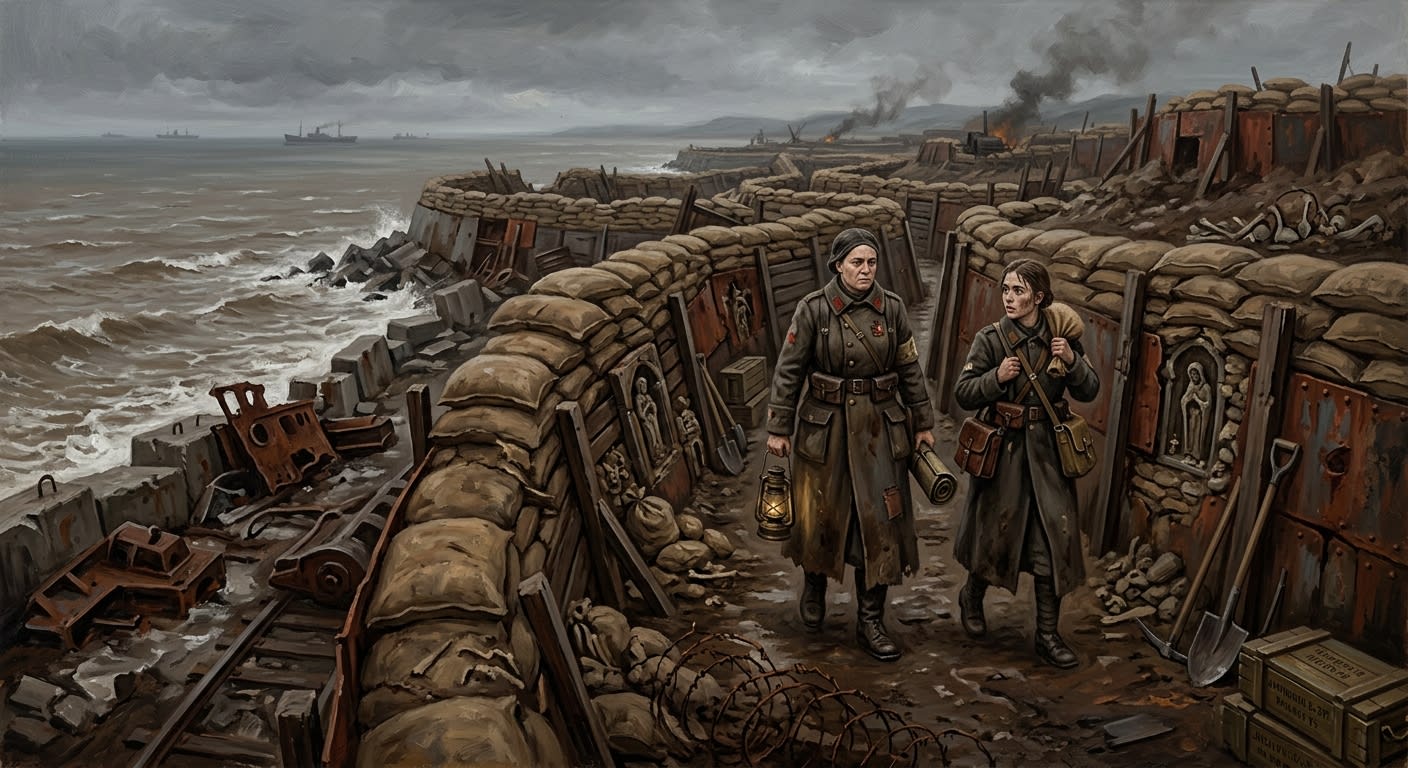
They are twin forward works along the southern theatre, one line named Elder and the other Younger, cut where the Thracian bluffs collapse toward surf and where the Sagittal Line learns the old insult of water. Seawalls and sandbags alternate along their faces. Reliquary timbers hold where ordinary wood would rot. Drowned saint-bones, fished from shipwreck, ossuary, and suspiciously convenient tide-pool, brace firing steps whose formal engineering classification is “temporary.” Temporary things become permanent when enough men die maintaining them.
Between the two cuts lies the Womb of Salt, a no-man's wash that changes colour with the tide: red one week, black the next, grey when the weather has lost interest in symbolism. Soldiers call it the Grave-Tide. They are correct more often than soldiers deserve.
#On Elder, Younger, and the Bell-Born Names
The naming tradition belongs to Thessaloniki, whose twin bells and harbour towers have infected half the southern coast with sibling terminology. Elder is the inland cut, or the seaward cut, depending on whose map survived the last washout and which bureau wishes to be blamed. Younger is the other one. This ambiguity has killed fewer men than expected and more than admitted.
The official survey places the trenches one to two days from Thessaloniki by coastal road, faster by cutter in weather too rare to plan around and too dangerous to trust. The port feeds them: grain, shells, masks, replacement rifles, brine cloth, priest-cadres, confession receipts, and men who have not yet learned that coastal service is trench service with drowning added.
The first works date to the early southern fortification years after the Sundering, when the Synod learned that the Aegean flank could be crossed by things that did not request permission and did not respect dry land as a category. The trenches were hardened during the post-charter expansion of Thessaloniki, under the sour patronage of the Bureau of War and the measuring chains of the Bureau of Engineering, then rebuilt after every serious failure, which is a noble military phrase meaning the original plan drowned.
An early War digest describes the Sister Trenches as “stable coastal redoubts attached to Thessaloniki supply command.”
Correction. They are unstable coastal redoubts attached to Thessaloniki supply command by paperwork, rope, faith, debt, and a road that becomes soup whenever Heaven sneezes.
The formal terms Elder and Younger now appear on requisition forms, casualty ledgers, mask orders, bell-timing charts, and grave tags. A man may be sent to Elder in the morning, transferred to Younger by afternoon, and returned by the tide at dusk without ever leaving the same square of mud. Records has a code for this. Records has a code for everything except mercy.
#On the Grave-Tide and Its Returned Tithe
Twice daily, the tide audits the dead.
Bodies buried in morning sandbags return at dusk. Bones lost in shell craters rattle back under moonlight. Femurs from men no clerk remembers recording knock against duckboards. Teeth collect in rifle drains. Once, a platoon swore that a skull with no lower jaw arrived wearing a tag assigned to a cook still alive in Thessaloniki. The cook was summoned, inspected, fined for improper tag custody, and returned to kitchen duty with a theological expression unbecoming to a man in apron whites.
The Bureau calls this repeated recovery a proof of discipline: the dead return to remind the living of service. Rationalists, in their little remaining dens, would call it erosion. Erosion does not sort buttons by regiment.
GRAVE-TIDE COLLECTION REPORT — YOUNGER SECTOR, A.S. 200 Recovered: forty-three long bones; nineteen jaw fragments; one intact hand wearing three rings; six tags unreadable; two tags future-dated. Anomaly: █████████████████████ returned warm. Disposition: lime, chant, reburial. Clerk note: do not assign same pit twice before next tide.
Soldiers joke that the tide is loyal because it always returns its tithe of marrow. Humour keeps men alive until it stops, at which point it becomes testimony. The marrow is collected, sorted, blessed, and buried again. Children in rear towns imagine that burial is an end. The Sister Trenches know burial as a scheduling dispute.
#On Rust, Rifles, and the Hymn That Offends Engineering
Sea-salt corrodes weapons faster than smiths can replace them. The Bureau of Engineering calls this waste. The soldiers call it Tuesday.
Every evening in both trenches, companies strip rifles under supervision and chant the Hymn of Rust. Each flake of corrosion that falls is named as an hour added to the Line. The rite began as maintenance, became superstition, acquired cadence, attracted chaplains, offended engineers, survived inspection, and entered official tolerance under the phrase “morale-adjacent care of materiel.” This is how liturgy is born in the modern Synod: a man cleans his rifle because it might save him, another man adds a tune, a clerk finds the tune useful, and suddenly the Creator has always preferred oiled bolts.
The masks arrive from the Maskwright Lanes by night convoy, iron-framed, leather-lined, fog-lensed, sometimes fitted with demon-glass eyes certified by Glassman Dimo or a lesser sinner copying his hand. Legal masks go to ordinary companies. Better masks go to officers, favoured squads, men with patrons, and those units expected to face Wrathforged surf-raids before sunrise. Fairness is a rear-area virtue.
The worst hours are second watch, when the Drowned Choir carries beneath the surf. Men hear a harmony under the water and dream toward it. The local countermeasure is filthy singing, rifle oil under the nostrils, and a buddy with permission to strike first and apologise after inspection. Thessaloniki's bell schedule helps, when the bells behave. The sea keeps its own time.
#On Assaults by Wrath and Water
Wrathforged raids come through surf, smoke, and the steam that rises when hot iron meets holy water and both prove stubborn.
The raiders strike at low tide when the no-man's wash thins into black channels. Their armour hisses. Their hammers glow. Sometimes their bodies are solid. Sometimes they arrive as heat behind rain, visible only where sandbags blacken and men begin screaming before the blow lands. The trenches answer with rifle volleys, bell-timed mortar, chain-shot from the coastal batteries, and the old trench prayer: fire until the shape stops arguing. The reports file most such assaults under Maldrake's pressure, which is accurate enough for artillery and insufficient for confession.
The sea is worse because it does not charge. It returns.
War Bulletin 77-S states that the Sister Trenches “have never been overrun by enemy action.”
Amended. Enemy action has repeatedly entered, burned, breached, occupied, eaten through, sung beneath, and departed sections of the works. The phrase “overrun” is reserved for losses lasting longer than the next authorised rebuilding.
The Collapse is preserved as a future entry in older prophetic ledgers and a date-mark in several corrupted field traditions; current Doctrine treats the numbered form as inadmissible anticipatory historiography. The useful portion remains clear: alternating seawall and sandbag emplacements fail when maintenance becomes theology without engineering and engineering becomes arithmetic without fear. The tide vomits bones. Soldiers call it miracle. Clerks choose the word that can be filed.
#On Their Present Condition
As of A.S. 201, the Sister Trenches remain active because the southern theatre has no spare coastline and the sea has not accepted transfer.
Thessaloniki feeds them and fears them. Every shell, ration tin, brine mask, priest, rifle spring, replacement boot, and reluctant conscript passes under the Harbor-Chain before entering the coastal road. If Chainmaster Kosta closes the gate, the trenches starve in a week. If Harbor Prefect Iolana suspends stamps, the convoys rot at anchor. If Pilot-King Nenos refuses passage, everyone above him discovers how much legality depends on criminals who know fog.
The men posted there age by corrosion. Their boots salt-stiffen. Their lungs acquire harbour weather. Their prayers shorten. They learn to sleep with one hand on the rifle and one ear refusing the surf. They bury comrades shallow because deep holes fill. They polish metal because metal is at least honest enough to show decay. They salute returned bones when the tags are legible.
The Sister Trenches hold the coast. Hold is a bureaucratic word, clean, square, and false around the edges. The trenches grip, slip, sink, rise, rot, chant, fire, and rebuild. They remain one of the wettest sacraments of No Man's Land, a place where the Line touches the surf and receives correction twice daily. They are held in the way a fist holds water: briefly, desperately, with most of the evidence running between the fingers.