
#On the Harmony Under the Water
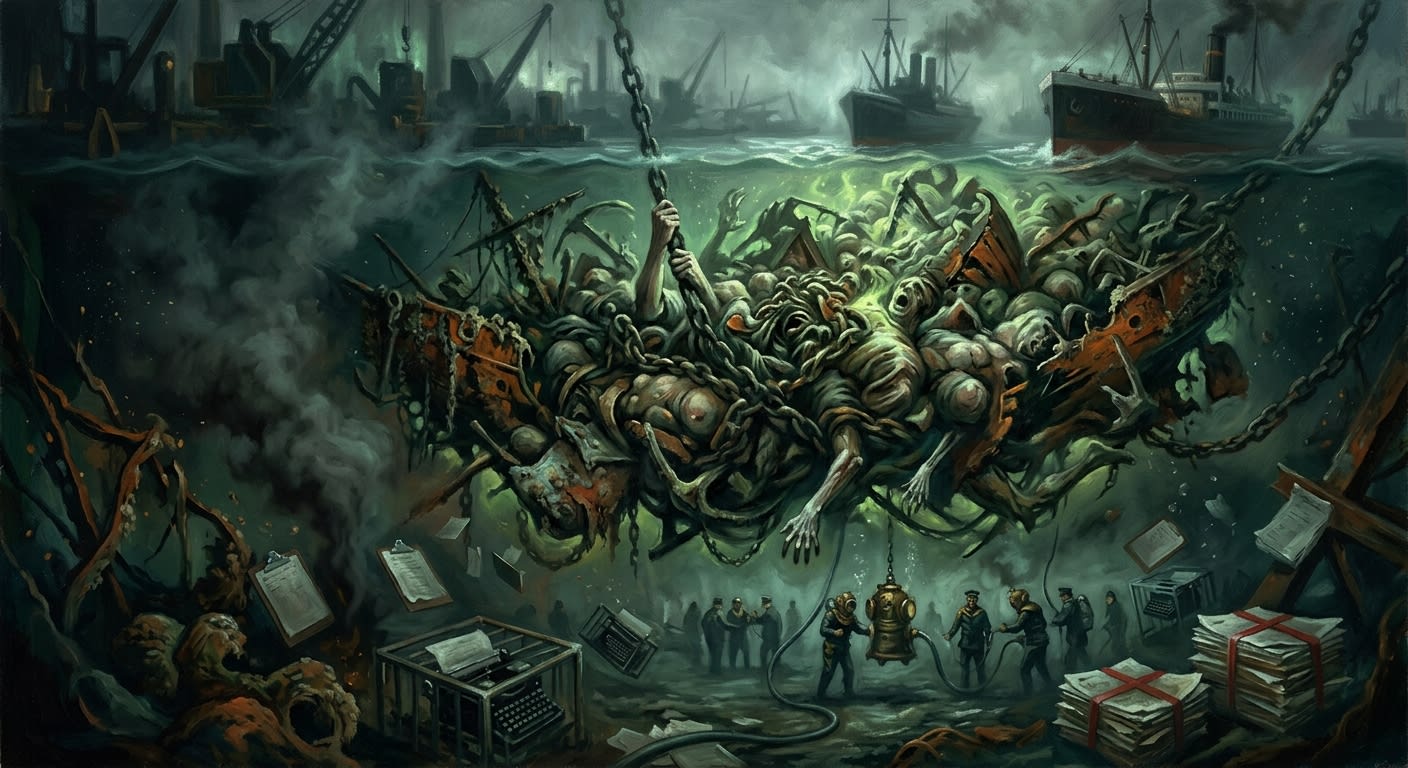
The Drowned Choir of Thessaloniki is a Category Three Harmonic Anomaly, which is the Bureau's way of saying that something sings under the harbour and that killing everyone who hears it would interfere with shipping. The designation has stood since A.S. 121. It remains under investigation. The phrase “under investigation” has now done eighty years of labour and deserves a pension.
It is heard most plainly where the Harbor-Chain Towers lower their psalm-inscribed links into the Aegean chop, but it travels by chain, fog, hull, dream, and tooth. Soldiers in the Sister Trenches hear it under the surf after second watch. Pilots hear it as a second voice braided through the passage hum. Refugees in the Sheds hear it just before sleep-singing begins. Children hear it first. This is one of the Choir's uglier habits, and the sea has many.
The Choir does not sing words at first. It sings intervals. A rise where the Bureau of Bells expects a fall. A held note where the Passage Psalm requires release. A harmony that seems to know the bell-schedule before the bell is struck. Sailors call this “the under-note.” The Bureau of Rites calls it “subaqueous liturgical interference.” Dockmen call it by gestures, because dockmen are not paid enough to improve theology.
#On the First File and the Counting of Names
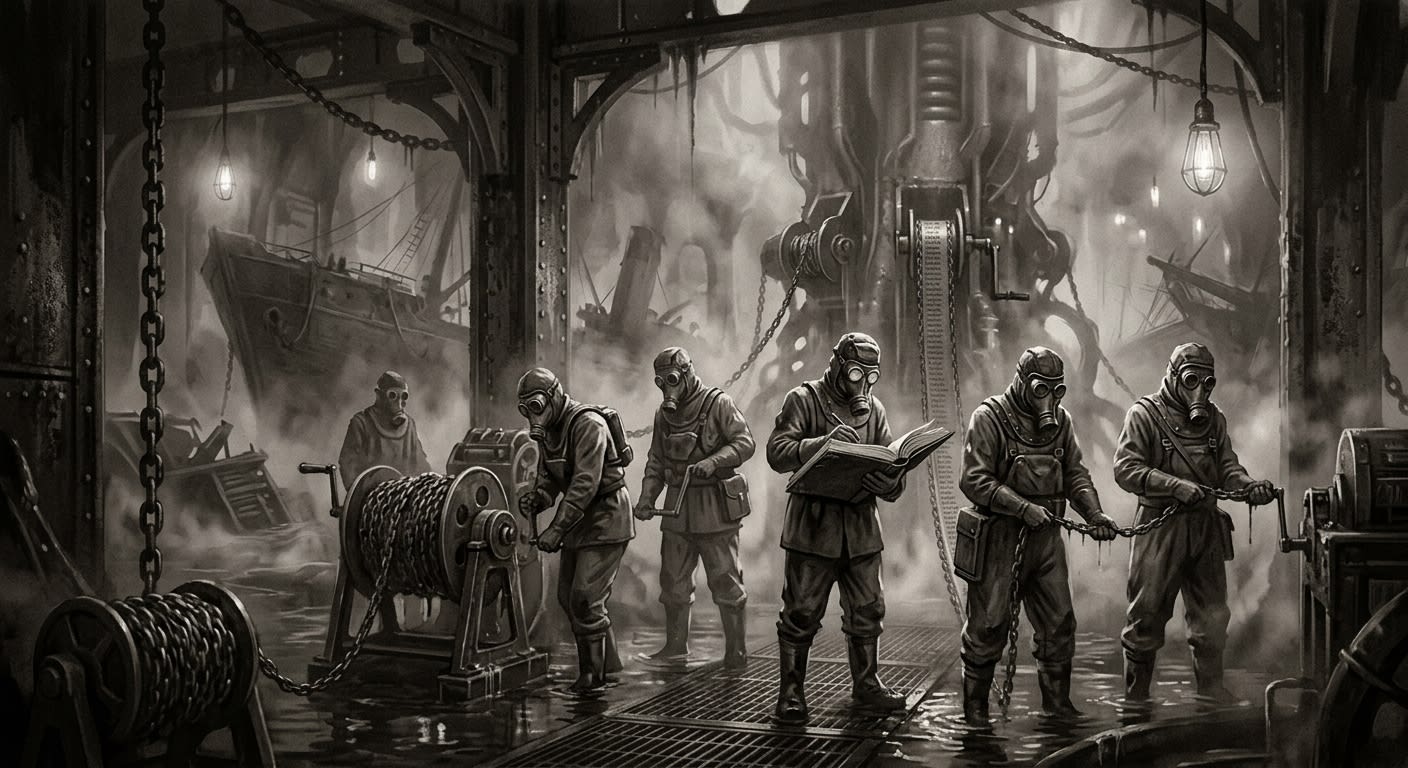
The earliest complete file dates to A.S. 121, though the coast had sung before the Synod learned to number its fear. After the Sundering, things came from the water wearing faces borrowed from drowned men, and the old harbour kept operating because ports, unlike philosophers, cannot survive purity. Chainwright accounts from the first century A.S. describe “double psalms” during fog; Diver-Matron predecessors recorded chain-links vibrating after the bells stopped; pilots marked certain tide tables with a small black circle, meaning: do not sleep aboard.
By A.S. 121, the pattern had become expensive. Twelve sailors from three ships walked into the surf on the same night. Their boots were found arranged in a line at the water's edge, toes toward the harbour mouth, laces tied together with the neatness of a sacristan preparing vestments. One survivor, a boy from a Marseille grain-hulk, said he had heard his own name sung from below, but older, as if the singer had known him after death and was correcting the pronunciation.
That sentence opened the file.
The Choir accumulates names. This is the central fact, and the reason the Bureau of Records pretends not to be interested while maintaining seventeen subsidiary indexes in rooms it insists are used for rope inventory. Names appear in Chainmaster Kosta's hidden ledger before drownings. Names recur in sleep-songs. Names form in corrosion on submerged links, the strokes resembling handwriting until a clerk tries to copy them, at which point the copied line becomes ordinary rust in the mind and remains legible only on the page.
The Bureau has debated whether these are recorded names, stolen names, predicted names, or names the sea already owned. Debate continues because debate is cheaper than diving.
Earlier Rites memoranda classified the Choir as a probable demonic lure.
Revised A.S. 146 after the Crying Choir incident failed to match any known Lust, Sloth, Wrath, or maritime Gluttony pattern. The current term is “undetermined harmonic agency.” It means the same terror wearing cleaner gloves.
#On the Crying Choir
The Crying Choir incident of A.S. 145 remains the wound Thessaloniki hides behind paperwork. Refugees had been quartered in the towers during coastal shelling, packed into stone chambers meant for chain crews, spare tackle, emergency oil, and fifty human beings if one stacked them with Bureau efficiency. They came from burned villages, flooded quays, convoy camps, and farms whose soil had begun producing salt. They arrived with bundles. They slept under bells.
On the third night the children began singing.
No adult taught the melody. No bell supplied the pitch. The song rose from rows of exhausted bodies in the pre-dawn hour when guards are stupidest and ghosts most punctual. Witnesses agreed on one detail: the children did not appear distressed. Some smiled. Some wept without waking. Some held their mouths open wider than any hymn required, as if receiving communion from the air itself.
At dawn, every child among them had lost the tongue.
The surgeons wrote “dissolution.” The tissue had not been cut, bitten, burned, or torn. It had become salt water while the child remained alive. Speech was gone. Breathing continued. Several attempted to sing and produced only a wet click the physicians recorded, with monstrous professional calm, as “residual oral rhythm.” The Bureau declared them sacrificed to silence. The declaration was stamped before the bedding dried.
Quarantine Crescent intake sheet, A.S. 145: number of affected children ███; number transferred ███; number listed in Harbor Ledger as “Port Loss (Clerical)” ███; number whose names reappeared in chain corrosion between A.S. 146 and A.S. 151 ███. The final column was written in another hand.
The children lived, according to the Bureau. The sea kept a different table. Their names remain in the Harbor Ledger, neither dead nor whole, entered under a category invented that morning and never used again. Thessaloniki learned its countermeasure from them. At night, the Refugee Sheds maintain a communal hum: low, ugly, constant, timed against the tower bells. If the hum holds, sleep-singing weakens. If the hum breaks, people walk.
#On Bells, Chains, and the Silence
The Choir's relation to the bells is officially unproved. This sentence is structurally sound and morally rotten.
The chains of Thessaloniki are counting instruments. Every ship that passes under them sets the links humming, and every hum registers somewhere the Records clerks cannot find. The Elder and Younger bells supply the city's clock: dawn, dusk, storm, chain-window, curfew, quarantine release. The bells tell the harbour when to open its mouth. The chains tell something below what has entered.
During the Silence of Thessaloniki in A.S. 198, the bronze bells produced no sound for seventy-two hours despite physical impact. Clappers struck. Instruments registered force. Air received nothing. Surface mechanisms failed. Diver-Matron Sera confirmed what the surface instruments denied: the submerged chain-links vibrated throughout, maintaining the correct bell-schedule below the water. Dawn and dusk. Lower then higher. Higher then lower. The sea kept time.
The Bureau of Rites does not connect the Choir to the Silence. The Bureau of Bells does not request Rites' Choir files. Doctrine issued Determination 198-K/7 — “a test of fidelity administered by mechanisms beyond current doctrinal scope” — and, with that immaculate fraud, converted terror into a lesson plan.
After the Silence, the bells resumed in exchanged voices. The Elder rang the Younger's note. The Younger rang the Elder's. Three years later, the reversal persists. Sera reports increased tonal complexity beneath the harbour. The Refugee Sheds' children hum harmonies no teacher supplied. The chain corrosion has begun to resemble script in longer clauses.
#On Countermeasures and Useful Cowardice
The approved countermeasures are simple because the Bureau prefers simple instructions when giving them to people it expects to die. Maintain the communal hum. Strike the bells on schedule. Keep chain-windows short. Forbid unsupervised sleep aboard moored vessels during fog. Lash children to bedframes with soft cloth, not rope, because rope leaves marks and marks create inquiries. Confiscate unsanctioned name-slips from tongues before choking occurs. Record all sleep-singing without attempting transcription.
Do not answer the Choir.
This last instruction appears in every manual and no one can explain who first gave it. The prohibition is older than the A.S. 121 file. Chainwright apprentices learn it before they learn safe tensioning. Pilots learn it before they learn bribe scales. Refugee aunties hiss it at children who wake humming too clearly. To answer means to sing back with the note the Choir offers. Those who do report relief first, then perfect sleep, then absence at morning muster. Their bodies are sometimes recovered. Their faces are peaceful. Peace, in Thessaloniki, is treated as evidence of contamination.
The Quarantine Crescent receives the living remnants: men who hear bells under floorboards, women whose dreams arrive wet, children who know the names of drowned sailors born before their grandparents. Warden-Physic Iri files them under acoustic distress. Some recover after weeks of vinegar steam and bell-drone. Some stop speaking. Some speak in harbour schedules. A few become useful to the Chainwrights, who employ them as early-warning listeners and pretend the wage makes the practice less obscene.
Public harbour notices advise citizens that the Drowned Choir poses “no threat to persons maintaining approved devotional rhythm.”
Corrected for the internal edition. Approved devotional rhythm reduces incidents. It does not grant immunity. The Choir has taken sober men, pious women, licensed Bellwardens, two Rites auditors, and one Purity novice who had tied both boots to a chapel rail. The rail remained.
#On the Present Song
As of A.S. 201, the Choir is learning. That is Sera's word from her private inspection logs, and Sera is not a poet; she is a woman who descends into black water with a brass lamp, touches vibrating iron, and returns with reports that make senior men discover urgent meetings elsewhere. The intervals have narrowed. The sleep-singing in the Sheds now carries a second line. The fog near the chains holds shape on clear nights. Kosta's ledger has added names in a hand he does not recognize. Fourteen from the Silence year drowned within twelve months. The new entries wait.
The external audit from Strasbourg will arrive with calipers, censers, wax, authority, and the usual touching belief that classification precedes comprehension. It will measure corrosion. It will interview Sera. It will request Kosta's official ledger and miss the hidden one. It will ask Aunt Velka whether the refugee hum is doctrinally supervised, and she will lie with the serenity of a saint whose patience has been weaponised by necessity.
The Choir will sing beneath all of this. It will count what passes above. It will gather names from hulls, dreams, ledgers, mouths, and rust. It will wait through reports, determinations, and stamped denials, because the sea has time and the Bureau has meetings.