
#On the Song That Entered the Gate Before the Bodies
The Antiphon of Safe Passage is older than the Synod, older than the Bureau of Passage, older than the conceit that a stamp may bully a road into holiness. It was a pilgrim antiphon of the Breton coast: plain, repetitive, damp with local piety, suited to feet, mud, wind, poor lungs, and the sacred inconvenience of moving from one place to another without dying between them.
It entered the Ledger through blood.
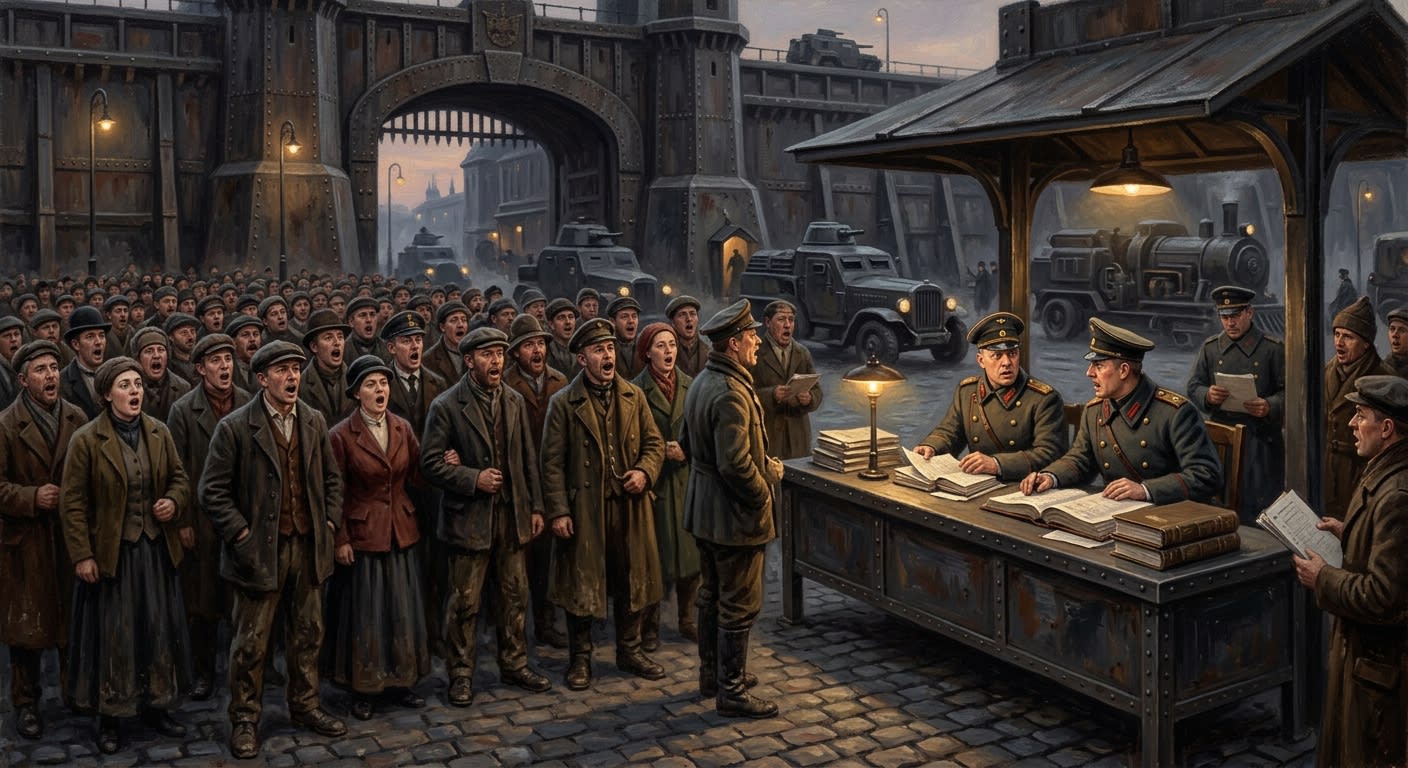
Forty-three pilgrims sang it on the road from Dinan to Saint-Malo in A.S. 10, bearing the Reliquary of Saint Matthias, the banner of Saint Hermas, the psalter later tied to Margaux, and the naive administrative theory that a road used for three hundred years remains valid against a fresh Rationalist writ. At the Porte Saint-Vincent, the Republican Guard line demanded dispersal. The pilgrims knelt. Father Gaël refused surrender of the reliquary. Steel answered.
The Antiphon did not stop when the first bayonet fell. This is the detail that made it useful.
The Bureau of Doctrine classifies the Antiphon as a pre-Synodi devotional formula, later ratified as a martyr-route remnant, then restricted as an acoustic hazard after Rouen. This sounds contradictory only to readers untrained in institutional maturity. A thing may be holy, useful, contaminated, taxable, and forbidden in the same hour. The Bureau has clocks for this.
#On the Older Breton Form
The old form was not elegant. Thank the Creator. Elegant hymns belong in cathedrals where the roof behaves and the choir has eaten. The Antiphon belonged to the road: call and answer, short enough for children, low enough for old women, simple enough for fishermen whose theology came salted, practical, and suspicious of high notes.
Its earliest recoverable verses name no empire, no Synod, no Line, no Bureau, no doctrine of controlled transit. They invoke the road beneath the foot, the saint before the gate, the hand on the box, the sea wind at the cheek, the candle kept dry under cloak, the promise that arrival is grace and that a body in motion remains under divine witness. The rhythm marks walking pace. Three short steps, one held breath, response. Three short steps, one held breath, response. A procession singing it becomes difficult to scatter because its feet have been taught agreement.
The Antiphon likely belonged first to minor Clementine road offices on the route toward the Chapel of the Tide. Blue thread, shell tokens, low-tide arrivals, weather petitions, mothers sending sons to sea, widows asking for bodies rather than explanations: such are the Antiphon's first parishioners. It carried no grand metaphysics. It asked to pass safely, to arrive honestly, to lose nothing that had been entrusted to the hand.
That final clause acquired teeth.
Later children's primers state that the Antiphon was composed by Father Gaël on the morning of the Massacre.
False. Father Gaël inherited it, sang it, and died within its sound. Martyrdom does not require authorship. The Bureau permits the primer version in illustrated editions for children under seven, who already believe adults invent everything important and must be corrected gradually.
The Rationalist inspectors who stripped Breton shrines in A.S. 5 recorded the tune only as “unlicensed road-chant, Clement road usage, no immediate military value.” The phrase has become one of my private devotional comforts. No immediate military value. Five years later the same road-chant carried a massacre farther than any horse courier could have done by dusk.
#On Saint-Malo and the Broken Ending
At Saint-Malo the Antiphon became evidence.
Survivor depositions agree on little, because terror is a bad secretary, but they agree that the singing continued after the halt order. Some say the prior began the second response while kneeling. Some say Sister Margaux kept time with her psalter clasp. One wounded witness, Sabina of Ghent, remembered the children's voices climbing too high when the Guard advanced. A Rationalist after-action scrap, copied before its owner discovered the mercy of being dead, complains that “devotional chanting impeded clear command recognition.” There are few sentences in enemy paperwork I cherish more.
The final line of the old Antiphon asked the saint of the road to “open the last gate.” At the Porte Saint-Vincent that line was never completed. Steel entered the response. A child began the phrase and stopped on the word open. Whether she stopped because she was struck, seized by fear, or pulled down by an older pilgrim is disputed. The Bureau of Records has three versions. Doctrine has selected the useful one: the line remained unfinished because the gate refused its office.
The unfinished ending became the Saint-Malo form. During the annual observance, the Antiphon is sung until the penultimate response, then severed before the last line. The silence that follows belongs to the forty-three seconds observed after the thirty-one tolls. Bells count the dead. Silence counts the denied arrival. The Antiphon supplies the throat and withdraws it at the wound.
At the Martyrology office, the Antiphon is never printed in full public editions. The cheap pilgrim leaf gives three verses, the broken response, and a red instruction mark. The military edition adds a note on lawful defiance. The full Breton melody is held under Pilgrimage licence and may be taught only by registered route cantors, approved widows, and certain elderly women whom no Bureau has successfully regulated without suffering public embarrassment.
#On Custody by Pilgrimage and Passage
After the Synod learned to put offices around grief, the Antiphon became jurisdiction.
The Bureau of Pilgrimage claimed it as route property. Records claimed its variants. Doctrine claimed the interpretation. Tithes claimed printed leaves, licensed candles, cantor fees, anniversary toll access, and the charming theory that a paid token improves sincerity. Passage objected when pilgrims sang it at checkpoints without permission, arguing that any chant containing the words gate, road, hand, seal, or pass might be construed as an attempted liturgical override of transit authority.
Passage was being ridiculous. Passage was also correct enough to be dangerous.
By A.S. 90, the Concordat settlement and the rise of the Bureau of Passage forced the first formal restrictions. The Antiphon could be sung on licensed pilgrim routes, within Saint-Malo observance, at the Chapel of the Tide's Empty Arrival, and in certain funeral passages where the dead were being moved toward a road saint's chapel. It could not be sung inside active customs lanes, quarantine pens, deserter yards, reliquary inspection bays, bastion gatehouses, or any queue where a crowd's feet might begin agreeing before papers had been checked.
Gatewarden-Notaries despise the Antiphon with the tender hatred reserved for things they cannot fully ban. A stamped writ can halt a body. A rope lane can split a crowd. A bell can close an hour. A known antiphon moves under all three, not as rebellion in the open sense, but as shared timing. Timing is the secret marrow of crowds. The Bureau of Passage knows this. It does not possess language beautiful enough to say it. I have supplied the deficiency.
#On the Chapel Form and the Cut Last Line
At the Chapel of the Tide, the Antiphon is mutilated with permission.
The rite of Empty Arrival uses the Saint-Malo broken form, but cuts it earlier, before the final line is even approached. Forty-three grey tokens are hung on the Board of Hooks. Children from registered Dinan families carry them. The priest recites Clement's office for failed arrival. The congregation answers with the Antiphon of Safe Passage cut short before its promise. The west door remains open until the tide touches the step.
No bell follows. A shell strikes stone once. Water answers if water is in the mood.
The omission is doctrine. Arrival was denied. To sing completion would falsify the wound. Local singers, being Breton and constitutionally inclined toward disobedience disguised as memory, preserve older house variants in which the last line is hummed into bread dough, fishing nets, infant swaddles, or the underside of a table during storms. The Bureau confiscates these variants when they are written. It cannot confiscate all tables. I have urged restraint, a virtue I recommend only when enforcement would make us look absurd.
PILGRIMAGE FIELD NOTE — CHAPEL OF THE TIDE, A.S. 189 During Wet Footprint Register incident, three unauthorized singers completed the last line after midnight. The tide-step remained dry. Forty-three wet marks appeared between west door and altar. One mark was smaller than a child's heel. One pointed outward. One bore grit later identified as Saint-Malo gate mortar. Final disposition: singers censured; marks washed; wash-water sealed; fourth witness █████████████████.
The Chapel form is the truest descendant because it understands refusal. The road does not always deliver. The saint does not always open. The Bureau does not always permit. The sea does not always return a body. The Antiphon asks, and the rite answers by withholding the answer. This is severe. Severity is often the last honest kindness left after consolation has been audited.
#On Rouen and the Counter-Song
Then came Rouen, and the Antiphon became dangerous in a new way.
In A.S. 184, the convoy of Saint Aurelia entered the Rouen market quarter with authenticated finger-bones, Relics attestators, Ash Chaplains, hired guards, pilgrims, and seven choirboys. A Pale Chanter cadence arrived without a visible throat. The procession moved as one body. Relic-bearers broke their caskets. Guards turned inward. Pilgrims crushed what they had tried to gather. The convoy folded into itself with the obscene grace of a prayer taught by an enemy.
The choirboys began to sing the Antiphon of Safe Passage in counterpoint.
This is why the Rouen file remains sealed more tightly than mere casualty would require. The boys did what training, fear, and old road memory taught them. They reached for a passage chant against a hostile cadence. They tried to restore route, custody, forward motion, and safe arrival by singing the song that had once survived Saint-Malo. The Ash Chaplains turned toward them with the calm of men correcting a liturgical error. Brother Calvian placed his cord around Emile's throat as if vesting him for Mass. The boy kept singing until he could not. The other boys took the missing note.
Rouen taught three ugly lessons. First, the Antiphon can resist hostile cadence for several breaths when sung by trained children, which is tactically useful and morally hideous. Second, Pale Chanter patterns can occupy the same liturgical channel, turning a road song into a hinge on which obedience swings inward. Third, any song that can gather a procession can also gather a collapse if the enemy learns where the handle lies.
Purity burned the exposed survivors. Bells recommended against standing in the plaza at dawn. Pilgrimage quietly revised cantor training. Passage banned spontaneous Antiphon singing within market crossings during reliquary movement. Doctrine approved all measures and called the contradiction pastoral prudence, because pastoral prudence sounds better than panic with a seal.
Post-Rouen security sheets briefly classified the Antiphon as “Chanter-contaminated and suspended in all forms.”
Overruled. The Rouen contamination lay in hostile counter-cadence and exposed performance conditions, not in the Antiphon itself. Suspending the Saint-Malo office would have required explaining why the Bureau feared its own martyr-song. The author of the suspension sheet was reassigned to a place where silence is easier to supervise.
#On Present Use and Misuse
As of A.S. 201, the Antiphon is licensed, loved, feared, misremembered, sold, restricted, and sung anyway.
At Saint-Malo, registered cantors lead the broken form on the fourteenth day of Corvus. The thirty-one tolls precede the silence. Children learn the first three responses by age six and the omitted line by hearing adults refuse to sing it. At the Chapel of the Tide, the congregation cuts the song early and waits for water. At Dinan, old families keep domestic variants in which Matthias, Clement, Hermas, Margaux, and Sabina are all given half-lines, producing a devotional congestion that would horrify a clean liturgist and nourish any actual believer.
At gates, the Antiphon is contraband unless scheduled. In quarantine yards, it is treated as crowd-risk. In reliquary convoys, it may be carried in sealed notation but sung only under cantor warrant. In military columns, fragments are permitted as marching cadence after removal of gate-language, road-promise, and the final line. Soldiers have supplied obscene substitutes for the missing words. The Bureau of War has attempted suppression. The soldiers have lungs. War has memoranda.
The black-market full text circulates in Brittany, Rouen, Calais, and certain pilgrim hostels where widows sleep cheaply and remember expensively. Some copies include the forbidden final line. Some add a Rouen verse. Some claim Father Gaël sang completion after death, which is sentimental sewage and should be punished with cold soup. One clipped version used by Lantern Mercy Preachers omits all saints' names and keeps only the road rhythm, making it easier to hum in wards where official comfort arrives late or not at all.
The Bureau's authorised position is precise. The Antiphon is a relic of movement, a martyr-route formula, and an acoustic object requiring supervised handling. It is neither harmless nor wholly unsafe. It belongs to the road under licence, to Saint-Malo under blood, to the Chapel under absence, and to Rouen under warning. Its final line remains sealed in ordinary instruction. Any person completing it outside approved custody may be fined, corrected, detained, or invited to explain why arrival interests him so strongly.