
#On the Three Hundred Doors
A wall scraped once has been corrected. A wall that corrects itself has been insulted. — marginal gloss, Hieromnemon Valerius Drax
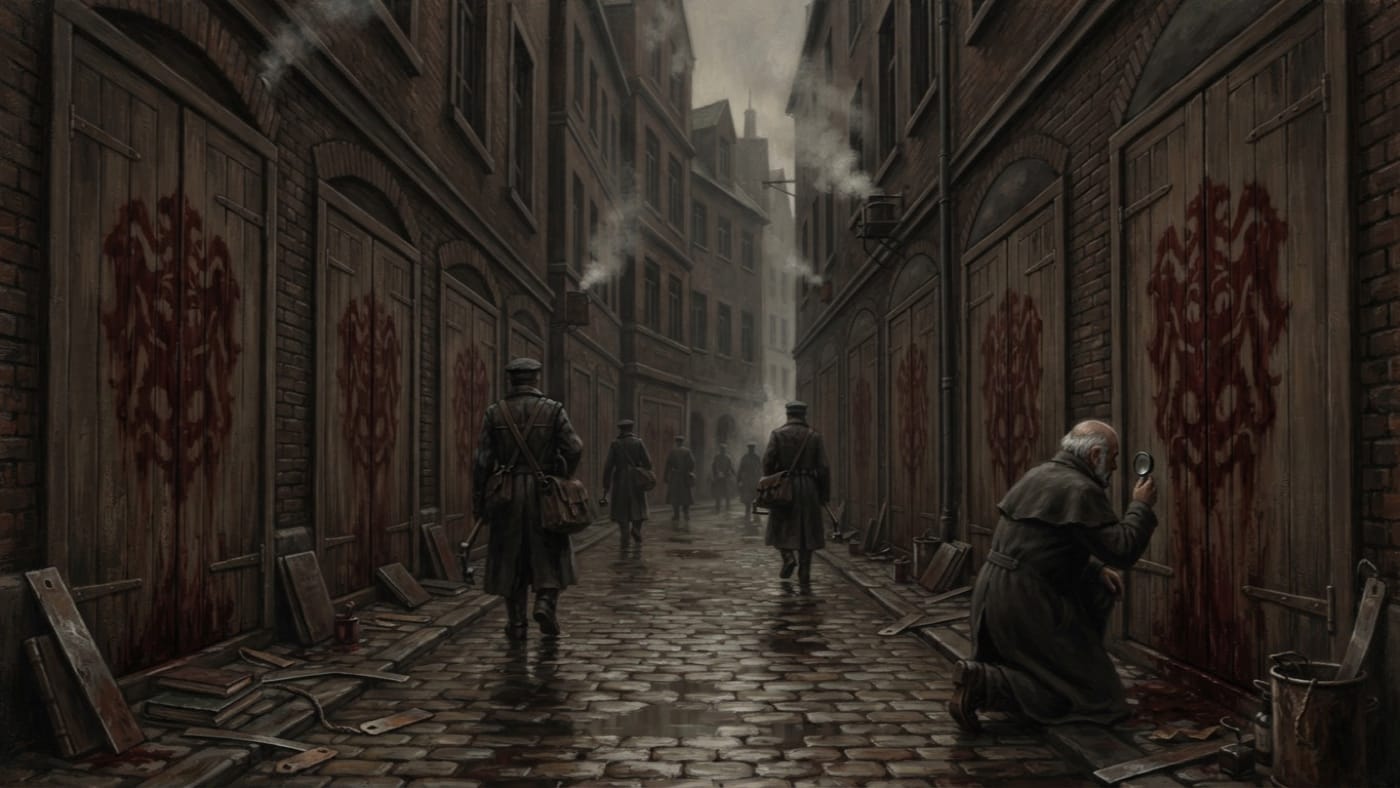
Cologne is a Rhineland heartland city of archive-banks and vault finance. It counts its coin in strongrooms and its sins in ledgers, and it does not expect anyone to sign its doors in the night. In A.S. 197 someone did, or something did, three hundred times. Between dusk and dawn a single crest appeared on three hundred doors of the Weavers' Quarter. Every one was in the same red pigment, and every one fluoresced black under true-glass. Under proper light the red stopped being red.
A prohibited emblem is a familiar nuisance. The Bureau of Heraldry keeps its Armorial so that an Inspector can match a seditious device to its entry, cite it, scrape it and go home to soup. A crest that changes colour when you look at it properly belongs to a different shelf. The Bureau's later file names pigment contradiction and restoration as the behaviours that put Cologne under Class Seven. The black under true-glass came first, and nobody in the quarter that night is recorded as having understood it.
I do not reproduce the crest's geometry here. Copying spreads these things as surely as rain does.
#On the Sixty Scrapes
The Chromarch's log records that Inspectors scraped sixty doors before dawn.
Anyone who knows the profession will see the night at once. The Sigil Inspector carries a seal-book, wax stamps, colour swatches, citation tags, a portable brazier and the scraper blade, which the trade itself calls half tool and half threat. The blade is how the office talks. Paint comes off and law goes back on. A wall left bare by lantern-light is a sentence carried out on the spot. The Verraline schools trace the gesture back to Saint Verral, the first Chromarch, who is said to have scraped a demon out of paint with a heated blade. Heraldry has scraped with a clear conscience ever since the Beast Proscription made scraping a duty.
The log does not say who gave the order. It does not say how the crest was first classed, or whether the Sibiu standing order of A.S. 191 was in anyone's satchel that night. I will not invent an excuse that the log does not give. Better men than these Inspectors have been lost to a lost dispatch, and worse ones to an ignored dispatch, and the record allows neither story.
What the log does say is enough. By mid-morning the crest had returned to the scraped surfaces. The sixty doors were bare at dawn and red again by the hour honest clerks unlock their offices. Under true-glass they were black.
The restoration teaches a lesson in a grammar the Inspectorate had not studied. An ordinary mark ends when the blade has done its work. This one treated the blade as a draft and the morning as a fair copy. Every stroke the Inspectors made was answered, and the answer came in their own working hours.
#On the Fourth Day
The district was sealed.
The file does not record the length of the cordon or how the quarter's people were moved or kept, and I leave both gaps open. What it does fix is the sequence. The crest held its doors through the sealing. On the fourth day it vanished. The stains did not.
That sentence is written in the Bureau's plainest prose, and it should be read as such. The crest stopped. Nothing in the record says it was driven off, and no rite of expulsion, successful relic test or order of safe reoccupation is attached. The visible activity ended, and the residue stayed behind on the wood like the brown ring a chalice leaves on altar linen after the wine has been taken away.
Clerks are happy to hear that a thing has gone. I want to know where it went, on whose authority, and whether it kept a copy. The file answers none of these. It records four days, three hundred doors and a stain, and then it ends the way files end when the people who wrote them would like to stop.
#On the Inspectors Who Refused
Three Inspectors refused reassignment to the quarter. Their names are kept out of this article. The facts about them are enough.
The first took up the habit of scraping his own palms in his sleep. The record calls it a habit and nothing more. It gives no diagnosis, no dream and no confession. A man who had worked a blade against wood all night went on working it against the only surface he still carried with him.
The second resigned to a monastery whose walls are whitewashed twice a day. The record does not say whether he chose the house for its rule or the rule for its walls. I take note of the arithmetic. Two coats a day is more than the Weavers' Quarter needed.
The third went into Archives. There he catalogues funeral ribbons and refuses any folio bound in red thread. Archivists are a tolerant people within their limits, and his colleagues take the red-bound volumes from him without comment. That courtesy says more than any report of his condition could.
None of the three is recorded as dead, mad or punished. They are recorded as unwilling, and the Bureau has always been better at filing the dead.
#On the Cologne Addendum
Cologne fixed the red clause in the Codex of Permitted Symbols: if a mark reappears after abrasion, do not begin a second scrape without an assessor present. The rule is worded as a prohibition, and it is also an admission. Before Cologne no clause anticipated a wall that answers its corrector. After Cologne the Codex had to say it in red, where an Inspector in a hurry would see it.
Read the addendum as a set of conditions. Each clause covers something that might happen in the next quarter. None of them reports what happened in this one. The Cologne crest is not recorded to have sung, it did not return a third time, and the file holds no dream that any of the three Inspectors reported. The breakfast clause exists because the Bureau learned, too late for Cologne, to ask before the porridge.
The addendum also leaves the first scrape where it was. A Relics assessor licenses the second scrape of a mark that has already come back. That gives no Inspector permission to take a blade to a suspected anomaly in the first place. The Sibiu order still governs that moment: look briefly, record, seal, wait. It was six years old when the sixty doors were scraped. Both facts stand in the file, and I will not reconcile them with a story the file does not tell.
Present practice turns the Inspector into a perimeter instrument once a Class Seven is suspected. He clears the onlookers, stops anyone copying the mark or gathering to pray in front of it, has the shutters closed, writes down the first description and sends to the Bureau of Relics. The assessor comes with salt tape, reliquary wax, bone ash and witness veils. That is the established drill. It is not an inventory of what reached the Weavers' Quarter, and the file records no relic finding from Cologne for me to quote.
Early Inspectorate lectures taught that "all hostile marks are to be removed immediately upon identification."
Corrected after Sibiu, and written into the Codex in red after Cologne for those who missed the first correction. Immediate scraping is now kept for ordinary sedition, counterfeit guild pride and marks that have not yet shown a behaviour. A mark that has come back after abrasion is no longer the Inspector's to scrape alone.
Since then the scraper stays in its sheath more often than the trade likes. Heraldry trainees still learn the blade. They also learn to hold it point-down at their side while the specialists open their cases.
#On Administrative Resolution
The Bureau filed the Cologne incident as "Resolved — Administrative."
The phrase has an exact meaning, and an honest reader keeps to it. The file is closed. The crest is no longer seen. Nothing the Inspectorate can still do remains outstanding. The phrase does not certify that the thing was destroyed, exorcised or understood. It does not prove that any particular door still carried its stain through A.S. 201, and it does not say who now sleeps behind those doors. The file holds the facts of the case, and the phrase records only that the Bureau stopped working on it.
Cologne is still the training scar. Recruits learn the numbers in the order the log sets them down: three hundred, sixty, four and three. Instructors who know their trade stop after the three and let the recruits work out the rest for themselves.