

#On the Saint Whose Scraper Was Hot
Saint Verral of the Clean Field is the patron of the Inspectorate of Visual Compliance, which is to say he is the saint of men who look at a wall, find it insufficiently obedient, and heat steel until correction becomes audible. His cult is small, mean, useful: exactly the sort of devotion that outlives softer parlour saints and their ribboned little sighs.
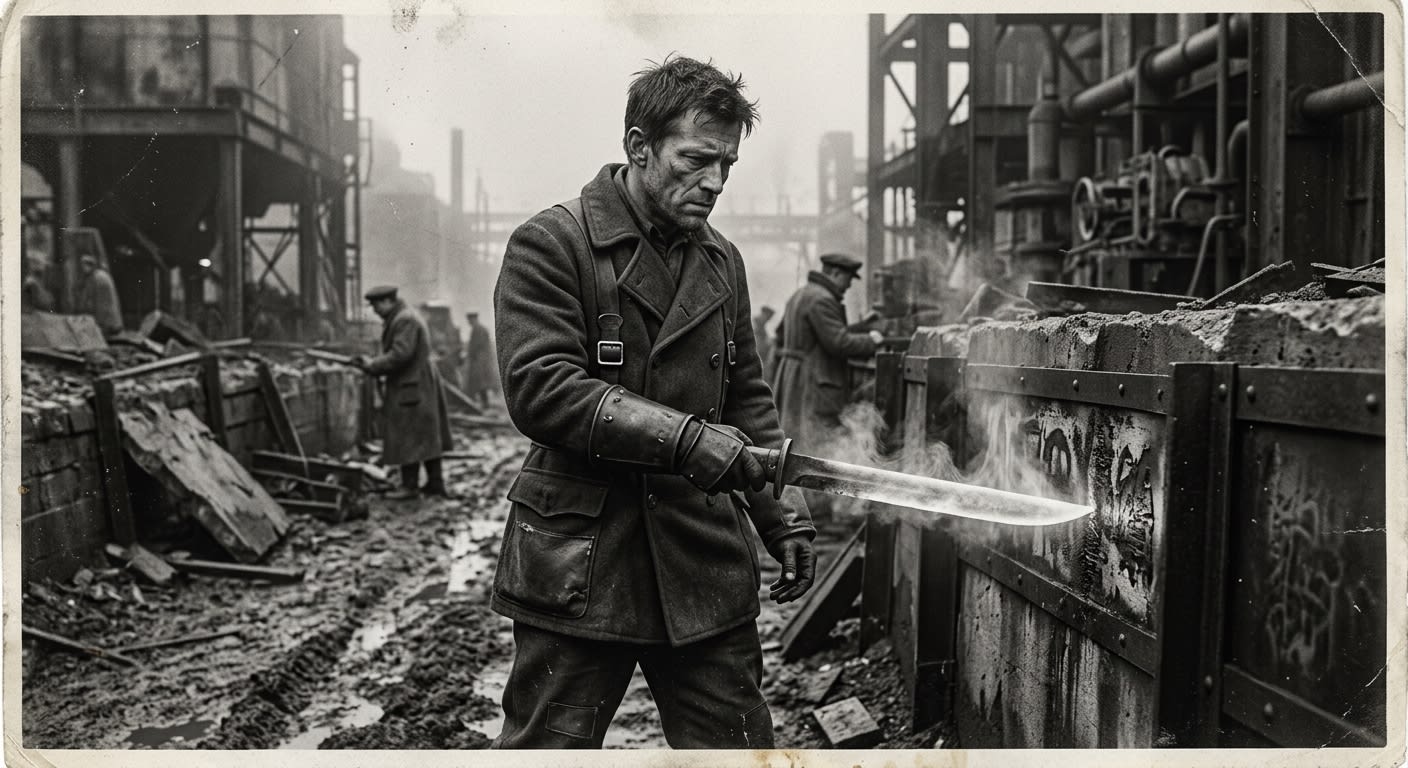
The official ikon shows Verral in a grey examiner’s coat that he cannot historically have worn, with a brass eye-badge over his heart, a scraper blade in his right hand, and a bare white wall behind him. The wall is always too white. Painters overdo sanctity when the subject’s virtue consists of removing paint. At his feet lies a curled strip of pigment, black-green in old chapels, yellow in Cologne copies, and the exact colour of fresh bile in the Strasbourg field-manual engraving. The strip is labelled Hostis Extractus in Latin broad enough to shelter ignorance.
His motto is recited before blade issue: A clean field is a quiet field. Inspectors say it with varying degrees of faith. Swatch-Runners mumble it because they are young. Gate Inspectors say it because a crowd is listening. Chromarchs say it softly, which is worse.
#On His Doubtful Life
The Bureau has not supplied a birthplace for Verral. This is charitable. Birthplaces become shrines, shrines become disputes, disputes become municipal petitions, and municipal petitions breed invoices like wet grain breeds weevils. Cologne claims him. Worms claims him. Essen-of-Hymnsteel claims his scraper handle, a relic whose provenance is so thin it could pass through a keyhole without touching the teeth.
The earliest stable account places Verral in the confused decades after the Sundering, attached to a convoy-sigil office that predated the Bureau of Heraldry by more than half a century. This is awkward, since the Inspectorate was not constituted until A.S. 110. The Bureau solves the awkwardness with a doctrine of anticipatory vocation: some saints serve professions before the professions become wise enough to exist. I admire this doctrine. It is magnificently convenient.
Verral’s lay name is absent. His rank is disputed. A Strasbourg copyist of A.S. 121 calls him Chromarch, which he could not have been if the title did not yet exist; a Mainz folio calls him wall-brother; a Cologne tavern song calls him Old Clean-Hand, which sounds true because it has the insolence of the street. The clean hand matters. Inspectors scrub pigment from their fingers until the skin stings. Verral’s hand, in every depiction, is unstained.
Earlier Inspectorate catechisms identified Verral as “First Chromarch of the A.S. 110 founding cohort.”
Corrected in internal training sheets. He is patron of the founding cohort, not a confirmed member of it. The street may continue calling him First Chromarch, since the street also calls Inspectors Paint-Lickers and cannot be expected to maintain filing discipline between insults.
#On the Clean Field Miracle
The miracle is brief, which speaks in its favour. Inflated miracles arrive wearing too many witnesses.
A wall had been painted in a forward market town after dusk. The town is unnamed in the oldest copy. Later versions place it at Cologne, then Essen, then a bastion gate whose geography is impossible and whose chapel conveniently sells Verral candles. The sign itself is described as a beast, a crest, a child’s horse, a six-legged wolf, an eye without a lid, a black boar, or “a colour shaped like hunger.” The contradiction has troubled theologians and delighted Inspectors, because their whole profession rests upon the proposition that a mark need not agree with itself to cause damage.
The people stared. That is the first danger. They gathered. That is the second. They began repeating a name no one had written. That is the third, and by then a prudent man would have run for Relics, Purity, or a shovel.
Verral heated his scraper in a brazier until the blade took a dull red edge. He ordered the crowd back. They did not move. He scraped once across the painted line. The paint curled from the wall like skin from scalded milk. Something screamed behind the plaster. Verral scraped again. The beast, glyph, colour, or whatever cowardice had chosen to wear that evening pulled itself out of the pigment in strips, and Verral kept scraping until the wall was bare.
CLEAN FIELD ACCOUNT — OLDEST SURVIVING COPY, DAMAGED “...and in the third scrape the painted thing came away entire, though it had no back by which to come, and the blade took from the wall a mouth, a hoof, an oath, and █████████. Verral did not look at the crowd. He set the curls in the brazier. The smoke spoke with the voices of six absent children.”
The field was “clean” by dawn. Whether the word referred to a market wall, a parade ground, a muster field, or the visual field of the faithful has never been settled. The Bureau prefers abundance of meaning when settlement would reduce usefulness.
#On Canonisation Without Comfort
Verral did not enter the calendars as a tender intercessor. He entered as a tool with a halo.
After the Beast Proscription of A.S. 108 and the constitution of the Inspectorate in A.S. 110, the first forty-three examiners required a patron who justified unpleasant work. Saint Verral supplied the image: the solitary examiner, the hostile crowd, the dangerous mark, the heated blade, the clean surface. A profession that would be called Flag Rats before its first decade ended received, through him, a story in which scraping saved souls. Men can endure being hated if they believe the hatred proves accuracy.
His canonisation file is no canonisation file in the ordinary sense. It contains no luxuriant vita, no noble childhood, no approved martyrdom, no relic inventory worth a merchant’s sigh. It contains copies of the Clean Field account, three dispute notes, two contradictory hymns, a page of blade-heating instructions, and a memorandum from Heraldry advising that the Inspectorate “requires devotional consolidation before field deployment.” Doctrine ratified the cult. I was not on that committee, which deprived history of several improvements.
The saint’s feast is observed by blade-cleaning, swatch verification, badge-touch, and the scraping of a practice wall. Apprentices paint authorised animal forms badly so senior Inspectors may remove them while lecturing. The exercise is called humility. It teaches contempt at speed.
#On His Instruments
Verral’s iconography is practical enough to irritate aesthetes. He has no lilies, no open book, no docile lamb, no golden wound arranged for devotional tenderness. He has a scraper blade, a brazier, a blank wall, and occasionally an eye-lantern with true-glass, though that device belongs to later Inspectorate practice and its inclusion in older scenes is an error the Bureau tolerates because it sells the lesson.
The blade is six inches in most authorised depictions. Brass handle. Flat steel. Edge heated. Every Inspector receives one upon full commission as a “Verraline implement” rather than a relic-copy; Heraldry dislikes that phrase. The distinction means the Bureau avoids relic taxes while enjoying relic behaviour.
The Clean Field itself is represented as blankness. This is harder than it sounds. A blank wall in art invites decoration, and decoration invites Heraldry, and Heraldry brings forms. The authorised Verral field must be white, matte, uncracked, unshaded except where the saint’s body casts lawful shadow. One provincial painter added a small flower at the base of the wall in A.S. 172. The painting was corrected. The flower was scraped. The painter found other employment in funeral borders, where his appetite for ornament could do less harm.
A Cologne chapel guide described Verral’s blade as “the Sword of Pure Sight.”
Withdrawn. It is a scraper. Calling every useful piece of metal a sword is how boys write epics and quartermasters lose inventories.
#On the Inspectorate’s Use of Him
The Sigil Inspector invokes Verral at three moments: before scraping in public, before entering a Class Seven Visual Anomaly cordon, and after accepting a bribe he intends to call discretion. The third usage is unofficial and widespread, which gives it the smell of genuine religion.
His prayer is short. Saint Verral, keep the field clean; keep the blade true; keep the crowd behind me. Some versions add and let the paint stay dead. This line is common in Bastion-Sibiu, where moving lines and singing paint have made piety less decorative. In Bastion-Brest, gate Inspectors add let the wagon-master sweat first. I have heard worse prayers answered.
Verral is also the saint of professional suspicion. His cult teaches that the harmless mark is the most dangerous mark, because it has not yet had the courtesy to declare itself. A child’s chalk beast, a grandmother’s old crest, a tavern sign, a funeral ribbon, a troop patch half a shade wrong at dusk: each can be decoration, recruitment, counterfeit, nostalgia, fever, demon seepage, or the first syllable of riot. Verral’s virtue is not certainty. His virtue is scraping before certainty becomes epitaph.
#On the Present Cult
As of A.S. 201, Verral is strongest in the Inspectorate houses of Cologne, Essen-of-Hymnsteel, Strasbourg, Bastion-Przemyśl, and Bastion-Sibiu. His small shrines stand near swatch lockers and blade racks rather than in public chapels. Inspectors leave solvent-stained cloth, snapped scraper edges, brass badge pins, bits of confiscated stencil, and little folded citations whose fines were paid without riot. These are humble offerings by institutional standards. I prefer them. Grand offerings usually conceal theft.
Children fear him. Dyers curse him. Guild painters petition him with the desperate piety of men whose livelihoods depend on not being noticed. Street artists draw his blank wall with a tiny crack in it, a joke too small to prosecute until it appears in seven districts at once.
Casselius of Mainz keeps Verral’s ikon in his private inspection room: a severe copy, no gilding, blade edge rendered with unpleasant care. Casselius is said to pray before it. I doubt this. Casselius does not pray to saints. He consults precedents.
The Bureau has never adjudicated whether Verral scraped out a demon, exposed a fraud, halted a riot, or supplied the Inspectorate with the best founding lie in Heraldry’s possession. The distinction has been filed as subordinate. The wall was cleaned. The crowd dispersed. The blade entered the manuals.