
#On the Decree That Put the Zoo on Trial
The Beast Proscription of A.S. 108 was the moment the Bureau of Heraldry looked upon the old animal crests of Europe — lion, eagle, stag, wolf, serpent, bear, boar — and found them guilty of remembering a world insufficiently owned by Strasbourg.
This was, naturally, described as safety.
Animals had lived on banners for centuries before the Sundering: gold lions on ducal shields, black eagles on guild charters, stags in chapel glass, serpents on physician signs, wolves on militia standards, bears on tavern beams, boars wherever men wished to advertise courage without acquiring any. The Synod inherited this zoological vanity after the Concordat and tolerated it with the exhausted indulgence of a parent allowing a child to keep a filthy toy because burning the nursery would take time.
The error lay in assuming that old symbols grow weak. They do not. Old symbols wait for frightened men to need them again.
#On the Crimson Gate Riot
The Proscription's immediate father was the Crimson Gate Riot of A.S. 106 at Essen-of-Hymnsteel, where a supply convoy arrived under wagon-banners stamped with the crimson boar of the old Saxon supply guild. The guild itself had been defunct since A.S. 30, which is to say it was dead in the way a buried knife is dead: unavailable until someone digs.
A quartermaster revived the boar from family papers and old convoy rolls. He claimed tradition. Tradition, in bureaucratic terms, is unauthorised memory with better handwriting. The rear garrison, already raw from reports of Maldrake's advance through Thrace, saw the crimson beast on the wagons and concluded that the old Saxon dynasty had returned, or that a demonic power had put on its skin, or that the Bureau had lied about one more thing and this one had tusks.
Eighty-seven people died in four hours. Wagons burned. Flour scattered through blood-mud. Two oxen were bayoneted because their yokes bore the same mark as the banners. The quartermaster survived, which proves that Providence occasionally mislays its hammer.
The Bureau of Heraldry received the after-action reports, read the casualty lists, examined the offending banner, and arrived at the conclusion that the boar had killed eighty-seven citizens. A vulgar mind might blame fear, rumour, military nerves, poor command discipline, or the quartermaster. Heraldry blamed the picture. Heraldry was correct in the way only a Bureau can be correct: narrowly, savagely, and with forms ready.
#On the Classes of Beasts
The decree of A.S. 108 did not ban all beasts. The Bureau is barbarous, not crude. It sorted the animal kingdom into moral filing drawers and shoved Europe through them.
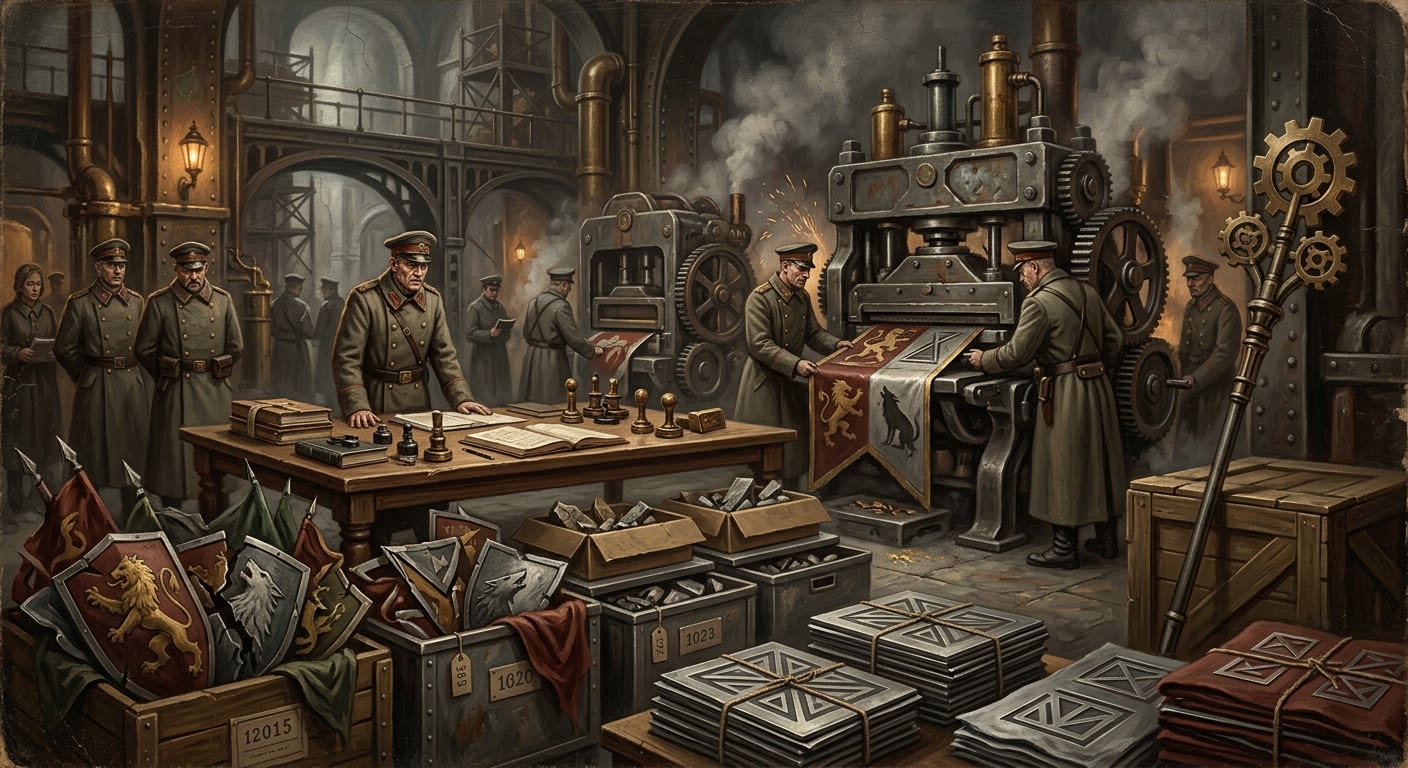
Lions, eagles, and stags were permitted in stylised canonical form: geometric, angular, emptied of fur, feather, eye, appetite, and any remaining resemblance to creatures that might bite without a writ. The lion became a square-jawed diagram. The eagle became a set of approved chevrons with wings implied by clerical mercy. The stag survived as a rack of triangles over a neck so stiff it could have been drafted by Theobald of Worms during a fever.
Wolves and serpents were banned outright. Wolves carried too much pack-memory; serpents too much temptation, coin, medicine, old guild learning, and every other subject that makes Purity's eyelid twitch. Bears were suspended pending review. That review has lasted ninety-three years. The bear, in the Synod's mercy, has been left to die standing in committee.
The crimson boar of Saxony received the decree's central damnation: “an emblem of wrath, a heraldic heresy, and a provocation against the Faithful.” It was the first formal use of heraldic heresy. Men had gone to the scaffold for words, for books, for songs, for bread leavened without prayer. Now a painted animal joined them.
Several provincial summaries state that the Beast Proscription abolished all animal devices from faithful display.
Corrected. Some beasts were killed. Some were shaved into geometry. Some were placed under review, which is how the Bureau buries without dirt.
#On Enforcement by Scraper and Shame
A decree does not enter the world until a hated functionary carries it there. In A.S. 110, the Bureau constituted the Inspectorate of Visual Compliance: forty-three licensed Heraldic Examiners drawn from heraldic clerks and discharged Purity field agents, equipped with the first Codex of Permitted Symbols, swatch sets, citation tags, and scraper blades hot enough to make paint confess.
They went first to Worms, Cologne, and Augsburg. Guild halls lost their lions within the season. Eagles came down from counting-houses. Stags were reduced to permissible angles. Serpents were gouged out of apothecary lintels while physicians watched their professional ancestry fall in curls of painted wood. The old surfaces of Europe were made obedient by abrasion.
The public resisted with the sullen genius of the governed. Beasts migrated into bread scoring, sleeve stitching, tavern foam, children's chalk, grave scratches, candle soot, and the private undersides of door beams where only widows, lovers, thieves, and Gate-Carvers would see them. Heraldry responded with a theory of surfaces: anything visible was display; anything hidden was intent; intent, once discovered, had always been visible to the Creator and could be fined retroactively by His clerks.
VISUAL COMPLIANCE FIELD NOTE, COLOGNE, A.S. 111: child drew six-legged horse on tenement wall; mother attempted removal with sleeve; pigment persisted through limewash; eye-lantern test produced █████████ fluorescence; wall requisitioned; child disposition █████████████.
#On the Sigil Reform of A.S. 158
The Proscription hardened with age, as decrees do when no one has courage enough to repeal them. In A.S. 158, under the Sigil Reform, Heraldry extended the animal ban into threshold decoration. This made the Gate-Carvers executioners of family memory.
Old boars, wolves, serpents, and eagles were to be removed from every door, lintel, shutter, warehouse arch, grave-slab, and family crest-stone. Six months. No deferments for age, lineage, municipal affection, wartime service, sentimental attachment, or the familiar legal category known in my office as Grandmother Wept Upon It. The Armorial had spoken. Wood and stone would obey.
In Cologne, a man attacked a Knotwright with a hammer for removing the stag from his grandfather's door. In Metz, a widow burned her own lintel rather than watch a serpent gouged from it. Inspectors filed both incidents as resistance to administrative improvement. That phrase should hang in a reliquary made of teeth.
Earlier Gate-Carver memoranda classify the A.S. 158 removals as “voluntary crest modernisation.”
Withdrawn for internal accuracy. The modernisation was voluntary in the sense that the citizen could choose whether the scraper entered before or after the citation.
The Reform gave the True Knot purists new sanctity and the Fast Hands new quotas. A door stripped of beast and marked with Knot became the Synod's favourite object: a conquered surface pretending to have always been clean.
#On What the Beasts Became
The beasts did not disappear. A thing forbidden from banners enters muscle, joke, lullaby, market code. The wolf survived in two knocks at a cellar door. The serpent survived in apothecaries' private ledgers, drawn so small it looked like a flourish until one knew where to squint. The eagle survived in military posture, elbows out, shoulders high, a salute that was never taught and kept appearing in recruit yards. The boar survived wherever hungry men lowered their heads and pushed.
This is the failure of Heraldry and its triumph. The Proscription proved that symbols were weapons. It also proved that confiscating a weapon teaches everyone where the armoury is.
As of A.S. 201, the Beast Proscription remains in force. Lions remain embarrassed. Eagles remain angular. Stags remain diagrams of lost woodland nobility. Wolves and serpents remain illegal. Bears remain pending, those magnificent saints of procedural limbo. The crimson boar remains a heresy in paint, cloth, brass, bread, chalk, and any child's drawing sufficiently fat in the shoulder.