
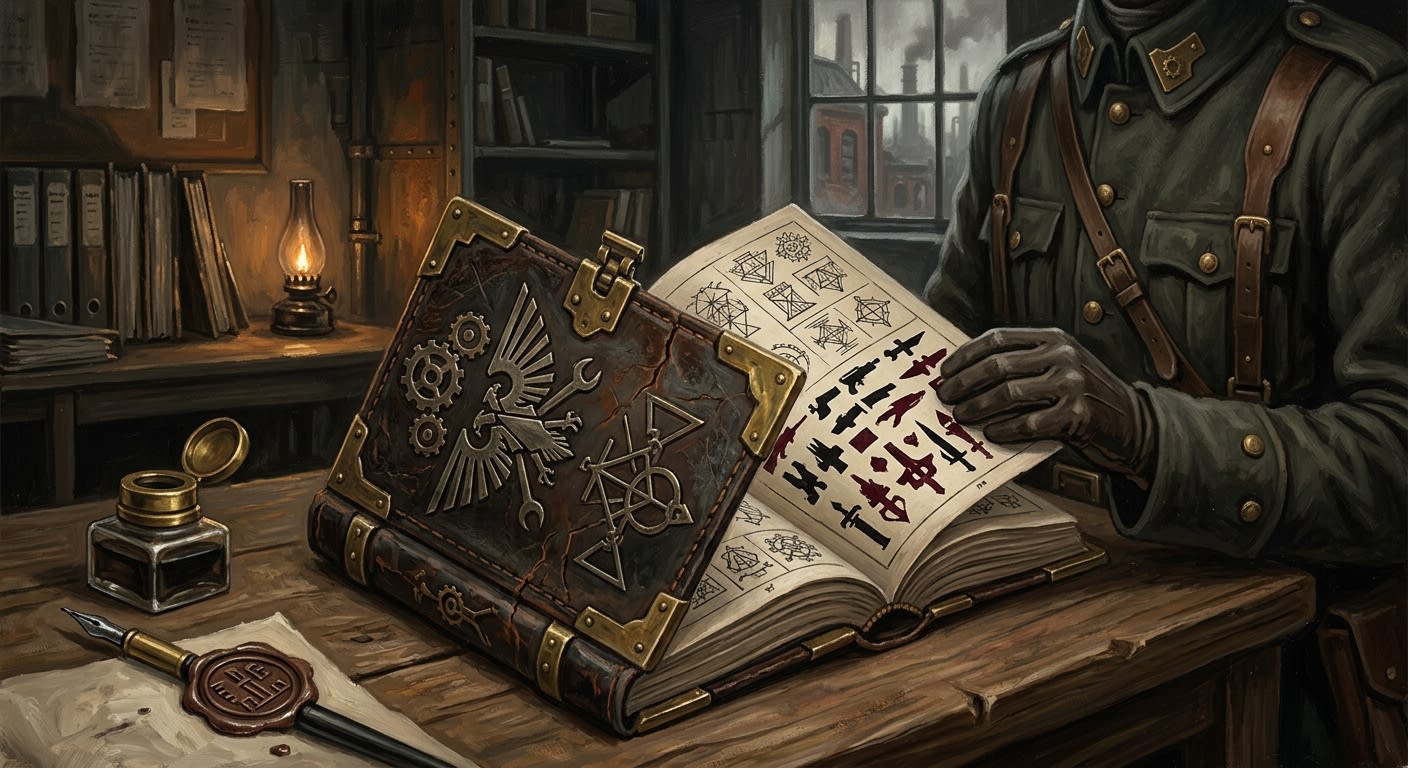
#On the Little Book That Makes Walls Guilty
The eye is a mouth. Feed it only law. — frontispiece, first Inspectorate issue, A.S. 109
The Codex of Permitted Symbols is the pocket scripture of the Inspectorate of Visual Compliance, a stitched field abridgement of the Armorial of the Faithful issued under the authority of the Bureau of Heraldry and carried by every licensed Heraldic Examiner who wishes to survive a gate queue, a guild hearing, a funeral procession, or a child with chalk.
It is small enough for a coat pocket. It is thick enough to stop a thrown stone. Both properties have been tested.
The uninitiated mistake the Codex for a reference book. Touching faith. A reference book helps a reader find what is true. The Codex tells the world what truth may look like without being scraped.
#On Its First Errors
The Codex was born from panic’s tidy widowhood. After the Crimson Gate Riot of A.S. 106 and the Beast Proscription of A.S. 108, the Bureau needed walking law: something a field examiner could open beside a wagon banner and say, with lethal confidence, this curve may live and that one must die.
The first edition, issued to the forty-three founding Examiners in A.S. 110, ran to forty-seven pages. It contained the approved Beast tables, emergency colour ratios, the earliest field diagrams for the Triune Knot, three pages of confiscation formulae, and a prayer to Saint Verral of the Clean Field which most Inspectors recited only when the crowd outnumbered them by more than twenty.
It also contained eleven errors.
A lion belonging to the Worms tanners was printed with one excess angle and became illegal on paper. A Cologne apothecary serpent, already banned, was drawn in the permitted-stag appendix, which made three physicians briefly hopeful and then poorer. An Augsburg dyer’s vermillion sample was cross-listed under sanctioned crimson, a mistake that produced fines, appeals, one branding, and a margin note in my private copy reading: colour has teeth when misnumbered.
Early Inspectorate commemorative sheets describe the first Codex as “flawless in doctrine, imperfect only in provincial application.”
Corrected. The errors were printed in Strasbourg. Provincial application merely supplied victims.
By A.S. 114, the eleven errors had been identified. The fines were not returned. Returned money encourages arithmetic among citizens.
#On Its Pages
The current Codex, ninety-first edition, runs to four hundred and twelve pages, with spring inserts, emergency paste-downs, and the colour appendix issued by the Chancellery of Colors. It is arranged for field cruelty: fast to consult, hard to dispute, expensive to replace.
The first section governs permitted geometry: bends, chevrons, knots, bars, halos, broken circles, relic-circles, punishment triangles, mourning squares, and those small authorised asymmetries by which the Bureau proves it can tolerate disorder once it has priced the licence. The second governs animal forms after the Proscription: lions, eagles, and stags reduced to canonical angles; wolves and serpents marked for seizure; bears left in suspended review, that magnificent clerical bog where large creatures go to drown standing upright.
The third governs civic marks: ferry tags, guild signs, ration badges, orphanage stamps, trench muster patches, funeral cords, market awnings, bell-house plaques, and door devices that may become riots if permitted to grow sentimental. The fourth contains suspect devices: dead houses, half-dead guilds, old dynastic flourishes, folk signs, Index spillover marks, and the crimson boar of Saxony, reproduced smaller than dignity would allow and larger than safety recommends.
The fifth section is newer: Class Seven Visual Anomalies. It instructs the Inspector to seal, step back, send for Relics, and refrain from heroism if the mark moves, sings, blooms, sweats, copies itself, alters its outline after prayer, or makes witnesses remember a name they have never learned. The instruction do not scrape appears in red.
CLASS SEVEN INSERT — COLOGNE FIELD COPY, A.S. 198 If mark reappears after abrasion, do not initiate second scrape without assessor present. If second mark appears on blade, surrender blade. If third mark appears on skin, isolate Inspector. If mark appears inside closed Codex, ███████████████████ and burn folio without opening prayers.
#On the Chancellery’s Little Treacheries
The Chancellery revises the colour appendix with quarterly malice and annual innocence. Sanctioned crimson, tolerated vermillion, penitential black, mourning black, ash-grey, bell-grey, permitted bone, forbidden bone, widows’ blue, Mercy blue, festival yellow, harvest-gold, suspended burgundy: each receives a square, a number, a usage column, a seasonal note, and a penalty schedule. The colour swatch set is evidence. The Codex explains how evidence becomes punishment.
Rain deforms pages. Sweat stains page edges. Candle smoke darkens margins. A field Codex can become obsolete, damp, bloodied, outdated, and still binding. The Bureau calls this continuity of authority. The street calls it being fined by wet paper.
Counterfeit copies circulate constantly. Seal-forgers print abridged tables with softened penalties. Guilds commission permissive inserts. Rebel cells circulate “people’s Codices” in which wolves are restored, knots loosen, and burgundy makes its vulgar little comeback. These books are usually easy to detect. They contain hope.
#On the Inspector’s Hand
A Sigil Inspector reads the Codex with one thumb, one eye, and one hand already near the scraper. The motion is practised until it resembles liturgy: open, compare, measure, cite, scrape. At gates he checks wagon marks against convoy plates. In guild halls he compares ceiling banners with registered devices. In muster yards he matches unit patches to War rolls. In festival squares he keeps one finger in the mask appendix and another in the section on animal fraud, since children and pageant committees possess the same appetite for illegal beasts.
The Codex does not make judgment easy. It makes judgment portable. Ease is for rear clergy and the dead.
A disputed symbol placed before a Heraldic Examiner enters the book’s jurisdiction before the citizen has finished explaining grandmother. Grandmother’s crest may be old. Grandmother may be beloved. Grandmother may have hidden the crest from three Examiners and a Purity sweep, which speaks well of her tactical sense and poorly of her descendants. The page decides whether the crest is memory, evidence, sedition, or fuel.
A.S. 190 civic guidance pamphlets state that family sentiment may be considered during heraldic adjudication.
Withdrawn. Family sentiment may be recorded. Consideration implies weight, and weight belongs to registered symbols, not weeping.
#On Casselius’s Edition
The ninety-first edition bears the dry knife-work of Archon Casselius of Mainz. The margins narrowed. Appeal language shortened. Tolerances tightened by fractions whose pettiness has already filled three tribunals. The doorbell appendix expanded from one paragraph to six pages after the Mainz chime-mark affair, because Casselius hears treason in hardware and has the courtesy to provide tables.
His preface is eleven sentences long. Sentence seven reads: A sign is a claim. Sentence eight reads: A claim requires authority. Sentence nine reads: Authority has a shape. I dislike the man professionally, which is to say I admire him with clenched teeth.
As of A.S. 201, the Codex remains active across the Synod’s territories, from Strasbourg to Bastion-Przemyśl, from Bastion-Brest to Bastion-Sibiu, wherever a surface presumes to speak before Heraldry has licensed its tongue. It will be revised next year. Some citizens will be rendered guilty by the new edition. Some were guilty already and lacked the courtesy to be detectable.