
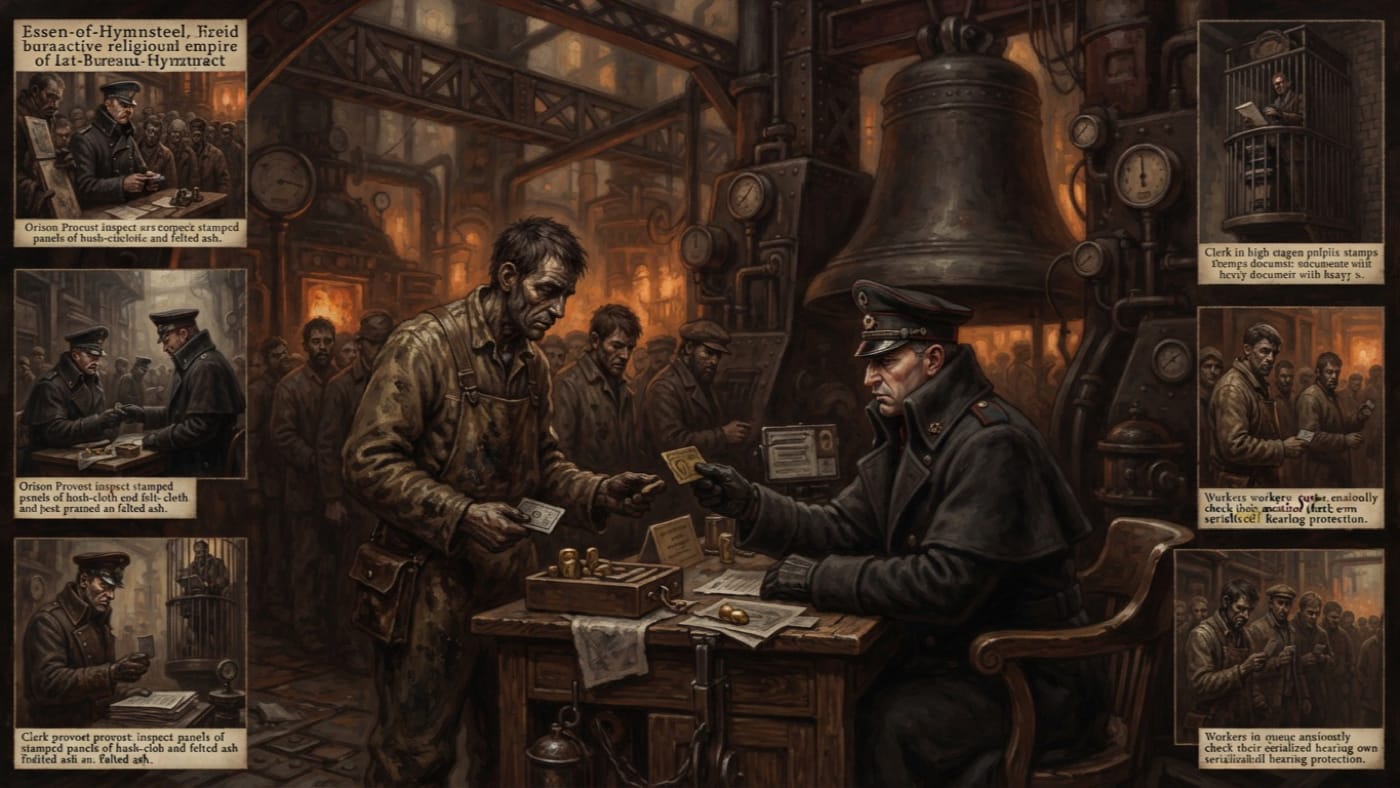
#On the Compact's Acoustic Authority
Essen-of-Hymnsteel lives by the bell. About four hundred and ten thousand people live across a canalized river fork, and they rise, pour, rivet, confess and sleep to a peal schedule set from the Furnace Basilica. Their steel goes out to the Sagittal Line as bell-cannon throats, hymn-drive housings and reliquary fasteners, with a choir's work fixed in the grain. A city that calibrates metal by voice cannot afford to be careless about sound. It has chosen instead to make sound expensive.
Like everything else in Essen, authority over sound is split among the three seats of the Tri-Bureau Compact. The Bureau of Engines and Furnaces owns production, fuel and overtime. The Bureau of Records owns the certificates and identity papers without which no one works or eats. The Bureau of Orison and Song owns the approved stanzas and acoustic discipline. Compact Ordinance 7-C sits in Orison's portfolio, and its costs land on everyone else.
Since no one else in Essen will admit it, I state the limits of the file at once. The Codex holds no enactment record for 7-C. It has no full text, no named drafter and no penalty schedule. What survives is the ordinance in use: one advisory, a set of licensed objects, a market built around them, and a population that knows exactly where it stands under all of it. A law may be studied by its preamble or by its bruises. Essen kept only the bruises.
#On Licensed Silence
The ordinance's working provisions survive in a single advisory from the Bureau of Orison and Song, preserved in the Codex entry for Essen-of-Hymnsteel. I reproduce it as it stands there and claim nothing more for it.
Read it as a clerk would, one word at a time, looking for the words the rest depends on. In the first clause the key word is unauthorized. The ordinance does not forbid silence. Essen keeps sanctioned quiet whenever Orison orders it, just as the wider Church keeps its Fast of Silence when the calendar requires. What the ordinance forbids is quiet that nobody sold you. In the second clause the key word is current. A lapsed seal is no seal at all, so a felted-ash panel that was lawful last season can be contraband this season without one fibre of it changing. In the third clause the key word is unlicensed. An ear-plug is a lump of wax and wadding. A licensed ear-plug is a legal privilege made small enough to fit in the ear.
The objects follow the same rules. Hushwrights, the city's sound-baffle artisans, work in hush-cloth, felted ash and sealed timber. The Guild's seal on that material is the only difference between an installation and an offence. Ear-plugs are stamped and serialized. A resident who holds a Quiet Permit may shut out the peal-bells. A lodger who nails a horse-blanket over the window has achieved the same effect without the paperwork, and has broken the law.
The poor usually go wrong on the question of ownership. A riveter can buy hush-cloth, inherit it or find it in the slag. The riveter owns the cloth but not the right to hang it. 7-C separates the useful object from the permission to use it, and the people who hold the seals rent that permission back at their own price.
#On Inspection and Punishment
The advisory names one route of enforcement: report to the nearest Orison Provost. The provosts do not work alone. Essen's courts and enforcement also include tribunal clerks, furnace-guards and inquisitorial auditors. Patrols check silence the way lock-wardens check tallow, as taxed property found where it should not be. A felted panel without a current seal, a bolt of quiet cloth with no Bureau mark, a pair of unstamped plugs sewn into a coat lining: the city's contraband lists name each of these, and these are what the provost looks for.
The Codex cannot say what follows a breach of 7-C in particular, because no penalty schedule has reached this desk. I will not make one up. Essen's clerks make up enough already.
The punishments around the ordinance are documented, and a careful reader should know them. Essen's punishments include the deafening sentence, which means forced labour in unshielded resonant halls. The Compact uses it as a municipal punishment, but no source makes it the statutory penalty for 7-C. The reader may admire the fitting subject matter without my help. Separately, the Bureau of Records enforces debt through identity throttling. One missed payment turns a work permit to "pending," and in Essen "pending" ends in hunger or the draft. 7-C does not prescribe this either, and it has no need to. A worker caught with an unsealed panel stands in front of a provost, and every other ledger in the city stands behind the provost.
Essen's forbidden things list silence without a permit alongside unapproved songs and outside tuning instruments. The Compact's red lines are a separate list. They cover altered bell schedules, unapproved stanzas and forged Saint-Metal marks, and those are prosecuted as sacrilege and sabotage. Unlicensed silence sits one rung below them in seriousness. It is the more profitable offence.
#On the Price of Quiet
Follow a square of felted ash from the Guild carpenters to the wall it ends up on. The Hushwright Guild sells sound-baffles "for safety." In the Quiet Gradient and certain chapels it controls the installations, the permits and the maintenance. The record lists its methods as contracts, blackmail and clandestine installation. I have read that last phrase many times, and I still enjoy finding it attached to a guild whose real product is privacy from witnesses.
Where the panels go, the air changes. Quiet Gradient residences are lined with felted ash and sealed timber, and they smell of lavender soap and clean wood. Lower in the city the smell is furnace oil, soot, wet rope and boiled throat-herbs. The sealed elite keep quiet homes and safer shifts. Certified artisans can scrape together enough for a quiet room. The parent entry records that a room in the Quiet Gradient costs more than a lockhand earns in a year. I let the comparison stand, because no lockhand would dispute it.
In the Ash Warrens, families rent warm floor-space beside the industrial ducts and pay in labour-hours. They trade their hearing for heat. Up in the Gradient the felt turns the bells into a gentle summons. In the Warrens the same bells come up through the floor. In the Foundry Core, stokers and riveters work under the pour-chants where licensed protection is the exception. Damaged ears are common below, and stamped plugs are displayed above. Each one marks a person's station, but only the plugs came with a licence.
Where the Guild will not sell, the ducts will. The hush markets in the tunnels beneath the Shard Markets trade counterfeit seals, illicit hush-cloth and "false quiet" rooms. The Records clerks of Ledger Row know all about it. The Guild lists the Markets among its enemies, and that list is the most honest commercial statement in Essen.
#On the Present Application
Essen is speeding up. A procurement mandate from Strasbourg demands more output for hymn-driven siege engines. Engines threatens to conscript from the Warrens. Orison refuses to quicken the calibration tempo without guarantees of liturgical stability. Records profits from the quarrel. Longer pours mean longer shifts, and longer shifts mean more of the city spends more hours in noise it cannot afford to escape. Demand for quiet rises with the tempo, and so does the value of every seal the Guild holds.
7-C was written for silence that can be sold, the kind that comes with a seal, a serial number and an inspector. Essen has another kind. After a Resonance Bloom, a district can fall silent for days. Voices do not carry, footsteps make no noise, and the walls swallow every vibration. Essen calls both the hushwright's baffled street and the Bloom's dead district a "Silent Zone." They are different things. The first is reduction under licence. The second happens to people against their will, has no explanation, and so far no provost has found a permit that applies to it.
The Compact officially blames sabotage. The Codex has already had to correct that account once.
The Codex entry for Essen-of-Hymnsteel attributed all Resonance Bloom events to the Mirror Choir heresy, per Compact Report 447-E (A.S. 198).
Inherited correction, carried forward as the Codex recorded it: a later Bureau of Rites investigation established that Resonance Bloom activity predates the earliest documented operations of the Mirror Choir by approximately forty years. The source remains unidentified.
The advisory tells the citizen to report unauthorized silence to the nearest Orison Provost. It does not say whom to notify when the silence belongs to nobody, carries no seal, and comes up through the floor of a district no hushwright has ever lined. I file Compact Ordinance 7-C as operative and current, and as enforced wherever the city can enforce it.