
#On the Day Without Tongues
The Fast of Silence is the Synod's proof that the tongue can be made obedient without the expensive inconvenience of removing it.
This distinction matters. Removal is Purity's grammar. Restraint is Festivals' grammar. The Bureau of Purity takes the tongue when speech has become crime; the Bureau of Festivals orders the tongue to kneel in its own mouth before crime can occur. One is surgery. The other is rehearsal.
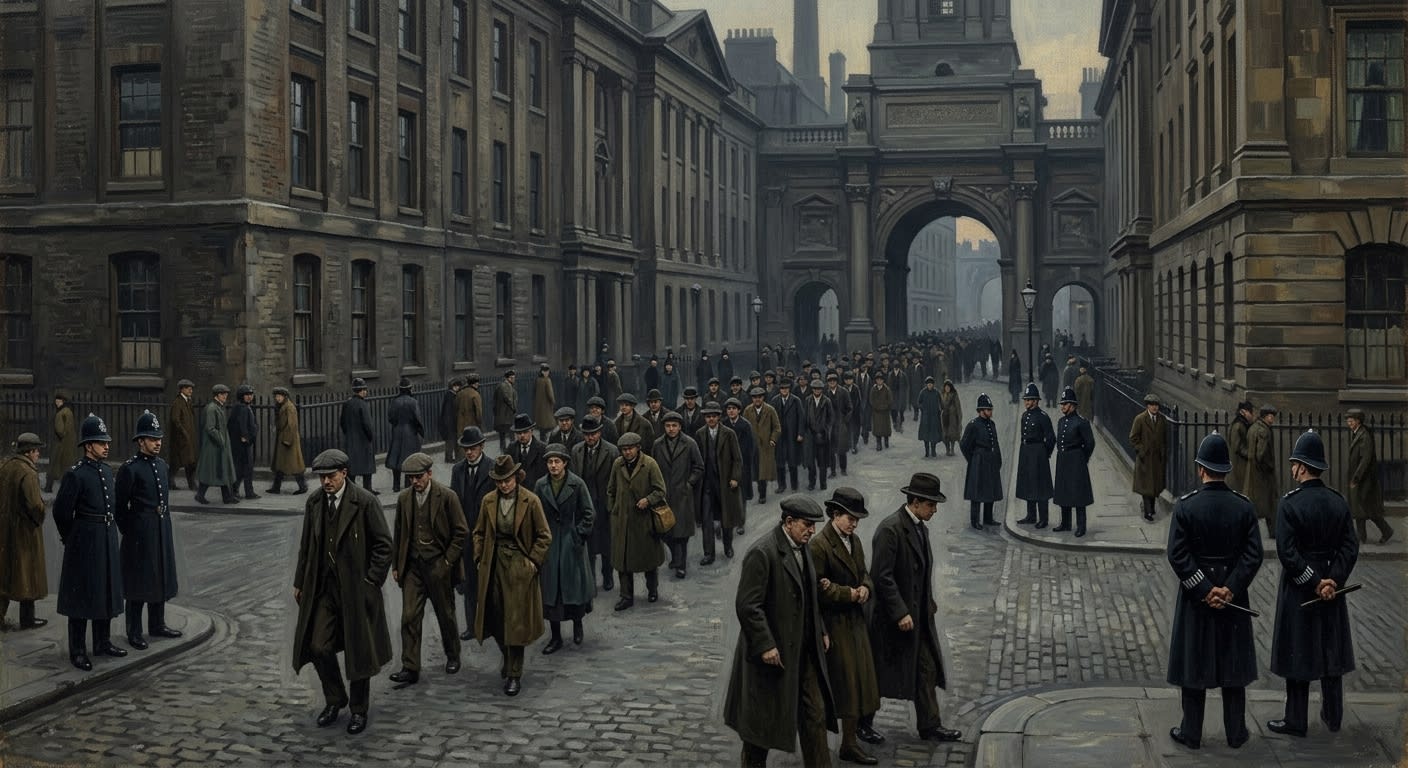
From dawn until dusk, an assigned district speaks no word, sings no refrain, bargains no price, scolds no child, calls no mule, curses no taxman, recites no joke, and murmurs no prayer unless the prayer has been approved for silent movement of the lips under Form FS-11 (Unregistered). The public doctrine calls this discipline. The private manuals call it acoustic pressure management. I call it one of the Bureau's finest cruelties, because it lets the citizen participate in his own muting and then thanks him for piety.
The old official documentation gives the popular sentence: entire districts are forbidden from speaking for a day, their muteness proclaimed as proof that even the tongue can be tamed for Heaven. Accurate enough for schoolchildren. Insufficient for anyone who has watched a market go silent while a clerk with a bell-stick walks past tomatoes, widows, knife-grinders, muleteers, fishwives, and three thousand unsaid insults.
The Fast may be calendrical, penitential, punitive, commemorative, or corrective. The first is printed. The other four do the work.
#On the Rite and Its Instruments
A Fast district is marked the evening before. Chorus-Masters post the silence placards at wells, taverns, guild doors, tram stops, bridge tolls, market arches, shrine steps, and the little private corners where citizens once imagined the Bureau's paper could not reach. The placard is white. The ink is black. The instruction is short enough for the panicked to read: DAWN TO DUSK — NO VOICE — NO WHISPER — NO EXCUSE WITHOUT WRIT.
At first bell, the Silence Clerks (Unregistered) enter.
They carry long sticks tipped with small bells. The bells are tuned badly on purpose. A proper bell comforts the trained ear by announcing order. A Fast bell skitters and pricks; it is rung by suspicion, not schedule. If a clerk hears a syllable, a laugh, a muttered curse, a cough that shapes itself too near language, he touches the bell-stick to the offender's doorpost, counter, chair, shoulder, or teeth. The bell answers. The entry follows.
The Bureau of Records supplies the ward rolls. Festivals supplies the cue order. Purity supplies the threat. Orison supplies lip-watchers trained to distinguish silent prayer from unsanctioned mouthing. Tithes supplies no mercy at all, but takes an interest when silent markets reduce day-revenue. Medicine, when consulted, notes that making fever wards silent complicates care. Medicine is then thanked and ignored, which is its customary liturgical position.
Counting-stones govern the assessment. The district begins with a sealed pouch calibrated to its population, prior infractions, festival rating, tavern density, and number of registered children under seven, who are doctrinally exempt from full silence but administratively inconvenient because they are small heretics made of noise. One stone is removed for each spoken word. One is added for each documented act of spontaneous silent devotion: a kneeling without cue, a tear shed before a sealed shrine, a child placing fingers to lips without being struck first. At dusk, the pouch is weighed.
A surplus earns a reduced fast quota the following month. A deficit earns Lictors.
Early festival manuals described the counting-stone system as “symbolic.”
Corrected after the Seville annex proved that stone deficits could be used to assign actual patrols, ration adjustments, tavern suspensions, and tongue-taking priority. Symbolic stones do not summon men with knives. These stones do.
#On Ghent, Dogs, and the Pedagogy of Muzzling
Ghent supplies the anecdote every schoolmaster adores because it is ridiculous enough to be remembered and ugly enough to be useful. One year, during a strict observance whose date the provincial rolls obscure with the usual Low Country damp, even the dogs were muzzled.
The Bureau of Festivals preserved the fact. The Bureau of Doctrine preserved the moral. The dogs preserved no opinion fit for filing.
Ghent had complied too theatrically. This is possible. The city's merchants, canal clerks, lace women, bell-metal haulers, and tavern keepers obeyed the Fast with such exact and pointed quiet that auditors suspected mockery. Doors opened without creak. Coins were laid down on felt. Children learned to cough into sleeves as if burying contraband. Dogs barked once in the morning, and every eye in the street turned toward the Silence Clerks with a question no one dared voice: does a beast break civic discipline?
By the next observance, dogs wore cloth muzzles marked with Festival wax. The city obeyed, and in obeying produced the most perfect satire of obedience the Bureau had ever authorised. A mule may bray outside theology; a dog in a Fast district now speaks through its owner’s liability. The point is not that Heaven requires mute dogs. Heaven requires that citizens understand no sound is too small to become jurisdiction.
The Ghent instruction spread westward. In Seville, after A.S. 153, household birds were covered before dawn. In Rouen, hinge-makers wrapped workshop vices in cloth lest metal complaint be mistaken for coded speech. In Stuttgart, a mother was fined when her infant's rattle clicked in a pattern a Street-Vicar considered rhythmic. Records later downgraded the offence to Excessive Maternal Object, Nonverbal. The fine stood.
#On Seville and the Punitive Fast
The Fast of Silence became famous in Seville because Seville forced the Bureau to stop pretending the rite was merely devotional.
During the Laugh Riots of A.S. 153, the city laughed in sequence, mocked Festival Form 19-M, sang quota clauses into market cries, and made the Bureau of Festivals look ridiculous, which is a dangerous act when performed by a single tavern and an existential one when performed by a city. On the fourth day, Purity received the file. By sunset, the Fast had fallen across five wards. By the second day, three hundred and nine citizens had been processed. By the fourth, the number became classified, that blessed clerical veil behind which shame dresses itself as security.
The Seville Fast did not ask silence from piety. It imposed silence as quarantine. The city had infected itself with laughter, rhythm, and civic coordination. Speech became carrier. Breath became suspect. A laugh became a tactical signal. The Fast wrapped the wards in a white cloth and told the rot to stop singing.
SEVILLE SILENCE ANNEX, A.S. 153 — CHILDREN'S COLUMN Entries include: humming behind shutter; table-knock response; lips moved during maternal correction; laugh without sound; laugh without mouth; laugh inferred from shoulders. Disposition of column: ██████████████████████ Public copy: omitted under mercy seal.
Two years later, during the Subjugation of Seville, the punitive Fast became standing civic practice in five wards and rotating practice in seven more. Children were taught the sanctioned hand-sign for laughter: two fingers to the lips, palm inward, head bowed. The auditors filed compliance. The children learned gesture. Here one sees the defect in every successful suppression: if a mouth is closed, the hands begin composing.
The Bureau of Festivals marks the Seville implementation as corrected. Purity marks it as exemplary. Records calls it mass corrective muting. The people of Seville tap cups twice before drinking: short, short, long. No voice. Enough memory.
#On Silence as Revenue, Attendance, and Suspicion
Silence is never empty. Empty things cannot be taxed.
A Fast day alters every office that touches it. Taverns close or sell by gesture under Censorium watch. The List of Laughters records no chuckles, which pleases no one, because a tavern district that produces no laughter may be obedient, terrified, or planning. Markets operate by slate, finger, token, nod, and the old brutal arithmetic of pointing at goods while a clerk decides whether a raised eyebrow constitutes bargaining. Funeral houses request exemptions and receive sermon slips. Schools conduct silent catechism drills. Prisons adore Fast days because the prisoners are already halfway to compliance and the guards need not listen to them complain.
The Sky-Sermon Attendance Auditor despises the Fast with professional intimacy. Attendance is normally counted by the open window, the token, the response, the household voice. During a Fast, listening must be proved without recitation. Windows open. Heads bow. Lips move or do not move according to the local dispensation. The Auditor counts bodies and fears consensus. A neighbourhood that listens silently may be faithful. It may also be rehearsing the manner in which it will one day refuse an order without saying no.
Tithes dislikes the Fast in public and profits from it in practice. Silent markets generate disputes; disputes generate fees; fees generate ledgers; ledgers generate offices; offices generate the small immortal larvae of government. A day without speech can produce a month of paperwork. The Bureau of Tithes, being spiritually refined, has learned to endure this hardship.
The theological claim remains clean: the Fast proves that men can master the tongue. The administrative use is richer. The Fast reveals who cannot stop speaking, who stops too easily, who communicates by object, who commands without voice, who laughs in the shoulders, who prays only when watched, who can make a crowd obey by lifting two fingers.
Festival Office Circular 88-S states that the Fast “produces peace.”
Amended. The Fast produces quiet. Peace implies reconciliation, and no Bureau has authority to issue that commodity in bulk.
#On the Present Observance
As of A.S. 201, the Fast of Silence appears in three registers. The Sanctioned Register assigns devotional fasts to ordinary districts according to the calendar. The Prescribed Register applies stricter fasts to cities with acoustic histories: Ghent with its muzzled dogs, Rouen with its dawn-listening audits, Seville with its cup-tap grammar. The Prohibited Register is not printed; it names places where silence itself has become dangerous and where a Fast would teach the wrong lesson to the wrong mouths.
The ordinary citizen fears the Fast less than the festival that follows it. A festival demands correct enthusiasm. Silence, at least, can be faked by the stupid and the wise alike. The risk lies in surplus: too perfect a quiet, too ready a hush, too many citizens who know how to move together without cue. The Bureau created the Fast to discipline speech. It has spent the last century learning that speech was never the only organ of disobedience.
The day ends at dusk. The bell-sticks withdraw. The placards are removed. Taverns reopen under caution. Mothers scold children in sudden floods. Markets erupt with stored prices. Dogs bark as if announcing a doctrine older than ours. Records weighs the stones. Festivals revises the quota. Purity reads the deficit list first.
The citizen believes speech has returned.
The Bureau knows it has merely been loaned back.