
#On the Charter That Put Three Hands on One Throat
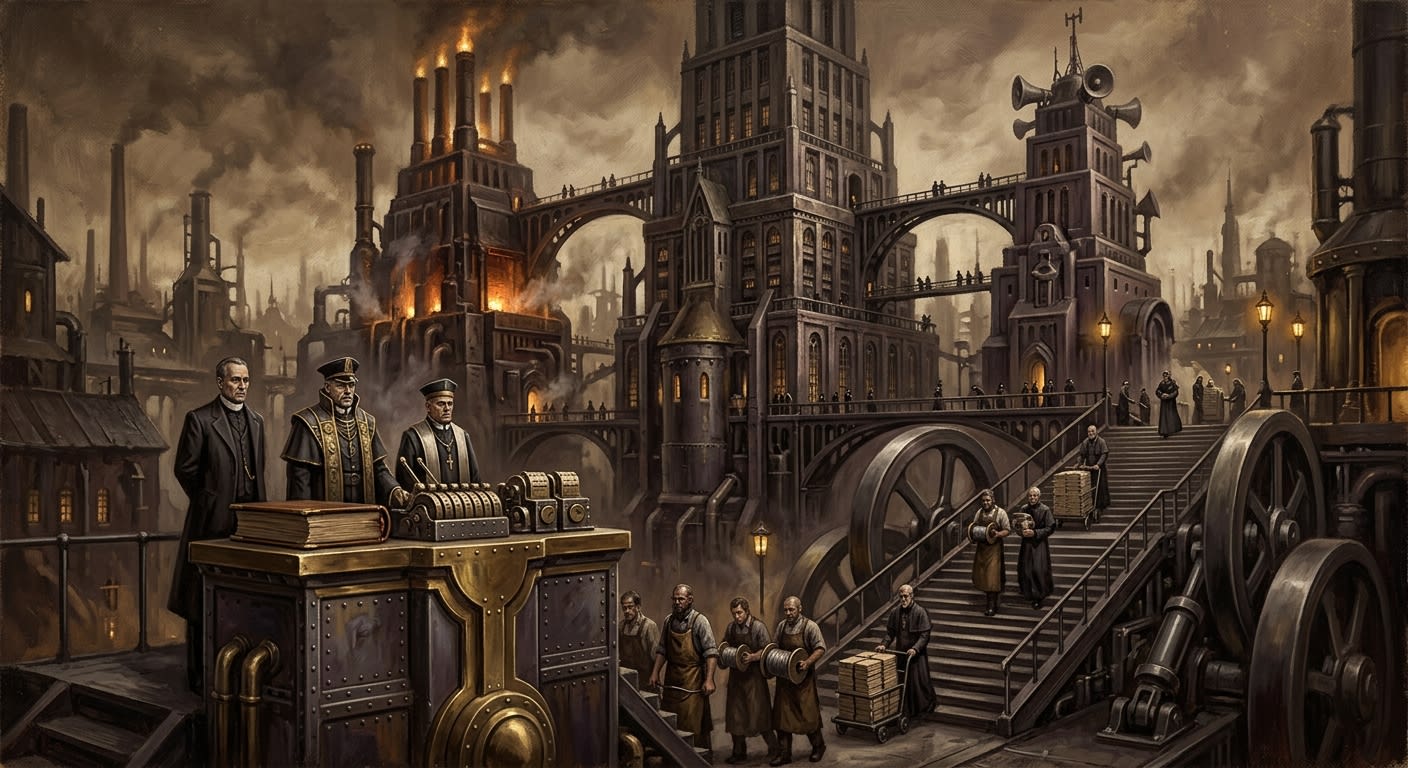
The Tri-Bureau Compact is the A.S. 110 settlement by which Essen-of-Hymnsteel ceased being an industrial city with guilds, debts, accidents, songs, and manners, and became a furnace-jurisdiction governed by three Bureaus whose mutual hatred performs the work of a constitution. It placed the heat under Engines and Furnaces, the name under Records, and the voice under Orison and Song. It did this in the language of coordination, stewardship, safety, output, sanctified metallurgical discipline, and other courtly perfumes poured over a corpse before relatives arrive.
The corpse was guild autonomy. It was already cooling.
Essen had been useful before the Compact. River fork, forge smoke, guild masters, freight gates, old Saxon pride, soot on every saint, enough skill to make steel and enough local memory to make Strasbourg uncomfortable. The A.S. 106 Crimson Gate Riot proved the city could still rally around dead symbols when cloth and fear met at a gate. The A.S. 108 procurement writs proved War wanted hymn-frequency steel in quantities the old charters could not or would not supply. By A.S. 110 the answer stood ready: annul privileges, absorb shops, seize cadence, number every hand.
The Compact’s genius was division. One Bureau might become local king. Two might conspire. Three produce minutes. Three produce appeals, counter-appeals, emergency clarifications, duplicative seals, and that lovely paralysis by which power avoids confessing itself while still crushing what lies beneath. The furnace continued burning. The paperwork acquired vestments.
#On the Conditions That Made It Inevitable
The Compact was born from need wearing a scholar’s cap. The Sagittal Line required bell-cannon throats, hymn-drive housings, reliquary rivets, ward clamps, tuning fixtures, signal braces, and bolts that could sit beside saint-bone without developing metallurgical hysteria. Ordinary steel cracked, softened, sang back, or surrendered to pressure with the moral courage of a provincial bishop asked to cut expenses. Hymnsteel answered because it remembered command.
Command required voice. Voice required custody. Custody required records. Records required fear. Fear, when properly arranged, is administration.
Before the Compact, Essen’s guild forges used work-cants, hammer rhymes, furnace songs, filthy measures, and the kind of inherited craft that offends every office because it works without asking permission. The old masters judged heat by colour, metal by ring, failure by smell, and apprentices by whether they stepped back before the slag spat. Such knowledge could not be taxed in full while it remained inside hands and throats. The Compact externalised it into stations, plates, rosters, seals, pour sequences, and punishable deviations.
Compact commemoratives state that the A.S. 110 settlement “harmonised existing Essen competencies under Synodal supervision.”
Corrected. The settlement confiscated competence, laundered it through seal and stanza, then leased it back to workers under threat of hunger, arrest, silence, or reassignment to a warmer portion of Hell with worse ventilation.
The immediate pretext was production purity. The practical pretext was line supply. The hidden pretext was control of song. Essen’s earliest calibrated pours answered too well. The foundations beneath the city responded during certain old stanzas, and the response frightened men who had expected obedient metal and found an industrial floor with opinions. The Master Hymnal descendants were revised. The fourth line was cut. The Compact gave that cut a legal home.
#On the Three Custodies
The Compact divided Essen by element: heat, paper, breath.
Engines and Furnaces received heat. Furnaces, crucibles, slag fuel, shutter chains, canal coal, overtime quotas, furnace guards, forced labour allotments, and the right to call every body on the floor a component when production arithmetic required moral simplification. The Engine chair’s authority is brutally honest. It asks: how much metal, how quickly, at what cost, and whose skin may be converted into delay reduction?
Records received paper. Names, batch ledgers, work-writs, ration chits, shipment seals, injury receipts, discrepancy cages, Prime Production entries, batch ancestry, death certificates, disputed death certificates, and the delicate category in which a person remains alive but his right to prove it is suspended. In Essen, Records does more than describe existence. Records issues it in renewable form.
Orison and Song received breath. Pour-stanzas, choir rosters, calibration measures, approved silences, bell orders, voice tithe, throat inspections, access to industrial hymn descendants, and the right to declare a wrong note sabotage when convenient and providence when survivable. Orison’s hand is the most elegant and the most intimate. It reaches into the mouth.
The arrangement made tyranny mutually dependent. Engines can heat metal that Orison refuses to sing. Orison can bless stanzas over furnaces gone cold. Records can certify boxes full of nothing and starve men whose hands are needed before dusk. Each Bureau holds the others by a portion of the throat. The city breathes between fingers.
#On Bell Orders and Living by Schedule
The Compact’s most durable invention is the bell order (Unregistered): a production command sounded into civic reality. Decrees sit in offices, fat and proud. Bell orders walk into lungs. A bell order changes shift onset, pour cadence, choir warming, lock admission, ration release, silence permission, confession windows, curfew intervals, and the little private clocks by which tired men know whether they are late enough to be beaten.
In Essen, law rings. The bell sounds and the city rearranges itself around obedience. Furnace crews move. Choir Quarters open. Lockhands admit barges. Records clerks uncap ink. Orison Provosts test mouths. Ash Warrens children learn to sleep in measures because the building itself refuses free time.
The bell order perfected what the Compact required: rule without conversation. Consent wastes heat. Explanation wastes paper. Delay wastes voice. A sounded command leaves no clerk standing in a square while citizens debate whether they heard the decree correctly; those who heard it wrongly provide excellent instructional material.
Early worker primers described bell orders as “audible notices for the convenience of labour.”
Clarified. A bell order is command, timetable, confession, threat, and alibi. Convenience belongs to the office that rings it.
The Compact Council later sat in the Furnace Basilica to issue, contest, and sanctify these orders, but the Compact itself is the deeper law: the root arrangement by which sound becomes governance and governance becomes proof of sound. One cannot appeal a bell while obeying it. The objection period begins after compliance.
#On Hymnsteel as Hostage
The Compact survives because Europe depends upon its product. This is blackmail with a sacramental wrapper, and I admire the workmanship.
Every bastion needs Essen. Königsberg needs clapper collars and bell-cannon parts. Przemyśl sends back cracked throats and demands replacements before Atheron’s next insult reaches firing range. Constantinople needs rivets that tolerate relic proximity while Maldrake and Kargath make philosophy of bombardment and rot. Sibiu needs hymn-drive housings released before the convoy road becomes a sermon in hunger. The Line eats hymnsteel faster than committees can pretend to plan.
This dependence gives the Compact a sanctified insolence. Strasbourg may rebuke Essen. It may audit Essen. It may send clean men with reform portfolios and gloves unacquainted with soot. Those men return wiser, dirtier, and sometimes in agreement with the people they came to discipline. The Compact knows the central truth: if Essen stops singing, the Line stops shooting within a season.
The Compact also produces blame at useful scale. A failed batch travels with ancestry: ore origin, furnace heat, singer roster, stanza plate, cooling trench, witness mark, shipment seal, receiving battery, casualty report. When a bell-cannon throat cracks at the Line, the Compact can find a dead singer, a tired clerk, a miscopied breath mark, a furnace-hand with disputed rations, or an unlicensed cough. Justice thrives when enough small people stand near a large failure.
DISCREPANCY CAGE ABSTRACT — RETURNED THROATS / PRZEMYŚL Batch sequence: 44-R through 44-V. Pours: separate days. Choirs: separate rosters. Crack pattern: identical. Records finding: possible copyist variance. Orison finding: possible Mirror contamination. Engines finding: heat within tolerance. Unentered floor note: same missing line audible before strike-test. Disposition: █████████████████████████████
#On the Wrong Choir and the Lie That Pays Rent
The Wrong Choir is the Compact’s unpaid creditor. It hums beneath the Foundry Core, arrives through teeth and rivets, cracks grain-lines the choirs sang into order, and leaves districts swallowed by silence after Resonance Bloom. It predates the Mirror Choir by decades. This chronology is rude and has been disciplined accordingly.
The Compact prefers sabotage as explanation. Sabotage has suspects. Suspects justify raids. Raids justify the Compact. The Mirror Choir has committed enough crimes to warm every gallows in Essen twice, which makes it a useful culprit even where facts decline to cooperate. Altered stanza sheets, quarter-tones, breath marks, oil-smudges, and chalk variants are real. They pass into batches, cross the Line as obedient metal, and betray men at a distance. The Choir is guilty. Its guilt is too small to cover the floor.
Beneath that guilt lies the cut fourth line of the Master Hymnal descendants, the old forge stanza that allowed sub-foundation articulation during pours. The Compact did not create the buried voice. It gagged it, then built a city on the gag, then expressed surprise when the gag slipped.
The lie is useful to all three chairs. Engines receives guards. Records receives names. Orison receives authority to police every throat. Doctrine receives the pleasure of being feared by people who suspect it already knows the truth. The workers receive posters.
#On the Present Force of the Compact
As of A.S. 201, the Tri-Bureau Compact remains operational under strain, which is to say it still harms efficiently enough to be called necessary. Strasbourg demands accelerated output for hymn-drive siege engines. Sister Rauth (Unregistered) resists tempo increases without liturgical stability. Furnace-Marshal Kord threatens labour sweeps from the Ash Warrens. Arch-Notary Veyl has printed forms for both triumph and catastrophe, matched by seal class, because Records is never caught without stationery for ruin.
Three Blooms in eighteen months have made the city superstitious in public and correct in private. Foremen scatter crews when bench-iron answers early. Orison calls this panic. The foremen live. Purity inspects teeth. Engineering tightens bolts. Records writes certain batch numbers in red under-ink. The Compact Council debates in a room hot enough to make cowardice sweat through its collar.
The Compact endures because no one has invented a cleaner method to make obedient metal at the needed scale. This is the defence offered by every ugly institution that feeds a war: we are necessary; necessity absolves; absolution renews the charter. The argument is false in Heaven and persuasive in procurement.
The Tri-Bureau Compact is the legal shape of Essen’s wound. Heat, paper, breath. Furnace, ledger, throat. Three hands on one city, each squeezing just gently enough that the song continues.