
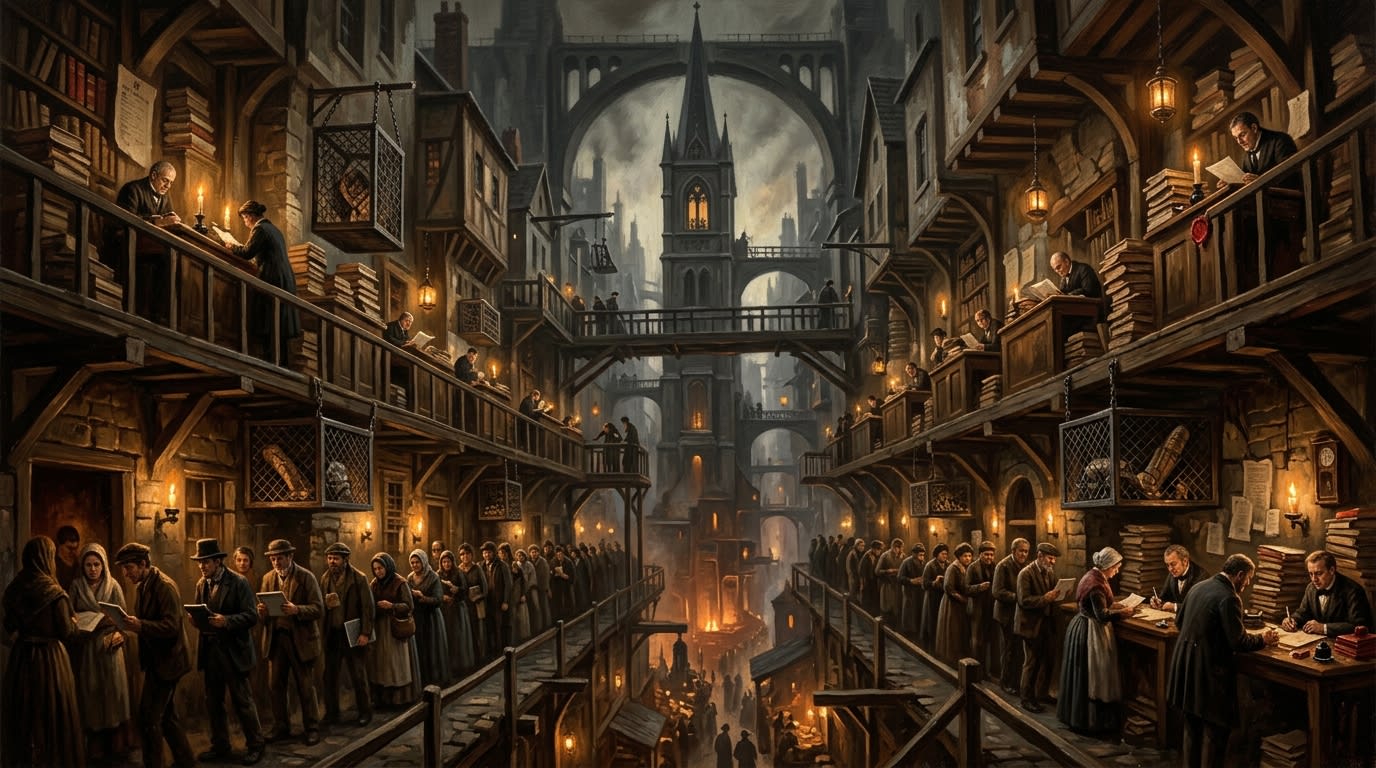
#On the Street Where Existence Is Counted
Ledger Row climbs the northern bank of Essen-of-Hymnsteel, above the Foundry Core's furnace breath and below the Quiet Gradient (Unregistered)'s purchased hush, a district of counting houses, notary halls, ration offices, seal presses, proof cages, correction desks, identity queues, and the Records spire from which Arch-Notary Veyl determines, with a dipped pen and no visible pity, who exists before supper.
The district smells of ink, clove-breath pastilles, hot paper, drying wax, iron filings, and clerks who have not seen the sun except as an audit colour. It is called a row because the first Compact survey drew its offices along one street. The name survived long after the Row became a stack, a hive, a paper cliff, a bureaucracy with rain gutters. Essen does this often: keeps the small word after the thing has grown teeth.
Ledger Row is doctrine in its coldest industrial form. Hymnsteel may be sung in the Hall of Measures, poured in the Foundry Core, riveted into gun throats, and shipped toward the Line, but none of it becomes lawful until Row clerks make the right marks in the right order. A part without a ledger mark is scrap. A worker without a shift mark is trespass. A singer without a throat record is noise. A citizen with a name misspelled by Records becomes a theological rumour, and rumours eat poorly.
#On the Tri-Bureau Compact and the Records Share
The Tri-Bureau Compact gave Essen three masters and called the arrangement governance, proving once again that the Bureaual mind mistakes shared custody for peace. Engines and Furnaces controls heat, coal, crucible, slag, overtime, and the unlovely mechanics of making metal submit. Orison and Song controls pour-stanzas, throat rosters, bell schedules, calibration licences, and the official injury of sound. The Bureau of Records controls sequence.
Sequence is the polite word for dominion. Engines can burn a shift to the bone; Orison can sing steel into obedience; Records decides whether the shift occurred, whether the bone belonged to the named worker, whether the steel batch carries liability, whether the broken throat was made here, whether the dead man's widow receives bread, whether the error is an error or a correction that began in advance. The other Bureaus command the visible instruments. Records commands the afterlife of action.
By A.S. 115, when the Foundry Core had consumed the old artisan quarter, Ledger Row had already become the city's second furnace. It took in guild names, parish rolls, rent marks, condemned-labour lists, old forge contracts, coal manifests, throat rosters, accident claims, and the personal histories of men who had believed, with touching provincial stupidity, that a life was something lived rather than filed. By A.S. 118, when Essen became Essen-of-Hymnsteel, the Row converted the decree into a thousand practical humiliations: old-name penalties, reissued seals, renamed districts, corrected trade signs, revised burial headings, and fines for memory left in ink.
Early Compact primers described Ledger Row as “the administrative support quarter of Essen-of-Hymnsteel.”
Corrected. A support quarter does not pause rations, void work permits, reverse accident liability, rename the dead, and make an entire forge-city queue before dawn. Ledger Row is one of the Compact's three hands. It simply prefers to strike with paper.
#On Names, Chits, and Administrative Pause
The Row's most famous cruelty is administrative pause (Unregistered). The phrase sounds merciful because it was designed by persons who deserve to choke on its syllables. A worker under pause does not cease to exist in the philosophical sense. Philosophy is cheap and cannot buy soup. The worker's permit becomes pending; ration chit under review; dormitory berth suspended; injury claim unreceipted; wage ledger held; family allotment delayed; burial status, if relevant, reserved for clarification. The body remains. The legal person goes out like a lamp pinched by careful fingers.
Arch-Notary Veyl has refined pause into an art. A misspelled name may pause a man. So may a smudged thumbprint, a throat-register mismatch, an old parish mark, a duplicated shift number, an overclean work slate, or the misfortune of sharing a surname with someone Records currently wishes to frighten. Appeals exist. Appeals cost paper, witness time, and the kind of literacy the Ash Warrens ration like meat.
The queues begin before Ninefold Matins finishes its descent. Men with burned hands clutch slates in cloth. Choir girls hold throat cards under their tongues so sweat cannot blur the ink. Widows carry death slips and rehearse grief in a tone clerks find legible. Condemned labourers stand apart because their documents are colour-coded for the convenience of contempt. A Row clerk calls a name. If the name is yours, you step forward. If the name is almost yours, you step forward faster.
#On Pour Records and the Discrepancy Cage
Every hymnsteel batch receives a life at Ledger Row. Its ore source, coal weight, bone-lime measure, crucible number, choir assignment, stanza plate, bell interval, pour temperature, cooling lane, inspector hand, rivet test, stress note, destination, cargo seal, and liability chain enter the batch folio before the metal leaves the city. The folio is then copied, countersigned, summarized, cross-indexed, and bound to a shipment ledger whose weight often exceeds the part it describes. This is not waste. This is sanctity with handles.
At the Foundry Core's edge stands the Discrepancy Cage (Unregistered), a Records enclosure of iron mesh and clerk desks where a batch whose documents disagree with itself waits under armed watch. No worker likes passing the Cage. Metal inside it ticks at night. Folios kept there acquire little amendments in hands no clerk admits. A batch may enter because the choir roster says twelve voices and the Orison slate says thirteen; because a rivet test passed before the rivet cooled; because a destination stamp names Bastion-Przemyśl while the freight label names Bastion-Constantinople; because the part hums when the folio is opened.
DISCREPANCY CAGE INCIDENT — A.S. 200 / FILE ESS-R-44 Batch: hymn-drive housing, southern shipment Document conflict: destination changed itself from ███████████ to ███████████ between Terce and Sext Clerk assigned: Mari Olt, junior copyist Observation: clerk heard batch folio recite her childhood catechism in reverse order Disposition: batch melted; clerk paused; ash retained Note in margin, unidentified hand: “Records is also metal.”
The Cage has become one of the Mirror Choir's favourite rumours. Some say variant sheets pass through it. Some say Records uses disputed batches to trap Mirror Choir carriers. Some say the Wrong Choir speaks more clearly there because documents and steel are both forced to admit uncertainty. The Bureau of Records condemns all three rumours and has built two new desks beside the Cage.
#On Bloom, Ink Ripple, and the Wrong Paper
Ledger Row is not safe from the sound beneath Essen. During a Resonance Bloom, the Row does not shake like the Foundry Core. It ripples. Ink trembles in wells. Wet seals pucker. Paper edges curl toward the floor. Clerks complain of jaw pain in the same left-molar, right-canine, lower-incisor sequence recorded by Medicine below. In the Records spire, index bells swing without tone. In the correction halls, suspended names slide one line down their forms.
This last symptom is denied with impressive desperation. A sliding name can void a marriage, assign a child to the wrong dormitory, ship a throat-singer to slag labour, or declare a dead man fit for second shift. Bloom makes matter answer. In Ledger Row, matter is paper, and paper is more dangerous than rivets because rivets kill locally.
The Row's official Bloom protocol requires sanded ink, weight stones on open folios, double-witness page holds, silence during tremor onset, and immediate quarantine of forms that alter without human hand. Unofficial protocol is better: grab the ledger that feeds your family and sit on it. Workers laugh at this until their ration column slips beneath another household's name. They laugh less after that.
Compact Report 447-E stated that all ink ripple and name-slide incidents in Ledger Row resulted from Mirror Choir sabotage.
Corrected under sealed Bureau of Rites review. Bloom activity predates the Mirror Choir's earliest documented operations by approximately forty years. The Choir has exploited ripple conditions; it did not invent the ink's desire to move.
#On Mirror Choir Contamination and Copyist Fear
The Mirror Choir loves Ledger Row because the Row loves copies. Alter one approved stanza sheet in a throat dormitory and the damage is local until carried. Alter the copy chain and obedience distributes treason by schedule. A breath mark added at the Records table may pass to the Hall of Measures, then to the choir platform, then into steel, then to a bell-cannon throat that cracks under fire months later while every office involved retains a signed receipt.
Records calls this stanza drift when arrests would inconvenience output. Purity calls it insurgency when output can spare the arrested. Orison calls it blasphemous notation and pretends its own plate revisions were born immaculate. Ledger Row clerks call it the wrong paper. They know the sensation: a sheet that feels warmer than it should, a copied rest that looks like a wound, a syllable whose tail curls after the ink dries, a margin note one remembers writing only after being shown it.
The Row has removed three licensed Cantor-Scribes, one Orison Provost clerk, and a Records copyist under acoustic seal since A.S. 201 began. The official notice calls this ordinary hygiene. Ordinary hygiene rarely requires muffled bells, dental inspection, and a wagon whose wheels have been wrapped in felt. The rot has manners. It signs in the correct hand.
#On Veyl, Profit, and the Price of Correction
Arch-Notary Veyl is described in Essen as the man who knows your name can be misspelled. This is unfair. Veyl also knows when to spell it correctly and charge you for the relief. He runs Ledger Row from a spire whose upper windows face the Quiet Gradient and whose lower drains empty toward the Ash Warrens, an architectural confession no sermon could improve.
Under Veyl, correction has become a revenue stream with doctrinal perfume. A worker pays to correct a birth mark. A widow pays to unpause a pension claim. A foreman pays to reclassify a furnace injury as production loss rather than negligence. Engines pays to accelerate labour lists. Orison pays to bury throat-failure rates. Purity pays for names arranged in useful order. The Mirror Choir, if it pays at all, pays through intermediaries in the Shard Markets (Unregistered) whose handwriting has learned to bow.
The moralists ask whether this is corruption. The question displays a touching faith that bureaucracy has a pure state from which corruption falls. Ledger Row does not fall. It accretes. Fee becomes surcharge, surcharge becomes protective review, protective review becomes devotional assessment, devotional assessment becomes mandatory. By the time the citizen complains, the theft has acquired seven ancestors and a feast day.
#On the Present Row
As of A.S. 201, Ledger Row is overburdened by Strasbourg's demand for tripled hymn-drive siege-engine output. Every acceleration produces forms. Every form produces errors. Every error produces correction fees, pauses, disputes, and opportunities for persons whose loyalties pass poorly under lamp inspection. Sister Rauth refuses unsafe tempo. Furnace-Marshal Kord threatens conscription from the Ash Warrens. Veyl has printed both sets of forms.
The Row has active cross-files on the Foundry Core, Hall of Measures, Discrepancy Cage, Wrong Choir, Mirror Choir, Ash-School Scandal, Inquisitor-Mechanic Mire, returned Przemyśl throats, and the Quiet Gradient silence permits. This is called preparedness. It is also appetite with dividers.
At Matins, the Row opens its lower doors. By Prime, it has already corrected six lives, damaged twelve, and billed thirty more for the privilege of waiting. The furnaces below roar. The foundations hum. The ink dries when it chooses.