
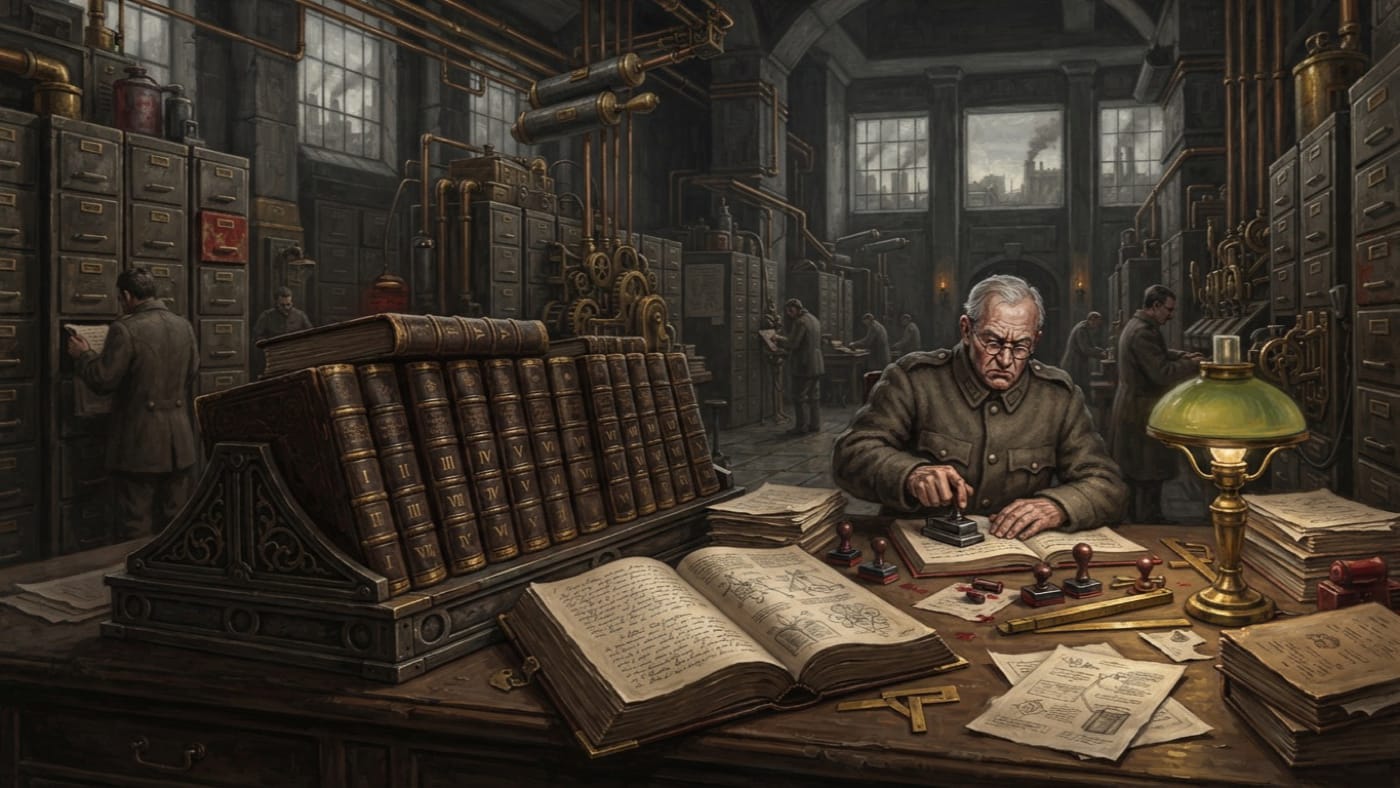
#On the Twelve Volumes
The Compendium Infernum is the Bureau of Doctrine's catalogue of the enemy. It runs to twelve volumes, and it records the infernal forces the Church opposes and the means by which each is to be opposed. In A.S. 201 it is consulted by chaplains drafting a sortie blessing, by bell-masters checking a peal against a reported manifestation, and by Hieromnemons composing Codex entries they were told not to compose. Both northern dossiers sealed this year cite it, the one on Bastion-Königsberg and the one on the Grey. Neither stopped to explain it. This entry does.
The size of the book is the smaller part of its authority. A catalogue of the enemy in twelve volumes presumes an enemy that fits in twelve volumes. Every page assumes that whatever comes over the wire could have been described before it came. It assumes that a description leads to a prescription, and that a prescription applied with discipline and the correct hymn leaves a garrison still standing at Lauds. The Synod fights on that assumption. I have filed on it for forty years. It has mostly held.
#On the Entry
Every demon in the Compendium carries four things: a designation, a taxonomic classification, a recommended countermeasure and a filing number. The order has a purpose. The designation lets a man speak of the thing without describing it again from scratch. The classification places it among its kin, which tells a chaplain what else to expect that week. The countermeasure tells him what to do. The filing number tells the clerk where the report goes afterward, and in the Bureau's estimation that is where the encounter properly ends.
Together the four turn a sentry's terror into an incident. A man who has watched something climb out of a marsh writes a report that is frightened, misspelled and accurate after its fashion. Set beside the Compendium, that report gains a designation he never knew, a class he could not have guessed, a prescribed answer already in the chaplain's satchel, and a number. Now it can be counted, compared with last month's and forwarded to Strasbourg. It can also be argued over, which in Strasbourg is the surest sign of a healthy document.
Two things should be kept apart, though the Bureau prefers them together. A field report records what a soldier saw. An entry records what Doctrine has decided he saw. The second is built from heaps of the first, sifted, and the sifting is both the Bureau's art and its vice. The sieve keeps whatever matches a class already on the shelf. Whatever falls through goes back to the sender with a request for clarification.
#On the Prescribed Answer
The countermeasure is what makes soldiers tolerate the rest. The Church's consecrated arsenal is old and plain: hymns, bells, relics and holy water, in the forms Doctrine defines and the Bureau of Bells regulates. The Office of Bells was constituted in A.S. 52, and the current Bell Codex standard was ratified in A.S. 115. Since then, any peal rung on the Line is a peal somebody has checked.
A prescription guides action. It promises no outcome, and the Compendium's honest readers know it. Take Syrion, the Sin-General of Sloth, whose time-fog lies over the Bulgarian highlands. The wording of his entry is the Compendium's business and stays there. The defences used against him are documented in the field whatever any volume says. Wake-bell patterns are rung irregularly, so that a sentry who still cannot predict the next stroke knows he is anchored in time. Anchor litanies (boots, belt, watch, tongue, breath) are spoken while the man touches each item in turn. The Synod's own assessment credits these measures with partial success. They help. Syrion waits.
Partial success is still a success the Bureau can count. A known enemy that a known measure only slows remains a known enemy. Its entry stays open on the chaplain's table and its number stays in the ledger. Casualties against it go down as the cost of an answer rather than the absence of one. The Compendium depends on that distinction from its first volume to its twelfth.
#On the Authority of a Name
Doctrine defines. That is the Bureau's office, and the Compendium is that office given a binding and a shelf. Its classifications belong to a wider habit. The same hall tells regional commanders that no encounter is unique and that the surprise they are about to suffer has already been tabulated. Its own field tables hold that by naming a horror, we have already half-digested it. Around the Compendium the other offices take their places. Records keeps the copies. Purity asks why a report fails to match. War wants to know what to bring, and Bells what to ring. All of them come to Doctrine to be told.
I defend the habit. A garrison that must improvise its theology at every alarm loses. A soldier facing a Sin-General's host is better armed with a classification than without one, even a wrong one. A wrong classification can be corrected. An absent one can only be prayed over.
The vice arrives with the virtue. An institution that holds the power to name comes to treat the unnamed as an administrative failing on the part of the thing. Reports that fit go in. Reports that exceed the scheme go back for clarification, then for further clarification, and finally into Pending, which is Doctrine's word for a drawer it does not intend to open. The Compendium has twelve volumes. None of them covers the drawer.
#On the Northern Exception
At Königsberg the sieve meets something it cannot sort. Since A.S. 190, the Bureau of War's Northern Theater assessment has carried contact reports from the Baltic approaches under Unknown Forces, Extradoctrinal Classification Pending. That is eleven years. The garrison calls the thing the Grey. Doctrine has accepted no classification for it, and an entry cannot be drafted for an enemy without a class. So the garrison holds one element of the four: a designation it coined itself. It has no class, no number and no countermeasure the Bureau will seal.
The countermeasure is where the injury lies. The Northern Carillon rings, and the Grey continues. Relics are carried along the Sea Wall, and it does not recoil. The Choir of the Northern Standard sings, and the Grey sings back. The returned hymns are perfect, note for note, in voices so close to the Choir's own that on three documented occasions the singers lost their place in the cycle. On two occasions the returned melody came several bars ahead of the Choir. The Bureau of Bells installed harmonic-isolation screens in A.S. 197. The echo diminished. It did not stop.
Against Syrion a commander can open the Compendium and find an answer that half-works. Against the Grey he finds the place where an answer would go. Every prescription in the twelve volumes presumes an enemy that consecrated measures can repel to some degree, however small. A thing that returns the hymn intact, and early, leaves every individual entry standing. What it calls into doubt is the countermeasure itself, the one element on which the other three rely.
Bastion-Brest supplies the second case. The Nameless Tide presses the Bug River sector in accumulating surges. Field reports from that wire describe forces that do not answer hymns, relics or cursing. The locked registry treats the Tide as distinct from Königsberg's Grey and holds it under the same suppression tier. I suspect a relation between the two. Suspicion is not a filing category, and I have entered mine where it belongs.
This Codex's entry on the Grey stated that the Grey, the Nameless Tide and det grå vattnet are "three names for the same phenomenon," and described the Brest Tide as the same unnamed enemy in another form.
Withdrawn. The canonical bastion registry assigns the Grey to Königsberg and the Nameless Tide to Brest as distinct forces. The reported failure of hymn and relic at both bastions remains on record, as does their shared suppression tier. A common origin remains the Hieromnemon's suspicion. It is unproved and recorded as such.
Other claims circulate around the northern files. The Scandinavians testify that the grey water was in the Baltic before the Sundering. I recorded my own four hypotheses in the Grey's entry. All of it is testimony and conjecture, and none of it has been tested. The Compendium need not believe a word of it to be troubled by the Choir.
#On the Present Application
The twelve volumes remain in use across the Line in A.S. 201, and rightly. They tell a chaplain at Shipka what to ring when the fog thickens. They tell a bell-master which peal answers which manifestation, and a clerk where to file the dead. Against the Great Deceiver's catalogued hosts they are the best reference the Church possesses, partial successes and all. I would sooner burn my own entries than see them withdrawn.
At Königsberg they answer every question but one. The Choir sings its cycle on the Bureau's schedule. The Northern Office's annual assessment still recommends that the current operational posture continue. The Grey keeps the name the garrison gave it and has no number.