
#On the Assessment
The Bureau of War wrote it. I put that first because an earlier page of this Codex said otherwise, and because authorship is the one fact about the Northern Theater Assessment that no office has yet thought to dispute.
In A.S. 190 the Bureau of War's Northern Theater office placed the contact reports from Bastion-Königsberg under a heading that has outlasted several of the men who wrote beneath it: Unknown Forces, Extradoctrinal Classification Pending. The assessment then went where every military finding of theological character must go, to the Bureau of Doctrine, which alone may say what a thing is. War may count the dead, chart the approaches and ration the powder. Doctrine names. War had found a thing it could describe and could not name, and it sent it upstairs.
Pending is a holding word. It keeps a chair empty at the table of the Compendium Infernum so that no one sits in it by accident. It answers nothing. It was drafted to be replaced by a ruling within a season. That season has now run eleven years.
I have read the assessment, under conditions I will not describe, in a room I was not supposed to enter. I said as much in the Königsberg entry, and I will not improve the story now with a guttering candle. What follows records what the assessment is attested to say, and what the offices did with it.
"The Bureau of Doctrine's Northern Theater assessment classifies both under the designation Unknown Forces, Extradoctrinal Classification Pending." — from the entry on the Seven Sin-Generals.
Incorrect as to authorship. The assessment belongs to the Bureau of War. Doctrine received it for theological review and has held it since A.S. 190, long enough for the document to look like Doctrine's property. "Both" overreaches too. The filing I have seen concerns the Königsberg reports, and nothing shows that it took in Brest's enemy under the same heading. The suggestion that the north hides an eighth Sin-General was withdrawn in the Königsberg entry and stays withdrawn. Doctrine has confirmed no such General. Doctrine has confirmed very little.
#On the Evidence Submitted
"It is grey in the way ash is grey, the way old snow is grey, the way a dead man's eyes are grey." — Northern Theater Assessment, suppressed, obtained by the Hieromnemon under conditions he declines to specify
That sentence belongs to the assessment, and it is the finest sentence a Bureau of War clerk has ever set down. My copy dated nothing against the passage. It may sit in the first filing or in the revision, and I will not lend it a date.
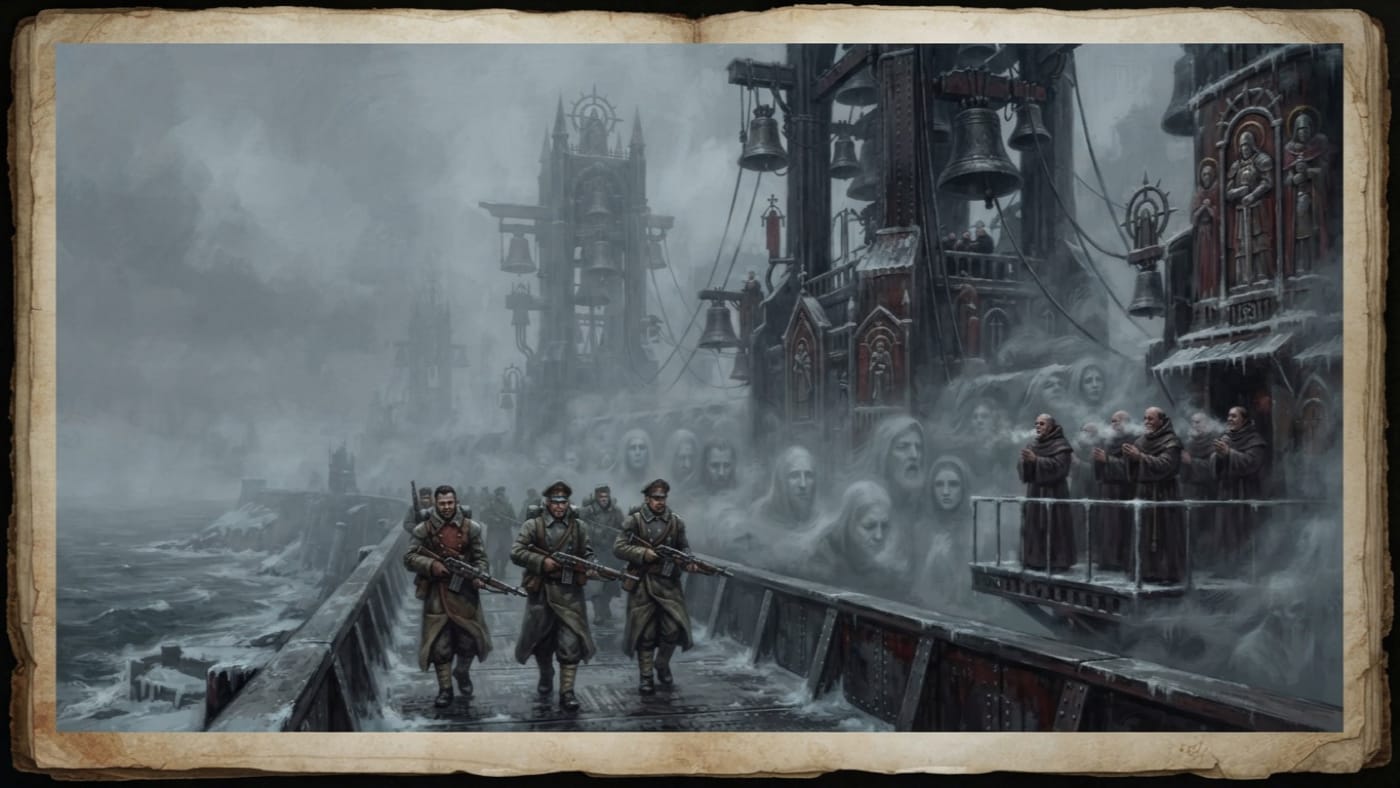
The contact descriptions follow the garrison's own accounts. Fog comes off the Baltic and the northeastern approaches and moves without reliable reference to the wind. It carries faces, all of them ordinary. Some are known, some are strange, and the worst are almost known. Sentries on the Sea Wall have saluted it. The Bureau of Purity has screened the witnesses, and Sergeant Halder of the Frost Yards has been found credible so many times that his credibility now constitutes a file of its own. Purity's screening establishes that Halder is sober and sane, and it stops there. What he saw and what he believes he saw remain two questions, and War's assessment, to its credit, records testimony as testimony.
Then came the countermeasures. The Northern Carillon, forty-one bells of Prussian gun-bronze tuned to Northern Standard Resonance, rang, and the fog continued. The Choir sang, and the fog handed the hymn back note for note in the Choir's own timbre. Relics went along the Sea Wall in full processional dignity, and nothing recoiled. Against every other enemy on the Sagittal Line these instruments draw blood. Here they drew none that anyone could measure.
In A.S. 191 Doctrine asked for more, and War sent seven hundred pages of testimony, acoustic analysis, atmospheric measurement and casualty reports. Those pages are supporting evidence, delivered after the filing. They do not give the assessment's length. I do not know its length, and a man who quotes a page count he has not counted is a ledger-clerk in everything but salary.
Doctrine acknowledged receipt.
#On the Limits of Classification
The difficulty is simple to state and expensive to admit. Each of the Seven who serve the Great Deceiver has a sin, a domain, a host and a countermeasure. Any hostile phenomenon on the Line is matched against them the way a shard is matched against a broken reliquary: by its edge, and by what it does when the sacred touches it. The Grey has no edge that fits. It wears faces nobody can file as demonic, it takes relics the way a wall takes rain, and it answers hymns by giving them back.
War's assessment therefore did the most a military office may do, which is to exclude. It halted at the threshold where exclusion would have to become identification. Doctrine holds the pen for identification, and Doctrine did not cross the threshold either.
The decisions that followed were small, and their smallness is what made them real. No entry opened in the Compendium. No distinct countermeasure protocol was issued, so the Carillon kept ringing the standard schedule. The Bureau of Bells was left to study an acoustic failure with no doctrinal object to study it against. The Bureau of Shadows restricted the related accounts and annexes. Each office did its part, and no part amounted to a classification.
The Fractured North says det grå vattnet is older than the Sundering. That is a claim and not a proof. When Bells asked for the old Scandinavian tunings, the third refusal, in A.S. 193, came with a demonstration at sea. Shadows holds the account of it, and I do not describe it.
Two seals sit on the same file, and they are routinely confused. Classification Pending holds a taxonomic question open. Absolute Suppression restricts who may read the question. The first confesses ignorance, and the second locks the confession away. A sentry on the Sea Wall cannot tell from his rotation orders which of the two keeps him there.
#On the Revision of A.S. 196
"If I could tell you what the Grey is, I would tell you what it is. I cannot. I can tell you what it is not, and the list is long enough to constitute its own argument." — Bureau of War, Northern Theater Assessment, A.S. 196
Six years after the first filing, War revised its assessment and recommended "urgent classification review."
In the epigraph a military office concedes, in its own hand, that its list of exclusions has grown long enough to stand up and walk off. War had gathered the testimony, measured the air, counted the wounded and the sleepless, and tried the bells. In the revision it asked Doctrine for the one thing War cannot supply for itself, which is a name with a countermeasure attached.
Doctrine acknowledged receipt.
War then did something I find almost moving in an office whose usual prose is ammunition tables. It followed up. In substance, it asked whether Doctrine intended to do anything beyond acknowledging receipt. Doctrine acknowledged that note as well. The acknowledgment was filed, and in every record I have seen the correspondence of A.S. 196 ends there.
I will not pad the revision with extracts I have not read. Its attested contents are the recommendation and the sentence above. The rest of its text, its annexes and its signatures lie wherever Shadows has put them.
#On Later Comparisons
Everything in this section postdates the revision. I set it apart so that no reader, and no Bureau, mistakes it for anything War knew in A.S. 196.
In A.S. 197 the Bureau of Bells fitted harmonic-isolation screens at the Carillon. The returned hymn grew fainter and never stopped. By northern standards this counts as a triumph.
By A.S. 199 the anticipation had been documented a second time, with the returned melody arriving bars ahead of the Choir. The observation is on record, and no record I have found explains it. "Anticipatory acoustic resonance, mechanism undetermined" is a confession wearing an apron.
In the same year at Bastion-Brest, six hundred miles south on the Bug River, the Confession Echo was first confirmed. Sins spoken in the Confessional Lanes came back hours later in the speaker's own voice, and at Booth 77 they came back before they were spoken. Brest faces its own enemy, the Nameless Tide, which the locked registry keeps distinct from the Grey. The Tide accumulates against the eastern wire and ignores consecrated countermeasure much as the Grey does.
The comparison matters for one reason: in both places, sacramental speech comes back out of order. I have argued in the Brest entry that the Tide and the Echo are connected, and I suspect the north holds one problem under two garrisons' names. That suspicion is mine alone. The registry disagrees, and Doctrine has filed me under Outside Current Doctrinal Scope. I would rather be overruled on the record than agreed with in silence. A Northern Theater memorandum of A.S. 200 raised the parallel in its own terms. It is later paper, partly sealed, and it forms no part of the revision.
#On the Open File
It is now A.S. 201, eleven years from the first filing and five from the revision. The classification is still pending.
War has since produced another northern document that I have read. It is the quarterly assessment of Bastion-Brest for this year, co-sealed by Doctrine, and it ends: "Bastion-Brest remains operational. The definition of 'operational' has been revised." Nothing I have seen makes it a later edition of the Königsberg assessment. It is a separate paper about a separate bastion, and what it revises is a word, not a classification. The Church has managed to redefine "operational" faster than it has managed to define anything in the north.
At Königsberg the garrison keeps its rotations on the Sea Wall. The Carillon rings the standard schedule, and the screens press the hymn down to a murmur. The fog still comes off the Baltic carrying faces, as the entry on the Grey describes at greater length. The men who salute it are screened, found credible and returned to duty.
None of that is a ruling. A ruling would say what the Grey is, or that the Church cannot say. Either sentence needs a signature, and the Northern Theater Office has not yet found an officer willing to sign a sentence the Creator might later correct.