
#On the Office's Charge
"Count the living. Count the dead. Deliver the relic." — Standard dispatch catechism, Ossuary Convoy Office
Every relic convoy owes three debts when it arrives. It owes the Bureau of War a delivery. It owes the Bureau of Rites an unbroken seal. It also owes someone an account of the bodies that carried the cargo, though the documents never agree on who that someone is. The first two debts are settled at the gate, in daylight, with a signature. The third is settled later, at a desk, by the Convoy Audit Office.
The Ossuary-Draft Handlers produce the evidence. Their Ossuary Convoy Offices take in the condemned from trench courts and Purity holding cells. They quarantine them, grade them, issue chain, seal the cargo, route the columns and reconcile whatever comes back. Each stage leaves paper behind: the condemnation writ, the draft roster, the cargo manifest, the carrier grade, the key number, the escort's signature, the passage marks of the Gatewarden-Notaries, the delivery certificate and the categorised loss. The Audit Office reads all of that paper against the iron and wax it describes, and then it issues an assessment.
That is the full extent of its documented charge. I can find no record of its founding, its seat or its master in any file I have been shown, and I have been shown a great many files. The Bureau of Relics keeps custody of the bones. The Bureau of Records keeps custody of the ink. The auditors work where those two custodies overlap and belong to neither, and an office that belongs to nobody is an office that nobody can be blamed for.
#On Seals, Heads, and Keys
The profession's own lore records the order of inspection, and the order says something about priorities. Seals come first, then heads, then keys.
Seals come first because a broken seal voids the cargo before anyone has asked about a single human being. The relic becomes doctrinally void, the Handler becomes suspect, and the convoy's whole loss report passes to tribunal scrutiny. The auditor checks the impression, the edge of the wafer and the way the wax has set in the cold. Wax cut with cheap tallow behaves differently, and the old hands say an auditor can smell the adulteration across the table, much as a confessor can smell a rehearsed sin.
Heads come second. The roster is checked against the court dockets, so that the column is compared with the sentences that produced it. A docket names a person, and a roster grades that person. Grade A means fit to carry forty pounds over twenty miles. Grade B carries lighter loads or shorter routes. Grade C is unfit for march and stays in depot custody. The grades matter to an auditor for a plain reason. A Grade C was never sent down the road, so he cannot die on it unless the paper says otherwise.
Keys come third. Every shackle key is numbered, stamped, blessed and counted at the end of each shift. A missing key means a missing prisoner. A key logged under the wrong number is what the Handlers call key drift, and it turns an escape into a clerical slip. Clerical slips cost less than escapes and far less than tribunals.
After the keys, the auditors question the escorts about unscheduled stops. Every escort remembers every stop as scheduled.
Note what the order counts. It measures losses, not deaths, and it sets two thresholds. The auditor convenes no tribunal of his own and sentences nobody. He hands War the numbers that decide whether War must sit in judgment, and that is power enough for any man who owns an abacus.
#On the Five Losses
This memorandum is the office's most widely circulated document, and it is a model of the form. It reached the whole bastion network. It names no bastion and no Handler. It speaks for "the Bureau" without saying which one. Like most good administrative writing, it says less than it knows.
The five categories need a short gloss for the lay reader. Death in march covers the column's ordinary attrition. Escape covers the irregular kind. Medical withdrawal is a body pulled from the line by fever or collapse. Doctrinal removal is a body pulled for reasons the Bureau of Doctrine supplies. Administrative correction holds everything the first four cannot. The memorandum does not say when that fifth heading was introduced, so I will not supply a date for it.
Read the figure carefully. Eleven per cent refers to Category Five's share of all recorded transit losses across the network. It is not eleven per cent of the condemned, of the departures, or of any single bastion's living stock. The loss is a fraction of losses, which keeps the number small enough to file.
In practice the fifth heading covers at least three habits, and none of them is unique to it. The first is the ghost slot, a blank line on a roster with no name, no crime and no grade. Later the line receives a name, a Grade C, and the notation expired in transit, while a living person walks out of custody at a waystation where the escort has been told not to count too carefully. The second is the mercy downgrade, which runs in the opposite direction. A march-fit prisoner is graded C on the strength of a fabricated medical note and kept at the depot until someone pays. The third is key drift, which I described above.
An honest auditor can catch each of these. A Grade C should not expire on a road he was never assigned to. A medical note signed in the same hand as three others on the same night tells its own story. A ghost slot is not always charity, and Category Five is not always a ghost slot. People are sold through these channels as often as they are saved. The paper records only that something which was once counted can no longer be counted.
#On Continued Observation
The only local finding I have seen in print is a single extract, reproduced in the dossier of Registrar Aldous Krenk. It reads: Category Five usage at Przemyśl: elevated, internally consistent, documentation clean. Recommendation: continued observation; no disruption pending front-delivery stability.
Krenk is Chief Handler of the Ossuary Convoy Office at Przemyśl. He is not an officer of the Audit Office. He is the man whose paper the auditors read. When I toured his intake hall in A.S. 197, he had served forty-one years. He did not invent the ghost slot. He made it tidy. The network memorandum does not mention him, and the extract names his bastion. Anyone may draw a line between the two documents. I have drawn mine, and I sign it as my own reading. The Audit Office never signed one.
Look at what the auditors found and what they chose to do about it. They found the usage elevated, and they knew it. They found it consistent, which means the corrections followed a pattern. They found the documentation clean, so every heading was entered, every seal was matched and every key was answered for. Then they recommended continued observation, and made even that conditional on delivery. As long as the relics kept reaching the front, the auditors would keep reading.
That is not an authorisation. No writ licenses a false death. It is a forbearance, and in a working bureaucracy a forbearance lasts longer than any writ. War receives its cargo and Rites receives its wax. The Audit Office receives a file so orderly that disturbing it would cost more than leaving it alone.
The same tolerance appears on the Convoy Office's side of the counter, in the language used to describe Krenk's discretion. His dossier carries the following correction, and I reproduce it because it records the bargain more honestly than the extract does.
Earlier handling manuals described discretionary upgrade as "a mercy classification available at the Registrar's pastoral judgment."
Corrected. Discretionary upgrade is a throughput tool used when convoy numbers, cargo weight, escort morale, and route hazard permit a weak body to be spent outside the depot. Mercy may occur incidentally. The Bureau does not reimburse incidental mercy.
The two documents fit together like a key in its lock. The Handler's mercy has been reclassified as throughput, and the Handler's corrections have been placed under observation. Each office has written up the other's conscience as a logistical matter, and each is satisfied with the result.
#On What the File Omits
The audit counts what the paper allows it to count: wafers, wrists, numbered keys and signatures from the far end of a road. It reconciles cargo against cargo. People enter its arithmetic only when they leave a gap in a roster, so a person who walked out at a waystation shows up in the file as one tidy line of Grade C ink.
Other offices keep files with the same habit. In A.S. 199 the Bureau of Mercy reviewed Convoy Office personnel and recommended counselling for its senior Handlers. The recommendation was filed and then lost, and the loss was categorised as administrative correction. Mercy ran that review, not the Audit Office, and nobody has told me which clerk made the entry. I mention it only because the heading appears there too. It began as an auditor's term and has since become the Synod's general shrug.
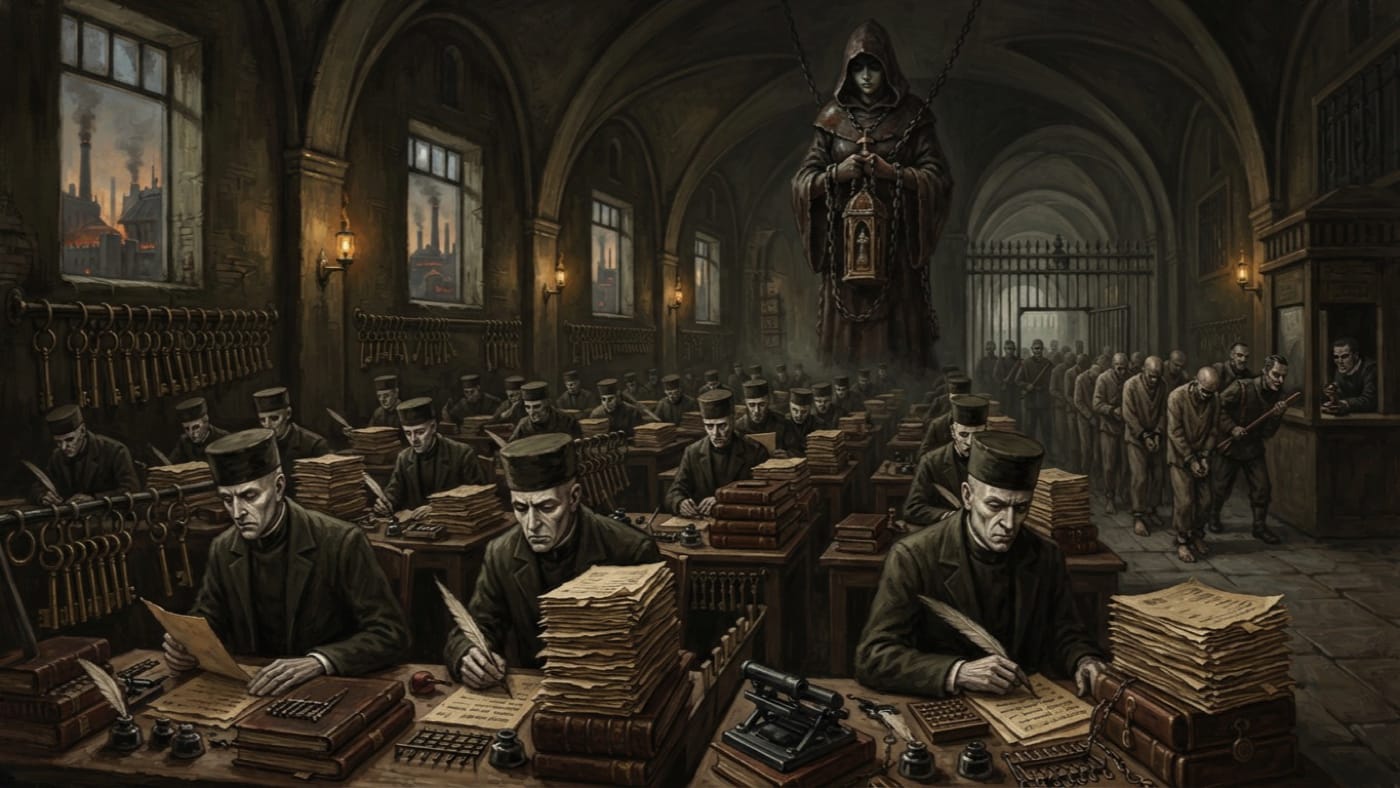
The hooded Marrow-Saint Elen hangs above the cold-ledger annex at Przemyśl, chained, carrying her reliquary, her face turned away from the desks. The old hands say she counts every chain. No one claims she counts the people inside them.
At the end of my A.S. 197 tour, a rack of shackles stood drying in Krenk's hall. They were sized for wrists thinner than mine. I did not ask about them, and nothing obliged me to. The rack was moved before second bell, and the tour record I signed has no column where it could have been entered.