

#On His Station
Registrar Aldous Krenk, Chief Handler of the Ossuary Convoy Office at Bastion-Przemyśl, is a small man made large by keys. Forty-one years in service have bent his shoulders forward, not from humility — spare me that devotional syrup — but from the weight of seal presses, route ledgers, shackle rings, and the constant forward lean of a clerk who has spent a lifetime peering across counters at naked condemned men while deciding how many pounds of saint-bone their backs may profitably bear.
He belongs to the Ossuary-Draft Handler profession, that licensed miracle by which the Synod converts sentences into transport capacity and calls the conversion penance. Krenk’s office receives bodies from trench courts, Purity sweeps, debt arrests, deserter pens, confessor-booth referrals, and the smaller civic cruelties too common to earn individual notation. He classifies them. Grade A, Grade B, Grade C. March-fit, depot-fit, lost before departure in the official imagination. The living pass before him as capacity; the dead arrive later as arithmetic.
His palms are wax-burned in the old pattern: red crescents below the thumb, pale seams across the base of each finger, the glossy puckering that comes from striking hot seal-wax in cold rooms and refusing gloves because gloves dull the pressure. He wears the profession’s heavy apron, though his rank excuses him from the worst brine work. The apron remains. Vanity, penitence, habit — three words clerks use when they have no authority to diagnose a soul.
#On the Intake Hall
I toured Krenk’s Convoy Office in A.S. 197. The memory has stayed with me, which is inconvenient, since I prefer my memories obedient and shelf-stable. The hall smelled of lime, brine, damp wool, old wax, and an apology nobody had made. Krenk showed it to me with the pride of a man displaying a cathedral.
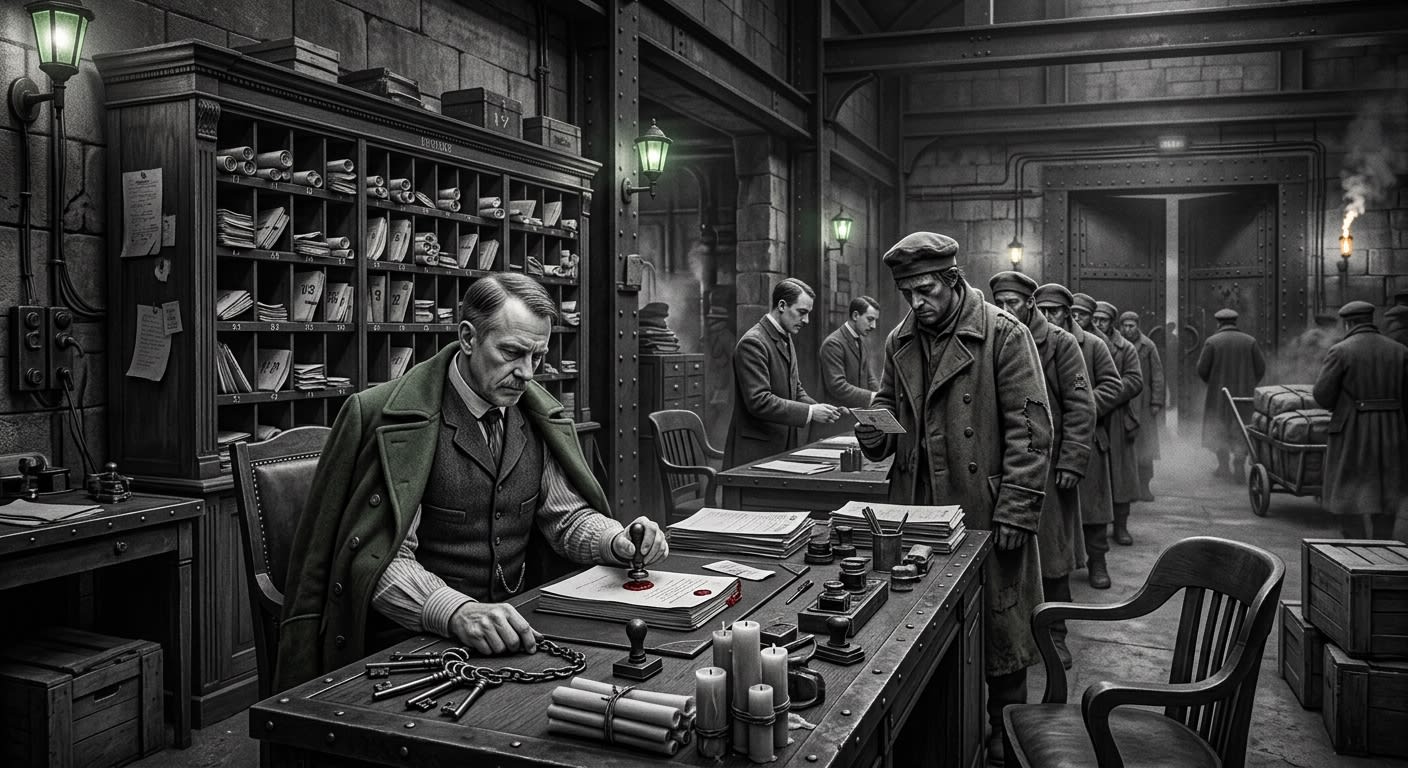
There were quarantine sheds first, whitewashed to a violence that failed to conceal the handprints along the lower walls. There were chain yards, with iron sorted by ankle, wrist, throat, and convoy spacing. There were seal rooms, kept colder than mercy, where wax wafers sat in shallow trays like drops of official blood. There was the cold ledger annex, its desks arranged beneath a painted Marrow-Saint Elen whose hooded face had been refreshed so many times by anxious junior clerks that the saint’s hands looked newer than the reliquary she carried.
“Everything in order, Hieromnemon,” Krenk told me. “Everything accounted for.”
He pointed with the stem of his seal press, never with a finger. Quarantine. Chain issue. Route desk. Seal verification. Departure chapel. Loss reconciliation. The movement of his hand was economical, almost tender, and every clerk in the room followed the motion without looking up. Krenk’s authority did not shout. It clicked. Key-ring, wax press, abacus bead, ledger clasp. Click, click, click. A smaller music than bells, and crueler because it never pretended to be sublime.
Then I saw the shackles drying on the rack.
They were sized for wrists thinner than mine.
I did not ask about that.
VISITATION NOTE — PERSONAL MARGIN, NOT ENTERED IN OFFICIAL TOUR RECORD Rack three, lower bar: twelve wrist irons of juvenile diameter; four throat loops with padded linen; two marked “symbolic carrier — light load”; one tag bearing the word ███████ in a child’s hand. Krenk observed my pause. He said nothing. I said nothing. The rack was removed before second bell.
#On His Method
Krenk’s method is exact. Exactness, in a more innocent trade, might pass for virtue. In his, it is the instrument by which pity is cut into standard lengths and stacked.
He begins with the writ. Crime, sentence, issuing office, transfer authority. He checks the name against the docket, the docket against the route requirement, the route requirement against cargo weight. Then the body enters. Fever hides behind the collarbone. Lice at the seam. Weakness in the arch. Panic in the breathing. Krenk sees these things at a glance. He has handled condemned men long enough to know which trembling comes from terror, which from sickness, which from hunger, and which from a body preparing to collapse in a way that will cost the convoy two hours and a disputed loss category.
His clerks say he can grade a man by listening to him cough. They say he can smell forged medical withdrawal notes, that he can tell by the heat of wax whether a seal wafer has been adulterated with cheap tallow from Candlewick brokers, that he knows which escort captains count heads and which count bribes. Such reputations grow around old officials the way mildew grows behind chapel paneling: silently, usefully, with a smell no one mentions while guests are present.
The common insult for Handlers is Shacklescribe. Krenk accepts it. A shackle without a scribe is merely iron. A scribe without a shackle is merely irritating. Together they become policy, and policy moves relic cargo through Gatewarden-Notary hands.
#On Mercy, Such as It Is
Krenk told me the worst part was not classification. That surprised me, which I resent. I had expected a practiced monster’s answer: the smell, the riots, the disease, the humming crates, the mothers at the side gate clutching salt and wedding rings. He gave me none of these. He looked toward the quarantine sheds and said the worst part was when a Grade C begged to be upgraded.
A Grade C is unfit for march. In the language of the public catechism, he is delayed. In practice he remains in depot custody, sells into labour no office wants to name, enters permanent quarantine, or vanishes into a wall whose mortar receives no questions. The march, for all its hunger and chain and probable death, at least leads somewhere. A depot leads to a category.
“They beg to carry,” Krenk said. “If they carry, they may arrive.”
He grants the upgrade when he can.
Earlier handling manuals described discretionary upgrade as “a mercy classification available at the Registrar’s pastoral judgment.”
Corrected. Discretionary upgrade is a throughput tool used when convoy numbers, cargo weight, escort morale, and route hazard permit a weak body to be spent outside the depot. Mercy may occur incidentally. The Bureau does not reimburse incidental mercy.
Understand the size of that phrase: when he can. It covers a territory smaller than charity and larger than cruelty. It includes bribes declined because the docket is watched. It includes bribes accepted because refusal would produce a worse officer’s profit. It includes the rare prisoner marched because a death on the road is cleaner than a disappearance in the shed. It includes a dozen sins filed under logistics and one or two gestures for which no official category exists, and that absence of category is probably the only reason they survive.
Krenk’s mercy has boundaries. He has used ghost slots. He has permitted mercy downgrades. He has also sent healthy men east because a relic convoy was short four backs and the Bureau of War had requested delivery by dawn. The Ledger does not ask whether a man is good. It asks whether the seal held.
#On the Ghost Slot
Every Handler of Krenk’s rank knows the ghost slot. A blank roster entry exists on paper. Later it receives a name, a Grade C notation, an “expired in transit” mark, and a body walks through a waystation door into some lesser hell with better air. The practice is condemned, tolerated, priced, hunted, used, denied. The Synod’s favourite conjugation.
Krenk did not invent the ghost slot. He made it tidy.
Under his administration, blank entries at Przemyśl acquired route logic, docket cross-stitching, and sickness stories prepared before the person needed saving or selling had even arrived. This offended idealists and impressed auditors, which is how one knows the work was executed at a professional standard. The Convoy Audit Office memo of A.S. 196 noted that “administrative correction” had risen across the bastion network. It did not name Krenk. It did not need to.
This is how the Synod handles a useful crime. It watches. It measures. It waits for the crime to cease being useful, then discovers morality with a trumpet.
Krenk’s defenders call him a pressure valve. Without him, they say, prisoners would riot, escorts would extort beyond sustainable limits, families would crowd the side gates, and the dead would become stories. His accusers call him a trafficker in bodies. The correct verdict is administrative: he is both, and the office requires both, which is why no one with authority to remove him has yet found the necessary pen.
#On His Devotions
Above the convoy yard gate hangs Marrow-Saint Elen, hooded, chained, reliquary on her back. Krenk keeps the paint renewed. Not personally; a Registrar does not climb ladders. He notices chips. He orders repairs. He has a small candle placed beneath her image on the first bell of every departure day. The candle is replaced if it gutters before the column clears the outer gate.
Whether Elen existed is a question Doctrine has answered with “canonically,” which is the ecclesiastical equivalent of closing a file drawer on someone’s fingers. Krenk venerates her because Handlers need a patron who does not look them in the face. A hooded saint is a mercy to men who spend their lives hooding others.
A provincial devotional sheet attributed to Krenk the statement, “Marrow-Saint Elen forgives every chain.”
False. Krenk’s recorded statement, taken from a gate-clerk’s deposition after the A.S. 197 inspection, reads: “Elen counts every chain.” The distinction is not ornamental. Forgiveness is Rites business. Counting is ours.
He attends no public feast when avoidable. He dislikes hymn-callers who ornament cadence. He drinks the bitter tea Handlers brew to kill crate hum in the throat, and he has the professional superstition of tapping the ledger spine three times before signing a convoy out. He does not use condemned names in casual speech. Name drift, the old hands say, starts when a clerk lets a name become familiar.
Krenk has survived forty-one years by keeping names cold.
#On the Present File
As of A.S. 201, Aldous Krenk remains in service unless the office has done what old offices do and quietly transformed him into a chair, a ledger, and a habit younger men obey without remembering why. His A.S. 197 file records no disciplinary action. His audit exposure is high. His convoy performance is excellent. His ghost-slot suspicion is persistent. His wax requisitions are above sector average. His loss reports are clean enough to be obscene.
The shackles sized for small wrists do not appear in the tour record. The rack was moved. The hall remains open. The relics continue east.
Krenk’s genius is minor and indispensable: he makes horror depart on schedule. There are grander villains in the Synod, brighter saints, louder frauds, prettier monsters. Krenk has none of that theatre. He has a seal press, a key ring, a ledger, and forty-one years of practice turning men into entries that arrive where the timetable says they must.