
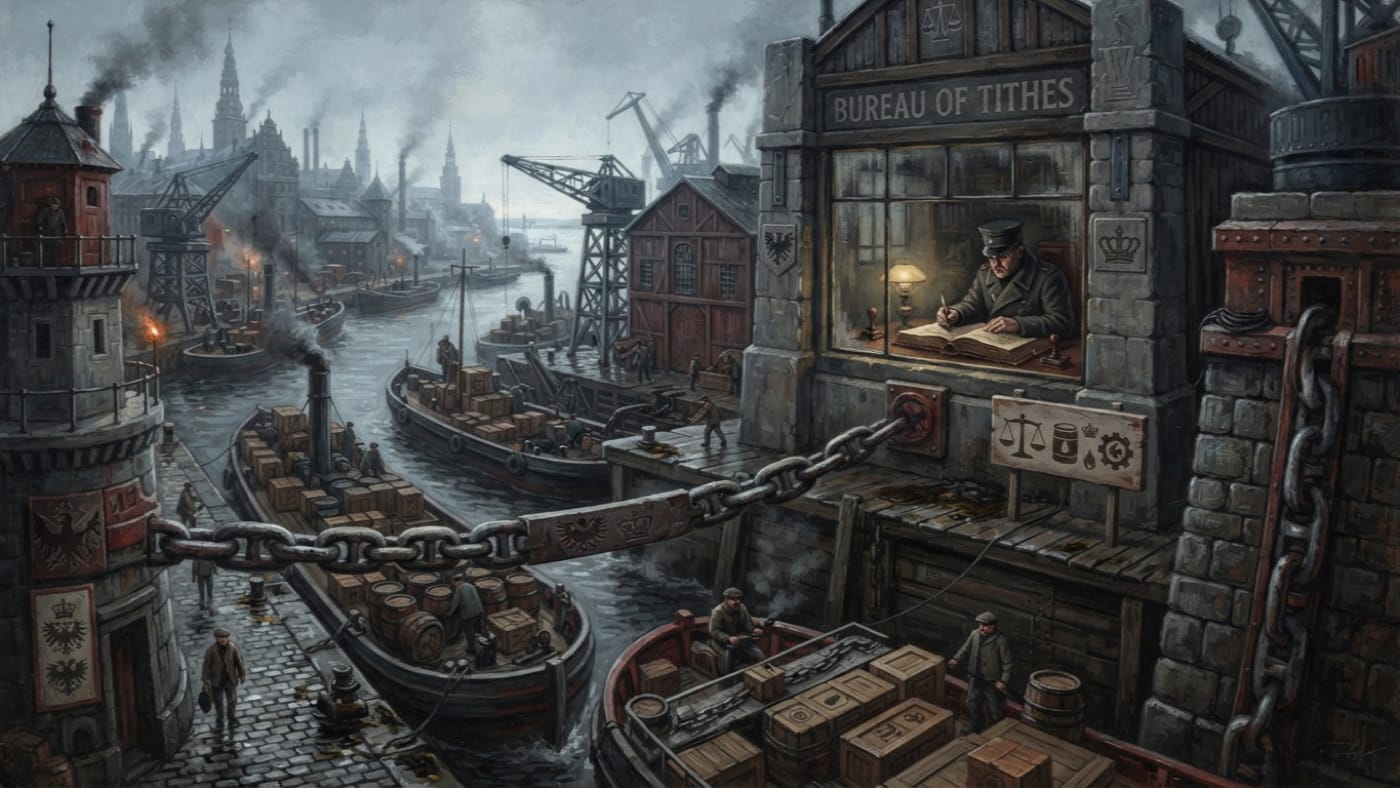
#On the Harbour and the Assessor
Copenhagen is the only city in the Fractured North where the Bureau keeps a permanent desk. The Bureau calls this a foothold. The Danes treat it as furniture.
The Danish harbour stands at the flat, near end of Zone 8. The land runs low to the water, the weather allows a continental administrator to arrive with his papers dry, and the sea lane runs south toward Hamburg. The Bureau of Records describes Denmark as "administratively accessible." It is the most accurate phrase that Bureau has ever applied to the North, and it means no more than this: here, a man from Strasbourg can find a counter to stand behind.
The Bureau of Tithes keeps a permanent assessor at that counter. He has an office of damp stone opening onto a working harbour, a ledger ruled in the Synod's columns, and the authority of the Synod pressed into red wax at the foot of every page. He records cargo. He records its kind, its quantity, its declared origin and its assessed due. Once the ink has dried, his part is finished.
Admission belongs to the harbour. The chain across the water, the berths, the warps and bollards and the hands that cast them off all answer to Danish authority. The assessor can enter a barrel in his ledger. Only the harbour can let it in. These are two different powers, and the city has spent a long time teaching the Bureau which of them comes first.
#On the Compact
The Fractured North has no central government, and Copenhagen does not supply one. The region is governed through clan moots, elder councils, regional assemblies and harbour compacts. In Copenhagen the harbour compact does the business that matters to the Synod. I can tell you what the compact does. Its membership, its manner of election and the date of its first sitting are absent from every file the Bureau has shown me, and I will not invent them to make the page look complete. A Hieromnemon who fills the empty columns of a ledger with guesses has found an easier trade than mine.
What the compact does is bargain. Each year Danish negotiators sit down with the Bureau of Tithes and settle the rate of tithe on the southbound oil trade. Elsewhere in the North there is no bargaining. The Danes negotiate and the Norwegian settlements ignore the question entirely, which is why the Bureau's regional tithe entry reads "Incomplete" and has read so for as long as I have been reading it. I will not print the agreed rate. It is reopened every year, and any figure I committed to vellum would be out of date before the binder's awl reached it.
The compact also guarantees, and I come to that below, because the guarantee is where the Bureau's embarrassment begins.
#On What Passes South
Danish waters are the northern approach to Hamburg. Seal-oil, northern timber, iron and salted fish all cross them on their way to the continent. The reader should not take from this that every barrel and every cord calls at Copenhagen. Many cargoes pass the Danish islands and never touch a Copenhagen berth, and the Bureau's own geography is loose enough on this point without my help. The iron is the exception I can certify: it moves through Copenhagen to Hamburg and then on to the continental foundries.
Seal-oil is the cargo the Synod can least spare. Norwegian rendering-yards produce about sixty thousand barrels a season across the region. Forty thousand go south through Hamburg's docks and twenty thousand stay in the North. In the northern garrisons the oil gives light and heat, and it lubricates gun mechanisms in cold that turns ordinary grease to paste. The Bureau of Engineering has a standing order for more than forty thousand cords of northern pine a year, and that timber becomes ships, barracks and trench-bracing.
At Hamburg the sea cargo is loaded onto rails. The Northern Corridor carries it to Kanzleiburg and Warsaw, and the forward spurs carry it to Bastion-Brest and to Bastion-Königsberg, where the Sagittal Line meets the Baltic. Copenhagen lies upstream of all of this. It is not a bastion and it is not the end of any Line. It is a harbour on a sea lane that the northern front cannot do without.
#On the Northern Advances
I published the following in my assessment of the Fractured North. The Bureau has not reprinted it in any document I have seen, so I print it again.
The Scandinavians finance part of the Synod's war debt. It works in four steps, and a novice clerk with a slate could follow them:
First, northern cargo not yet shipped (seal-oil not yet rendered, timber not yet felled) is valued as future trade.
Second, the harbour compacts of Copenhagen and Bergen guarantee advances against those future shipments, secured on seal-oil futures and timber contracts.
Third, Hamburg's banking houses carry the credit south and into the Synod's accounts.
Fourth, when the Bureau of War's quarterly spending runs past the Bureau of Tithes' quarterly collection, which it does often enough that the Bureau has classified the frequency, the gap is covered with northern money.
I have not seen the lending ledgers. I cannot give the reader a sum, a rate of interest, a lender's name or a clause about default, and anyone who offers you those figures for Copenhagen has made them up or stolen them. What I have seen is enough. The Bureau of Tithes' own memorandum puts the full value of the Scandinavian trade relationship above 2.3 million Crowns of Grace a year. The Bureau of Records' standing classification of the same region is "Partially Independent, Economically Marginal."
Those two documents sit in the same archive under the same seal. The assessor in Copenhagen enters dues on cargo that a Danish compact has already pledged as security for the Synod's borrowing. He taxes the barrel on its way south, and his superiors have already borrowed against the same barrel before it has been filled.
#On the Faith and the Price of Cargo
The people of Copenhagen speak the Creed, keep the Church's calendar, and fall under the same regional settlement as the rest of the North. I know of no rite peculiar to the harbour, and I will not make one up so the city has something to be famous for. The Bureau of Bells has given me no Copenhagen finding to report. The ruling that governs the city is the regional one.
Erratum — Bureau of Rites, Filed A.S. 199, reproduced and applied here to Copenhagen within its regional scope: The Fractured North's liturgical practices are classified "Concordat-Variant, Category B — Locally Adapted, Non-Heretical." The prior regional classification of "Potentially Schismatic, Pending Review" is retired. The Bureau of Rites has issued no separate Copenhagen ruling. The regional correction governs, and Copenhagen was never anything but Category B. Ratified, A.S. 199. Reproduced A.S. 201.
Readers who meet the Concordat faith of the North only in Copenhagen will find it tidy. The cargo comes from places that are not.
At the Seal-Oil Shrinefjord of Hrafnvik the oil is rendered in yards that smell sweet and rancid at once. It goes out as barrels, and grain and iron tools come back. In that country fasts are kept by measuring lamp-oil as well as bread. A household that breaks the communal fast becomes what the northerners call a dark-house, cut off from the shared warmth. There the fog answers prayers with altered words. I classified that phenomenon Category Two Localised Acoustic Distortion during my nine days at Hrafnvik in A.S. 197, and I have nothing to add to the classification here. All of this belongs to the settlements where the oil is made. None of it has been recorded in Copenhagen, and I will not move it there for effect.
The connection is arithmetic. Each barrel entered in the Copenhagen ledger, or carried past the city to Hamburg, is a barrel that was not burned in a northern window. The twenty thousand barrels that stay behind are rationed, hoarded and fought over. The forty thousand that go south are taxed at a rate the Danes negotiate and pledged against credit the Synod needs. The fjords keep their fasts and the harbour keeps its accounts, and the cargo passing between them carries both obligations.
#On the Present Condition
The arrangement works. In A.S. 201 the assessor is at his counter and the chain is in Danish hands. The southbound oil is taxed at a rate settled by bargaining, and the iron reaches Hamburg's foundries through Copenhagen. Copenhagen and Bergen still guarantee the advances, Hamburg still carries the money, and the northern front still burns oil that Strasbourg has listed among the products of an economically marginal region.
This plate is indexed to the Zone 8 compliance assessment sealed in A.S. 201. It records no separate Copenhagen inspection, because none was made. The harbour did not need inspecting to give its answer. Its answer has been in the ledger the whole time, in the Bureau's own columns.