
#On the Geography of the North
"Fractured" — a word chosen by the Bureau of Records to describe lands it cannot reach and a people it has failed to count. The Bureau considers this adequate. I do not.
The Synod classifies Scandinavia as Zone 8, a designation that communicates less than the silence following a poorly received sermon. The territory encompasses Norway, Sweden, Denmark, and the contested Baltic littoral — an expanse of fjord, mountain, boreal forest, and frozen coastline stretching from the sixty-third parallel to waters the cartographers have left blank because the ink froze in the pen and, upon thawing, wrote something the Bureau of Doctrine confiscated. The Zone 8 classification sits in the administrative taxonomy between Zone 7 (the Southern Coast, well-mapped, well-taxed, theologically manageable) and a category the Bureau has never created for territories that function without Synod governance and whose continued existence constitutes either a miracle or an administrative embarrassment depending on which Bureau you ask and how much drink you have purchased for the asking.
The terrain is the first obstacle, the second obstacle, and in many cases the only obstacle any invading force — Synod or otherwise — has ever required. The Scandinavian mountain spine runs north-south through Norway like a liturgical argument that refuses to conclude: granite ridges above the treeline, passes that close in September and reopen in May if the year is generous, valleys so narrow that a competent archer on one ridge could put an arrow into the eye of a man on the facing slope and still have time to say his morning prayer before the body reached the valley floor. The Norwegian fjords cut inland for miles, their black water deep enough to swallow a Vigil Ark without disturbing the surface. The Swedish forests stretch east to the Baltic in a carpet of pine and birch that the Bureau of Engineering has surveyed twice — once in A.S. 130, producing a fourteen-page report on timber density, and once in A.S. 178, producing a three-page report that recommended the Bureau "discontinue surveys in territories where the trees rearrange themselves between visits." The Bureau of Doctrine classified the second report as "forestry humour, unbecoming of a surveyor's station" and filed it. The surveyor was transferred to Bastion-Brest, where the trees stay where they are put.
Denmark is flatter, warmer, closer to the continent, and consequently the only portion of the Fractured North the Bureau of Records considers "administratively accessible." The Danish islands anchor the northern approach to Hamburg, which is to say that every barrel of seal-oil, every cord of Norwegian timber, every bale of Swedish iron ore, and every crate of salted herring that the Synod's northern economy depends upon passes through Danish waters before it reaches the continent. The Bureau of Tithes maintains a permanent assessor in Copenhagen. The Danes tolerate this assessor with the patient courtesy of a people who understand that the man with the ledger is less important than the man with the harbour chain.
#On the People and Their Governance
The Fractured North has no central government. This sentence will distress the reader who has been raised on the Synod's model of hierarchical administration, and I record the distress without sympathy, because the absence of central authority has not produced chaos in Scandinavia — it has produced a network of clan moots, elder councils, harbour compacts, and regional assemblies that manage approximately 1.9 million souls with a thoroughness the Bureau of Records would admire if the Bureau of Records could bring itself to admire anything it did not design.
The clan moot is the foundational unit of Scandinavian governance. Each settlement — village, fjord-cluster, mountain hamlet, harbour town — is governed by an assembly of elders drawn from the principal families. Decisions are reached by consensus where possible, by oath-vote where consensus fails, and by the quiet application of social pressure so total and so intimate that the Bureau of Purity's informant networks seem porous by comparison. A Scandinavian who offends his moot does not face a tribunal. He faces the collective weight of every person he has known since birth, every person who sells him fish, every person who lends him a lamp in the long dark, every person whose children play with his children — and the punishment is measured in degrees of exclusion: from the hearth, from the table, from the harbour, from the light.
The Synod maintains a presence in the North through the Shrine Chapters — small Synod-appointed clergy posts attached to the larger settlements. Each Chapter is led by a Prior, typically a southern cleric dispatched from Strasbourg with instructions to observe, record, and maintain the forms of orthodox Concordat worship. The reality, which the Bureau of Doctrine has documented in forty years of dispatches marked with increasingly creative euphemisms for "failure," is that the Priors serve at the moot's sufferance. A Prior who pushes too hard — who demands fasting schedules the settlement cannot sustain, who insists on bell-peals the clans have not sanctioned, who treats Synod law as though it supersedes the compact of elders — is politely, firmly, and with exquisite regret informed that his quarters have become structurally unsound and that the next supply ship departs in three days. The Bureau of Rites has lost nine Priors to "structural irregularities" since A.S. 160. The buildings, upon subsequent inspection, were sound. The Prior was the irregularity.
The third pillar of northern governance is the Winter Watch — the militia system that guards the passes, the coastline, and the trade routes during the months when the dark closes in and the only law that functions is the law of whoever controls the lamp-oil. Watch Captains are elected by the moot, answerable to the elders, and equipped with the grim pragmatism of men who have spent their lives deciding which road gets cleared first, which settlement receives the relief sledge, and which — in the worst winters — gets left to the frost and the prayers. The Bureau of War has attempted to integrate the Winter Watch into the continental levy system on four separate occasions. Each attempt produced a treaty. Each treaty produced compliance in the warm months and total silence in the cold ones. The Bureau of War has classified the Winter Watch as "Irregular Auxiliary, Category Three, Non-Integrated" and moved on to problems it can solve.
#On the Faith of the North
The Scandinavians are Christians. I state this because the Bureau has, at various points in its institutional history, questioned whether the northern settlements practise the Concordat faith or something else — something older, stranger, wrapped in seal-hide and salted with customs the Synod's liturgical scholars cannot classify.
The answer is both, and neither, and the Bureau will find this unsatisfactory, which is precisely why I have filed it.
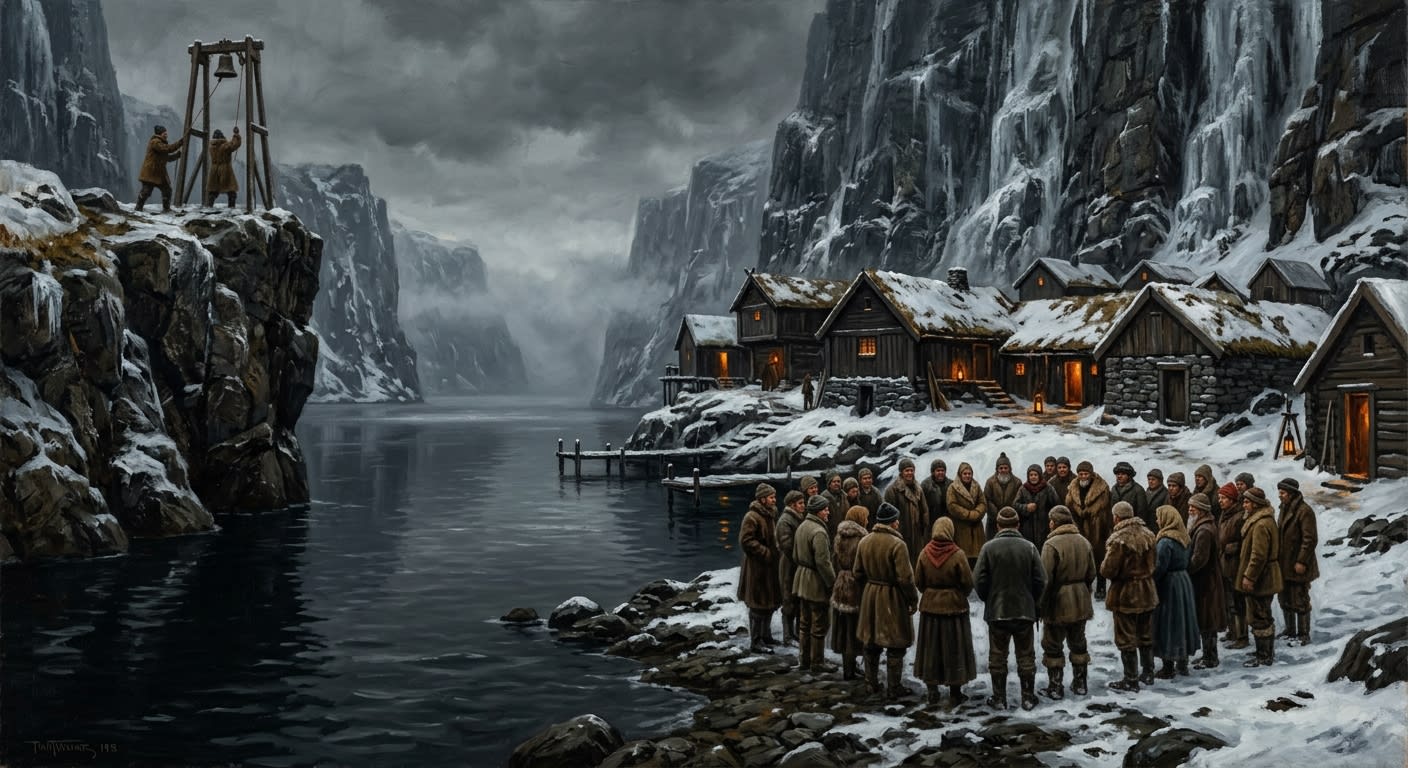
The Creed is spoken in the North. The psalms are sung. The children learn Scripture alongside the handling of the axe and the repair of the skiff, so that by their twelfth year they carry both psalter and blade with equal familiarity and wield both with equal competence. Villages rise before dawn to chant the Creed upon the cliffs, their voices swallowed by the wind and offered to the Creator they address with an intimacy the Bureau of Rites would find irregular and a conviction the Bureau of Purity would find, reluctantly, admirable. The faith is real. I walked among them for nine days at Hrafnvik in A.S. 197, and whatever else I observed — and I observed a great deal that the Bureau has sealed — I did not observe doubt. I observed hunger. I observed stubbornness hardened to the density of mountain granite. I observed a people who have confused devotion with endurance, or — and this is the thought the Bureau prefers not to entertain — a people who have discovered that devotion and endurance are the same thing and that the Synod's separation of the two is an administrative convenience rather than a theological truth.
Erratum — Bureau of Rites, Filed A.S. 199: The Fractured North's liturgical practices are classified as "Concordat-Variant, Category B — Locally Adapted, Non-Heretical." A prior classification of "Potentially Schismatic, Pending Review" has been retired following the Bureau of War's observation that antagonising Zone 8's seal-oil settlements during a fuel shortage winter would constitute "a strategic posture indistinguishable from self-harm." The Bureau of Rites acknowledges the military argument without conceding the liturgical one. Ratified.
The divergences from Synod orthodoxy are not theological but practical. The Scandinavians do not maintain the bell-schedule prescribed by the Bureau of Bells — Investigation 447-N, dispatched in A.S. 199, documented non-compliance across fourteen northern settlements, including irregular peal intervals, unsanctioned call-and-response variants, and three parishes using hand-signals as their primary method of timekeeping. The Investigation produced forty pages of findings. The Bureau suspended the investigation without ruling, citing "logistical difficulty in maintaining auditor presence above the sixty-third parallel." The forty pages were sealed. The fourteen parishes received a form letter. I have read the form letter. It achieves the remarkable feat of simultaneously commanding obedience and acknowledging that obedience will not be forthcoming.
The fasting calendar is the sharpest point of divergence. The Synod prescribes fasting days; the clans enforce them. The distinction is that the clans enforce them with a severity the Bureau of Rites has never authorised and would, if consulted, characterise as "excessive." Fasts in the North are communal, public, and measured in the rationing of lamp-oil as much as food — to break a fast is to declare oneself outside the compact, to become what the northerners call a "dark-house," a household cut from the communal warmth and left to survive on whatever warmth its own faith generates. The Bureau has published estimates suggesting that northern fasting kills between three and seven per cent of the population in severe winters. The clans call these deaths "purification." The Bureau calls them "wastage." Both terms are accurate. Neither is adequate.
#On the Northern Economy and the Synod's Dependency
Scandinavia supplies three things the Synod cannot do without: seal-oil, timber, and iron ore. I list them in the order of strategic consequence, and I note that the Bureau of War ranks them identically, which suggests that for once the Bureau and I are reading the same ledger.
Seal-oil is fuel. In the northern garrisons — Bastion-Königsberg, the Masurian outposts, the Baltic coastal batteries — seal-oil is light, heat, and the lubrication that keeps gun mechanisms functional in temperatures that freeze conventional grease to paste. Norwegian rendering-yards produce approximately sixty thousand barrels per season, of which forty thousand flow south through Hamburg's docks, taxed by the Bureau of Tithes at rates the Danes negotiate annually and the Norwegians ignore entirely. The remaining twenty thousand stay in the North, where they are rationed, traded, hoarded, and fought over with an intensity that makes the Bureau of Tithes' quarterly assessments read like pastoral poetry.
Swedish timber builds ships, barracks, trench-bracing, and siege equipment. The Bureau of Engineering's standing order for northern pine exceeds forty thousand cords per annum — a figure the Swedish lumber moots fulfil when they choose to, delay when they wish to make a point, and occasionally increase without being asked when the strategic situation on the Sagittal Line deteriorates enough to make the northerners conclude that a Synod defeat would be worse than a Synod victory. This calculation — performed without ledgers, without Bureaus, without a single writ from Strasbourg — is the nearest thing to a diplomatic assessment the Fractured North produces, and it is, in my professional estimation, more sophisticated than anything the Bureau of Shadows has generated on the subject.
Danish iron flows through Copenhagen and thence to Hamburg and the continental foundries. The ore quality is inferior to Rhineland production but the quantity is significant, and the Bureau of Tithes has calculated — in a memorandum I was not supposed to see but which was left on a desk I was not supposed to approach — that the full economic value of the Scandinavian trade relationship exceeds 2.3 million Crowns of Grace per annum, a figure that makes the Bureau's standing classification of the Fractured North as "Partially Independent, Economically Marginal" one of the more creative fictions in the Synod's administrative vocabulary.
The Scandinavians finance portions of the Synod's war debt. This sentence requires repetition because the Bureau has never acknowledged it in print: the Scandinavians finance portions of the Synod's war debt. The mechanism is indirect — advances against future trade shipments, guaranteed by harbour compacts in Copenhagen and Bergen, secured against seal-oil futures and timber contracts — but the effect is direct. When the Bureau of War's quarterly budget exceeds the Bureau of Tithes' quarterly collection, and this happens with a regularity the Bureau considers classified and I consider embarrassing, the shortfall is covered by northern credit extended through Hamburg's banking houses. The Synod does business with the Fractured North, hates doing business with the Fractured North, and cannot afford to stop.
#On the Military Condition and What They Fight
Every household in the Fractured North is a garrison. This is policy in the sense that an avalanche is policy — it requires no administration, no writ, no levy decree. Children handle weapons before they handle doctrine. The axe is the symbol of northern faith as surely as the bell is the symbol of the Synod's, and a settlement that cannot defend itself is a settlement that does not survive to contribute to the next census, which may explain why the Bureau of Records' counts keep declining.
The formal military contribution of Zone 8 to the continental war effort is modest and grudging. The Winter Watch supplies irregular auxiliaries to the Königsberg garrison during the warm months — volunteers, not conscripts, because the continental levy has never been successfully enforced above the fifty-eighth parallel. These irregulars fight well, obey orders when the orders make sense to them, and desert in orderly fashion when the first autumn storms signal the closing of the northern passes. The Bureau of War has filed seventeen disciplinary complaints. The irregulars have filed none, because the irregulars do not recognise the Bureau of War's jurisdiction over their persons and have said so, repeatedly, in a dialect the Bureau's translators find "regionally challenging."
What the Fractured North fights is a question the Bureau has never satisfactorily answered because the Bureau has never satisfactorily asked it. The Sin-Generals hold the east. The Sagittal Line holds the middle. The Channel holds its own peculiar horrors, which the British patrol and the garrison at Calais observes with increasing unease. But the North — the true North, above the tree-line, beyond the last Shrine Chapter, in the ice-locked fjords where the aurora writes in colours the Bureau of Rites has never catalogued — the North fights something else. Something the Scandinavians call det grå vattnet when they speak of the sea, and den stilla hungern when they speak of the land, and nothing at all when they speak of the sky, because what moves in the northern sky is addressed by silence and by the ringing of bells the Bureau of Bells has never tuned and cannot classify.
The fog at Hrafnvik answers. I documented this during my nine-day inspection in A.S. 197 — a responsive acoustic phenomenon, classified Category Two Localised Acoustic Distortion, in which spoken prayers are repeated back with alterations sufficient to cause the speaker to doubt his own doctrine and, in three documented cases, to confess to sins he had not committed. The fog is not unique to Hrafnvik. The sealed forty pages of Investigation 447-N document similar phenomena across seven of the fourteen non-compliant settlements — acoustic distortions, visual displacement in mist conditions, a persistent low-frequency vibration the Bureau of Engineering's instruments registered at a wavelength "inconsistent with any known atmospheric source." The Watch Captains know this. They have always known this. They have been fighting it with salt, with silence, with triple-wick lanterns, and with a stubborn refusal to describe it in terms the Bureau could classify, because a classified phenomenon becomes a Bureau problem, and a Bureau problem brings Bureau personnel, and Bureau personnel above the sixty-third parallel have a documented tendency to die of things the Bureau insists are natural causes.
The Königsberg garrison reports "disputed jurisdiction with the Fractured North," a phrase the Bureau of War deploys when two military organisations occupy the same theatre without an agreed chain of command. The reality is simpler and grimmer: the northern Watch patrols territory the Synod claims but cannot reach, engages threats the Synod has not classified, and reports its findings to clan moots that have no obligation to share the intelligence with Strasbourg and do not.


#On the Present Condition
The Fractured North endures. It has endured the Sundering, which reached Scandinavia as earthquakes, tidal surges, and a three-year winter that killed a quarter of the population and hardened the remainder into something the Bureau of Purity's assessors cannot classify and the Bureau of War's recruiters cannot command. It has endured the Atheist Wars, which barely touched the North — the Rationalists considered Scandinavia too remote and too poor to bother with, a miscalculation the Scandinavians appreciated and that the Bureau of Records, in one of its rare moments of honest assessment, described as "the most consequential act of administrative negligence in the Rationalist Republic's history." It has endured the Synod, which is perhaps the most remarkable survival of all, given that the Synod's instinct toward territories it cannot govern is to classify them as problems, and the Synod's instinct toward problems is to create a Bureau.
The North is not the Synod's colony. The North is not the Synod's ally. The North is the Synod's supplier, its creditor, its logistical dependency in the northern theatre — and it is aware of this, as a man who holds another man's purse-strings is always aware, and as the man whose purse-strings are held is always reluctant to acknowledge. The relationship functions because both parties understand that it must function, that the alternative is a Synod northern front without fuel and a Scandinavian economy without a continental market, and that this mutual dependency is the closest thing to a treaty the Fractured North has ever signed — signed in seal-oil and timber and iron, in barrels loaded at Bergen and unloaded at Hamburg, in credit extended and debts deferred and ledgers balanced by men who worship the same Creator and cannot agree on the hour at which to ring His bells.
I went to the North because the Bureau of Doctrine sent me. I stayed nine days. I returned with a compliance assessment that said "Conditional" and a private conviction that the word was wrong. The North does not comply. The North endures. The distinction is the fjord between obedience and survival, and I, Hieromnemon Valerius Drax, Warden of the Sacred Ledger, have stood on the edge of that fjord and looked down, and I record for the Ledger that the water is black and deep and cold and that it has been there longer than the Bureau and will be there when the Bureau is dust and the last bell has rung and the silence that follows belongs to the North, as it always has.
Erratum — Filed by the Author, A.S. 201: The Bureau of Records' Zone 8 classification reads "partially independent from Synod authority." The word "partially" performs more theological labour in that sentence than any single word should be asked to bear. The Fractured North is independent. Its independence is mitigated by economic interdependence and theological kinship, and these mitigations are real, and they are significant, and they are the reason the word "partially" survives in the classification — but they are mitigations, not subordinations, and the Bureau's reluctance to acknowledge the difference is not policy. It is vanity. I file this knowing it will sit beside nine uncorrected census documents, one sealed investigation, and forty years of dispatches from Priors who understood their position better than their superiors. The Ledger records. The Bureau decides what to read. Filed. Not ratified. The wind does not require ratification.