
#On the Harbour
Bergen is where the Fractured North comes down to the water to trade with the Church. It is the one place on the Norwegian coast where a southern clerk can stand on a quay with an open ledger and reasonably expect someone to sign it. The regional account gives Bergen and Trondheim populations approaching thirty thousand each, and credits both with "something resembling a municipal government." I have no separate Bergen census to improve on that figure. I will not invent one, because the Bureau of Records has already invented enough northern population for all of us.
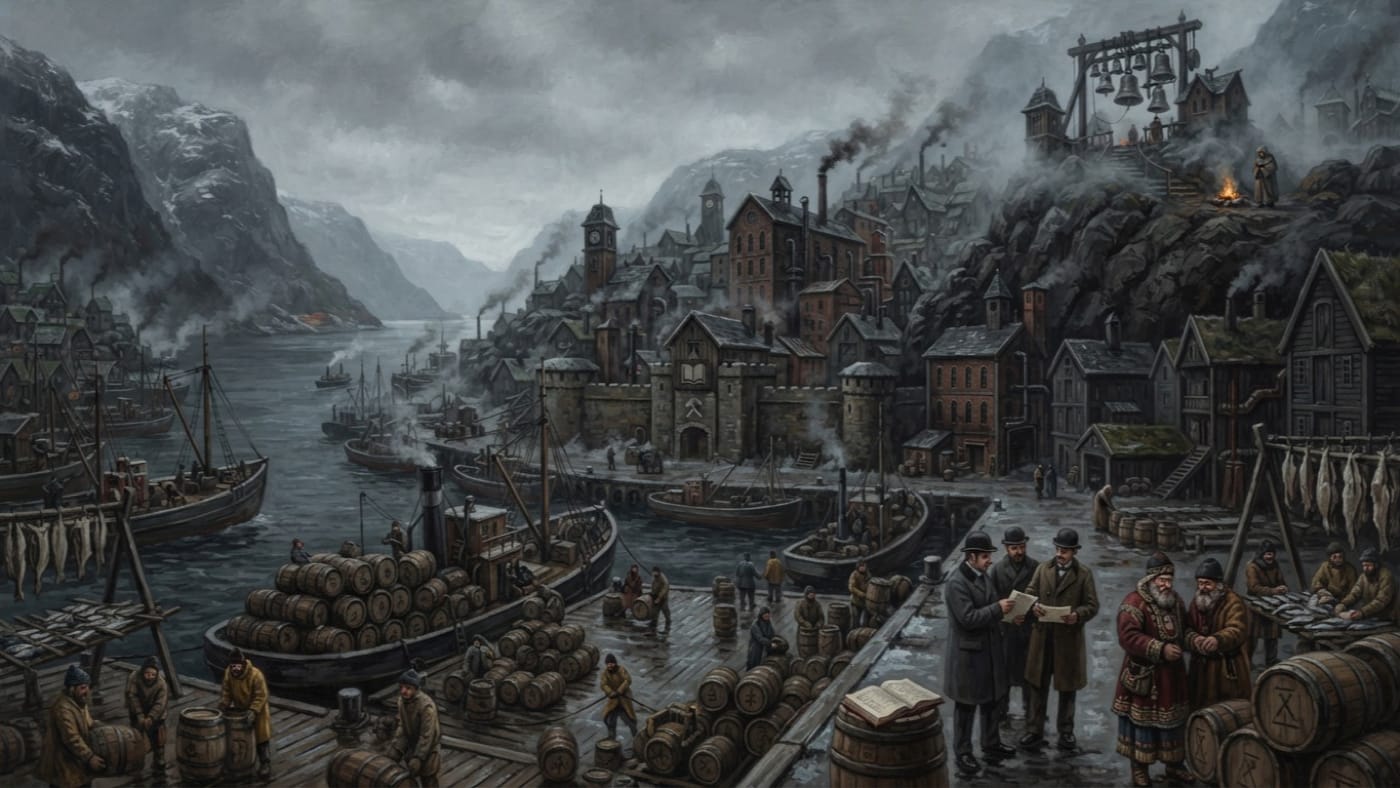
The harbour holds cargo, and the cargo sets the order of the day. There are boats of every northern pattern, tarred and patched. Nets hang dripping from the rails, split cod dries on racks, and herring sits in salt. Barrels stand in ranks with their bungs sealed in pitch. The air smells of fish, tar, wet wool and seal-oil, in roughly that order of strength, with the order changing as the wind changes. Paper comes north in oilcloth, and the dockhands carry it the way a southern sacristan carries a reliquary, since the North cannot make paper and the Bureau will not accept anything else.
On every Synodal map, Bergen lies inside Zone 8. Its correspondence goes through the Bureau of Doctrine's Northern Office at Bastion-Königsberg, a long way east by any route a letter can take. The Church claims Bergen under the Concordat. Bergen governs itself by compact. On a clear day the space between those two statements is about the width of a fjord.
#On the Compact and the Prior
"The Fractured North is Synod territory. The Fractured North is not Synod territory. Both statements are filed." — Bureau of Doctrine, Northern Correspondence
Bergen is governed the way the whole of Scandinavia is governed, with more paperwork. Elders of the principal families sit in council. Above the council, or beside it, or underneath it, depending on who is asked and how much he has had to drink, stands the harbour compact. This is the arrangement through which Bergen's people of standing guarantee the town's cargo and the town's word. Southern merchants deal with the compact. Southern clergy deal with the elders. Sensible southerners learn quickly that these are mostly the same people, seated in different chairs.
The Church is present in the person of a Prior. Eleven Prior-districts run nominally from Bergen to the Lofoten Islands, and the Bergen posting is the most comfortable punishment the North has to offer. It has a quay, letters arrive, and the fish is fresh. The Prior keeps a chapel, conducts the services and files quarterly compliance reports, which the Northern Office stamps and puts in a cellar that floods every spring. He does not govern. Anywhere in the North, a Prior who mistakes his chapel for a court soon finds his quarters declared structurally unsound and his passage booked on the next ship south.
The All-Moot has no fixed seat. The grand assembly meets at midsummer and rotates its location, traditionally to a field near whichever harbour town lost the argument about hosting. The Codex's plate of the Fractured North records a gathering at the Bergen approaches around A.S. 193. That was one of the four years in which the Church was invited to attend. The usual courtesies were observed: the Synod's business was placed on the final day and conducted in Old Norse, at speed, while the mead went round.
#On What Goes South
"In Strasbourg, wealth is ink. In the North, wealth is warmth." — Prior Malthus of Hrafnvik, letter to the Bureau of Doctrine (A.S. 198)
Northern coin is mostly ornamental. In Bergen it actually changes hands, because trade with Hamburg and the Danish ports requires it. Cod, herring and halibut go south, and grain, iron and paper come north. Seal-oil barrels are loaded at Bergen and unloaded at Hamburg, and from Hamburg the oil goes on to the lamps, stoves and gun-locks of the northern front.
Not all of that oil is rendered at Bergen, and the Bureau of Tithes would do well to remember it. Much of it comes down the coast from rendering-yards and shrinefjords such as Hrafnvik, where a lamp is a promise and the fasts are counted in oil as well as in bread. The totals I gave for the whole North are not Bergen's totals. Dividing them by the number of Bergen quays produces a fiction, however tidy the arithmetic.
Every barrel on a Bergen quay is a barrel that some settlement decided it could spare. In a hard winter, that decision is made against the lives of the people who rendered the oil. Grain comes back north in exchange. It does not always come back in time.
The credit is the part the Bureau never prints, so I print it here. Harbour compacts in Copenhagen and Bergen guarantee advances against future shipments, secured against seal-oil futures and timber contracts. When the Bureau of War's quarterly budget outruns the Bureau of Tithes' quarterly collection, Hamburg's banking houses cover the shortfall with northern credit. That is my report of how the arrangement works. The Bureau's public classification of the North is still "Partially Independent, Economically Marginal."
#On the Bergen Cliff-Post
"The bells work. Do not change them." — Classifier Aldric Moen, Bureau of Rites (A.S. 178)
Every coastal settlement in the North keeps a Watch. Bergen's watches from the cliffs above the approaches, where fires are tended, bells are hung and the water is observed by men and women who do not explain what they are looking for. The Watch answers to its elders. To the Bureau, it gives the same answer it has given seventeen times by letter: the Watch watches, and what it watches for is the Watch's business. An observer may come. He will be fed, housed, given a post on the cliff and told nothing.
In A.S. 178 the Bureau of Rites sent such an observer. Aldric Moen was a classifier, trained to measure liturgical practice against the Bell Codex and to record each departure from it in the approved form. He was posted to a cliff-post near Bergen to assess the Watch's bell practices, and he stayed six weeks. Six weeks on that coast is long enough to watch the fog come in off the water more than once, to see it stop at the line it stops at, and to hear the bells rung while it waits there.
He returned to Kanzleiburg and filed three pages. The first two described the weather. The third contained a single sentence.
I have my own reading of those two pages, and I keep it to myself. A classifier who has spent six weeks watching something he has no approved form for will describe whatever he is permitted to describe. Then, on a clean sheet, he will write down the one thing he is certain of. The Bureau received a finding of exactly the kind it asks for: brief, unambiguous and actionable. It classified the report as inconclusive and reassigned Moen to the Paper Mines of Ulm. That was unjust. The Bureau of Bells has never answered his sentence. It has only made sure that no other classifier writes one like it.
#On the Present Condition
Bergen still loads barrels. Hamburg still unloads them. The ledgers balance in the harbour because they have to, and both sides know it. Without Bergen, the Church's northern front loses its fuel. Without the Church, Bergen loses its grain, its iron and its paper.
The town's jurisdiction is as tangled as ever. Königsberg reports "disputed jurisdiction with the Fractured North," which is the Bureau of War's phrase for two forces sharing one coast and no chain of command. Across the region the Watch is thinning, because the young go south for coin, for warm food and for Hamburg's shipyards, which hire without papers. Some of them leave on the same ships as the barrels. Bergen's bell practices stand where the regional rulings leave them. Their status is unresolved. The Bureau of Bells' attempt to harmonise northern bells is suspended. The Bureau of Doctrine still files the North as compliant in substance and deviant in form, and the Bureau of Rites has since given it a category of its own.
Erratum — Bureau of Rites, Filed A.S. 199 (regional ruling; reproduced here because Bergen lies inside Zone 8): The liturgical practices of the Fractured North are classified as "Concordat-Variant, Category B — Locally Adapted, Non-Heretical." The earlier classification, "Potentially Schismatic, Pending Review," is retired. The ruling names no town. Bergen falls under it by geography and for no finer reason. Ratified.
No ruling has yet required anyone to change the bells above Bergen. The Bureau of Rites once had a classifier who could have told it why that is the right course. It sent him to make paper.