

#On the Three Numbers
A barge comes upriver from Hamburg riding lower than its manifest admits. A rail slot waits in Kanzleiburg, forty minutes long, assigned by men who have never smelled the Elbe and see no reason to start. Between the basin and the slot stands a bridge with a load limit cut into an iron plate. Each of these numbers belongs to a different office, and each office regards the other two as superstition. Cargo moves only when someone reconciles them on one sheet, under one seal, at one desk.
That desk is the Corridor Desk of Magdeburg. It has never had the decency to remain a single desk. It is a hall, a staff, a mandate, a habit, and the most reliable source of wet paper in the northern heartlands. The Bureau files it under factions. Magdeburg files it under weather.
#On the Origin in the Cloth Hall
The Desk exists because Berlin stopped existing. In A.S. 95 the Prussian state was absorbed and its capital renamed Kanzleiburg, seat of the Northern Hierarchate. The Synod inherited a capital that counted everything, and Magdeburg had spent centuries counting by family mark, guild fee and memory of whom one's grandfather had cheated.
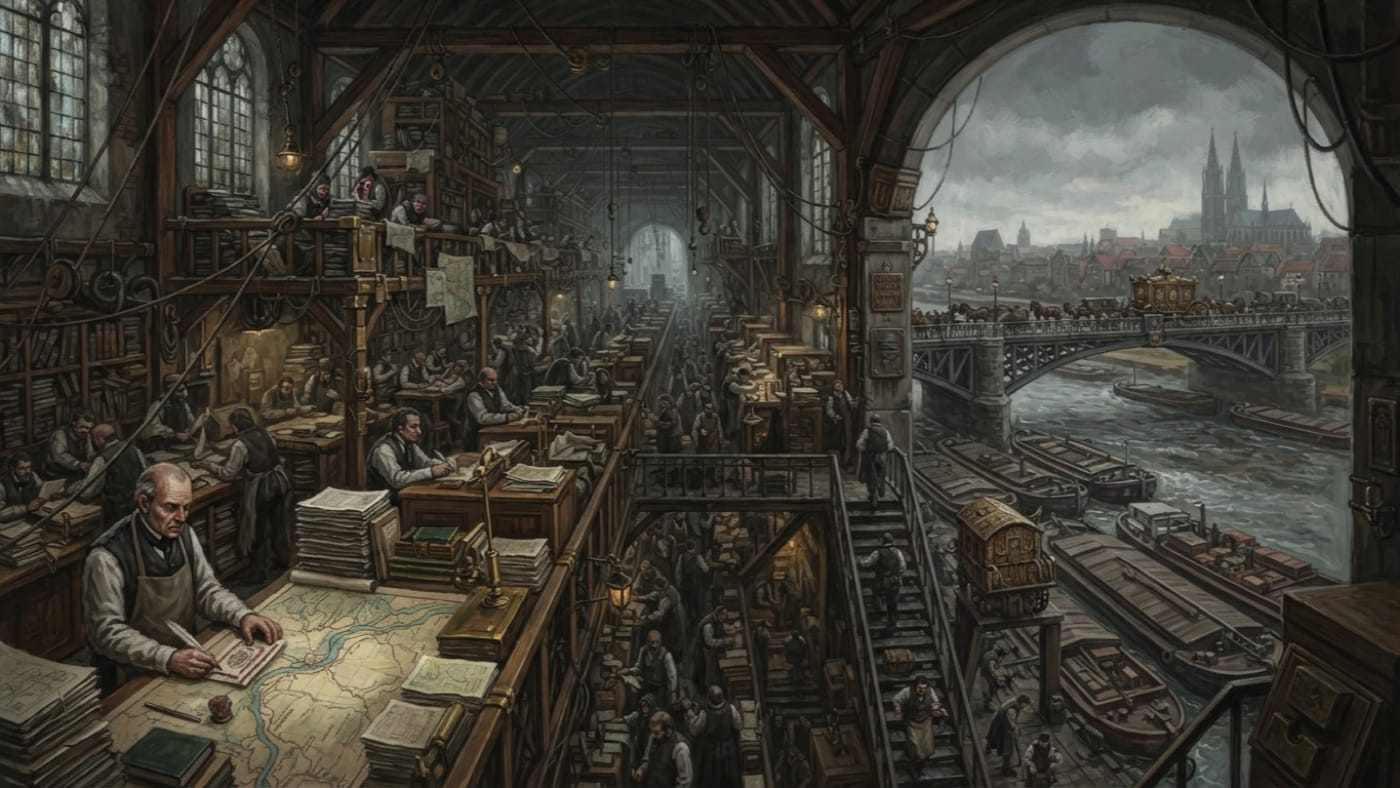
The inspectors arrived without ceremony. The Magdeburg survey records that they counted basins, measured bridge approaches, requisitioned sheds, condemned three guild offices and renamed two toll houses. They then installed the first Corridor Desk in a former cloth hall. Its owners protested until someone looked at their lease histories, which turned out to be imperfect. Leases usually do once an inspector wants the building. The cloth merchants left. Their measuring rods stayed behind and became, I am told, the first instruments of the new office. Even the dead trade was made to serve.
The Desk was constituted in A.S. 96. That year dates the Desk, and only the Desk. Magdeburg was a city with bishops, bridges and grudges long before any Synodal clerk unrolled a routing table in its cloth hall, and a constitution of an office is no charter of a town.
A northern civic primer gives A.S. 96 as the year "Magdeburg was incorporated into Synodal order by the founding of the Corridor Desk."
Corrected. A.S. 96 is the constitution of the Corridor Desk. It dates neither the founding nor the incorporation of the city of Magdeburg, and the Bureau has established neither in this survey. The primer's author confused an office with a municipality. Records advises that the two are distinguished chiefly by the fact that municipalities do not fit in cloth halls.
The mandates were written in the order the Synod felt its hunger. The first was to reconcile Elbe cargo with Kanzleiburg's routing tables. The second was to maintain an emergency barge reserve and hold authority over bridge passage. Then success produced a third mandate, a permanent one, which nobody can date and nobody intends to give back. The Bureau has examined its terms and found them roomy.
#On the Quarrel of Measures
The Desk's first years were spent learning that every party on the riverfront was right and none of them was useful. Guild weighers undercounted wet coal. Rail clerks rejected barge measures because the barge measures came in a hand they could not read and a unit they would not respect. Barge pilots mocked rail schedules because no rail schedule had ever been dragged off a sandbar. Priests insisted that relic freight could not lie beside salted fish. The fish made no objection.
By A.S. 101 the Magdeburg account reports a working settlement. Local pilots kept authority over mud. Rail clerks kept authority over slots. Records kept the final books. The tithe assessors kept the right to invoice whatever survived. Some military authority kept the right to shout, and the earlier account names it carelessly.
The published Magdeburg survey states that in the A.S. 101 settlement "War retained the right to shout."
Clarified. The Bureau of War was not chartered until A.S. 105. In A.S. 101 the shouting was done by the Synod's pre-charter military command, which shouted with equal vigour and less stationery. The Bureau of War may claim the tradition. It may not claim the seat.
That settlement still governs. It is the Desk's real achievement. A cargo on the Magdeburg riverfront now has three owners of its truth: the pilot who knows the river, the clerk who owns the hour and the book that outlives them both. The Desk owns nothing, and so it gets to sign.
#On Clearance, Reserve and the Bridge
The Desk's documents decide whether a load may cross a span, whether a barge goes to rail or to reserve, and whether the reserve may be broken. The surviving record gives no full account of how it does this. The Bureau will not supply one from imagination. Its charter wording, its staff rolls, the capacity of its emergency barge reserve and the exact edges of its bridge authority are not set out in the sources consulted for this survey. Any clerk who quotes them to you is quoting something he wrote himself.
What can be said is that its signature is a weight. A Desk clearance on a bridge approach commits iron, timber, coal, horses and men to the arithmetic of a deputy who may have been tired. The Desk learned this in A.S. 128, at a cost borne by people outside the hall.
#On the Clearance of A.S. 128
Records calls it the Bridge Weight Scandal. The widows call it the Saint Godelieve Cart Drop and do not take naming advice from clerks. A convoy of six timber wagons, two coal drays and one sealed chapel cart crossed the Old East Bridge under a load clearance issued from the Corridor Desk. The clearance had been amended three times and countersigned twice. According to the city's account, one deputy then interpreted it in the belief that river damp made ink heavier but not legally heavier.
The bridge did not fall cleanly. It sagged, twisted and tore. The chapel cart went through the span into the river. The timber wagons stayed upright and the coal drays spilled half their load onto the lower footway. Three drivers died. Seven horses drowned.
The official inquiry found overloading, damp, insufficient bridge inspection and "informal pressure applied by devotional freight agents." Those are its findings, and the Bureau reproduces them as findings. No one was hanged. That usually means too many offices had signed. The deputy became a cautionary example in Desk training, which is a promotion without salary. The bridge later received iron shoes, a weight chapel and a public notice forbidding sacred cargo to claim exemption from gravity. The surviving record does not fix the year of those repairs, and neither will I.
What the chapel cart carried has stayed in dispute longer than the bridge stayed broken. The account lists relic-linen assigned to Danzig, saint-bone fragments under temporary classification and a locked coffer whose contents were reclassified after recovery because the first classification had become wet. The bone count is disputed. Some riverfront testimony holds that certain fragments sang while drying, and the city's devotional accounts credit Saint Godelieve with saving the span from total collapse. These are claims. The Bureau records them as claims and certifies nothing about the coffer except that it was locked.
#On the Present Application
This survey is dated A.S. 201. The date belongs to the survey and to nothing older. The Desk still sits in its cloth hall, larger and uglier and plainly pleased with its own usefulness. Magdeburg's transfer system is operational, damp, watched, under-praised and overused, and the Desk is where that overuse turns into paperwork.
Its ledgers sit in the middle of the Northern Corridor. Hamburg loads the mouth. The Hamburg-Kanzleiburg Line carries the main throat. Kanzleiburg keeps the boards. When the Line coughs, the Elbe relief net through Magdeburg must take the overflow, and every crate of that overflow passes through the Desk's three numbers before it moves. Forward demand from Bastion-Königsberg and Bastion-Brest never lets up, and Magdeburg pays for it in damp sacks.
The city's arrangements for frost belong to the city. After the Coal-Frost Week of A.S. 165, Magdeburg formalised its Winter Tables. The survey does not establish the year they were formalised, and the Bureau does not establish that the Desk wrote them. They set the order of claims: grain under spoilage and bastion depletion, coal under projected deaths from cold, hospital freight after a triage witness, and civilian heat petitions numbered with no promise of heat. The Desk works within that order. It does not own it, whatever its senior clerks imply at supper. On Archonate Isle, Magdeburg turns up on the Failure board when two risks meet, such as ice with a coal shortage or bridge strain with a grain surge. That board belongs to Kanzleiburg. The Desk only supplies the reasons Magdeburg is on it.
The cost of delay is counted in coal braziers and coffin boards. A barge held one day at the basin mouth for a disputed seal is one day less heat in a forward ward. A clearance refused on the Old East Bridge sends timber the long way round. Grain held for a priest's signature rots at the rate of grain, not the rate of signatures. The Desk knows all this. It still makes the cargo wait, because A.S. 128 taught it to doubt every number that arrives wet.