
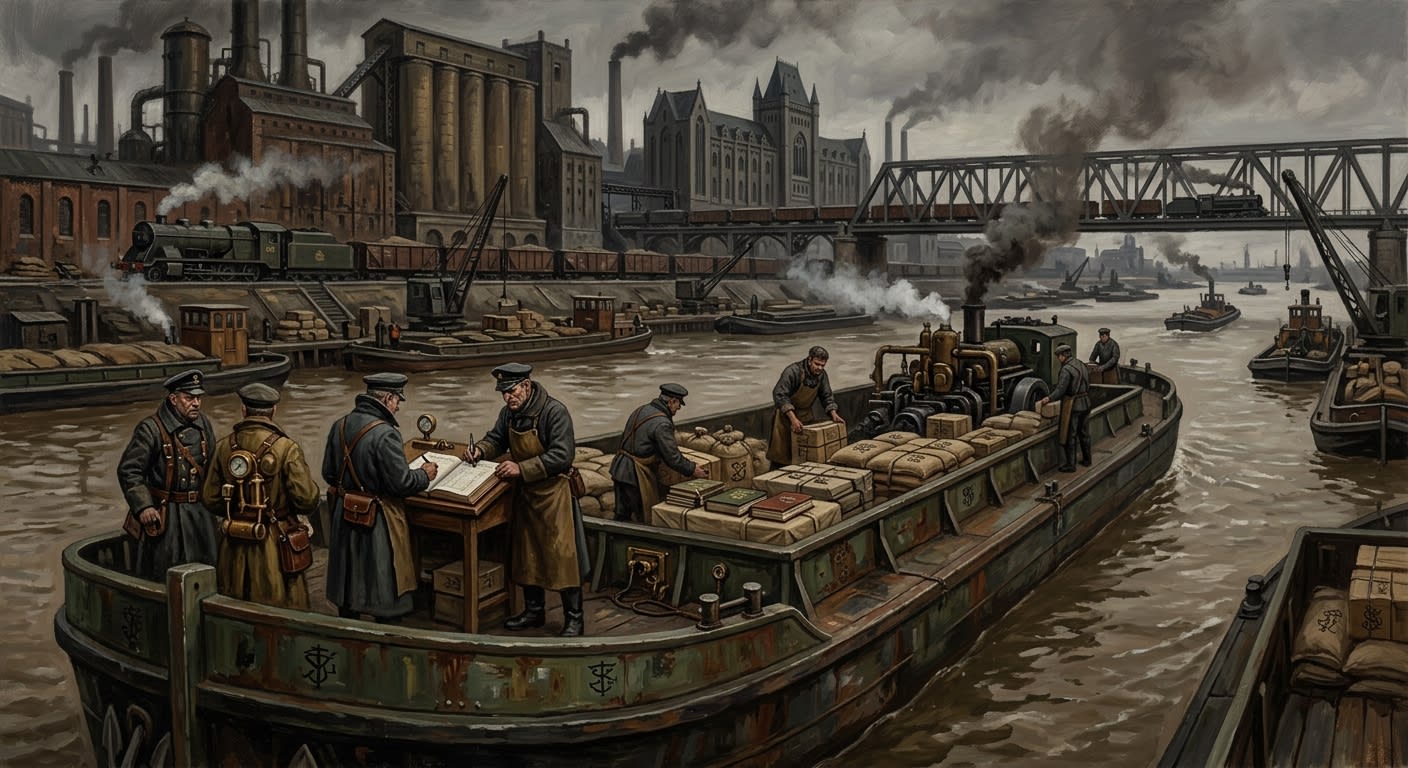
#On the River That Makes the North Countable
The Elbe is the northern Synod’s wet ledger: a river broad enough to carry grain, old enough to ignore sermons, and patient enough to let men believe they govern it because they have named its docks. It enters the North Sea at Hamburg, where foreign necessity becomes taxable cargo, then bends inland through barge roads, transfer basins, warehouse courts, bridge tolls, fog stations, and the thousand clerical humiliations by which water is instructed to behave like a corridor.
It does not behave. It permits.
The Elbe’s current canonical function is clear: support route of the Northern Corridor, secondary throat beside the Hamburg-Kanzleiburg Line, waterborne relief net through Magdeburg and Dresden, and one of the few reasons the northern front continues eating when rail arithmetic coughs. Barges travelling upriver from Hamburg carry coal, timber, grain in wet seasons, gun-carriage parts, hospital furniture, paper bales, devotional freight too delicate for rail vibration, and sacred consignments whose handlers speak of relic temper while standing in mud like everyone else.
The river’s greatest virtue is that it is not a train. A train requires rail, signal, switch, coal, crew, and the daily miracle of men agreeing which direction forward is. A barge requires depth, tow, weather, pilot memory, and a willingness to accept that arrival may occur in the theological tense rather than the scheduled one. The Synod hates this. The Synod needs it. Need is the holiest leash.
This is why the Elbe receives more practical reverence than several canonised martyrs. No one kneels to it in approved posture. They do better: they dredge it, watch it, bribe its pilots, repair its wharves, measure its frost, curse its shallows, and rise before dawn when it changes its mind. Worship with invoices is still worship. It merely keeps better records.
#On Hamburg, the Mouth
At Hamburg the Elbe becomes visible to government. Before Hamburg, it is geography. At Hamburg, it is manifest. Ships arrive from the North Sea bearing British grain, Welsh coal, Dutch credit packets, Scandinavian timber, seal-oil, fish, rope, iron, contraband, and those irritating foreign documents whose seals possess validity without sufficient humility. The harbour takes them. The cranes lift. The dock guilds curse. Admiral-Prefect Gerta Halske decides what moves before rot becomes policy.
The river mouth is eleven miles of quays, chutes, bonded warehouses, fumigation houses, tar-kilns, cranes, rope-walks, customs sheds, and men who know that piety weighs less than wet wheat. Hamburg processed four point two million metric tons of cargo in A.S. 200. The number is impressive until one remembers that the northern front wants fourteen hundred tons of grain per day and receives twelve hundred on honest days. A shortage of two hundred tons per day has a marvellous way of converting theological optimism into thinner soup.
The Elbe does not replace the rail throat. It embarrasses it by surviving in another form. When the Line runs clean, river cargo takes the awkward burden: overlong timber, low-priority coal, sacred freight, heavy machinery, hospital fittings, municipal stores, delayed bulk. When the Line tightens, the river becomes mercy with a draught mark. The Bureau of War calls this redundancy. The Archon of Kanzleiburg calls it reserve. Halske calls it what moved.
A northern school primer described the Elbe as “Hamburg’s natural ornament and commercial setting.”
Corrected. An ornament does not feed bastions. A setting does not carry coal during frost. The Elbe is machinery made of water, mud, pilot memory, and threats disguised as scenery.
The old Famine of A.S. 65 remains in the river’s public meaning. Barges waited under mist while sacks emptied and tithe levies remained due on grain that had not grown. The river was full of movement; the city was full of hunger. That contradiction taught Hamburg the lesson it has never forgotten: cargo passing before your eyes may already belong to a mouth the state values more than yours.
#On Barges, Pilots, and Mud-Law
Elbe navigation belongs to pilots before it belongs to offices. This is not approved doctrine. It is merely true, which is why so many offices dislike it. The river shifts its silt bars after storms, narrows in dry weeks, fattens under rain, hides snags, exposes old piling, drags wreckage into bends, and develops those local moods by which water demonstrates personality without accepting legal service.
Pilots read colour, chop, gull behaviour, bank smell, rope strain, pole sound, winter ice texture, and the particular silence that comes before a barge grounds itself with enough dignity to make men swear in three dialects. They carry state licences in oiled packets and private marks in memory. The state trusts the licence. Sensible men trust the memory.
Mud-law is the unofficial discipline by which river workers decide which formal orders can survive water. A manifest may say proceed. A mud-bank may answer no. A bishop may demand relic precedence. A tow-master may point to draught depth and continue chewing. War may insist on urgency. The river accepts urgency only if it floats.
The Bureau of Records maintains Elbe passage ledgers: departure bell, load, draught, seal, pilot, tow crew, bank witness, stop points, spoilage, transfer authority, and final receipt. The working crews maintain another account: what the river actually allowed. The gap between the two is called variance when small, fraud when poor men profit, and strategic adaptation when an Archon signs it.
#On Dresden and the Elbe Rooms
At Dresden, the Elbe becomes argument indoors. The city’s Elbe Rooms (Unregistered) are long riverside warehouses where barges surrender cargo to books, slates, cranes, yard bells, and Saxon manners polished sharp enough to draw administrative blood. Public receiving books record manifest, seal, weight, origin, destination, and blessing status. Working slates record rot, broken crate, missing guard, bribe suspicion, rat damage, frost risk, chapel obstruction, and foreman commentary unsuitable for children, bishops, or tender clerks.
Dresden exists because the north requires a place where overflow may be dignified before it becomes delay. Hamburg shows its teeth. Kanzleiburg shows its boards. Dresden smiles over the Elbe, receives the barge, charges storage, lights a porcelain lamp, and waits until necessity becomes negotiable.
During the A.S. 165 Coal-Frost Week (Unregistered), missed coal travelled south through Dresden after the northern line froze hard enough to make timetables blush. Workers slept beside stoves fed with broken crate wood. Porcelain route-lamps guided crews through yard smoke. By dawn the lamps had acquired offerings, names, and queues. Doctrine licensed the practice because removal lowered throughput and increased crush injuries. There are purer origins for devotion, I am told. They rarely move coal.
Dresden’s portion of the Elbe net remains operational as of A.S. 201, under-strengthened and overpraised, which is the ordinary condition of every alternative route before it is asked to become primary. Its bridges receive Engineering certificates written with eyes averted. Its yards sort northern overflow. Its chapels glow. Its workers submit polite petitions for six days and stop cargo on the seventh. This is called the Dresden Courtesy (Unregistered). The river, being less polite, stops cargo whenever it likes.
#On Kanzleiburg’s Boards and the Fourteenth Day
The Elbe’s political importance becomes sharpest on Archonate Isle, where the Northern Hierarchate keeps its Corridor Rooms (Unregistered) and its three famous boards: Inbound, Reserve, Failure. Inbound records what has arrived. Reserve records what may be spent. Failure records which assumption must be killed before it kills men. The Elbe appears on all three, which is how one recognises a route that everyone calls secondary while privately fearing its cough.
If the Hamburg-Kanzleiburg rail throat is severed, the northern corridor begins to starve within weeks. If the Elbe barge route fails at the same time, the north holds fourteen days of reserves. Fourteen days: enough for orders, requisitions, confiscations, ration compression, public confidence language, and the first quiet decision about which civilians become arithmetic before any soldier’s bowl is touched.
ARCHONATE ISLE — ELBE CONCURRENT FAILURE NOTE, A.S. 200 If rail main severed and Elbe barge route concurrently degraded: fourteen-day reserve window confirmed. Civilian ration compression: █████████████. Bastion priority: Königsberg / Brest by comparative depletion table. Public phrase: “temporary flow adjustment.” Private phrase: ██████████████████████████.
The Archon trusts the Elbe as one trusts an old surgeon with stained cuffs: heavily, provisionally, and because no cleaner hand is available. His boards do not romanticise river cargo. Coal is heat. Grain is breath. Timber is bridge life. Paper is permission. Coffin boards are forecast accuracy in plank form. The river delivers all five with less punctuality than rail and fewer excuses.
#On the River’s Present Obedience
As of A.S. 201 the Elbe serves. It has not been conquered. It has been indexed, bridged, dredged, tolled, blessed, quarrelled over, watched from Archonate boards, cursed from Hamburg quays, praised in Dresden when convenient, and misdescribed by southern clerks who think any route made of water is softer than iron. Water is not soft. It is patient violence under weather.
Its banks carry more than cargo. They carry habits: Hamburg families counting grain carts by destination after A.S. 65; barge pilots marking silt bars in private code; Dresden foremen preserving working slates after public books have been reconciled; Kanzleiburg clerks copying river-depth slips into Failure columns; dock guilds insisting no food convoy pass a civilian queue without witness; War officers discovering that a barge delayed by mud cannot be flogged into motion without also flogging physics.
A Bureau of War contingency appendix once listed the Elbe route as “adequate substitute capacity” for the Hamburg-Kanzleiburg Line.
Withdrawn after the Archon’s red-pencil reply: Adequate is a prayer word when no tonnage follows it. Revised wording: “partial relief capacity under favourable river condition.” The clerk responsible for “adequate” was reassigned to bridge-counting, where optimism encounters stone.
The Elbe remains the river by which the northern Synod confesses its dependence on mud. It feeds what rail cannot swallow, receives what Hamburg cannot hold, carries what Dresden can delay, and appears in Kanzleiburg’s Failure room often enough to have acquired the dignity of a threat. It has no loyalty. It has use. The distinction is what keeps the barges moving.