
#On the Iron Throat
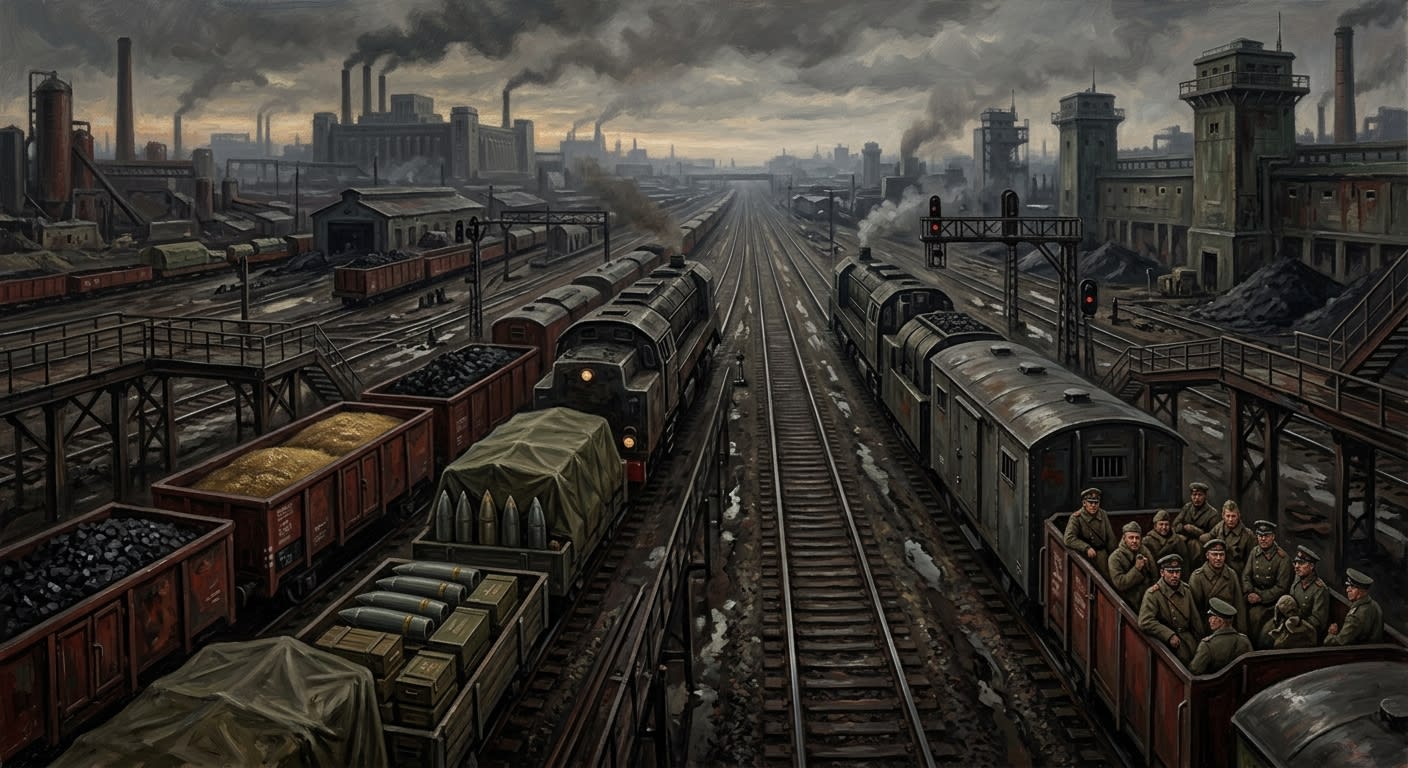
The Hamburg-Kanzleiburg Line is two hundred and eighty kilometres of double-tracked, continuously maintained iron between Hamburg and Kanzleiburg, which is to say between the mouth that swallows the world and the city that teaches swallowed things to march east. It is the most heavily trafficked railway in the Synod's northern territory. Forty trains pass in winter, sixty in summer, each train carrying between two hundred and six hundred tons of grain, coal, timber, shells, cloth, medicine, replacement boots, prayer stools, coffin boards, and the smaller freight of bureaucratic vanity.
A lesser civilisation would call it infrastructure. We call it a sacrament with timetables. The distinction is mostly billing.
The line begins among Hamburg's wet cranes, foreign invoices, dock curses, coal dust, British grain captains, Dutch credit factors, and Gerta Halske's blue-pencil severity. It ends at Kanzleiburg's terminus, beneath glass and soot, where lantern-men walk couplings before dawn and clerks convert harbour chaos into eastbound sequence. Between those two civic jaws lies the throat. Everyone who matters pretends to command it. The rails answer to maintenance.
#On Hamburg's Mouth
Hamburg loads the line with the raw arithmetic of survival. In A.S. 200 the harbour processed four point two million metric tons of inbound cargo. Roughly a third was grain. Another third was coal and raw material. The remaining third was filed as Sundries, a category into which Records places anything too embarrassing, too holy, too foreign, or too poorly labelled to survive daylight.
The dock guilds feed the wagons: the Longshoremen's Brotherhood on the quay, the Stevedores' Compact in the holds, the Coal-Heavers' Union in the black yards where dawn is a rumour told by foremen with dirty hands. British ships unload grain with Protestant smugness. Dutch houses finance contracts with smiles thin enough to slice wax. Scandinavian timber, seal-oil, salted fish, Welsh coal, contraband too clever for Tithes, and devotional cargo too stupid for War all come to the sheds.
Admiral-Prefect Halske's office decides which cargo moves before rot, which waits behind ammunition, which receives armed escort, which devotional shipment may sit under canvas until its sponsoring bishop learns that relic-freight spoils slower than wheat. The Bureau of Purity complains. Halske listens after the loading window closes, which is a form of courtesy in Hamburg and an insult everywhere else.
A harbour catechism once called the Hamburg terminus “a point of departure for blessed abundance.”
Corrected. It is a place where hungry arithmetic is tied down with rope, stamped, weighed, argued over, undercounted by Tithes, overpromised by War, and sent east before the rats develop legal standing.
#On the Track Itself
The Line leaves Hamburg under gulls, coal smoke, and the damp suspicion of the Elbe. It crosses flat country, service yards, guarded bridges, culverts with numbered grates, winter sidings, signal boxes, coal stops, hospital transfer spurs, and villages whose inhabitants have learned to sleep through iron thunder. Every eight to twelve kilometres stands a Guild of Rails section house: stove-poor, oil-stinking, tool-proud, more powerful at two in the morning than half the chancelleries of the west.
A railway is not two strips of iron. It is a chain of permissions. Bridge load. Signal clear. Crew awake. Coal dry. Track sounded. Switch pinned. Manifest reconciled. Prayer optional, despite what priests say near cameras. The Railway Track Engineer walks it with gauge rod, chalk, oilcan, and ledger, listening for dead notes under sleeper and frost-buckle under snow.
The Bureau of Engineering inspects every kilometre quarterly, files recommendations, and then discovers the Guild has repaired whatever mattered before the forms arrived. This annoys Engineering in the manner of priests discovering that laymen can pray without supervision. Engineering retains authority. The Guild retains the wrenches. Authority without wrenches is liturgy.
#On Kanzleiburg's Swallow
At Kanzleiburg the Line enters the Rail Quarter, twelve square kilometres of marshalling yards, sidings, engine sheds, coal bunkers, signal gantries, coupling lamps, and men who can identify a cargo by smell before the manifest is opened. Here the Hamburg flow is broken, sorted, recombined, and dispatched: east to Warsaw, north toward Danzig and Bastion-Königsberg, onward to Bastion-Brest, southwest to Magdeburg and the Elbe barge net, south to Dresden and the central corridor.
The Archon governs this end of the Line by boards: inbound, reserve, failure. Inbound says what reached him. Reserve says what may be spent. Failure says which assumption must be killed before it kills men. I admire the third board more than several saints.
ARCHONATE ISLE — LINE FAILURE PACKET, A.S. 200 If Hamburg-Kanzleiburg main line severed: activate ████████████ diversion through ██████████. If Elbe barge route concurrently severed: ration class reduction █████; civilian concealment language ██████████. If northern bastion reserve below ███ days: authorise █████████████████. Public phrase: confidence.
Kanzleiburg does not receive trains as a city receives visitors. It consumes them. Wagons enter with harbour mud on their wheels and leave as doctrine made physical: grain to this bastion, coal to that yard, prayer-stools to the unfortunate unit whose chaplain has requisitioned sincerity in bulk.
#On the Soldiers Along the Iron
The Bureau of War guards the Line with eighteen thousand soldiers, more than most stretches of the Sagittal Line itself. This fact offends romantics. Good. Romance is for walls. Grain is for survival. A bastion without food becomes a monument with teeth marks.
The guard force occupies bridgehouses, culvert posts, patrol huts, signal stations, rail approach forts, and those miserable little winter dugouts where men learn that watching a track for sabotage is colder than being shot at, because being shot at at least grants narrative shape. Patrols walk in pairs near the culverts. Mounted detachments shadow supply surges. Signal guards sleep in their boots. Purity informants sniff for seditious chalk. Records clerks count the informants and undercount the rats.
Sabotage attempts are filed under classifications the Bureau of Records does not discuss. This means there have been enough attempts to require a drawer, then a cabinet, then a locked room, then a euphemism. Loose spikes. Mis-set switches. Wet powder under bridge timbers. False devotional crowds near signal boxes. Children paid to place icons on railheads. Men found in culverts with wire, saints' medals, and no satisfactory order of allegiance.
Public safety circulars describe the Line as “secure by the vigilance of the faithful.”
Clarified. The Line is secure by soldiers, section crews, informants, bribes, dogs, locked points, bridge lamps, and the willingness of tired men to crawl beneath wagons in weather that would make a demon request reassignment.
#On Failure, the Fifteenth Day, and Other Theological Questions
If the Hamburg-Kanzleiburg Line is severed, the northern corridor begins to starve within weeks. If the Elbe barge route fails at the same time, the Northern Hierarchate has fourteen days of reserves. The Archon says he will have fixed matters before the fifteenth. I believe him against my taste, vanity, and professional resentment.
The alternative routes exist as all alternatives exist in government: too small, too slow, too expensive, and described in memoranda as adequate. Magdeburg can take barges until the river misbehaves. Dresden can receive transfers until snow converts theory into comedy. Road convoys can supplement rail, provided horses, fodder, guards, weather, bridges, and the Creator agree. The Creator has not countersigned the plan.
The Line's weakness is also its sanctity. It is a single throat, and single throats invite knives. Yet multiplicity is expensive, and the Synod has many mouths: Strasbourg's magnificence, Munich's warehouses, Warsaw's yards, the bastions' hunger, Purity's appetite for everyone else's budget. The Line remains a tolerated impossibility because each day it works becomes proof that yesterday's risk was wisdom.
#On the Present Condition
As of A.S. 201, the Hamburg-Kanzleiburg Line runs. This is the highest praise a railway can receive and the only praise it respects. Forty trains in winter. Sixty in summer. Grain west to east, empties east to west, wounded sometimes back, orders always forward, excuses in every direction.
Halske feeds it. The Guild listens to it. War guards it. The Archon routes it. Tithes miscounts it. Purity suspects it. Doctrine blesses it from a safe distance and later claims responsibility.
There are holier roads in Europe, cleaner roads, older roads, roads with shrines at every mile and songs attached to each ditch. None feeds the northern bastions with such brutal regularity. The Hamburg-Kanzleiburg Line has no patience for pilgrimage sentiment. It carries grain, coal, shells, boots, boards, medicine, men, and the occasional bishop who spends the trip discovering that freight precedence is a harsher tutor than theology.
The timetable is posted. The lanterns are lit. The guard walks the bridge. The section man taps the rail. Hamburg exhales. Kanzleiburg swallows.