
#On the City That Receives What Iron Cannot Swallow
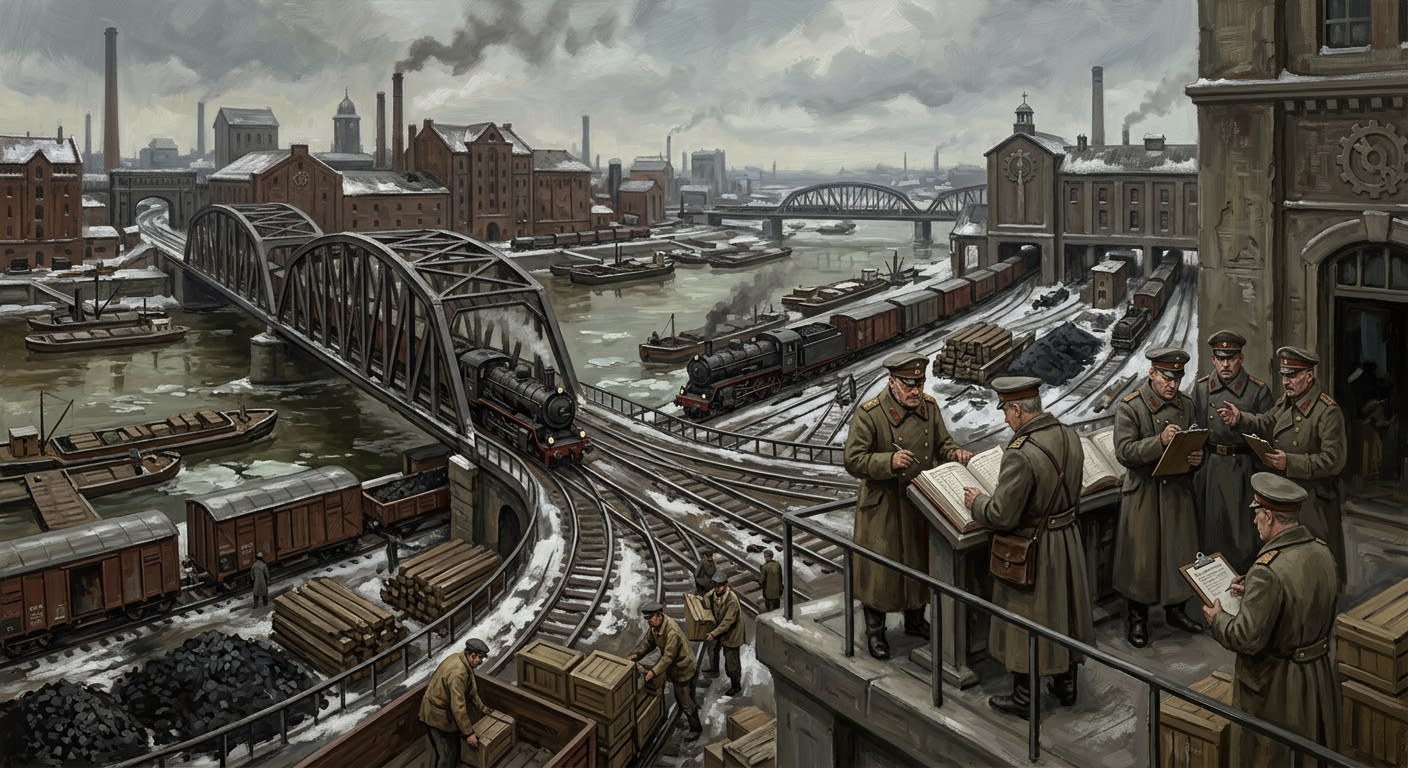
Magdeburg sits on the Elbe with the expression of a clerk who has been handed a wet invoice and told that the fate of the northern front depends upon legibility. It is a transfer city, which sounds minor until one remembers that empires die less often from grand defeats than from cargo waiting at the wrong platform while a committee decides whether a barge may become a train. Hamburg is the mouth. The Hamburg-Kanzleiburg Line is the iron throat. Kanzleiburg is the swallow. Magdeburg is the place where everything that failed to fit in that theology arrives damp, late, underguarded, overlabelled, and still expected to save men.
The city has never enjoyed this description. Cities prefer titles with towers in them. Magdeburg has towers, churches, bridges, guild halls, old scars, and enough civic vanity to outfit a minor kingdom; the Bureau records none of these first because none of them matter when barges queue at low water and coal wagons wait under frost. Its dignity is logistical. Its sin is the belief that logistics, once repeated often enough, becomes innocence.
As of A.S. 201, Magdeburg belongs to the Northern Corridor's underpraised machinery: Elbe barge relief, rail handoff, wet-storage discipline, winter contingency, bridge toll custody, and that miserable art by which a crate blessed in Hamburg may reach Warsaw, Danzig, Dresden, or the northern bastions without becoming a lawsuit, a relic scandal, or soup for rats. It succeeds often. It claims virtue whenever it succeeds. The two are not identical.
#On the Elbe Rooms of the Middle River
Magdeburg's transfer basins begin before dawn, because water cares nothing for civilized hours and railway men become vicious if made to wait under steam. Barges come upriver from Hamburg with coal, grain, timber, hospital furniture, paper bales, sacred freight too delicate for rail vibration, and crates marked Sundries in that cowardly hand by which Records signals either ignorance or discretion. The Elbe gives them mud. The city gives them numbers.
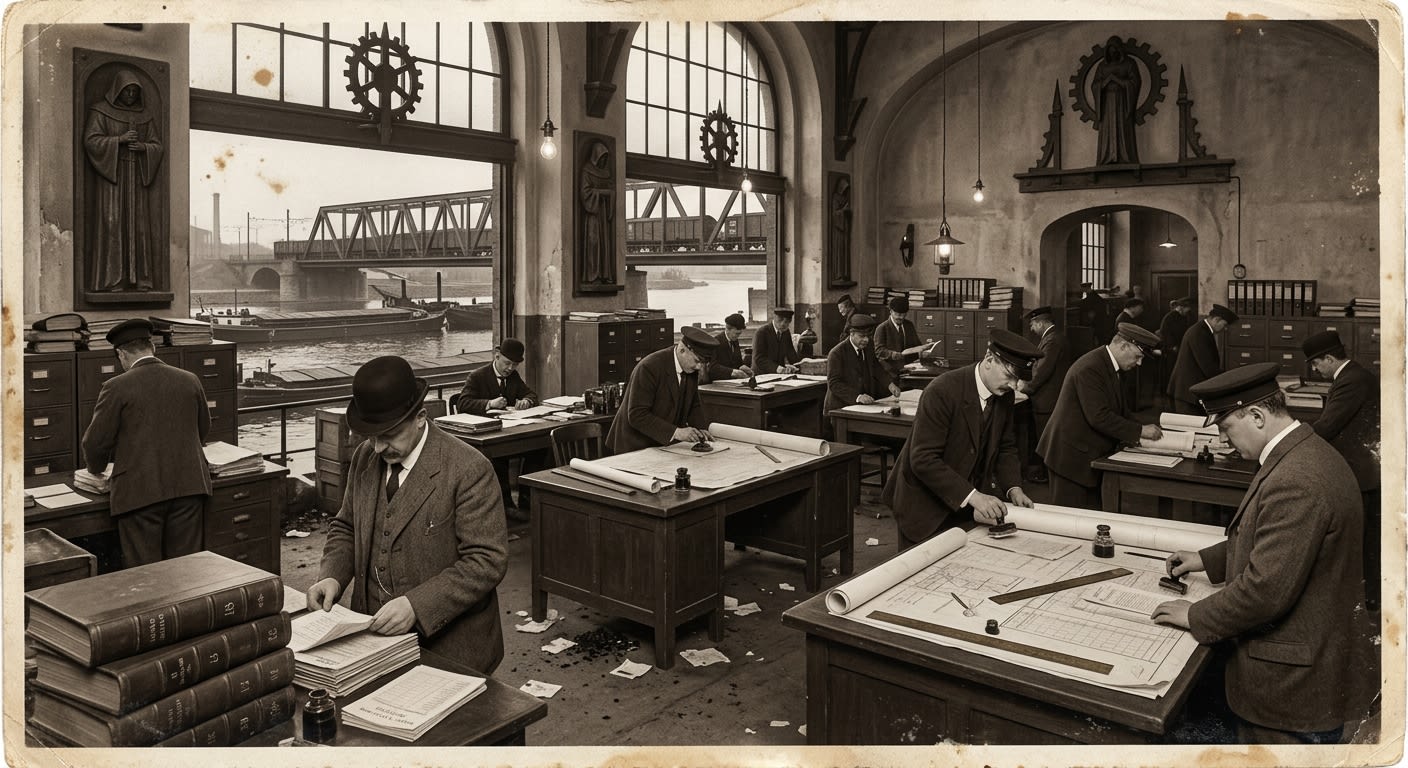
The riverfront is a sequence of basin locks, crane towers, weigh houses, covered platforms, salt sheds, rope stores, cattle slips, lamp posts, chapel kiosks, Customs benches, and three great wet warehouses called the Middle Rooms. The name is dull enough to be true. Middle One takes grain and ration cargo. Middle Two takes coal, timber, machinery, and the sort of iron pieces that injure men who call them by the wrong name. Middle Three takes sacred, disputed, fragile, perishable, politically hot, legally cold, or otherwise annoying cargo. Middle Three is always fullest.
A barge does not simply unload. It confesses. Pilot name, draught, depth at last bend, seals intact, seal suspect, seal missing, rat marks, waterline creep, rope damage, guard complaint, spoilage smell, blessing status, ward priority, declared destination, suspected destination, and whether any passenger travelled unlisted beneath tarpaulin. Magdeburg clerks record the confession in river books and rail books. When the two disagree, the cargo waits in penance while humans discover which book lies more usefully.
A northern transport primer described Magdeburg as “a simple inland transfer station.”
Corrected. Nothing involving water, hunger, rail slots, bridge weight, sacred cargo, Dutch credit, Prussian routing, and Bureau seals has ever been simple. The primer has been withdrawn from officer instruction and retained for use in identifying idiots.
#On A.S. 95 and the Prussian Harness
Magdeburg became indispensable after A.S. 95, when Berlin received its Synodal paint and became Kanzleiburg. The old Prussian road-and-rail habits survived the renaming, as sensible diseases survive bad incense. Kanzleiburg drew the boards inward: Inbound, Reserve, Failure. Hamburg loaded the western throat. Warsaw, Danzig, Brest, and Königsberg demanded forward life. Magdeburg found itself converted from river city into contingency organ.
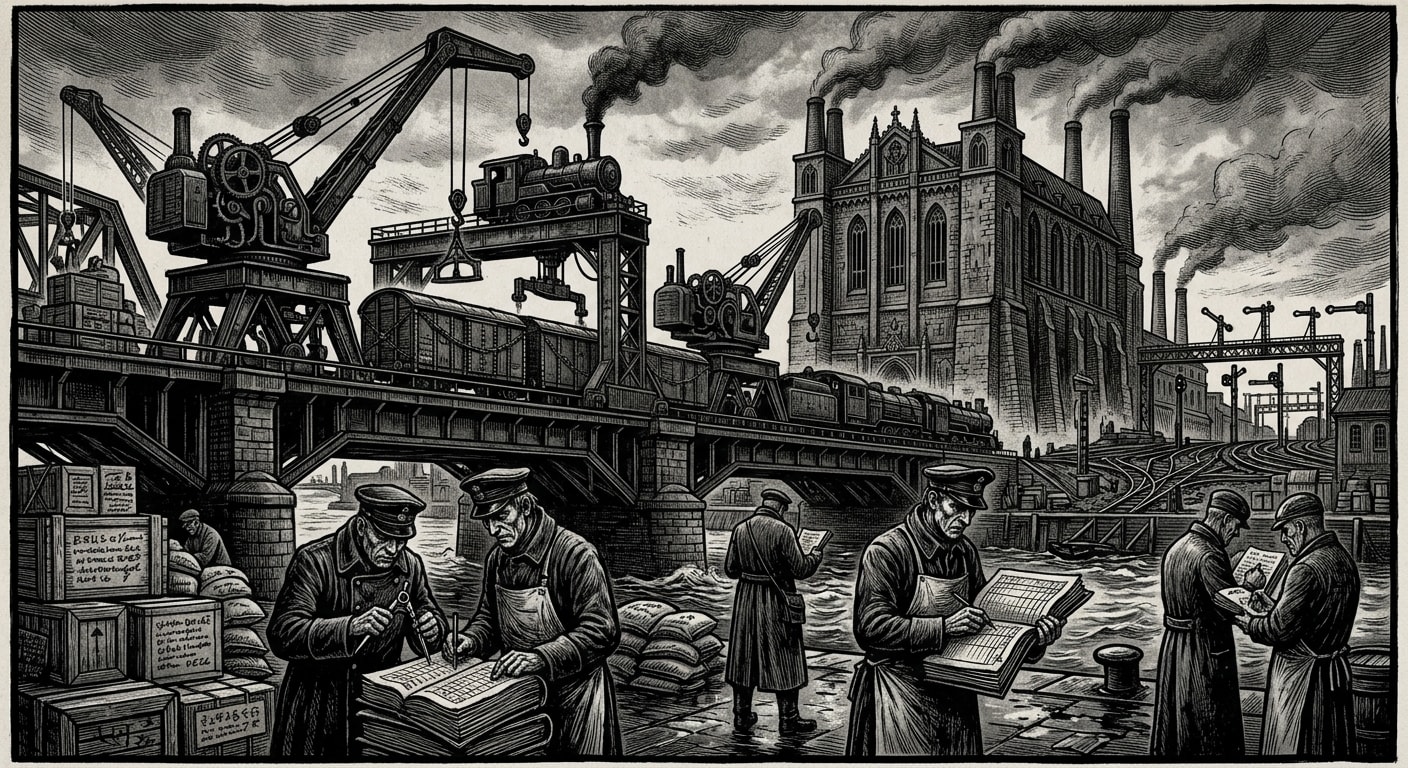
This conversion was not dramatic. No grand consecration, no white horse, no archbishop weeping over the cranes. Inspectors arrived, counted basins, measured bridge approaches, requisitioned sheds, condemned three guild offices, renamed two toll houses, and installed the first Corridor Desk in a former cloth hall whose owners protested until their lease histories were discovered to be imperfect. The Desk still stands there, larger now, uglier, and entirely pleased with its own usefulness.
The Corridor Desk was constituted in A.S. 96 with an initial mandate to reconcile Elbe cargo with Kanzleiburg routing tables, a secondary mandate to maintain emergency barge reserve and bridge-passage authority, and a permanent mandate invented after success, as all permanent mandates are.
The Prussian officers did not trust Magdeburg's old guild arithmetic. This was sensible. The old guilds counted by fee, favour, oath, chapel-right, family mark, and memory of who cheated whom in a winter no one could date. Kanzleiburg required numbers that could be transmitted without a tavern argument. The first year nearly broke the riverfront. Guild weighers undercounted wet coal. Rail clerks rejected barge measures. Barge pilots mocked rail schedules. Priests insisted relic freight could not be stored beside salted fish. The fish, being dead, lodged no objection.
By A.S. 101, the Corridor Desk had achieved the settled compromise: local pilots retained mud authority; rail clerks retained slot authority; Records retained final books; War retained the right to shout; Tithes retained the right to invoice whatever shouting survived. The city has functioned ever since, proving again that government is less the absence of conflict than the habit of filing conflict before it explodes.
#On the Bridge Weight Scandal
Magdeburg's first great modern shame is called the Bridge Weight Scandal by Records and the Saint Godelieve Cart Drop by widows who do not take naming advice from clerks. In A.S. 128, a convoy of six timber wagons, two coal drays, and one sealed chapel cart crossed the Old East Bridge under a load clearance issued from the Corridor Desk. The clearance had been amended three times, countersigned twice, and interpreted once by a deputy who believed river damp made ink heavier but not legally heavier. This deputy later became a cautionary example in training, which is a promotion without salary.
The bridge did not collapse in a gratifyingly total fashion. That would have simplified blame. It sagged, twisted, and let the chapel cart fall through a torn span into the river while the timber wagons remained upright and the coal drays shed half their load onto the lower footway. Three drivers died. Seven horses drowned. The chapel cart contained relic-linen assigned to Danzig, two crates of saint-bone fragments under temporary classification, and a locked coffer whose contents were reclassified after recovery because the first classification had become wet.
MAGDEBURG OLD EAST BRIDGE RECOVERY — A.S. 128 Recovered linen lots: 41 of 43. Recovered bone fragments: count disputed; three pieces sang during drying and were transferred under seal. Locked coffer contents: ███████████████████████. Bridge deputy statement: “The number was correct when dry.” Disposition: █████████████████.
The official inquiry blamed overloading, damp, insufficient bridge inspection, and “informal pressure applied by devotional freight agents.” No one was hanged, which tells the trained reader that too many offices were implicated. The Old East Bridge received new iron shoes, a weight chapel, and a public notice forbidding sacred cargo from claiming exemption from gravity. The notice remains one of the Bureau's finest minor achievements.
Local devotional accounts claim Saint Godelieve preserved the bridge from complete collapse.
Clarified. The bridge preserved itself by partial structural competence, prior masonry, and the fact that the overloaded wagons were badly spaced. Saint Godelieve may accept gratitude for the three surviving drivers. She may not accept credit for engineering.
#On Frost, Bottlenecks, and the Winter Tables
Magdeburg hates frost more honestly than it loves the Creator. Frost enters the Elbe, grips the basins, slows tow lines, splits rope, makes crane chains bite, locks barges into positions that look deliberate only to fools, and turns every contingency memorandum into kindling with footnotes. Kanzleiburg may keep red pencils for failure, but Magdeburg keeps axes, coal braziers, ice hooks, and men whose hands resemble old root wood by their thirtieth year.
The Winter Tables were formalised after the A.S. 165 Coal-Frost Week, when Dresden made its porcelain lamps famous and Magdeburg made itself useful without becoming picturesque. Hamburg cargo had missed primary rail slots. Coal lots came upriver in bad sequence. Three barges iced into a basin mouth. Two crane crews worked under canvas heated by illegal stoves. One stove killed four men and saved enough coal to keep a hospital train moving. Records listed the deaths as ventilation error. The riverfront called them Furnace Four.
The Winter Tables now govern frost passage, basin priority, thaw crews, coal braziers, night unloading, civilian heat claims, hospital-transfer precedence, and the delicate question of whether devotional freight may be opened for packing straw if the straw is needed to keep wounded men from freezing. Doctrine said no. Mercy said yes. War used the straw and asked for retroactive blessing. Doctrine supplied it. The wounded, inconsiderately alive, complicated the original ruling.
The city became expert in ugly triage. A barge of coal for Bastion-Königsberg outranks a merchant hall. Grain for Bastion-Brest outranks a parish feast. Coffin boards outrank decorative timber if the casualty forecast has worsened. Paper bales outrank furniture when the papers contain conscription orders and the furniture contains only comfort. Comfort, in the northern corridor, travels third class when it travels at all.
#On Archonate Isle and the Magdeburg Table
In Kanzleiburg's Corridor Rooms, Magdeburg is not a room of its own in the proud sense; it is a table that refuses to stay secondary. The Hamburg room smells of salt and foreign credit. The Danzig room smells of damp sacks and Baltic anxiety. The Dresden room is full of conditional arrows and Saxon politeness. The Magdeburg table smells, according to one Archonate clerk, of wet rope, coal dust, and decisions postponed until they grow teeth.
Magdeburg appears most often on the Failure board when two risks touch: rail disruption plus river delay, bridge strain plus grain surge, ice plus coal shortage, sacred freight obstruction plus bastion depletion. A single problem belongs to its own desk. Two problems become Magdeburg. Three become the Archon's voice in the corridor and clerks suddenly writing faster.
The city's power lies in being deniable. No one in Strasbourg praises Magdeburg when the northern front eats because the Elbe net held. Praise goes to the Line, to the Archon, to Hamburg's tonnage, to War's foresight, to Providence if the sermon is hungry. Magdeburg receives revised tables, heavier locks, and another instruction to improve throughput without increasing labour unrest. Such is the gratitude of systems.
A Bureau of War contingency appendix once treated Magdeburg and Dresden as interchangeable Elbe relief nodes. It has always been withdrawn after Kanzleiburg objection. Dresden delays with manners. Magdeburg transfers with mud. Confusing the two is how cargo ages in sheds while officials congratulate themselves on river literacy.
#On the Present Condition
Magdeburg in A.S. 201 is operational, damp, watched, under-praised, and overused. Its cranes rise before dawn. Its bridge bells sound load sequence. Its pilots argue with clerks. Its railmen insult pilots with professional affection. Its priests bless cargo they do not understand. Its Tithes assessors count wet sacks as if water were a taxable collaborator. Its children learn to read destination marks before catechism, because destination marks decide which bread passes through and which bread may be bought.
The city has profited from dependence. Let no sentimental municipal councillor pretend otherwise. Transfer fees, storage charges, winter supplements, bridge tolls, pilot licences, repair contracts, chapel custody fees, disputed-freight arbitrations, and the small extortions of urgency have fattened families whose public prayers mention sacrifice with admirable volume. Magdeburg does not merely serve the Northern Corridor. It invoices the corridor for the privilege of being served. When Archonate Isle asks for humility, Magdeburg sends tonnage tables. When War asks for speed, Magdeburg sends bridge limits. When Tithes asks for cleaner accounting, Magdeburg sends wet sacks and dares the assessors to wring them.
And yet, when the river is high enough, when the rail slots cough, when Hamburg's mouth is full and Kanzleiburg's boards turn red, Magdeburg does the ugly work. It receives. It weighs. It dries. It argues. It transfers. It sends coal east, grain north, paper onward, wounded away, coffin boards where forecast requires plank mercy. The city is no saint. Saints rarely know axle weight.