
#On the Port Ordained for Argument
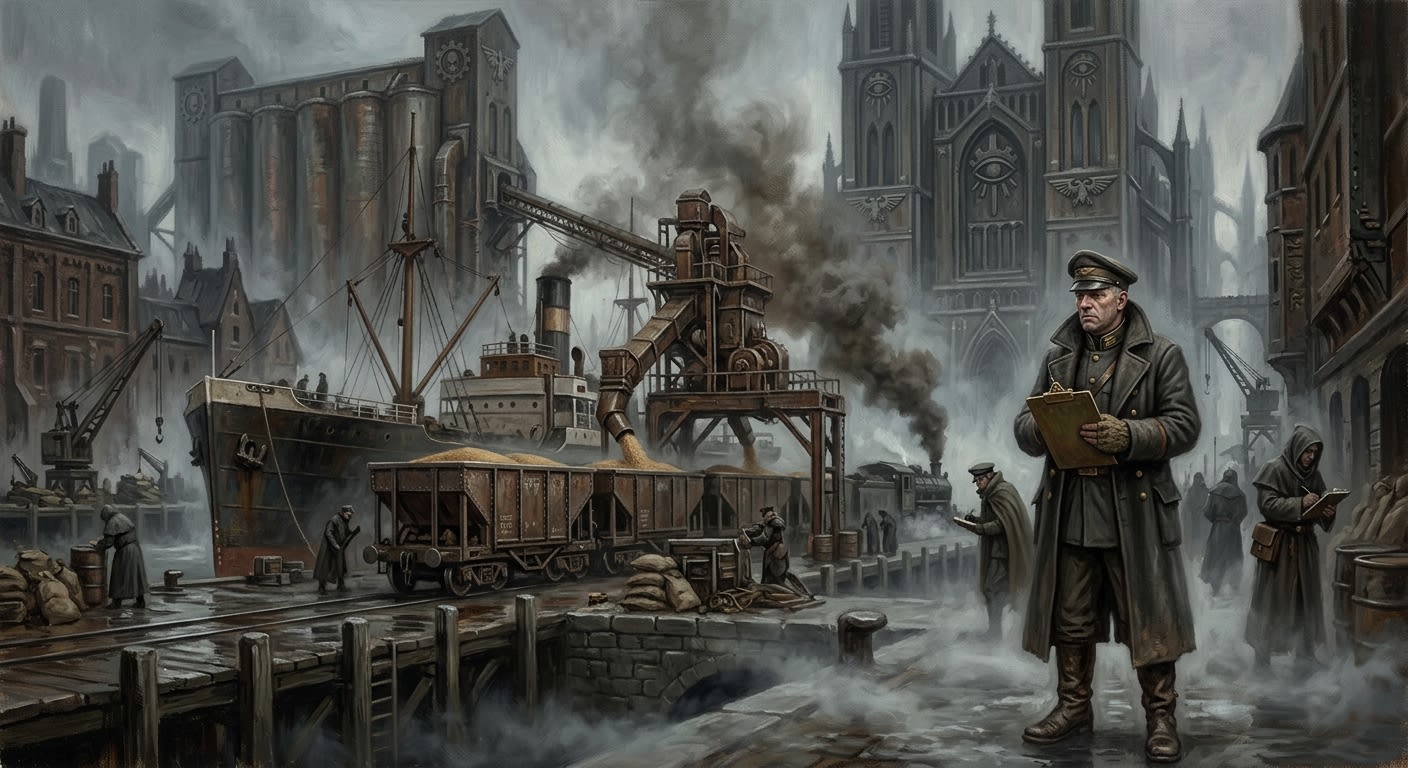
Danzig sits on the Baltic coast where the Northern Corridor grows cold enough to acquire manners and dangerous enough to deserve them. The maps call it Gdańsk, Danzig, Dantiscum, Free Port, Synod Port, grain mouth, timber basin, and the usual succession of names by which officials attempt to prove that a city has changed owners when in fact the warehouse keys remain in the same wet hands. It lies west of the worst Grey pressure, east of comfort, north of Kanzleiburg's boards, and close enough to Bastion-Königsberg that every sack, rope, bell-clapper, barrel hoop, and rumour feels already inspected by hunger.
It is a port made from grain, fog, old law, brick, amber, fishbone, tariffs, Lutheran ghosts, Catholic corrections, and the slow civic genius of men who can bow in public while keeping a second ledger under the salt bin. Call it Baltic literacy.
Danzig's significance is vulgar and holy: it feeds the north. Hamburg swallows the North Sea and sends bulk east through iron throats. Lübeck learned silence after smoke. Danzig faces the Baltic directly, draws from Polish grain roads, Vistula barges, coastal timber, Fractured North oil traffic, fish fleets, amber cutters, and the unofficial courage of pilots who know which fogs ask questions. Its cargoes enter Kanzleiburg's Danzig Corridor Room, Warsaw's forward tables, Königsberg's ration estimates, and Brest's winter contingency sums. A sack miscounted here may become a ladle withheld at a bastion two weeks later.
The tithe authorities knew this before they had the dignity of a Bureau. Since A.S. 65, when the northern Line hardened and every grain mouth became a moral organ, Danzig has been loved with the eyes of a creditor at a funeral. The Bureau of Records knows it too, though Records prefers the city flatter, cleaner, more obedient on paper, and less inclined to let dockside practicality outrun doctrinal permission. The Bureau of War does not love Danzig. War loves nothing that smells of fish unless fish can be issued by ration code. War depends on Danzig, which is stronger and more humiliating.
#On the Warehouses and the Smell of Old Law
The harbour district has the ancient look of a city that was rich before the Synod learned to spell necessity. Brick warehouses crowd the Motława (Unregistered) channels. Granaries stand with hoist beams extended over black water like clerks pointing at unpaid arrears. Counting houses keep windows angled toward basin and weighbridge, allowing merchants to pretend they admire weather while watching cargo. Churches rise behind them, severe enough to satisfy Purity at a distance and old enough to remember prayers that have not yet been approved.
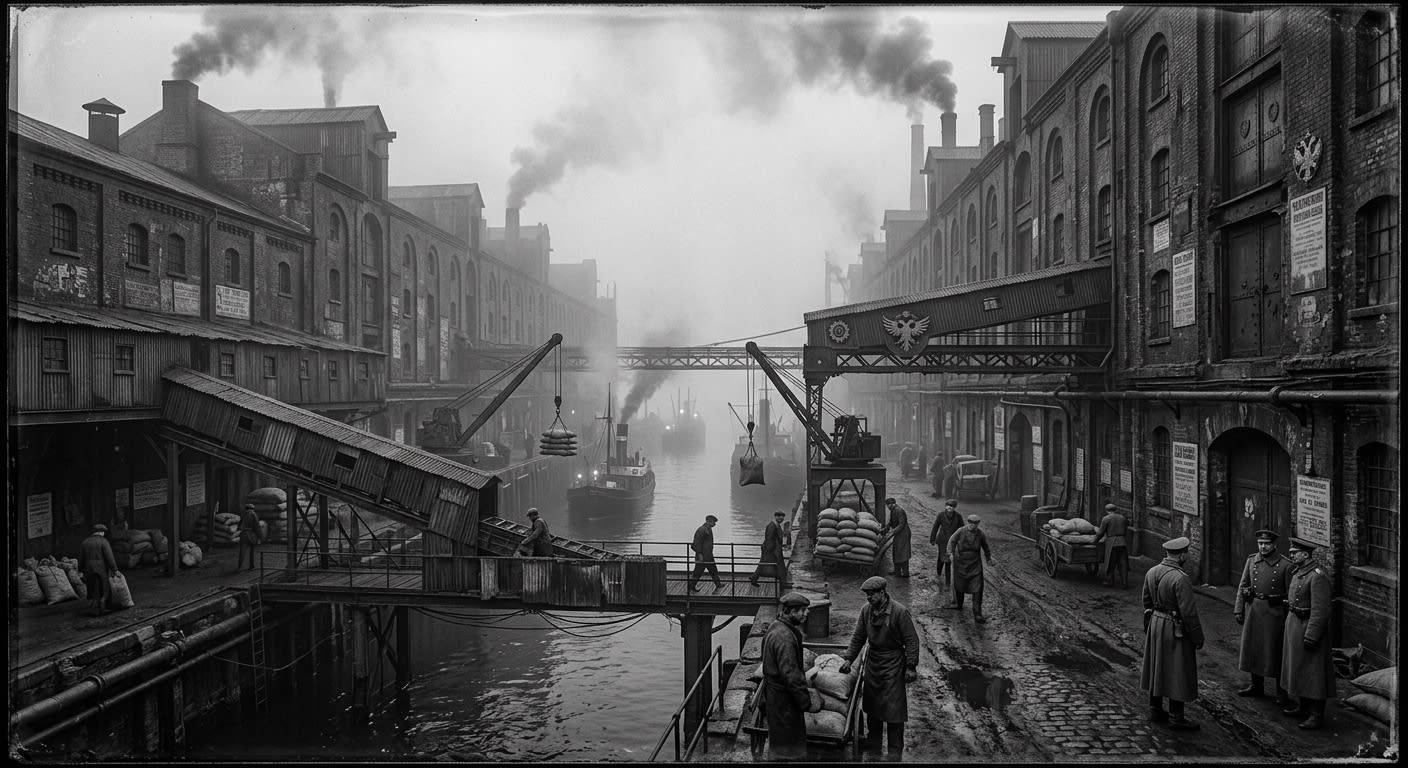
The smells arrange the city more faithfully than its maps. Damp rye at the grain quays. Pine tar and thawing rope near the timber yards. Cod, herring, and salt at the fish stairs. Wax, smoke, and mould in the chapel courts. Amber dust near the cutters' lanes. Foreign pitch at the repair slips. In the alleys: old beer, wet wool, lamp oil, cabbage steam, and the sharp little smell of paper hidden under coats.
Danzig moves by basin, gate, bridge, cellar, and bell. The Long Granary takes river loads and coastal sacks. The Timber Mouth receives rafts and boards, with northern pine stacked in damp ranks that creak during fog as if remembering forests. The Amber Stairs handle small cargoes whose value makes thieves pious and clerks attentive. The Fishmarket closes only when ice makes boats theological. The cathedral quarter keeps its own lanes, its own old bell customs, and a chapter house whose public humility has been corrected by history into something almost elegant.
Danzig's warehouses are built to sort more than goods. A cargo may enter as grain, become military reserve by stamp, become tithe collateral by weight, become famine insurance by margin note, become contraband by late discovery, and become dinner only after six offices have fed from it first. Barrels of fish carry messages. Timber rafts carry men. Wax consignments carry seal rumours. Rope bundles carry knives, saints' medals, unofficial catechisms, old bell notes, and the occasional honest invoice, included for camouflage.
Smuggling in Danzig is commerce admitting weather exists. Ice alters schedules. Fog alters witnesses. War alters priorities. The Fractured North sends oil, pilots, carved icons, cured fish, old tones, and answers Strasbourg dislikes. Danzig receives, repacks, denies, prices, blesses when required, and forwards. The Bureau of Purity calls this corruption. The Bureau of Shadows calls it useful. The city calls it Tuesday in a good coat.
A northern trade circular described Danzig's dock economy as “fully regularised under Synod tariff discipline.”
Clarified. Danzig's dock economy is regular enough to feed the north, irregular enough to survive winter, and disciplined chiefly in the art of knowing which irregularity must be visible to satisfy the office that came to be deceived.
#On the Jurisdiction of Grain
Grain is Danzig's cleanest sin.
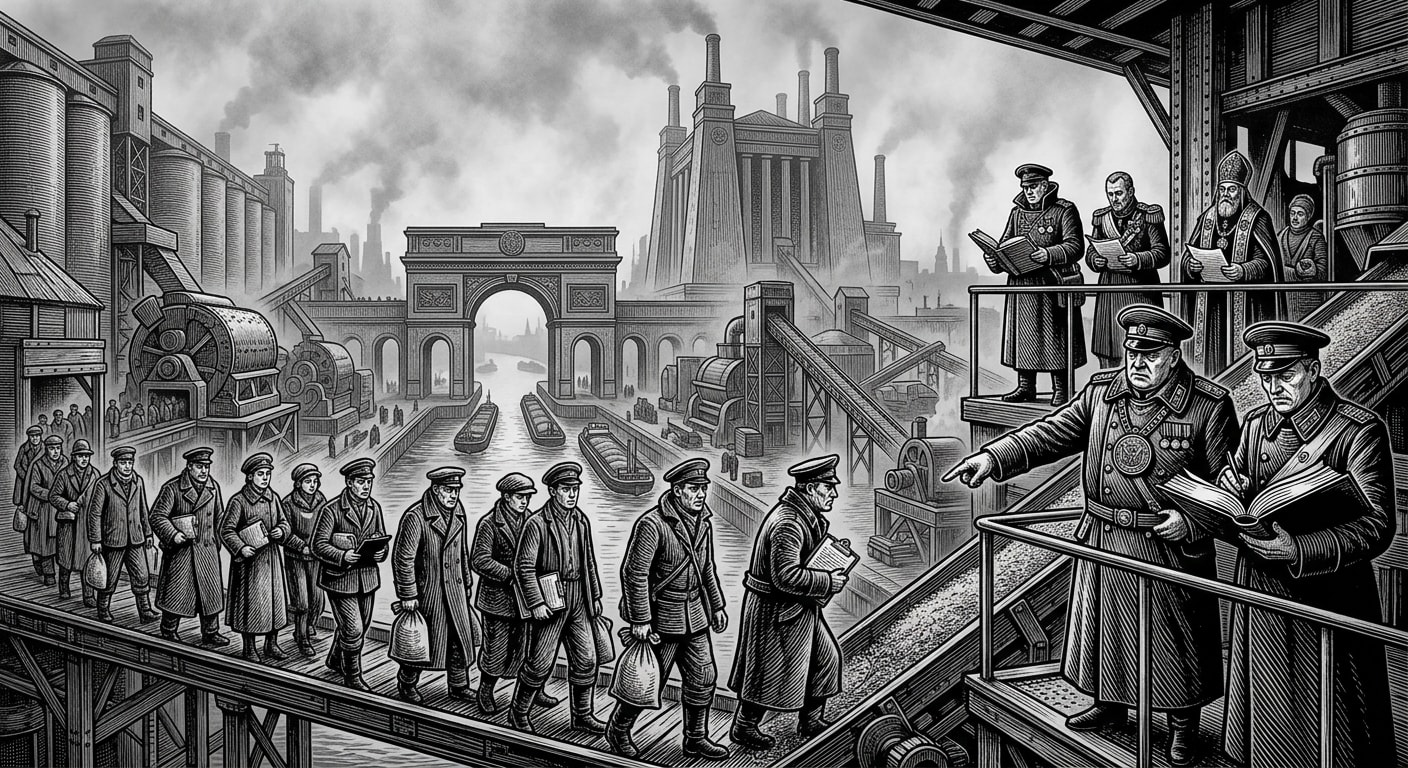
It arrives by river and cart, from Polish fields that have learned to grow under requisition and from inland brokers whose patriotism increases when price rises. It arrives damp, dry, spoiled, mixed, blessed, stolen, seized, donated under pressure, marked for Königsberg, redirected to Warsaw, held for Brest, pledged twice, sampled thrice, and watched by men who understand that one bad winter can turn a polite queue into a theology of knives.
Whoever can feed a bastion may speak above civic rank. Whoever feeds a bastion will be audited until his grandchildren inherit the headache. This is the first law of Danzig.
The dissolved Bureau of Agriculture once kept tables on Baltic rye, coastal soil, silo rot, fungal spread, seed hardiness, river damp, and the precise miseries that distinguish a sack fit for garrison bread from a sack fit only for Mercy broth and lies. Agriculture is gone, dissolved into better-funded appetites after the western granary reorganisations; its tables survive in basements, marginal notes, and three clerks in Strasbourg whom no one admits to consulting until famine makes them sound prophetic. Tithes inherited authority over the grain without inheriting respect for soil. That is how empires learn hunger in columns.
A Danzig sack may feed a Königsberg gun crew holding grey fog at bay, a Warsaw rail yard worker coupling ammunition wagons at second watch, a Brest confession scribe writing through frost, a Mercy ward whose broth has become philosophy, a condemned labour gang shoring wet sleepers, or a sealed convoy whose destination has been removed because truth would delay departure. The sack is weighed by Tithes, followed by Records, requisitioned by War, prayed over by Rites when photographers are near, and corrected by mice where human systems fail.
Kanzleiburg's Archonate Isle keeps a Danzig room among its Corridor Rooms: Hamburg, Warsaw, Danzig, Magdeburg, Dresden, Königsberg, Brest. The Danzig room smells of damp sacks, lamp oil, and fear made tidy. Pins mark grain lots, timber surges, ice closures, pilot shortages, under-inspected barges, northern oil delays, spoilage percentages, and rumours that have become expensive enough to acquire a file. The Archon's boards do not romanticise grain. Inbound records what arrived. Reserve records what may be spent. Failure records which assumption must be killed before it kills men. Danzig appears on all three boards more often than its civic vanity deserves and less often than its civic anxiety claims.
#On the False Bishop and the Practical Chapter
The Trial of the False Bishop of Danzig (Unregistered) is one of those pleasing morality plays the Hierarchy keeps in its school cupboards for use against children, local clergy, and readers with insufficient suspicion. The approved lesson is clear: whenever a city dares deviate from Strasbourg's chain of obedience, ruin follows close behind. The False Bishop presumed. The Hierarchy corrected. Doctrine prevailed. Order returned. The pupils recite, the teacher nods, and somewhere a port continues doing what saved it in the first place.
The fuller file smells of herring and sense.
The condemned chapter did not crown a rival pontiff, summon a demon, burn a Bureau annex, declare a new creed, or perform any of the theatrical errors by which amateur heretics make prosecution easy. It adjusted fast days around grain arrivals so dock crews could unload before prayer. It blessed ice roads without central approval because the ice would not wait for Strasbourg's winter correspondence. It recognised fjord-bell testimony in a minor maritime hearing, since the Scandinavian pilot who heard the bell was the only witness not drunk, dead, or employed by Tithes. It permitted fishermen to swear by old saint-names whose ratification had been pending since the assigned clerk became bones.
The trial converted local necessity into universal warning. The bishop was condemned as false, the chapter corrected, the rites standardised, the old saint-names placed under review, the ice-road blessings tied to forms, the fast schedule harmonised with calendars printed somewhere drier, and the fjord-bell testimony sealed behind enough caution to suffocate a choir. Danzig obeyed publicly from that day with such visible discipline that Purity has often mistaken the performance for conversion.
Danzig learned the right lesson: ports may move cargo, never doctrine. Since the trial, its cathedral chapter has cultivated an obedience so exquisite it reflects like polished brass. Every public fast is scheduled. Every chapter sermon carries approved phrasing. Every disputed saint-name receives proper provisional language. Every maritime hearing includes the expected caution about unstandard bell testimony. In fog, private competence resumes. Men who must not swear by old saints swear by rope, gull, knife, and mother instead. Ice roads are blessed by “route-stability prayers” whose wording passes review and whose timing remains mercifully local.
TRIAL OF THE FALSE BISHOP — SEALED EXTRACT Charge cluster: unauthorised fast adjustment; unsanctioned ice-road blessing; acceptance of northern bell testimony; local saint-name indulgence; correspondence delay tolerance. Public finding: episcopal deviation tending toward schism. Private annotation: all disputed acts increased winter throughput by ███ percent and reduced dock unrest by ███ incidents. Instruction: suppress method; retain benefit where possible.
The False Bishop's name is cited in Hierarchy manuals. I omit it here because the city has already made him more durable by refusing to say it in front of officials. There are breads named after him, nets tied with his knot, a sailor's cough before certain prayers, and one side chapel whose candle rack burns hardest on nights when ice is forming. Purity has inspected the chapel four times. It found wax. This is because Purity, for all its virtues, has not yet learned to interrogate heat.
Ambition may have been present; ambition is present wherever two priests and a chair occupy the same room.
#On Ice, Bells, and Baltic Neighbours
Danzig's north does not end at the harbour mouth. The Baltic begins there, grey and insolent, taking cargo, returning fog, making every map look childish by breakfast. In winter, ice skins the basins and gives War the illusion that surfaces can be controlled. The illusion lasts until bells sound under ice, or pilots refuse a channel because the fog is standing too straight, or a fishing crew returns with river stones from a voyage that touched no river.
The city keeps old procedures in new words. Fog watch. Ice road witness. Bell-hearer lists. Pilot oath alternates. Barrel-hearing before deep freeze. Rope thaw prayers. Warm-paper quarantine. Amber inclusion review. Each one has a public form and a working form. The public form goes to Records. The working form goes to the man who will drown if the public form is wrong.
Across the water, the Fractured North rings bells older than Concordat tables and refuses, with admirable consistency, to teach Strasbourg everything it knows. Danzig needs those pilots. Königsberg needs those tones. Hamburg needs the oil, the cured fish, the weather warning, the awkwardly faithful northerners who send cod and refusal in equal measure. The Synod claims the North with the weary confidence of a creditor addressing an armed cousin. Danzig translates the relationship into cargo.
This translation produces profitable absurdities. A crate of seal-oil may be logged as chapel lamp reserve, naval winter fuel, infirmary heat, or devotional lubricant depending on which office arrives first. A carved icon from a shrinefjord may become folk art, relic suspicion, morale object, or confiscated contraband on a schedule determined by train departure. Amber bubbles arranged like notation are filed under natural inclusion if War needs the shipment moved and under musical hazard if Bells has brought a clerk with good eyesight.
The Bureau of War maintains northern flotilla facilities at Danzig and Königsberg: shallow-draft gunboats, icebreakers, bell-buoys, signal cutters, patrol craft, and crews who age around the eyes. Danzig's naval yards repair what the Baltic has chewed and return vessels to water with patched hulls, corrected manifests, and sailors who have learned to distrust peaceful fog. Bell-buoys hang from crane arms in winter, salt-stained and ugly, tuned for alarm rather than beauty. Sailors trust them because bells cannot be promoted.
#On Smuggling and Authorized Blindness
Danzig denies hosting smugglers in the same solemn register with which bishops deny vanity and Tithes denies delight. The denial is useful, traditional, and entirely false.
A coast of islands, ice, fog, old allegiances, overtaxed grain, semi-autonomous northerners, bell knowledge, amber routes, fish barrels, and hungry garrisons is a crime invitation issued in triplicate. Northward move paper, medicine, sacramental wine, iron fittings, bell-metal scraps, unofficial catechisms, forbidden hymn sheets, and luxuries small enough to hide beneath fish. Southward come seal-oil, pine tar, amber, old bell notes, pilots without proper papers, cured fish, carved icons, warm-papers, and testimony about grey water nobody in Strasbourg wants to hear in a room with minutes.
The trick is not hiding all of it. Only amateurs attempt perfect concealment. Danzig permits enough seizure to satisfy appetite. A bad crate is found. A foolish broker is fined. A fisherman with too much amber and too little imagination is displayed in the market court. Purity writes an energetic memorandum. Tithes adjusts estimates. Shadows copies names. War receives the cargo it actually needed by the second route.
The Bureau of Shadows understands Danzig better than Purity does. Purity wants clean ports, which is sweet in the way of nursery songs and equally useful in sleet. Shadows wants monitored dirt. A supply chain one can watch is preferable to a saintly emptiness in which nothing moves because everyone is dead or honest. Lübeck's Year of Smoke remains the warning. When a port remembers too much and shares too little, black gauze appears and forty years of useful arrogance become ash. Danzig studies Lübeck the way a clever sinner studies a gallows.
Grey contact has made even crime less obedient. Fish arrive salted when no salt was loaded. Warm-papers appear from northern settlements that deny issuing them. Seal-oil burns grey at the wick after certain voyages. Amber sometimes holds bubbles arranged like liturgical notation; the Bureau of Bells says do not hum it, and for once I advise obedience. One customs assistant opened a barrel marked lamp tallow and found inside a page of his own future handwriting. He paid the duty, sealed the barrel, and requested transfer to candle inspection. Sensible man.
#On Kanzleiburg, Warsaw, and the Rail North
Danzig is not an isolated mouth. It is a tooth in the northern jaw.
From Kanzleiburg, lines branch east to Warsaw, north to Danzig and the Baltic coast, southwest to Magdeburg, south to Dresden, and forward by arithmetic toward Brest and Königsberg. Danzig's cargo enters that system with salt on its edges. Timber becomes bridge repair. Grain becomes reserve. Rope becomes artillery hauling. Wax becomes seals, candles, medical use, and little household economies of mourning. Fish becomes supplement ration when rail delay thins porridge. Amber becomes cash, contraband, charm, evidence, or bell hazard depending on whose hand closes over it first.
Warsaw receives part of Danzig's flow through the Polish plain. The city is the Last Floor before the north and east become Line logic: rail spurs, mud, wire, Brest's exposed approach, Königsberg's frozen appetite. Danzig merchants pretend to despise Warsaw's yard clerks. Warsaw yard clerks pretend Danzig manifests are unusually poor. Both accusations are affectionate by northern standards.
The Northern Hierarchate treats Danzig as a variable with teeth. In ordinary weeks, the city supplies, cheats, complains, and obeys. In winter surge, it becomes indispensable and less free. Priority codes descend from Archonate Isle. War cutters receive berths. Grain sampling accelerates. Purity inspections grow theatrical and brief. Tithes howls about deferred levy recognition. Records adds temporary columns to forms already swollen with ancestry. The port moves faster and lies cleaner.
Danzig resents Kanzleiburg because all ports resent inland boards. Kanzleiburg resents Danzig because all boards resent weather, and Danzig is weather with invoices. The Archon routes. Danzig improvises. Between the two, the north eats.
#On the Present Condition
As of A.S. 201, Danzig remains prosperous, audited, necessary, and insufficiently frightened for Strasbourg's taste. The Trial of the False Bishop has done its public work. The cathedral chapter bows correctly. The fasts are printed. The ice-road prayers use approved language. The chapter writes promptly to the proper offices and waits the correct interval before doing what the harbour required last week.
The grain moves. The timber moves. The fish moves. The amber moves, though never in precisely the quantities declared. Northern pilots arrive with old bell caution folded inside weather advice. Fractured North oil enters under pious labels. Königsberg sends requests that smell of frost and unprinted fear. Warsaw sends delay notices with locomotive soot pressed into the folds. Kanzleiburg sends priority changes, which are merely orders wearing arithmetic.
The city has learned the approved posture: bend where visible, stiffen where useful, never confuse a seal with seamanship, never confuse doctrinal victory with winter food, never allow Purity to leave empty-handed, never allow Tithes to see the second count, never mock the Grey aloud, never hum amber notation, never bless an ice road early enough to be quoted.
At second watch, when fog lies low and the basins sound larger than they are, Danzig's merchants count sacks by lanternlight and leave one ledger unstamped. The buoy bells knock under ice. Somewhere beyond the harbour mouth, old water listens with the patience of an office that never closes.