
#On the Rim Above the Ledger
"The sea is patient. We are more patient." — Coastal Chapterhouse public line, Calais
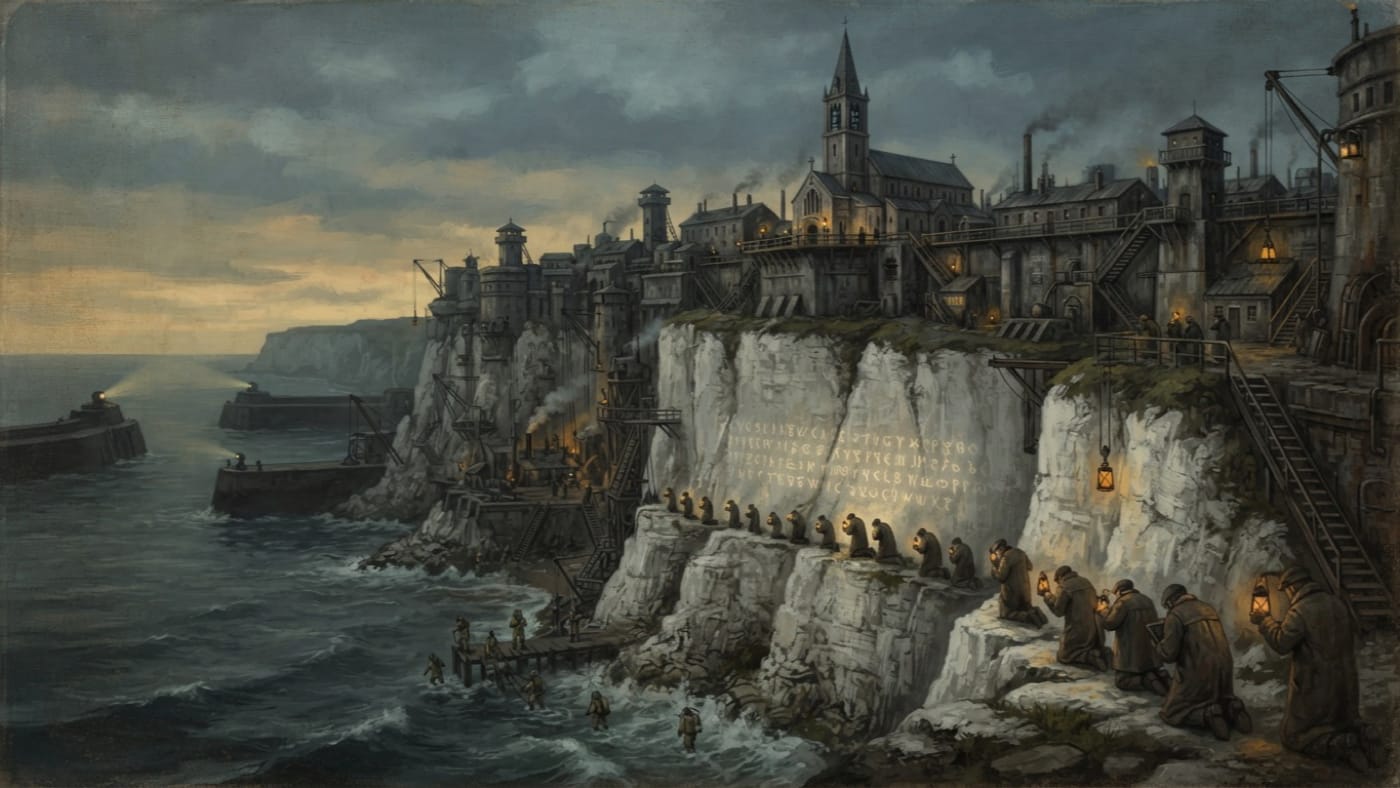
The Crownline is the upper fortification of the Chalk Redoubt of Calais. It runs along the cliff rim, and it houses the Synod Coastal Chapterhouse and the officer quarters. It adjoins the Script Wall, which every competent register places between the Gun Galleries and the Crownline: seventy feet of exposed chalk facing the Channel. Command sits at the top of the cliff. The names appear below it, and the readers kneel lower still.
Calais is a western coastal installation of Zone 1, set there to guard Channel shipping. The Crownline belongs to that installation and to nothing grander. It is no separate city, no bastion and no foreign possession, and no record explains its name. That has never stopped a junior chaplain from inventing an explanation over dinner.
The district survey gives the Crownline three smells: wax, ink and warm stone. Read them as a class schedule. Wax seals the writs. Ink lays down the orders. Warm stone means dry rooms, and in Calais a dry room is a form of wealth that the quays can only rent by the hour.
#On the Stone and the Stairs
Calais is built in a line along the cliff rim and then stacked downward. Casemates are cut into the face. Tunnels run behind the casemates, sea caves lie under the tunnels, and below the caves is the Undertide, which the Bureau has listed as pending since A.S. 71. The Crownline holds the top of the stack. It is built from the redoubt's common materials: chalk-lime cement, rust-iron, brass fittings, tallow-wax sealant and salvaged ship timber. It suffers the redoubt's common afflictions too, among them cliff slough, salt-rot and the white-lung of chalk dust. The dust settles more politely on officers, but it does settle.
Movement between levels goes by cliff stairs, hoist cages, rope lifts, stair runners and the catwalks inside the casemates. The cliff hoist is restricted. All of these serve the whole redoubt. No surveyed plan of the Crownline has reached my desk. I have no measured gate, no chamber count, no private lift reserved for the Commander-Prior and no secret stair down into the caves. I mention the last because every visiting colonel asks for it. Fortresses gain escape passages in the retelling the way minor saints gain knucklebones.
What the Crownline does have is height. From the rim on a clear night the harbour mouth and the Teeth breakwaters can be seen, and so can the quays under curfew. At curfew the sea-gate closes and the lantern corridors below open. The watch routes circle the Script Wall like a procession around an altar that bites. The Crownline is above that circuit and does not walk it.
#On the Commander-Prior and the Divided Keys
Commander-Prior Sabelle Morn governs from the Crownline. The Coastal Chapterhouse under her holds the garrison, the writs and the gun keys, and its territory runs from the Crownline out to the Teeth forts. Her power rests on garrison rotation and quarantine authority. The local file describes her in two words: calm, sleepless. I have no longer biography of her and I will not manufacture one. No appointment date of hers has come to me under a seal I trust, and I do not set guessed years in a Codex that carries my name.
Her residence on the rim makes the Crownline the seat of one government among three. Captain Lute Auvray assigns the reading rosters. Seal-Justice Corvin Hald controls sea-pass stamps and cargo legality from Salt Tribunal Row. Cantor-Major Pell and the Gunline Choir keep the bell-artillery sequences and charts, and Pell sleeps with the chart, which is the right place for it. From the rim Morn can see all these offices. Living there does not put their ledgers in her drawers.
The local survey ranks Calais in five layers. First come the Chapterhouse and Tribunal, recorded as warm, mobile. Below them are Gunline officers and seal masters, then licensed traders and ship captains, then quay folk and miners, who are recorded as surviving. Last are the Unread, named in fog, short of rations and targeted. The levies run downhill in the usual way: salt tithe, harbour tolls, night-watch hours and the voice levy of mandatory reading. Every household owes voice and night watch. I have seen no register that exempts the Crownline. The redoubt's corruption ledger does list bribed reading exemptions among local habits. That proves exemptions are bought. It does not say who buys them, and I am not paid to speculate in print.
The Chapterhouse roll also lists a Chaplain Rook, noted for chalk-stained hands. It is the only detail in the file that suggests anyone on the rim has touched the cliff.
#On the Watch Beneath Command
The connection is as old as the Wall. After the Great Breach of A.S. 71, the sentry Haller stood midnight watch beneath the Crownline. His orders were to observe the cliff for seepage. Command wanted to know whether the chalk was leaking, and it got fourteen names written in fog-water in a narrow, disciplined hand. Haller read them aloud. Six of the named drowned and eight survived. So the first usable report on the Script Wall came from a man posted at the foot of the command district, doing a job the command had given him, who then did a second job nobody had thought to order.
The arrangement has been formalised since then. When fog descends, the Fog Bell Tower strikes three short, one long and three short. Readers take their stations. Lantern-bearers angle their light so that no reader's shadow falls on the letters. Chalk Scribes kneel with waxed slates, and the Bureau of Doctrine's copyists stand behind them and copy everything again. Protocol 9-C sets the order of reading: left to right, upper chalk to lower. An unread name requires immediate bell notification. A sinking starts the quarantine clock.
That clause links the Wall to the rim. A sunk name becomes a bell, the bell starts a quarantine clock, and quarantine authority belongs to the Commander-Prior. The Crownline does not read, but the reading supplies the Crownline with its orders, its emergencies and its excuses. Out in the water the Undertide Divers, whom the quays call Black Lungs, go under with throat plates and rope bells. Above them the Crownline issues the writs.
Beside the Wall run the Silent Steps, corridors cut after the Unread Uprising of A.S. 187, where speech is forbidden on pain of beating. So Calais demands voice at the chalk and silence a few yards away, and both are enforced from above. The Unread whisper that the readings feed the sea, and that every spoken name steadies some relic mechanism the Synod installed and cannot confess. The Bureau has condemned that proposition. I record that it is whispered, and I record the condemnation, and the Bureau's records will say nothing more on the subject.
#On the Record and Its Corrections
The war administration that the later registers file as the Bureau of War requisitioned the chalk headland in A.S. 69. The coastal Chapterhouse followed in A.S. 70. The formal Synod whose name that Chapterhouse now carries was not constituted until A.S. 90, so every early use of that name is the Bureau's tidying-up after the fact. The Great Breach came in A.S. 71, and the first standardised reading register in A.S. 83.
None of these dates belongs to the Crownline. The records I have do not say whether the upper quarters went up with the first gun galleries, were raised for the Chapterhouse, or were rebuilt after the Breach. Haller's watch shows only that the Crownline stood above the cliff by A.S. 71. The construction year stays blank. A blank line in a ledger is an honest line, and Calais has few enough of those.
Several frontier maps labelled Calais "western Line anchor."
Corrected under Geographic Harmonisation, A.S. 201. Calais is a Zone 1 coastal redoubt on the Channel and lies outside the Sagittal Line. The Crownline commands a coast, not a sector of trench. Officers who arrive expecting the eastern front should expect correction from the fog, which does not bother to stamp its corrections.
#On the Present Command Under Amber
In A.S. 201 Calais remains under Amber. The Wall writes every night in fog season and with growing insolence in clear weather. Since A.S. 199, chalkscript has been confirmed on doorframes in the Chalk Warrens, three hundred yards inland, in rooms that no fog should reach. Inland writing increases during oil shortages, during fog weeks and after arrests of the Unread. The readers are hoarse. The Salt Tribunal has started taxing emergency lantern allocations. That proves the Tribunal can find a fee in any anomaly, however sacred.
Commander-Prior Morn has asked for more lantern oil, more readers and more bell-riggers, and for authority to seal the boat tunnels that the Grey Keel Syndicate works beneath the Warrens. The Bureau of War answered with a circular praising vigilance. The requests are still requests. I have seen no oil delivered, no new roster filled and no tunnel sealed. When any of those things happens I will enter it with pleasure and a fresh nib.
The Crownline still keeps its watch from the rim, with its wax, its ink and its warm stone, and with a commander who does not sleep. Below it the bells sound, the lanterns line up along the chalk, and the households of Calais pay their voice levy in breath.