

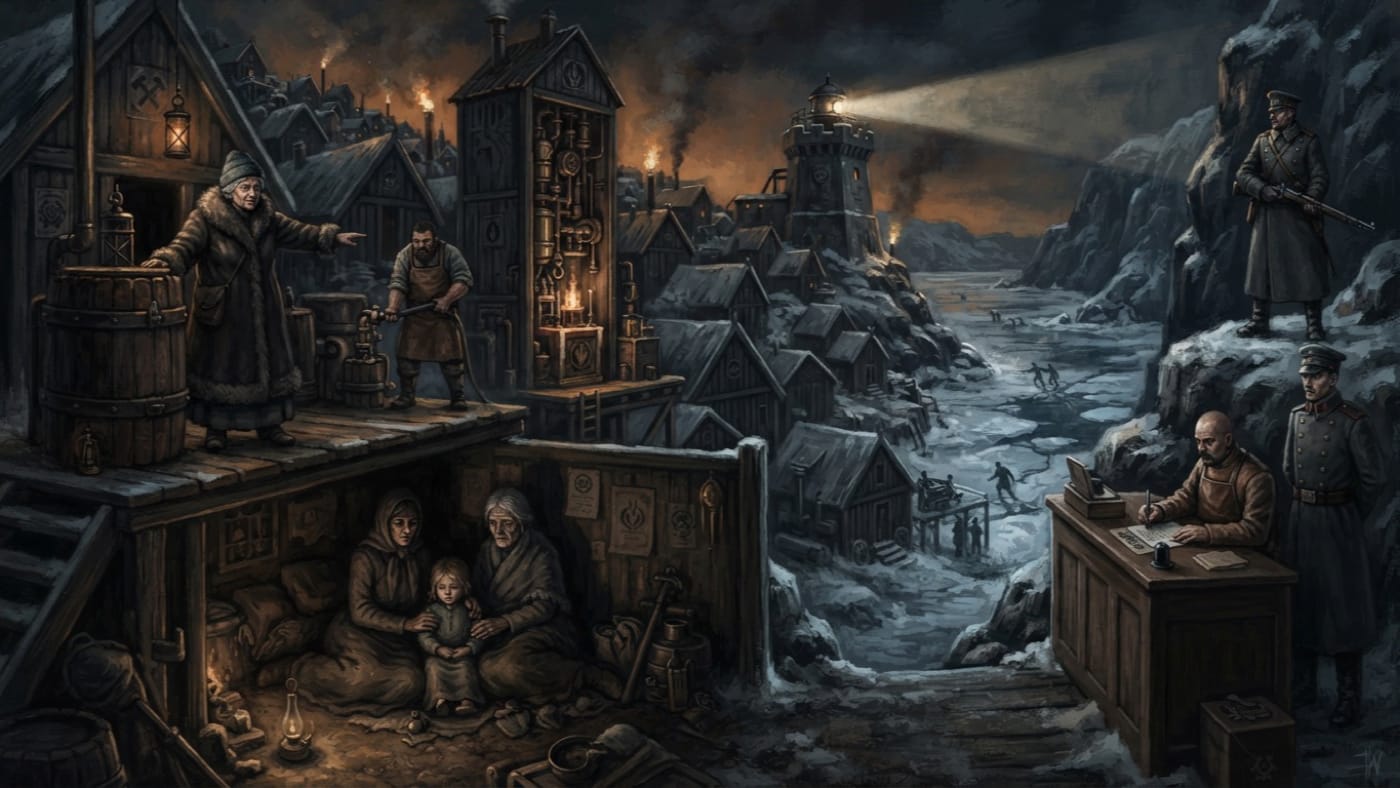
#On the Household and the Status
"A stamped paper can kill faster than cold." — Hrafnvik saying, repeated often and believed by nobody
At the Seal-Oil Shrinefjord of Hrafnvik, a Norwegian fjord cluster in Zone 8 of the Fractured North, a dark-house is a household that no longer receives communal lamp-aid. The word describes how that household stands with its neighbours. It does not describe a building, a congregation or a sect. Southern correspondents who picture a haunted longhouse with a hex daubed on the lintel have been reading novels in the Bureau's time.
The Dark-House Circle must be kept out of this definition. The Circle is an unregistered mutual-aid body with a register of its own. It supplies some darkened households from beneath the ledgers. A household can be darkened without ever meeting it, and nothing in this survey treats exclusion as evidence of membership.
I compile this survey in A.S. 201 (1911 CE) for the Bureau of Doctrine. It draws on my notes from the nine-day inspection of A.S. 197 and on the Hrafnvik registers published since. The date belongs to the compilation. The status is older, and nobody has established its first use. The clans say the first dark-houses came out of a seal die-off winter that nobody wrote down. I record their account. I will not assign that winter the year A.S. 188, which dates Elder Sigrun Half-Wick's reputation and nothing more.
#On What the Household Owes
A household at Hrafnvik owes the Clan Moot four things. It pays oil-tithes in notched barrels, serves watch-hours on the cliffs, keeps the fast days the Shrine Chapter sets, and pays wick dues. In return it receives lamp-aid, the allowance of oil and lamp-time that carries a longhouse through the twenty-hour dark.
The count is kept in wood. Notch-codes on the staves record the barrels, because paper rots in the sleet. Oil-chits and bone tokens settle the smaller debts between households, and a good deal more is held in memory, which the elders trust more than either. The Chapter keeps its sanctified ledgers alongside, and the lamp audit does not wait for them. A confession taken at the shrine is entered as a correction to oil-debt. In Hrafnvik the soul's account and the barrel's account share a column.
Arrears can be converted. If the Moot cannot have fat, it will take nights on the ridge instead. Lamp-time can be owed, traded and withdrawn, which is why the local term lamp-debt names an obligation measured in nights of light. A fast-breaker without sanction becomes uncounted: the name comes off the tally, and with it go lamp-aid and priority for passage when the ice opens. These terms overlap with dark-house status. The registers do not show them to be identical, and they do not show that every case carries the same consequences. I leave them unreconciled because Hrafnvik does.
The published accounts give the grounds on which houses have been darkened: a failed quota, a fast broken without sanction, oil sold knowing it was tainted, a shrine lamp put out in spite. Other entries describe shortfalls that someone at the count decided were theft rather than a thin season, and confessions the Prior judged incomplete. These are recorded practices. They are not a schedule. The Clan Moot registers state that there is no tariff, and that the elders weigh the offence, the house, the season and what the barrels will bear.
#On Withdrawal and Its Consequences
When lamp-aid is withdrawn in January, the arithmetic is quickly learned. In the north a fast is measured in lamp-oil as well as bread, so the cold and the hunger arrive together. The household also loses its work. Sigrun's published account says a dark-house gets no place at the vats unless she intervenes, and the vats are how a household earns its light. A house excluded from rendering is excluded from the trade that pays for the thing it has lost.
The registers do not describe every dark-house as flameless from the first night. Some keep a private barrel, a cousin with a full lamp, or a purse of bone tokens, and these last longer. The Moot's own entry says a dark-house in January burns whatever it owns that will burn, then its furniture. I cite that entry and do not extend it to every case. Some households send a member onto the ice for fuel. Whether anyone is sent out after that member is the Winter Watch's decision, and the Watch makes it with whatever lamps and whatever bodies it has that night.
Sigrun has ordered doors left unlit for three nights, and has watched the occupants come to the Moot on the fourth. That is a recorded act by one elder. It is not a term of sentence, and no register treats the fourth night as a release.
One prohibition stands above the allocations. No one may trade or tamper with a child's lamp or the lamp-pin cut for a child's cloak. The rule protects the object. It does not fill it, and it does not exempt a child from what happens to the household.
Some Chapter rhetoric speaks of a darkened house as fallen from grace, and the older Hrafnvik register repeats it. I record this as the Chapter's preaching. No register I have examined declares a household condemned before the Creator, and the Chapter's own exemptions show that its ink can be revised. The registers describe a dark-house as a debtor household. They do not describe it as a convicted bloodline.
#On the Moot, the Chapter and the Watch
Three offices touch a darkened house, and each would prefer that one of the others had done it.
The Moot allocates the oil. Sigrun is its senior voice. Her standing rests on survival, reputation and the assent of the other elders, who would quickly correct any clerk who wrote her up as sole ruler. She sets the render schedule and controls communal lamp-aid in practice. When lamp-aid is withdrawn, the Moot has withdrawn it.
The Shrine Chapter of the Blessed Wick, under Prior Malthus, keeps the paper. Malthus has held the post since A.S. 192. He sets the fast calendar, issues exemptions and passage writs, and keeps the confession ledger. According to the Circle's register he signs the dark-house forms himself. The same register says it costs the Chapter one stroke of ink to strike a name. That is a fair description of the Chapter's share and a poor description of the whole sanction. Malthus can also excuse a darkened house from the fast that darkened it, or delay a writ until the delay does the work. When he denied exemptions to three households after a thin-seal week, Sigrun produced a barrel tally showing their quota met by weight, one barrel having split and been re-bound. The exemptions were issued.
The Watch, under Rauk One-Eye, controls the routes, escorts and ice closures, and decides who is fetched back when the whiteout comes. Its watchers come from the same longhouses whose oil the Moot counts.
There is no single procedure. The Moot cuts the oil, the Chapter writes up the debt, and the Watch decides how far its patrols go. No tribunal sits over the three, and no form joins them.
A Northern Office abstract of A.S. 195 described Hrafnvik's oil allocation as "managed jointly by Shrine Chapter and Clan Moot under Synodal advisory order."
Corrected after the A.S. 197 inspection. The Moot allocates. The Chapter blesses, documents and exempts. The Watch decides who travels and who is fetched. The advisory order exists only in the abstract's grammar.
#On Arrears and Conditional Aid
A dark-house is not always left to the arithmetic. Sigrun's register records households cut from lamp-aid that cursed her and then sent a daughter to ask whether an arrear might be paid in watch-hours, in wick-spinning or in seal-hide rope. She refuses when refusing preserves the rule. She accepts when accepting keeps the house alive without making mercy fashionable. The same register records wicks delivered quietly to houses she had darkened herself. She does not forgive arrears. She sometimes rearranges them until the household can survive.
None of this cancels the debt. An arrear moved into watch-hours is still owed and still remembered. A wick delivered at night restores no lamp-aid, earns no place at the vats, and gives the house no claim on a second wick. No register records a right to pardon or a test that releases a house when passed. What exists is one elder's judgment, exercised unevenly, alongside the households' own resources: kin with oil, tokens put by, and debts owed to them by neighbours who still remember.
The Circle's supply is a separate matter. Its register acknowledges concealed oil and stolen shrine wicks carried to excluded households. Its leaders, carriers and informants are not identified, and this survey adds nothing to what has been published. Sigrun's quiet wicks do not make her a member. A darkened household's survival does not prove the Circle reached it. The registers keep these things apart, and so does this survey.
#On the Present Application
The A.S. 201 registers give the position plainly. Seal returns have thinned. The south wants tighter quotas, because Königsberg burns northern oil and the Northern Office measures faith in barrels. Warm-paper brokers are multiplying at the Slipways. Hrafnvik's compliance has been renewed, on conditions, pending review.
Each pressure falls on the same allowance. A thin season makes a quota harder to meet. A harder quota makes a shortfall more likely to be read as theft. Each such reading turns another longhouse door into a question for the Moot, the Chapter and the Watch. The registers still show no uniform code and no fixed term. Sigrun still decides at the vats, Malthus still signs under imported wax, and Rauk still decides who is fetched.
The Bureau holds the deed to the fjord. The households owe their light to the Moot.