

#On the Site and This Compilation
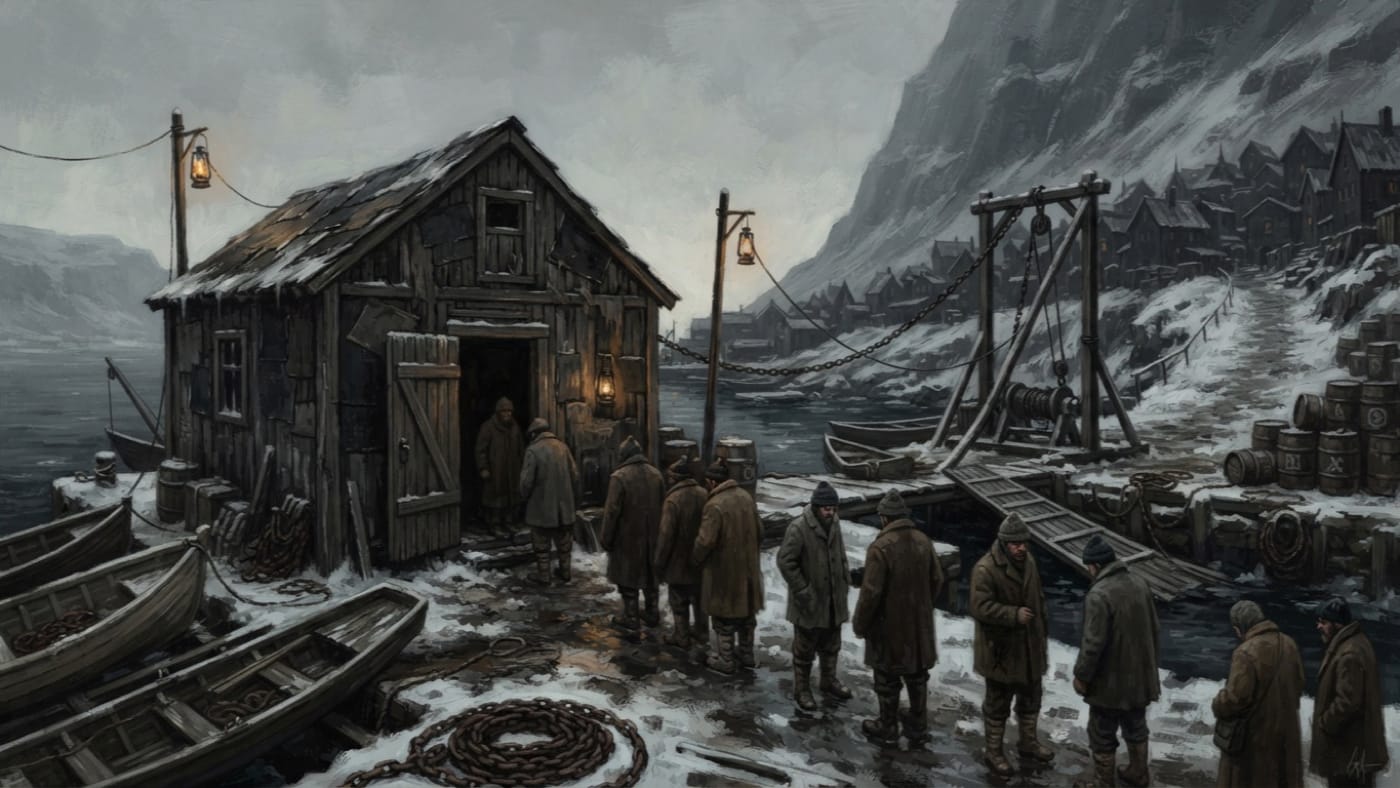
A hut at the waterline, where paper comes ashore wetter than the fish.
This survey is a present compilation, assembled at the Northern Desk in A.S. 201 (1911 CE) from my notes of the Hrafnvik inspection of A.S. 197, from the published entries on the fjord, and from reports received since. The year at its head is the year of compiling. It is not the year the Hut was raised, which nobody has told me, and it is not the year of any bargain struck inside. I have not returned to Hrafnvik. What I saw in A.S. 197 is dated A.S. 197. What I have read since is entered as reading, and the reader may weigh the two as he weighs a relic against its certificate.
Hrafnvik is a cluster of semi-autonomous villages along a black fjord on the Norwegian coast, in Zone 8 of the Fractured North. Its Slipways lie at the narrows, where skiffs are hauled up the shingle on lines and the tar never quite dries. The Paper Hut stands there. It is a single timber building, used by southern document brokers for their trade and for the negotiations that trade attracts. Inside it smells of ink and damp wool, with tar carried up from the hauling ground on every boot. That is all of its architecture I will certify. I do not know who built it, in what year, who owns the boards or who collects the rent. The Warm Paper Brokers work from it. When the brokers first came to the fjord is also unrecorded.
Why open a paper-shop where paper rots? Because the south governs by paper, and the fjord has to answer it in the same medium. A household that cannot prove it exists cannot claim grain. A son without a writ cannot try for the southern boat when the ice opens. A mother without an exemption keeps the fast whatever the seal catch. The Hut is where these lacks are brought to be priced.
#On the Papers and the Coin
Four papers cross the Hut. None of them is warm, though the fjord calls all four warm papers.
The fjord's warm papers come in four kinds: identity proofs, passage permits, fast exemptions and ration stamps. Each answers a different southern demand. The identity proof keeps a household on the count, along with whatever the count entitles it to. The exemption excuses a fast that a thin seal week has made dangerous. The passage permit allows a person to attempt the journey south, and I chose the verb with a canonist's care. The ration stamp supports a claim on grain that arrives by skiff, if it arrives.
Each of these papers is a request. It works only when someone with authority recognises it and someone with oil, men or a chain acts on it. A perfect writ shown to the wrong man on rotten ice is kindling with a seal on it.
Some of the fjord's papers are genuine. Exemptions leave the Shrine Chapter under the Prior's seal, and permits and stamps come north on hulls out of Hamburg and the ports that feed it. The brokers' documented trade is the other kind: forged exemptions for barrels of seal-oil, and counterfeit passage writs for lamp-time. From this desk I cannot tell which kind a given buyer took home. Usually the buyer cannot tell either, until the paper is shown to someone whose opinion matters, and by then it is late to complain.
Payment is made in the fjord's own currencies. Barrels come first, notched at the Render Yards before anyone rolls them downhill. Lamp-time comes second. It is the hours of light a household may draw from the communal lamps, and it can be signed over against nights that have not yet come. Oil-chits settle the larger sums and bone tokens the smaller. No rate is fixed. The temperature sets it, along with the seal harvest and the length of the queue at the door. I found no tariff in A.S. 197 and have been sent none since. I will not invent one to make this folio look industrious.
#On Jurisdiction at the Slipways
Three powers share the fjord. None of them has shown me a deed to the Hut.
The Hut sits inside a settlement governed by three hands, and none of the three keeps its seat under that roof.
The Chapter of the Blessed Wick holds the stamp, the fast calendar, the confession ledger, the exemptions and the official passage documents. It is led by Prior Malthus with three shrine-clerks. Malthus was posted in A.S. 192 and inherited a Chapter older than his appointment. The Chapter and the brokers are separate concerns. The Chapter disapproves of the forgeries, and its disapproval has not closed the Hut. Malthus issues the genuine article and the brokers trade in imitations. The fjord buys from both, according to need and to whichever queue is shorter. The Chapter's influence reaches the Hut. No ledger opened to me said whether that influence amounts to custody.
The Clan Moot controls the render schedules, the communal lamp-aid and the narrows chain. Its senior voice is Elder Sigrun Half-Wick, who earned her name in the Seal-Death Winter of A.S. 188. Every barrel that reaches the Slipways was counted first in the Moot's notches, lamp pins and remembered obligations. The Chapter keeps its receipts and ledgers in ink, while the Moot cuts its count into the stave. The fjord needs both records, and the Hut keeps neither.
The Winter Watch under Captain Rauk One-Eye controls the patrols, the routes, the escorts and the order of rescue. A passage writ bought at the Hut does not come with an escort, and an exemption puts no oil in a lamp. The paper makes its request, and the Moot and the Watch decide whether anything follows.
ERRATUM — NORTHERN OFFICE (reproduced from the existing correction)
A Northern Office abstract of A.S. 195 described Hrafnvik's oil allocation as "managed jointly by Shrine Chapter and Clan Moot under Synodal advisory order."
Corrected after direct inspection, A.S. 197. The Shrine Chapter blesses, stamps and reports. The Clan Moot allocates. The brokers price their papers by the second fact and quote the first.
Sigrun and Malthus bargain in several places. The published accounts list the Paper Hut, the Shrine Chapter side-room, the threshold of the Render Yard, and once a blizzard on the way to the narrows chain. The side-room is the Chapter's own, in the Chapter's building. The Hut belongs to the Slipways and is shared with whoever is buying. Allocation itself is settled at the barrel, where the knife cuts. The Hut is one table among several, and it is the one where the subject of the quarrel is usually lying on the planks already. I place no particular bargain under its roof, because no account I trust has put one there.
Sigrun tolerates papers-for-oil because warm papers keep sons out of bad drafts and mothers out of impossible fasts. She keeps her hold on the brokers through the things they cannot forge, namely render shares, escort and the chain across the narrows. Malthus can condemn a writ in one sentence. Sigrun can make a broker unwelcome, and at the Slipways that is the heavier sentence and needs no appeal.
#On the Price to Households
Paper is light to carry. The barrel it cost rolls downhill.
A household that pays a barrel for an exemption has eaten this week with oil it would have burned next month. A household that pledges lamp-time has sold nights it has not yet reached. In deep winter those debts come due in the dark. A household that misses its quota or its tithe can become a dark-house and lose its communal lamp-aid. The consequences are physical: frost on the inside walls, lamps trimmed to a stub and then left unlit, and adults shaking with wick-sickness. Some dark-houses have driftwood, a hoarded stub or a neighbour. Some are helped by the Dark-House Circle, whose membership no register records. Some have nothing. I do not know which customers of the Hut ended in which of these conditions, and I will not invent a widow to make the point.
One payment is refused by rule. A child's lamp, or the bone pin cut for a child's cloak, may not be sold, pledged or confiscated. Sigrun forbids the brokers to accept one. The rule is firm, and it has been broken. The published accounts state that some brokers have taken pins when desperation ran deep enough, and that taking one invites a clan blood feud, settled by cousins carrying gaff-hooks. The last broker who tested Sigrun's rule left Hrafnvik with both ears and without his trade. Nobody gave me his name, and I have not supplied one.
#On the Present Position
Where the seals fail, the paper multiplies.
The reports reaching the Northern Desk by A.S. 201 describe thin seal seasons and a fjord more dependent on southern paper than the one I inspected. The Bureau wants tighter quotas, because Königsberg burns oil and the north is expected to deliver its faith in barrels. The clans want fewer fast days. Every fast day the Chapter keeps raises the price of an exemption by roughly one more household's winter, so the Hut does well out of both demands.
Hrafnvik's compliance was renewed in A.S. 201, conditionally and pending review. The renewal covers the tithes, the confessions and the fasts. It says nothing about the Hut. The Bureau of Doctrine never chartered the brokers and has never closed them, and the Bureau of Records holds no lease to the timber. The building stands at the Slipways, smelling of ink and damp wool, and the queue forms whenever the cold is bad enough to make one.