
#On the Assembly and Its Authority
"The Synod governs by writ. The Fractured North governs by saga. When the two systems collide, the saga wins, because a saga can be recited at a feast with ale, and a writ cannot." — Bureau of Records, Northern Administrative Assessment, A.S. 187
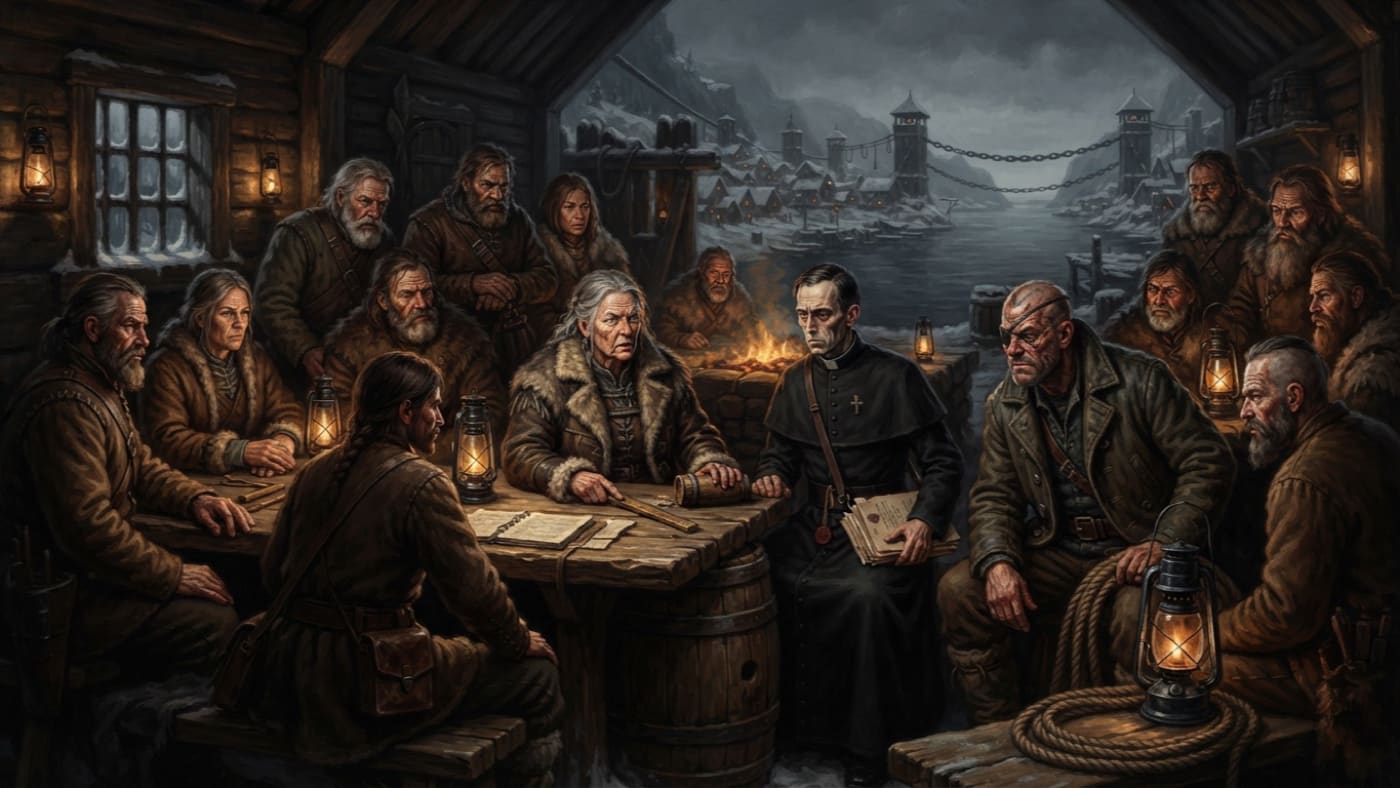
A Clan Moot is the assembly that tells a northern household what it owes and what it will receive in return. The Fractured North has a great many of them. Each holds its own valley, fjord or island chain. Each is bound to its neighbours by marriages, trade debts and grievances older than the people now nursing them. None answers to the others except when it chooses to, or when winter chooses for it. There is no northern parliament and no master list. The Bureau of Records tried to make one, once, at scale.
Strasbourg's writ reaches these assemblies the way a letter reaches a man at sea. It arrives eventually, damp, after the decision it concerned has been made and lived with. A moot cannot wait for Strasbourg. The seals come when they come and the ice closes when it closes, and a household that needs oil in the sixth week of dark needs it then, countersigned or not. The moot's ruling binds because the moot is in the room. The writ is still in a boat.
The Synod's own geography makes it worse. On paper the North is divided into eleven Prior-districts. Each has a Strasbourg cleric keeping a chapel, a report and an exemption-stamp, and each reports through the Bureau of Doctrine's Northern Office at Bastion-Königsberg. The districts correspond to nothing on the ground. They are not eleven moots. They are eleven postings, drawn by men who had never been rowed into a fjord.
#On Who May Speak
A moot is made of elders, and in the North a person becomes an elder by surviving. The principal families send them: clan-heads, fjord-wardens, and council-women whose standing rests on kinship, reputation, and the plain fact that their households were still breathing in March. The Bureau has asked for the rules of membership, the quorum and the term of office. Each time it has received a list of particular people and the reasons they are listened to. I cannot call the answer wrong. It simply does not fit any form we print.
Women sit, speak and decide. Southern correspondents who find this remarkable have not met the women.
Decisions are reached by consensus where consensus can be had, and by oath-vote where it cannot. Any Strasbourg reformer who hears the word "vote" and pictures a ballot box with a clerk beside it should study the oath-vote. An elder who swears to a ruling binds himself before every household that will sell him fish, lend him a lamp, or carry his grandchild over a snow-bridge for the next forty years. Nobody forgets the oath, and nobody is permitted to. Enforcement comes in degrees of exclusion: from the hearth, then the table, then the harbour, and at last the light.
Some moots add instruments of their own. At Hrafnvik the elders hold lamp audits, reconciling the oil ledger against barrel and wick, and they read omens in the colour of a flame. The audits are the most honest bookkeeping north of Königsberg. I record the omens as local practice and decline to certify them. The Bureau of Rites has not asked me to, and I have no wish to join Moen in the Paper Mines of Ulm.
#On the Price of Warmth
"In Strasbourg, wealth is ink. In the North, wealth is warmth." — Prior Malthus of Hrafnvik, letter to Bureau of Doctrine (A.S. 198)
Hrafnvik's Clan Moot is a compact of elders who speak for the longhouse families of the fjord. It holds three things: the render schedules, the communal oil, and the chain across the narrows. With those three it governs everything else.
Every household owes. It owes oil-tithes in notched barrels, because paper rots in the damp and a notch does not. It owes watch-hours on the cliffs. It owes fast days, set by the Shrine Chapter and kept by clan honour, and it owes wick dues. A household that falls behind finds its debt turned into watch duty: if the moot cannot have fat, it will take nights on the ridge. A household that refuses, and refuses again, becomes a dark-house and loses its communal lamp-aid. A household that breaks a fast without sanction is un-counted. It is struck from the tally, from lamp-aid, and from passage priority when the ice opens.
In a southern parish these would be fines. In a fjord in January they are sentences, and arithmetic and frost carry them out within days.
The moot does two things with scarce oil, and they should be kept apart. It husbands the stock so that the settlement outlives the winter, and it uses the same stock to punish. The elders see no need to tell the two apart. In a bad season the cold does not tell them apart either.
Elder Sigrun Half-Wick is the senior voice of the compact. She earned her name in the Seal-Death Winter of A.S. 188, when she halved every wick in her longhouse and stretched three weeks of oil into seven. She lost two fingers and kept her whole household alive. Her office rests on that winter and on the moot's assent. She sets the render schedule, decides which households boil and which carry, and withholds lamp-aid from any household that misses its quota. She has also sent wicks, by routes no ledger records, to houses she darkened herself.
One prohibition outranks all allocation. A child's lamp may not be sold, traded or tampered with. Papers-for-oil is always for sale in Hrafnvik, and so is passage priority. A child's lamp never is. A broker who touches one has started a blood feud, whether or not he understood what he was buying.
Beneath the ledgers runs what the locals call unlogged warmth. It is oil hidden under false tags, wicks passed from hand to hand, and heat that the moot's count never sees. It keeps some dark-houses alive, and it turns every audit into a negotiation with the uncounted. It does not make the system kind. It makes the system survivable for those who have friends.
A Northern Office abstract of A.S. 195 described Hrafnvik's oil allocation as "managed jointly by Shrine Chapter and Clan Moot under Synodal advisory order."
Corrected after direct inspection. The Shrine Chapter blesses, stamps and reports. The Clan Moot allocates.
#On the Captain and the Prior
The moot elects its Watch Captain, and the elders hold the captain to account. That is the entire constitution. A captain is chosen because the settlement trusts the candidate to close the right road first, and that trust comes from knowing the passes, the households, the weather, and which family can last two nights without lamp-aid. The Winter Watch has no central command and no Strasbourg charter. It has captains, and the captains answer to moots.
The Bureau of War has tried four times to fold the Watch into the continental levy. Four times it has learned that rank cannot be shipped north in a crate. A southern appointment brings a commission. A moot election brings the households that must supply the watchers. In February, only the second clears a road.
The Prior sits outside the moot and presses on it. Prior Malthus was posted to Hrafnvik in A.S. 192 as keeper of the Shrine Chapter of the Blessed Wick. He holds the stamp, the exemption papers, the confession ledger and the fast calendar. The moot can darken a house. Malthus can excuse that house from the fast that darkened it, write it a passage south, or quietly leave a name off the roster. He governs nothing the moot governs, yet he holds the only appeal from its rulings that does not end in a feud.
Then there is Rauk One-Eye, captain of the Hrafnvik Watch. He sets the patrol routes, the escorts and the ice-road closures, and he decides who is rescued when the whiteout comes. The moot keeps the narrows chain and oils it. Rauk orders it drawn when the water warrants. Nobody in Hrafnvik regards this as a conflict of jurisdiction. Everybody in Strasbourg does.
During my nine days at Hrafnvik in A.S. 197, I recorded the arrangement as tripartite because the Bureau's forms offer that word and no better one. The word flatters it. Sigrun, Malthus and Rauk do not divide authority; they bargain for it every day, over whatever the settlement needs next. At dawn that is the render schedule. At dusk it is the road. In the hour when a mother needs a fast suspended, it is paper. My report recommended no intervention, and I stand by it.
#On the North Beyond One Fjord
No moot lives alone. Whatever one valley cannot settle with the next goes to the All-Moot, the regional assembly that has met every midsummer since the Concordat era. It gathers in a field near whichever harbour-town lost the argument about hosting. The moots send their clan-heads, fjord-wardens and council-women to price feuds, divide oil obligations and fix the winter passages, and they leave Strasbourg's business for the final day. The All-Moot has no command over the local moots. Its rulings hold because every neighbour will need every other before March.
The bells belong to that larger circle. The fjord tunings are older than the Bell Codex of A.S. 115, and no single moot holds them. The Bureau of Bells has asked for them three times and learned that no single moot may sell them. What they do on a cliff above black water lies outside this entry. It lies inside the Bureau of Bells' unresolved file, where it will remain.
The young leave for Königsberg, for Hamburg and for the Line. Every winter the Watch has fewer names to call, and the moots have fewer households to call them from. The moots still sit. They still decide, by debt and kinship and memory, which lamp stays lit. The Northern Office still addresses its instructions to the eleven Priors, and the instructions still arrive after the ice, in time to be useful as kindling.