
#On the Sermon and Its Occasion
De Clavibus Restitutis is the principal sermon of Father Ambrosius of Como. He was a parish father, a schismatic celebrant and the principal key-bearer of the Coalition of the Crossed Keys. The title may be Englished as On the Restored Keys. That gloss is mine, offered to readers whose Latin stopped at the catechism, and it should not be cited as a second title. The sermon's fame belongs to A.S. 150, the year Lombardy rose against the Synod and declared for the so-called True Successor of Rome. The file does not say when Ambrosius first preached it, how often he preached it, in what tongue or before which congregation. The Latin of the title proves only the Latin of the title.
The Bureau holds the argument as the Ambrosius dossier reports it, together with a handful of its images. No complete transcript is known to me. I have looked. I hold the keys to every room where one ought to be.
The claim was restorative. Ambrosius presented himself as a man returning stolen property. In his telling the keys of the Church had been carried off to Strasbourg sixty years earlier at the Concordat and kept there by men who had never been handed them. Restoration is the most expensive word in the rebel's vocabulary. It costs him nothing to say, and the province pays for it in full.
#On the Entrusted Hand
Here is the thesis in the dossier's words: authority descends by custody rather than decree. Its proof was a single household figure. A key, Ambrosius said, belongs to the hand entrusted with the house, not to the clerk who inventories the hinge.
I have read a great many sentences against the Synod. Most of them are shouted, and the rest are worse. This one is built. The house is the Church, old and lived in. The hand is the priest, or the line of priests, each receiving the key from the one before and passing it on, as a steward does when a master dies. The clerk is us. He stands to one side with a pen, counting hinges. He has never opened anything in his life, and he believes his count gives him title to the house.
Every listener in Como understood the figure before the sentence ended, and that was its craft. The quarrel between Roman succession and the Bureaucratic Synod is a constitutional question, and constitutional questions put congregations to sleep. Ambrosius turned it into a question of who keeps the keys to a house. A sacristan, a warehouseman and a widow with one locked chest could all answer that at once, and all of them would answer his way.
The dossier attaches two further charges to his preaching. The first is that Strasbourg had appropriated Rome's inheritance and replaced apostolic succession with docket succession. "Docket succession" is good invective. It is also a fair description, and Ambrosius knew it, which is why it wounded. The second set the seven chairs of the Hierarchy beside the house and called them seven locked doors between the Church and its rightful shepherd. For the pedantic, the seven are seats. The Bureaus are a separate count, and the sermon's arithmetic does not reach them.
This is where the carpentry splits. Custody without record is rumour. Who entrusted the hand? Who witnessed it? Who keeps the account of which key went to which steward, what was owed in candles and oil, and which steward drank the oil? The clerk does. Take away the clerk and the entrusted hand becomes whatever hand is holding a key when the bells stop. By morning every thief in Lombardy is a successor. Ambrosius needed a register to prove his own line, and he denounced the registrars in the same breath.
The Synod's title to the house rests on more than the count of hinges. It counted them, recorded the count, sealed the record and ratified the seal at Strasbourg in A.S. 90, and it can produce all four on demand. That is what decree means. Decree is custody that kept its receipts.
#On Rome, Conscience and the Congregation
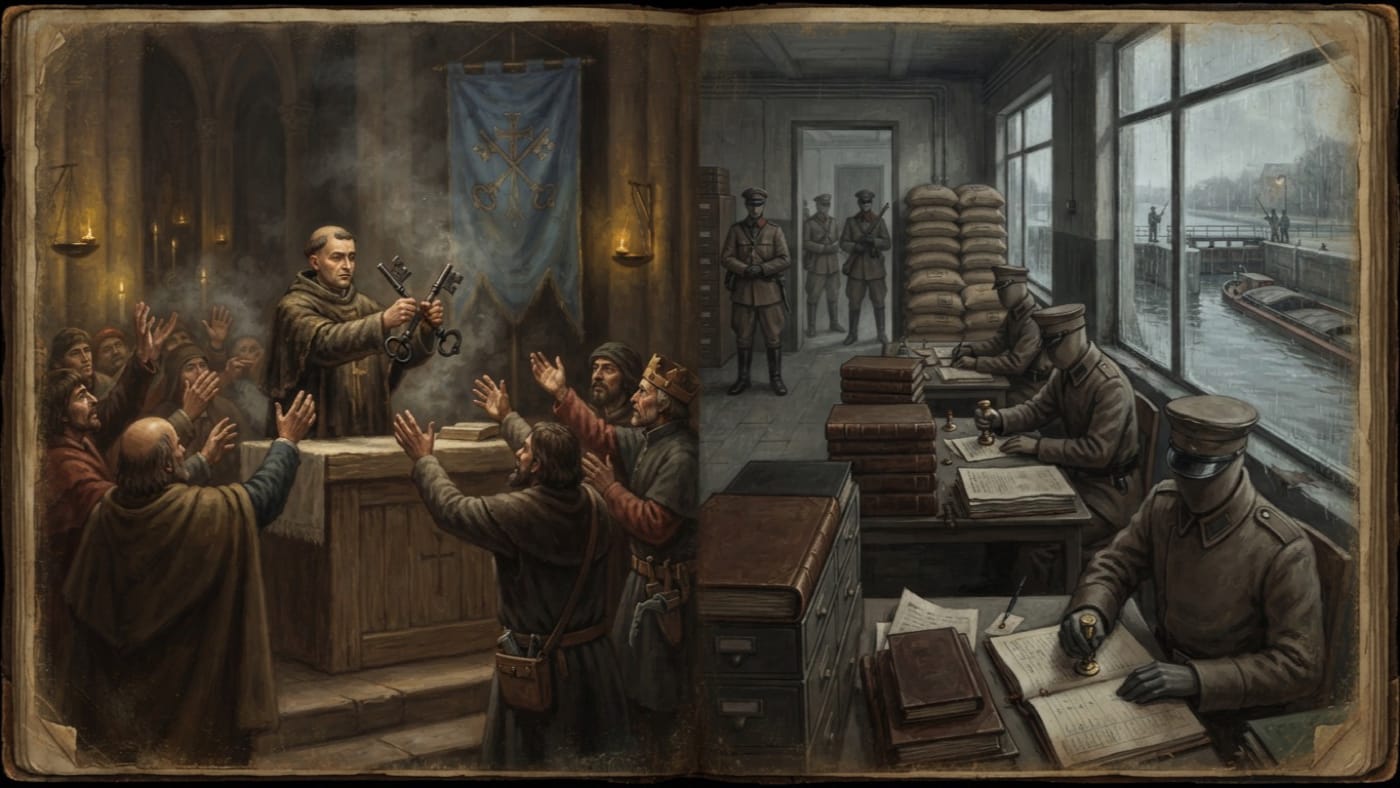
The gesture was two keys crossed over the altar at Como, beneath a blue silk hanging. The dossier assigns one key to Rome and one to conscience, and I have no better account of the gesture than that.
Rome was the key of memory. It spoke to the papalist nostalgists, the old families who kept Roman habits through the Concordat the way some families keep a dead man's chair at table. No record I hold gives a genealogy for his True Successor, and I will not invent one on his behalf.
Conscience was the more useful key because it fitted more locks. In his mouth it did not mean that every man may believe what he pleases. Ambrosius was a priest preaching restoration inside the Church, and a Rationalist would have horrified him as much as one horrifies me. It meant that a Lombard soul could recognise its rightful shepherd without a countersignature from Strasbourg. Merchants heard independence in that. Magistrates heard their old freedom to issue an order on their own seal. Clergy heard their standing returned. The poor were promised bread after victory, which needs no key, only an empty table.
The keys themselves were already in every hand. Guilds carried them, counting houses trusted them and sacristans wore them at the belt. Lombardy needed no lesson in the symbol. Ambrosius found it hanging from the province's belts and told the province what it meant. The movement spread by chapel, guildhall and warehouse. The file does not establish whether each of those rooms heard this sermon or some cousin of it trimmed for the trade. The revolt also had more causes than one preacher's best sentence.
Provincial schoolbooks once described the Coalition of the Crossed Keys as "a foreign-backed papalist disturbance."
Corrected. The revolt was domestic: clerical, mercantile and Lombard. Its keys were cut in Milan and Como, and the hands that turned them were local. The sermon needed no foreign sponsor. It had a congregation.
#On the Administrative Answer
Strasbourg never troubled to compose a counter-sermon. I record this with some professional regret, because a reply in kind would have been a pleasure to write.
The reply came instead from several desks at once. The Bureau of War supplied the force. The Bureau of Tithes seized the granary accounts, which settled the matter of bread after victory well before any victory could arrive. Coalition letters were read on the road, and the Bureau of Records copied the names. The Bureau of Purity did what Purity does with any doctrine taught in public: it went looking for the pupils.
Strasbourg judged the sermon an administrative threat, and correctly. Its whole argument was that the register did not matter. A preacher who persuades a magistrate that a Strasbourg countersignature is optional does more harm than one who persuades him the Great Deceiver has been misjudged. The second error damns a soul. The first stops the tithes.
The dossier calls the War response hydrological pacification. The province calls it the drowning, and by the dossier's account the Po carried it east. I add nothing to either account, and no honest engineer should either.
Ambrosius disappeared in the suppression. The reports of his end disagree, and I certify none of them.
#On the Preserved Error
The Bureau of Doctrine, which I have the honour to serve as Archivist, preserved the Coalition's name for instruction. Records preserved the names useful for prosecution. The sermon survives inside both: as a title in the dossier, as a thesis, as a sentence about a hinge, and as a gesture at an altar under blue silk. What survives is teaching that was remembered and reported. Whether a complete original lies in a sealed annex, a Lombard attic or the river, I do not know. I would not tell you if I did.
Since A.S. 150 the dossier has kept a category of offence called Ambrosian sympathy. It is broad. It runs from papalist nostalgia to the merchant who says, a little too warmly, that a key belongs to the man who holds it. Fifty-one years later, in A.S. 201, the phrase is still heard in Lombardy, which is administered and not yet pacified. Nobody there quotes the sermon. They have no need to. They have keys.