
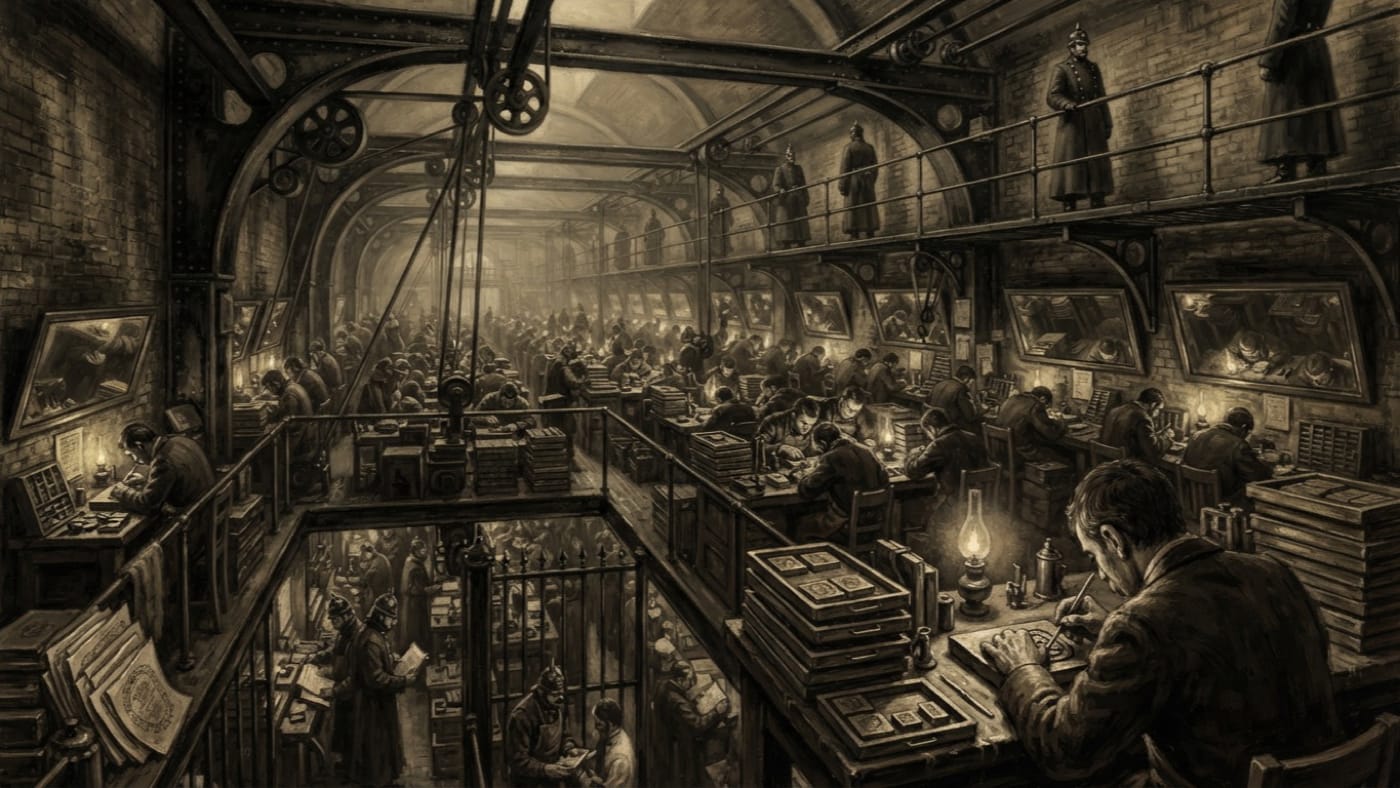
#On the Northern Engraving Halls
Die Row takes up the northern arc of the Crownwright Diehouses in Cologne's south quarter. You smell it before you see it: oil and hot metal. The rest of Sable Court supplies the black brick, the iron, the ash drifting off the annealing stacks and a low steam fog that never quite turns into rain. Die Row adds only the smell of steel being persuaded.
This is where the Crownwright Guild keeps its masters' benches. A human face is cut here by hand into a steel die, and a batch of coin can later be struck from that die. The engravers work with their fingers wrapped in silk. The inspection windows behind them are mirrored, so a master at the bench sees her own back while the warden on the other side sees everything else. Above the halls, the rooftop watchwalks carry the Wardenate from bridge to bridge, and the soot on their boots falls on everyone equally.
Die Row makes a face that can be copied. The other halls make it lawful, and both halves send a bill.
#On the Benches and the Compact
The benches are older than the walls. Cologne's die-cutting families were working the south guild district long before the Mint-Chapter existed, cutting seals and coin-faces for anyone who could pay. Nobody knows when the Guild was founded or who founded it, and the Guild has never bothered to find out. A craft older than the Sundering does not keep minutes.
The Compact of A.S. 94 changed the customers first and the architecture second. Albrecht Sable founded the Mint-Chapter and tied the Face Registry to it. The Guild kept its hands and gave up its independence. Between A.S. 94 and A.S. 100 the old district was enclosed, gated, mirrored and bridged until it became Sable Court, and Die Row was built around the masters' benches where they already stood. No record I have consulted gives the halls their own founding day. The Chapter dates them to the enclosure. The Guild dates them to the first apprentice who cut himself on a burin, and will not say who that was.
Albrecht founded an office, not a craft. The Guild reminds each Mint-Prelate of this at intervals timed to stop just short of insubordination.
The published survey of the Anneal Courts states that metal from the furnace yards is "carried north to Die Row's presses."
Corrected. Die Row has no presses. It has benches, burins and grievances. Striking is done on the Strike Floors in the western arc, where the hymn-timed presses run. The clerk who put presses in the engraving halls appears to have followed a tray north and lost interest before it turned west. This office has not invented a second press hall to rescue his sentence.
#On the Hand That Cuts
A lawful face goes through several offices, and they disagree about the exact order. The Bureau of Records assigns the registry number. The Mint-Chapter commissions and licenses the die. A Crownwright master cuts the face. The Face Archive at the centre of the quarter holds the approved master plates and checks the new face against its concordance with the Great Ledger. The Assay Cloisters in the eastern arc certify the metal and the fidelity of the face. The die is blessed. The Strike Floors stamp the batch. One die makes many coins. A master does not carve a new portrait for every penny, though the identity fee is sometimes priced as if she did.
The Anneal Courts to the south soften and temper the metal. A furnace hand may handle a blank all day and never be trusted to touch a die. The bullion itself comes up Sable Court's own Black Canal from the Rhine barges. That canal shares a name with Candlewick's older waterway and nothing else of note.
Engraving alone cannot make a coin anyone may spend. Records holds the number, the Chapter holds the licence, the Archive holds the original and the Cloisters hold the verdict. Die Row holds the only part that cannot be done by a clerk.
The tools come down through the guild lines: burins, gravers and punches worn into the shape of hands long since struck from circulation. The bench goes with the tools and the tools go with the apprentice. No master has ever explained to me what happens to a bench when its master dies without a successor. I suspect the answer involves a fee.
The engravers wear finger-veils, silk wrapped over each digit. Guild procedure treats the bare fingertip as a blasphemous tool, one that may carry the engraver's own identity into the steel. The Bureau of Doctrine has classified this belief as "procedurally relevant." I am asked from time to time whether that means the belief is true. It means the veils are mandatory. Theology can take its time over the rest.
What the silk protects is called the gift. Masters use the word for the tactile judgement that tells a burin how deep is deep enough, where a cheekbone stops being bone and starts being opinion. Irena Coilhand, the present Master Engraver, wraps her fingers in prayer-scarves blessed by three cantors. Her stated fear is not theft or recall. It is the day her fingers stop telling her things.
In A.S. 134 Doctrine condemned mechanised die-cutting as spiritually imprecise. The ruling covered cutting only. The striking presses on the western floors still run on steam and hymn, and nobody has proposed that strikers work with their thumbs.
#On Permission and Recognition
Nobody wanders into Die Row. A visitor needs guild papers, an appointment or a labour warrant. The gates check faces against coin, and every passage ends with the clean-hand inspection: palms up to the mirrored glass, nails scraped, veils counted. The Guild guards blank dies more jealously than finished ones. A finished die carries a face the Archive knows. A blank die carries an opportunity.
The Guild's real power is its bottleneck. It controls the skill, the apprenticeships and the seats at the benches, and masters take on apprentices seldom, late and for a fee. The Master-Engraver Council governs the Guild. How many sit on it, how they are chosen and how they vote are not entered anywhere I have been allowed to read. Every newborn, convert and migrant waiting on a face waits for a bench, and the Guild charges an identity fee for each new entry. When a face is corrected, the levy goes to the Chapter. The Bureau of Tithes taxes the coin that results. A citizen pays several offices to become legible, and the queue moves exactly as fast as the masters want.
Irena Coilhand decides which faces are cut, and when. Mint-Prelate Varo Sable signs the licences and recall orders and controls access to the master plates. Warden-Captain Joss Kline controls the guards, the raids and the vault keys. Each of the three can stop the work. None of them can finish it alone.
#On the Work Beneath
The lawful benches stand above an unlawful copy of themselves. The Clipped Choir, a separate counter-mint, works out of market stalls, canal basements and the furnace tunnels where stolen trays of ruined blanks cool in the dark. It does not own Die Row and has never needed to. It lives on what Die Row throws away.
The apprentice bins supply finger-veils. Furnace loss supplies ruined blanks. Rejected batches teach the Choir which defects matter. Its counterfeit plates imitate Crownwright work closely enough to fool a tired gate clerk and badly enough to offend a master, and its acid pens and face-swap ledgers handle the rest. In the back stalls of Clipper's Market, a borrowed face can be rented for one gate at a time.
Irena condemns the Choir as an adulteration of the craft, and she seems to mean it. A badly cut die insults the face. A falsely cut one insults the hand. Her apprentices whisper that she once paid the Choir to recover a stolen plate, then paid the Wardenate to arrest the broker she had paid. No Guild record certifies the story. No Guild record denies it, and in Sable Court an omission does the work of a denial.
#On the Present Cutting
The Face Theft began in A.S. 199. Citizens found the faces on their own coins subtly wrong: another man's eyes, a stranger's jaw. The Chapter ordered an emergency recall across seventeen denominations. Every recalled coin needed a die, and every die needed a Crownwright hand. Die Row went to triple shifts. The burins have not been cold since.
The Guild then closed its apprentice rolls. A guild that cannot vouch for its newest members stops admitting any. It also inspects its oldest members more closely, and verification at the gates and benches has tightened accordingly. The Assay Cloisters test struck faces against the archived plates using blind clerks, who have never seen the faces they judge and are therefore not taken in by them.
The trouble has not stayed on the benches. On the western Strike Floors, two hymn timings slipped and two batches came out bearing faces nobody could identify. The dies were Crownwright work, cut and licensed in the ordinary way. The faces were not in the concordance. The Chapter has opened its inquiry and closed its mouth.
When the quarter was surveyed, Irena Coilhand had not left Die Row in eleven days. She had begun wrapping her prayer-scarves around the dies themselves. Doctrine classified this as "irregular devotional practice," a ruling issued from a desk at some distance from Die Row.
Then there is the master die. The Chapter has denied in four depositions that it exists. Rumour describes a single steel cylinder bearing no face and every face. If it is real, Die Row becomes ornamental, because a die that holds every face needs no master to cut one. The benches have kept working through the rumour. Masters say it is a story told by people who have never held a burin. They say it louder than they need to.
DIE ROW SHIFT REGISTER — THIRD WATCH — EXTRACT Dies drawn: ██. Dies returned: ██. Discrepancy: none recorded. Annotation in Master Engraver's hand: "Count again." Second count: ██████████. Annotation struck through by Chapter clerk. Reason for striking: ████████.