
#On the Guild and Its Compact
"The Chapter owns the face. The Guild owns the hand. Ask which of them can hold a burin." — saying of Die Row, unattributed
The Crownwright Guild is the oldest body in Sable Court that still draws wages. Its families were cutting seals in Cologne before the Sundering. They cut wax matrices for Rationalist magistrates and signet steel for ecclesiastical courts, and now and then a ring for a client who paid late and disliked the likeness. No folio I have been allowed to open records the Guild's founding year. Its founder has no name. The Guild calls this a privilege. The Bureau calls it an oversight it has meant to correct for a century.
The bargain is recorded. In A.S. 94, four years after the Concordat of Strasbourg created the formal Synod, Albrecht Sable sat down with the masters of the engraving houses. He was a canon lawyer of Cologne cathedral and would become the first Mint-Prelate. The published accounts say the negotiation took nine days. The compact it produced bound the existing Guild to the new Mint-Chapter. Crownwright hands would cut the dies. Chapter seals would make the cutting lawful. Each side would watch the other in perpetuity, and that is the only clause either has kept without complaint.
Albrecht founded the Chapter. He did not found the Guild, though every Sable since has found the confusion useful.
Between A.S. 94 and A.S. 100 the old guild district in Cologne's south was walled into a restricted quarter. The benches stayed where they stood, and Die Row was built around them.
#On the Hand That Cuts the Face
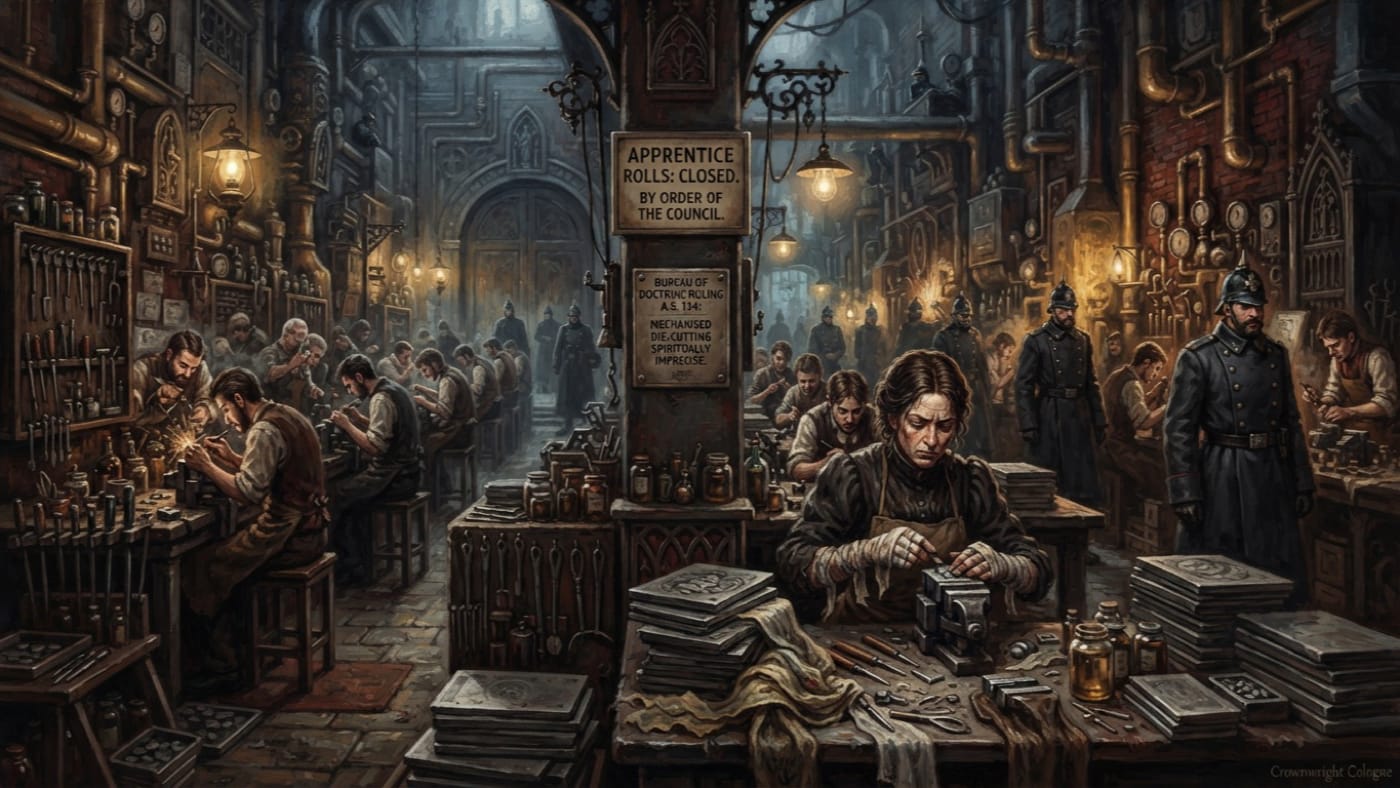
A Crownwright master cuts a human face into a steel die by hand. The tools come down through the guild lines: burins, gravers and punches worn smooth by masters long since struck from circulation. The bench goes with the tools, and the tools go with the apprentice. An apprentice advances only when the master consents, and masters consent seldom, late and for a fee. If the Guild has any other constitution, I have not been shown it.
The order of work is fixed by law. The Bureau of Records assigns the registry number. The Mint-Chapter commissions and licenses the die. A Crownwright cuts it. The Face Archive, established in A.S. 102, files the master plate and keeps its concordance with the Great Ledger. The Assay Cloisters approve the issue, the shift choir blesses it, and the presses of the Strike Floors bring it down in time with the hymn. A die is cut once. Its coins are struck by the batch, which is why losing a coin costs a citizen nothing. Losing the face is another matter.
The engravers wear finger-veils, silk wrapped over each finger. Guild procedure treats the bare fingertip as a "blasphemous tool" that may carry the engraver's own identity into the steel. The Bureau has classified the belief as "procedurally relevant." That classification ends the inquiry, and it was written to end it. Whether a fingertip can really leak a soul into a die I am not competent to certify. The Guild prefers me incompetent. On this point we agree.
The hand's monopoly has a date. In A.S. 134 the Bureau of Doctrine condemned mechanised die-cutting as "spiritually imprecise." The Crownwrights lobbied for the ruling, and Doctrine delivered it with a straight face. A machine that cut dies would have made apprentices unnecessary, masters replaceable, and the Guild's consent a quaint gesture. The presses were never in danger. They strike all night.
#On Masters and the Price of Recognition
Sable Court is governed by three powers: the Mint-Prelate, the Crownwright Master-Engraver Council and the Mint Tribunal. No register open to the Cologne Sub-Registry gives the Council's size, how its members are chosen, or how they vote. I asked three masters and got three evasions, and one of them came with an invoice.
The current Master Engraver is Irena Coilhand. She wraps her fingers in prayer-scarves blessed by three cantors. Her power is simple, and nothing in the quarter can replace it: she decides which faces are cut, and when. Her fear, as Die Row tells it, is losing the finger-feel the masters call "the gift." A master's eyes, wit and politics can all go, and the Guild will carry her. A master without the feel is a pensioner.
Mint-Prelate Varo Sable is Irena's supervisor and her counterpart. He is not her guildmaster. He signs recall orders, approves access to the master plates, and receives the Council's reports. Records lists him as Albrecht's heir by office. Whether he is also an heir by blood is not entered, and I have learned not to ask questions the Ledger declines to answer. The Chapter can command a face but cannot cut one. The Guild can cut a face, but without the Chapter's seal its work is treason. Each holds the other's throat, and they call the grip partnership.
The arrangement is paid for in fees. The Guild charges an identity fee for every new entry: a newborn, a convert, a migrant waiting on a free bench. The correction levies belong to the Chapter. The inspection tolls at the gates belong to the Wardenate. The Bureau of Tithes taxes the coin that results. A citizen pays four offices to become legible and can afford none of them, and the queue for a master's bench moves exactly as fast as the masters want.
Beneath the benches sits the rest of the quarter. Furnace hands, acid runners, die polishers, strikers and assay clerks work there, and so do the men and women on debt-labour warrants and purity-penance shifts. Most of them are not Guild members, and no census I have seen says how many. They serve the Guild's benches without any of its privileges. When a polisher is careless he is fined. When a master is careless, the polisher is fined.
#On Corrections and the Trade Beneath
The Guild's most valuable product is a face that can be withdrawn. A face cut by a Crownwright lasts as long as the Mint Tribunal permits. When the Tribunal orders a recall, the Chapter gathers the coins and strikes them again, either blank or bearing a replacement. The levy goes to the Chapter. The work goes to the Guild. The recalled person goes on living and becomes unspendable. Merchants refuse their custom and landlords cancel their leases. The memory of a revoked face weakens in everyone who handled it, and families argue about whether a brother existed. Records files the result as "administrative dissolution, non-lethal variant." The masters call it unfacing, and they bill for it.
Below the lawful benches works the Clipped Choir. It is a separate underworld union and a counter-mint, assembled from what the official mint throws away: ruined blanks, rejected batches, finger-veils stolen from apprentice bins, and the citizens turned away at the gate. The Choir clips coin, rents faces and sells forgetting in the back stalls of Clipper's Market. Irena condemns it as an adulteration of the craft. Her apprentices whisper that she once paid the Choir to recover a stolen plate, then paid the Wardenate to arrest the broker she had paid. No Guild record certifies the story. No Guild record denies it either, and in Sable Court the omission does the work of a denial.
Earlier editions of this Codex stated that the Crownwright Guild operated independently of Synod oversight. A later correction stated that the Guild has always operated under Mint-Chapter authority.
Corrected again. The Guild has operated under Mint-Chapter authority since the Compact of A.S. 94. Before that it cut seals for whoever paid, Rationalist and ecclesiastical alike, because there was no Mint-Chapter to obey. "Always" was a courtesy the Chapter extended to itself. The clerk who wrote it could count forward from ninety-four but not back.
#On the Closing of the Apprentice Rolls
The Face Theft began in A.S. 199. Citizens found the faces on their own coins subtly wrong: another man's eyes, a stranger's jaw. Complaints reached the Mint Tribunal by the hundred and then stopped, because the complainants could no longer say what their faces should look like. The Chapter ordered an emergency recall across seventeen denominations. Every recalled coin needed a die, and every die needed a Crownwright hand. Die Row went to triple shifts.
The Guild then closed its apprentice rolls. The Diehouses survey calls this the first closure in a century. Its official reason is purity of craft, and its practical effect is fewer hands to suspect. A guild that cannot vouch for its newest members stops admitting any. A guild that fears its oldest members inspects them more closely, and the Assay Cloisters now test the fidelity of struck faces against the archived plates. The clerks doing the testing are blind and have never seen the faces they judge.
Irena's precautions have grown with the crisis. At the time of the Diehouses survey she had not left Die Row in eleven days, and she had begun wrapping her prayer-scarves around the dies themselves. Doctrine classified this as "irregular devotional practice." It ruled from a desk at some distance from Die Row.
The Unface Society claims responsibility for the theft. It is a heretical cell working out of the furnace tunnels beneath the Anneal Courts, and the published reports describe it as six engravers and a disgraced archive scribe. The Bureau of Purity doubts that seven people could manage a campaign this sophisticated. The reports do not say whose benches those six engravers once kept, and the Guild has not offered to say. A claim of responsibility is evidence of ambition.
Then there is the master die. The Chapter has denied it in four separate depositions, each more emphatic than the last. Rumour describes a single steel cylinder bearing no face and every face, able to unsettle the Archive's concordance simply by circulating. If it exists, the Archive becomes unreliable and the Guild becomes ornamental, because a die that cuts every face needs no Crownwright hand. No one has shown me such a die. No one has shown me its absence either.
#The Ratification
The Crownwright Guild cut seals before the Synod existed and cuts faces under the Synod's licence. It holds the only hands the Mint-Chapter has. It charges for recognition, cuts the corrections that revoke it, and keeps its rolls closed while the presses run day and night. The Bureau of Doctrine has considered alternatives and found none it can afford.