
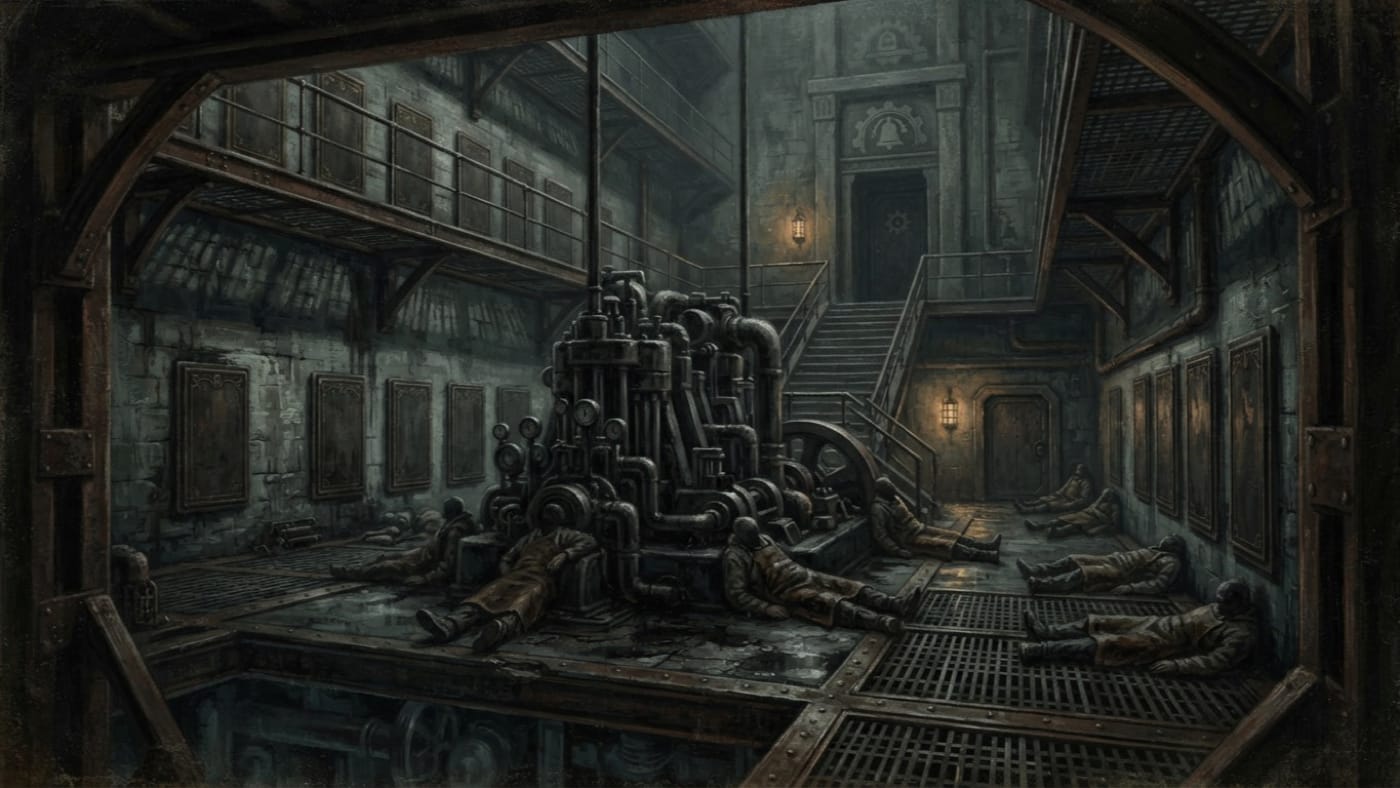
#On the Western Underlevels
Where the bastion keeps its pulse, and has been known to mislay it.
District Seven lies under Bastion-Przemyśl, the Wire Orchard, the fortress that holds the western Carpathian passes on the Sagittal Line. Above it are the permit halls, the rail yards, the stamp counters and the wire. Below, in the western underlevels, is the machinery that lets any of those answer when a sentry pulls a rope.
The surviving record describes the district by its parts and never by its borders. It has a west service trench, a lower seam, and an infirmary with a fever bay. It has a thumper manifold, a manifold chapel lettered C, and at least six underlevels, which is how many failed in sequence. Upper Works stands above it, near enough to send down a bell relay by hand. No survey I have been allowed to read says where District Seven ends and its neighbours begin. Its founding, its census and its formal perimeter sit in drawers that the Bureau of Engineering has either locked or never filled.
The district counts as industrial because it shakes. Take away the shaking and you have six storeys of wet stone holding their breath.
#On the Working Lines
The conduits come first, since everything else hangs from them. Iron pipe as thick as a deacon's waist runs along the gallery walls. It sweats a diesel film that catches the lamplight and keeps it, like a guilty conscience. Heated fuel moves through the pipe under pressure, and the pressure makes the walls tremble. The trembling passes into clamp rings, brackets and hymn-gaskets, and from them into the stone. At Irongate, during the Great Hush of A.S. 94, the Synod paid three thousand lives to learn that this trembling holds the walls up.
The thumper manifold sits at the centre of it all. This hammering assembly sets the beat for the whole network, a low pulse you feel in your soles before you hear it. Every protection in the district depends on that beat. The ward-plates on the gallery walls keep watch only while the pulse reaches them. The alarm ribs return a challenge pulse, the gate listeners register what moves behind the wire, and the chapel-mouth relays carry warnings and devotions to men who cannot tell one from the other at the end of a double shift.
Starve the conduit and the beat falters. When the beat falters, plates, ribs, listeners and relays all go mute together, the way a choir does when its precentor drops dead mid-psalm.
Whatever the Wire Orchard's wider mysteries, and it has some that are better left in their own files, District Seven's problem is a pipe that must keep shaking. The Diesel Resonance Plumbers who work it press stethoscope-horns to the iron and listen for drift. They isolate weeping lines with valve keys and bleed off the air that collects when the diesel temperature swings between shifts. They clamp gasket strips over failing seals, retime the manifold when its beat wanders, and test each plate for response. Then they fill in compliance sheets with the same devotion a novice brings to inventing sins for confession.
#On the Hands Below
Their trade names are Pipe-Singer and Thumper-Runner, and their ranks are rigid. The Clamp Runner seals leaks and carries fuel. The Line Technician patches, bleeds and retimes. The District Resonance Plumber answers for a whole sector and its paperwork. Above them all is the Harmonic Listener, who can tell hostile harmonics from honest wear by ear alone and can retune a live manifold without a sermon upstairs missing a syllable.
Down here a man works by spark-safe lantern in air that is half soot. The stone is always wet and the metal is always hot enough to brand a careless wrist. Old hands speak too loudly in the mess because the pipes have taken their hearing in instalments. Their wax goes onto the icon before they descend, and their diesel goes onto it when they come back.
District Seven's administrative portrait is one roster. On the morning of A.S. 171 it listed twelve authorised Resonance Line Technicians. Three reported: two Clamp Runners with temporary seals and one Line Technician. No qualified Harmonic Listener had been posted for seventeen days. The duty captain had asked for one twice, and both requests came back marked RESOURCE ALLOCATION PENDING.
An earlier Codex abstract of District Seven recorded it as "fully maintained within prescribed staffing variance."
Corrected. Three of twelve rostered technicians were present, with no Harmonic Listener among them for seventeen days. Whoever prescribed that variance must have had a dry office and a short memory.
The manifold had been knocking in metre for a week. The Plumbers filed Form 77-K, then the Supplemental. They requisitioned replacement hymn-gaskets. The lawful stock had gone to Bastion-Shipka, where the Unhymn Infiltration of A.S. 163 and the Seal Standardisation Edict of A.S. 164 had made blessed seals precious and their counterfeits cheap. The senior technician, Edric Sann, fitted counterfeit stock. It held for six hours.
So the district failed through absent hands, deferred repairs, diverted parts and a gasket of dubious ancestry, all of them lodged in the same pipe. Blaming one of them alone flatters the rest.
#On the Silence of A.S. 171
The Thumper Blackout came during the second half of Matins load. The ward-plates did not burst. They fell mute, first on one level, then two, then six. The manifold lost its beat. The alarm ribs failed their challenge, the gate listeners went deaf and the chapel-mouth relays went on talking nonsense.
Hostile bodies came in through the lower seam where maintenance had lapsed. The records call them breach incursion assets. They name no commander and no host, and I will not supply one simply because Atheron's spires stand on the ridges opposite.
Four hundred died before containment. Some died at enemy hands. Some died when ward-doors sealed late and sealed wrong. Some were shot by their own relief company, which arrived in a silent district and drew the obvious conclusion about anything that moved. The Bureau of War lists all four hundred as enemy casualties. The ledger balances. The dead were never consulted.
Containment took several things at once. Upper Works rang a manual bell relay. Men retuned the live manifold under hostile contact. A rifle cordon held the galleries, the chapel-mouths were purged, and the ward-plates were brought back one strip at a time. How long all of it took remains classified under local security. Readers who want the incident told hour by hour should consult its own entry. This entry is about the place it happened.
#On the Wheel Beneath Chapel C
Ward restoration began at an auxiliary wheel under Manifold Chapel C. In A.S. 168, three years before the Blackout, that wheel had been marked inoperable. Its access corridor was listed as sealed, its key as missing and its pressure rating as exceeded. Someone reached it anyway, crossing sealed corridors, a flooded sump and a service passage hot enough to blister the breath, and turned it against pressure until the plates came back.
The official restoration records name no one. Plumber testimony names Sann, the man who signed for the counterfeit seals. I record the testimony as testimony. A handprint remains on the wheel. Engineering calls it heat distortion. The Bureau of Purity calls it an unauthorised devotional marking. Neither office has asked the Plumbers, who have not volunteered.
Beside Chapel C hangs an icon of Saint Vellum of the Valve, the uncanonised patron of the trade, with a worker at a wheel and a bell-shadow behind his shoulder. After the Blackout it was found with diesel burned black across the wheel and the wax melted uphill. Przemyśl's version of Vellum's legend puts his welded hand on this valve. Irongate and Shipka tell other versions, and so far no saint has turned up to settle the dispute. Whether Sann died at the wheel, lived out his years, or had anything to do with the saint, the record does not say. Local tradition says a great deal, at volume.
#On the District That Functions
As of A.S. 201, District Seven works. The plates ring, the gates answer and the chapel-mouths carry the approved bulletins. The fever bay takes patients, and the four hundred have been folded into the bastion's paperwork as a lesson in staffing.
Every Plumber at Przemyśl knows the place. Apprentices are taken down to the manifold scar and told to keep quiet and listen. In cold weather the pipe still knocks twice. Nobody answers the third knock, and no foreman has ever had to order them not to.
The profession won a new title from the dead: Resonance Line Technicians are now "auxiliary personnel, conditionally essential." The petition to strike the word conditionally failed. The revised roster requires a Harmonic Listener within bell-run distance of every primary manifold, except during shortages, feasts, inspections, budget closures, disciplinary reallocations and convoy surges. Together those exceptions cover most of the year.
The handprint stays on the wheel. Engineering has not polished it off, Purity has not sealed it over, and the Plumbers have not let either Bureau near it with a rag.