#On the Origin of the Trade
"Pure flow, pure voice." — Inscription above the Subworks Entrance, Bastion-Irongate, chiselled in brass and unreadable beneath a century of soot.
The Sagittal Line sings. This is doctrinal fact, structural necessity, and the reason approximately four thousand men and women spend their lives crawling through tunnels with diesel on their hands and psalms ringing in the bones of their skulls. The choirs provide the voice. The Bureau of Bells provides the schedule. The reliquary pipes provide the medium. And the Diesel Resonance Plumber — that unwashed, half-licensed creature of the underworks, formal title Resonance Line Technician, street title Pipe-Singer or Thumper-Runner or, among the inquisitorially inclined, Heretic Wrencher — provides the labour that keeps all of it from collapsing into a silence that kills.
The trade exists because the Synod discovered, at a cost of three thousand lives during the Great Hush of A.S. 94 (Unregistered), that sound is structural before it is decorative. The gasket seals that hold the bastions together require vibration at prescribed frequencies. Without it, seals creep, bolts work loose by increments invisible to the eye but sufficient to bring down a tunnel section on the men sleeping within. The bells ring; the pipes carry the resonance; the gaskets hold. This is the architecture of survival. And the pipes — pressurised arteries of diesel-fuelled vibration that branch beneath every bastion from Brest to Constantinople — require hands. Dirty, competent, frequently unlicensed hands.
The Bureau of Engines and Furnaces maintains, officially, that all resonance infrastructure is "self-sustaining under prescribed liturgical conditions." The Bureau means that if the choirs sing correctly and the engineers calibrate correctly, the pipes should never fail. The pipes fail constantly. They fail because diesel corrodes the hymn-gaskets. They fail because air pockets form in the reliquary chambers and cavitate against the seals. They fail because the system was designed by theologians, built by engineers, and maintained by neither — maintained, instead, by a class of tradesmen whose existence the Bureau acknowledges only when their absence produces casualties.
#On the Substance of the Work
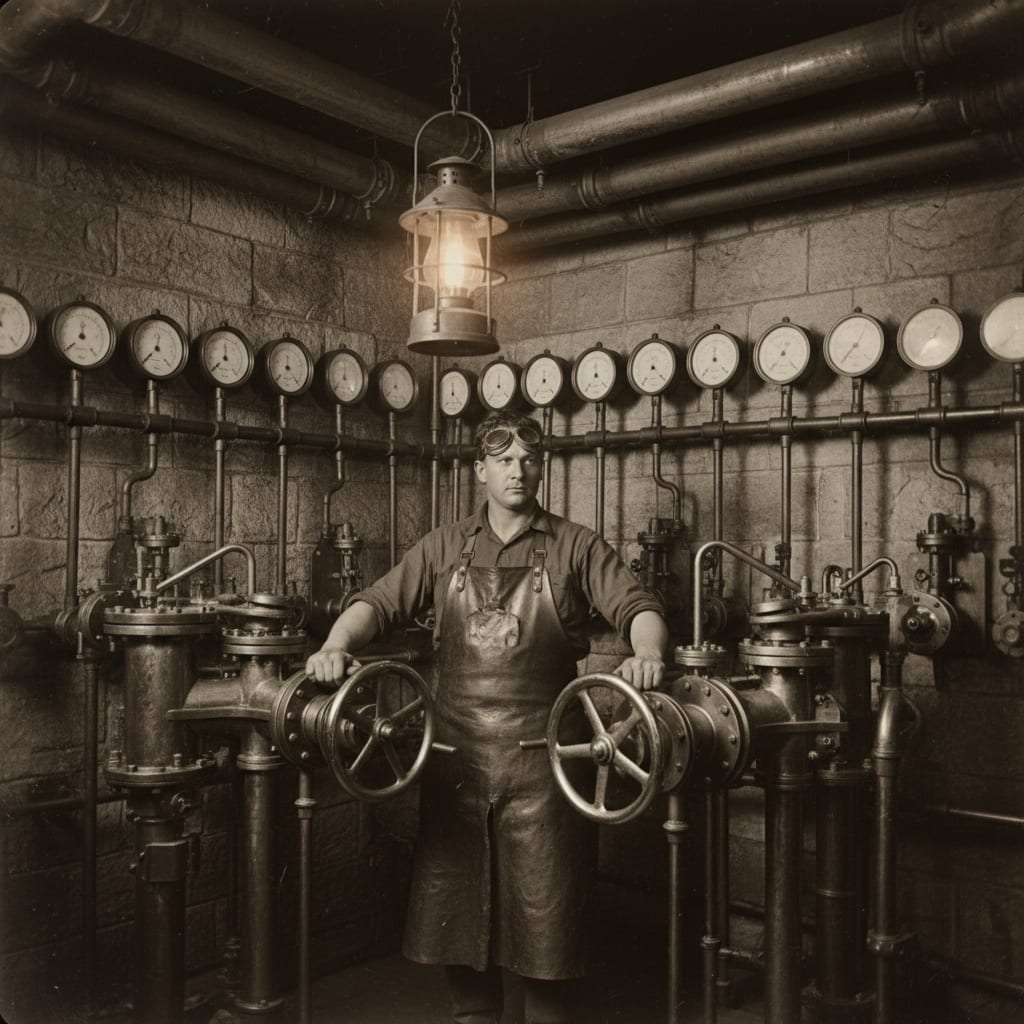
The resonance lines are diesel-pressurised conduits — iron pipe, mostly, with reliquary inserts at junction points where the Bureau of Orison requires specific harmonic properties. Diesel fuel, heated and pressurised, passes through these conduits at velocities calibrated to produce sustained vibration in the pipe walls. The vibration transfers to the surrounding architecture through contact points — gasket seals, clamp rings, mounting brackets — and maintains the structural frequencies that prevent the bastions from settling, cracking, and burying their inhabitants.
The Plumber's work is this: keep the diesel flowing, keep the pressure stable, keep the vibration within tolerances that the gaskets can bear. It sounds simple. It is simple in the way that keeping a man's blood flowing is simple — which is to say, it is simple until something goes wrong, and then it is a catastrophe measured in minutes.
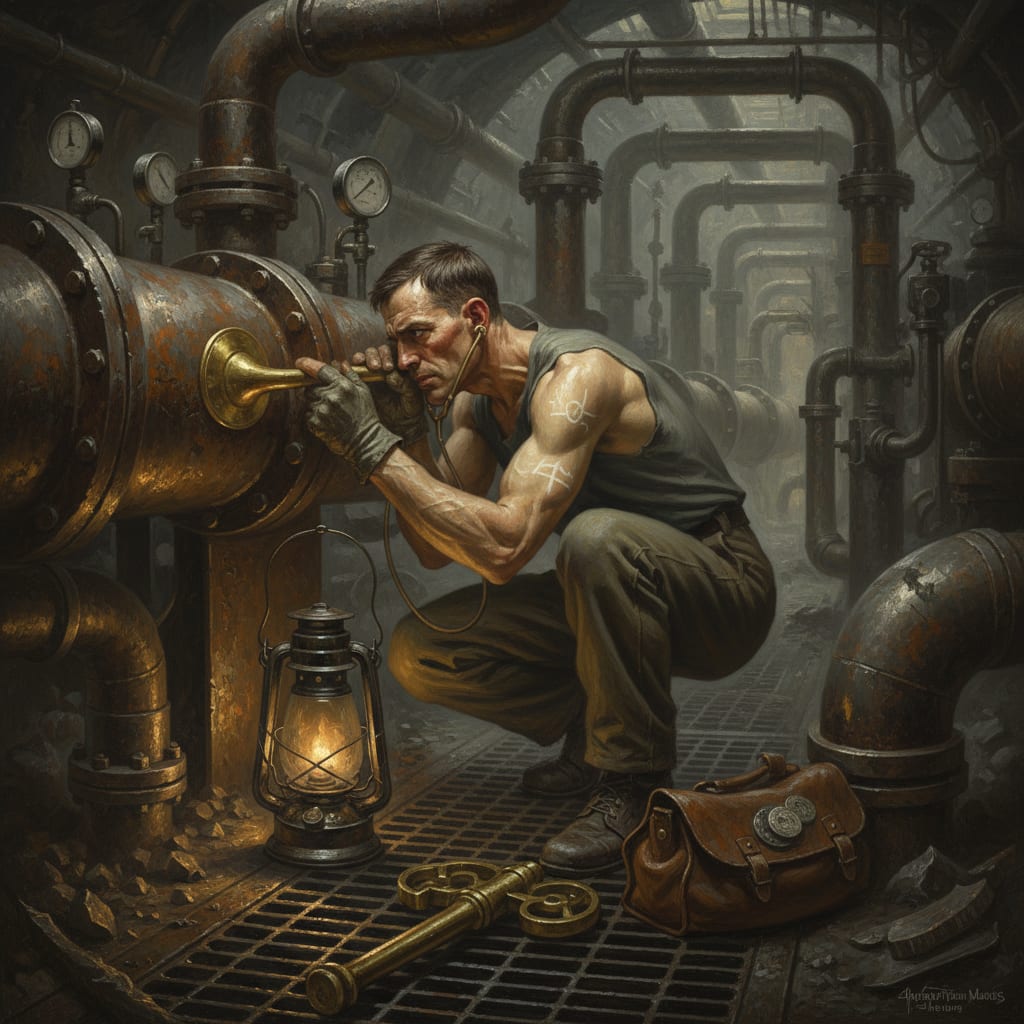
A typical shift begins in the sump chambers beneath the bastion's primary bore. The Plumber descends with lantern, valve key, hymn-gasket kit, and the stethoscope-horn that is the trade's one indispensable instrument — a brass-coned listening device pressed against pipe walls to detect resonance drift before it registers on the gauges. The good ones can hear a failing seal by the change in harmonic character alone: a thickening of the tone, a flutter where there should be smoothness, a knocking that has no mechanical source.
The midday hours are worst. Sermon broadcasts, factory bells, ward-plate activation, and choral schedules all converge to produce peak resonance load. The system strains. Micro-leaks that were tolerable at dawn become critical under full pressure. The Plumber patches live — clamping hymn-gaskets onto weeping seals while the pipe shakes against his chest, negotiating with Litany-Engineers over whether a given frequency can be reduced for twenty minutes without collapsing the ward-field in the district above, paying the checkpoint marshal to let a fuel cart through without the standard four-stamp process that would delay it past the crisis window.
By evening, the load drops. The Plumber bleeds air pockets — the insidious cavitation that forms when diesel temperature fluctuates between shifts — retimes the thumper manifolds that drive the primary resonance pulse, and replaces gaskets that have degraded beyond the point where wax and prayer will hold them. Then he files compliance sheets. The compliance sheets are, by universal and unspoken consensus, creative fiction: numbers that satisfy the audit pattern without reflecting the seventeen emergency bypasses, four counterfeit seals, and one moment of outright heresy that kept the district singing through the day.
#On the Controversies and Complications
The profession's fundamental scandal is theological. The Bureau of Doctrine maintains that bells resound with "Heaven's breath." The Bureau of Orison claims the vibrations align metal at a molecular level through sacred harmonic principles. The Bureau of Engines, in a Contradictory Sidebar that has been reprinted in seventeen separate technical manuals, states flatly: "Vibration sustained by diesel resonance through reliquary pipes." All three positions are, by Bureau Resolution, simultaneously true. The Plumber, who has his hands inside the machine and knows precisely which truth is getting diesel on his gloves, is forbidden from expressing a preference.
This produces what the profession calls "practical heresy" — the daily reality that maintaining sacred infrastructure requires profane methods. A hymn-gasket is a consecrated seal, blessed by the Bureau of Rites and stamped with a purity mark. It is also a rubber ring that costs three ration chits on the legitimate market and half a chit on the counterfeit one. When the legitimate supply runs short — and it runs short with a regularity the Bureau of Tithes attributes to "seasonal logistical variance" and the Plumbers attribute to graft — the choice is between a counterfeit gasket that works and no gasket at all. The Bureau of Purity has immured men for using counterfeit seals. The Bureau of Engineering has also immured men for allowing resonance failures. The Plumber occupies the space between these two immurements and calls it a career.
Previous editions of the Operational Classification listed Diesel Resonance Plumbers as "auxiliary personnel, non-essential."
The Bureau of Engineering has revised this classification following the Thumper Blackout of A.S. 171 (Unregistered), during which resonance failure in District Seven of Bastion-Przemyśl produced a cascade that silenced ward-plates across six levels, permitting a breach incursion that cost four hundred lives. The revised classification is "auxiliary personnel, conditionally essential." The Plumbers' Guild (Unregistered) petitioned for removal of the word "conditionally." The petition was denied. The word "auxiliary" was, in a gesture of administrative mercy, italicised.
The Unhymn Infiltration of A.S. 163 (Unregistered) introduced a second complication. Engineers at Bastion-Shipka discovered that certain line harmonics — specific frequencies produced by pressure irregularities in poorly maintained conduits — could be exploited by hostile acoustic phenomena. Syrion's agents, whose methods are soporific and harmonic in nature, had learned to "ride" resonance lines, inserting sleep-inducing tones into the vibration pattern that spread through an entire district's infrastructure before anyone noticed the garrison had stopped waking up. The casualties were classified. The response was the Seal Standardisation Edict of A.S. 164, which created officially blessed "hymn-gaskets" — seals tuned to reject non-standard frequencies — and simultaneously created a thriving market in counterfeit versions, since the official ones cost four times the price and arrived three months late.
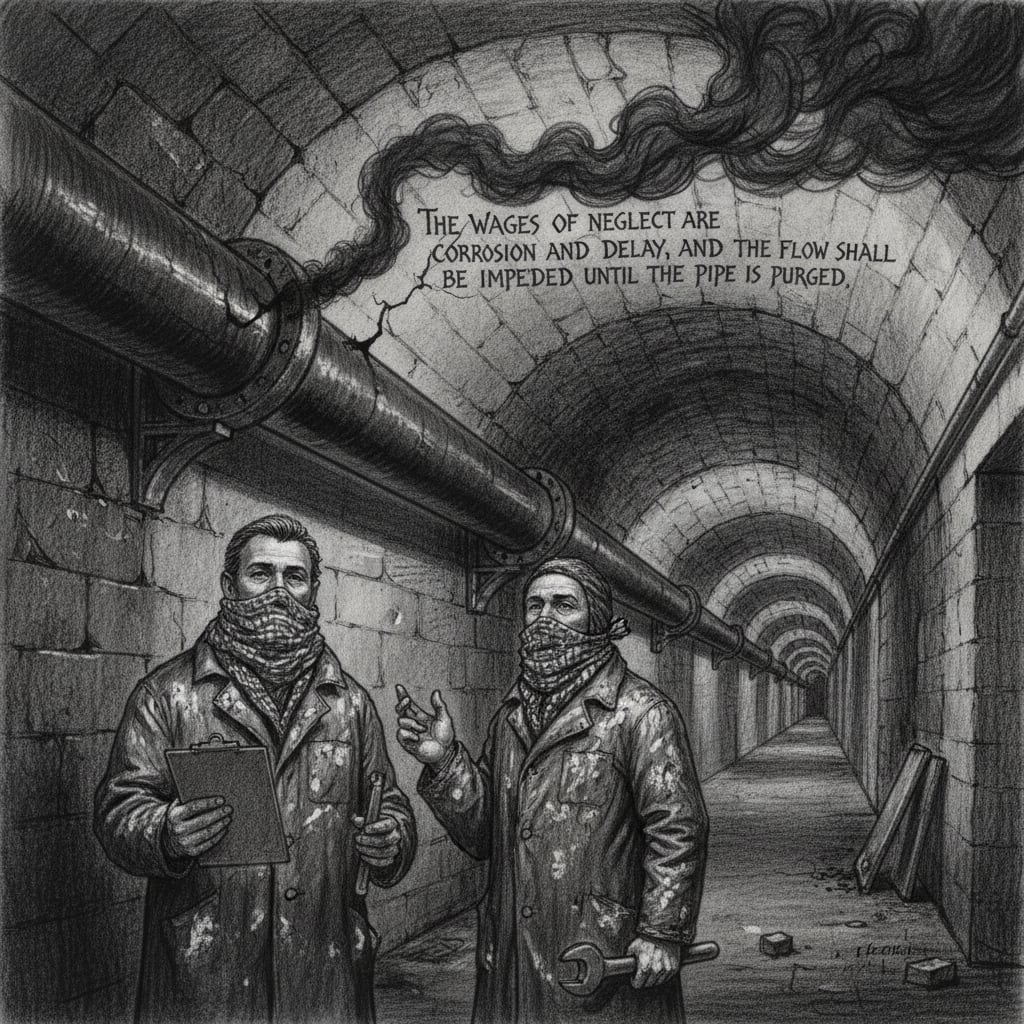
The black diesel question compounds everything. Official resonance lines run on sanctified fuel — chrismole, processed through the seven-stage hymn-calibrated distillation cycle at Brast. Chrismole is expensive, arrives by convoy, and is allocated by a rationing formula that the Bureau of Tithes adjusts quarterly in directions that never favour the maintenance budget. Black diesel — unsanctified, Anatolian-sourced, magnificent in its combustion — burns hotter, flows better in cold weather, and costs a quarter of the price. It also produces what the profession calls "scripture-smoke": fumes that, under certain pressure conditions, form legible words on tunnel ceilings. The words are always doctrinal. They are always wrong. The Bureau of Purity has classified scripture-smoke as a Category Two Spiritual Hazard. The Plumbers continue using black diesel on the quiet because the alternative is a cold district with dead wards and a garrison that doesn't wake when the alarms ring.
#On the Present Application
There are, by the most recent audit, approximately four thousand two hundred licensed Diesel Resonance Plumbers operating across the eight zones of the Synod's territory. The actual number — including apprentices, shadow-guild operators, and the category the Bureau of Records delicately terms "unregistered maintenance consultants" — is closer to nine thousand. They work in shifts governed by the alarm-cycle, eat when the pipes allow it, sleep in rotation bunks that smell of diesel and chalk-salt, and maintain a professional culture built on three pillars: uptime, discretion, and the absolute certainty that if anything goes wrong, they will be blamed for it whether or not they were present.
The hierarchy is stark. A Clamp Runner — the entry rank, given to debt-conscripts and tradesmen's sons and anyone desperate enough to descend into a sump chamber for wages that the Bureau of Tithes has already taxed into symbolic value — learns to seal leaks, carry fuel, and not ask questions about the sounds in the deep lines. A Line Technician patches, bleeds, retimes. A District Resonance Plumber holds responsibility for an entire sector's infrastructure and the compliance sheets to prove it. A Harmonic Listener — the elite, the feared, the ones the Bureau of Bells pretends do not exist — can diagnose a failing seal by ear alone, can distinguish hostile harmonics from mechanical drift, and can perform a live retune of a thumper manifold while the district above continues its sermon without a flutter in the broadcast.
They will tell you — if you find one sober and trusting enough to speak, which requires either a great deal of patience or a great deal of drink — that the lines are getting worse. That the knocking is more frequent. That the harmonics are drifting in directions the gauges cannot explain. That certain deep sections, particularly in the forward bastions, have begun producing sounds that respond to human speech. That a Clamp Runner in Bastion-Irongate, two months ago, pressed his stethoscope-horn to a main conduit and heard, clearly and unmistakably, his own name spoken back to him in a voice that was not his and was not mechanical and was not, by any definition the Bureau has published, possible.
He filed Form 77-K. It was logged. It was not investigated. The system functions as designed.