
#On the District That Went Quiet
The Thumper Blackout of A.S. 171 was the moment Bastion-Przemyśl learned what Irongate had paid three thousand lives to learn seventy-seven years earlier: a bastion may possess guns, walls, rites, ward-plates, pious officers, and enough stamped confidence to roof a province, and still be undone by a pipe that stops shaking.
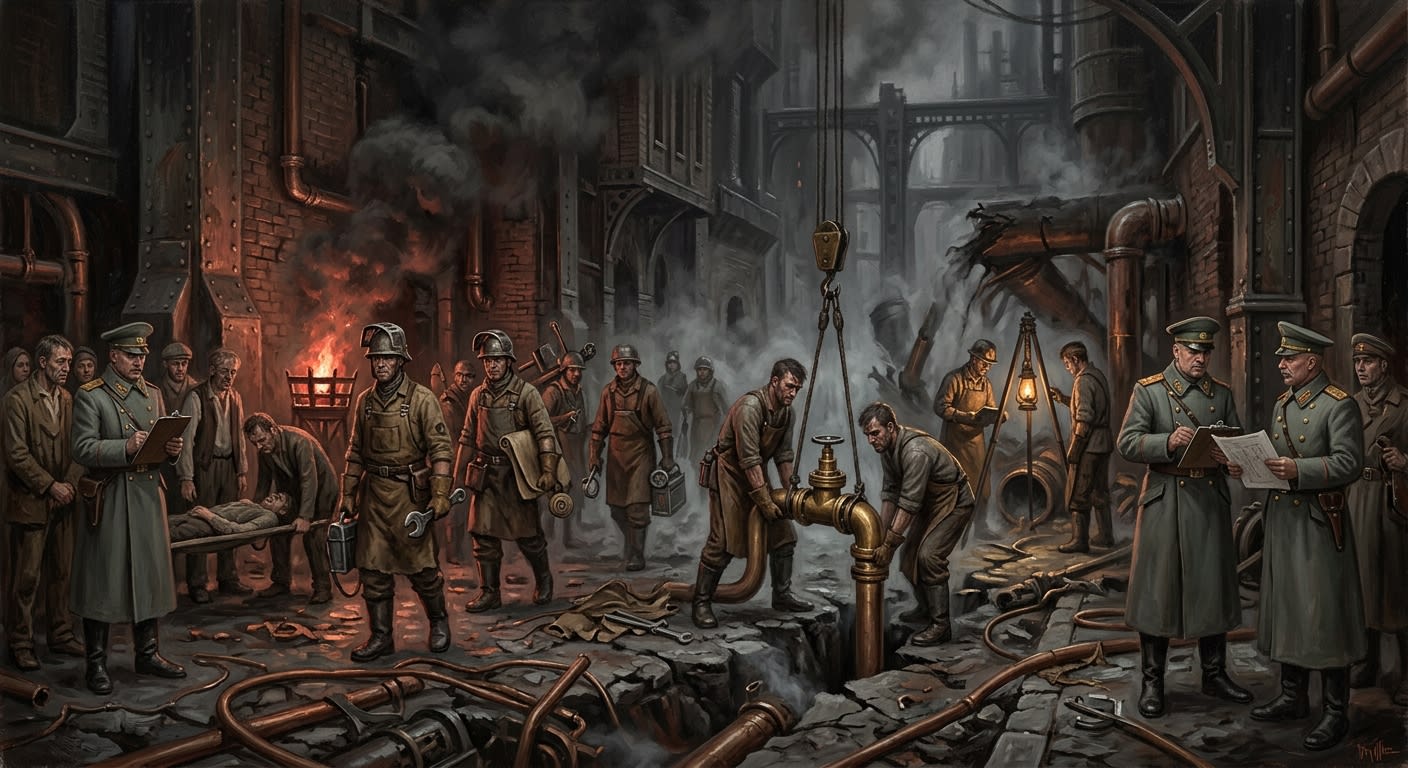
District Seven went quiet during the second half of Matins load. That phrase is mild enough to deserve indictment. The ward-plates across the western underlevels did not crack, burst, glow black, or announce betrayal with the courtesy of theatre. They fell mute. One level, then two, then six. The thumper manifold lost cadence. The diesel conduit network, already starved by ration shaving and understaffed maintenance, stopped carrying the low hammer-pulse that kept the district's alarm ribs, gate listeners, and chapel-mouth relays in obedience.
A quiet ward is an unlocked confession.
By the time the first runner reached the duty office, the breach had already entered.
#On the Missing Hands
The Blackout was not born from one failed valve. That would have been merciful, and the Bureau dislikes mercy when blame can be itemised.
The shift roster for District Seven listed twelve authorised Resonance Line Technicians. Three appeared. Two were Clamp Runners carrying temporary seals. One was a Line Technician with burns along both wrists and a disciplinary notation for “unlicensed expediency,” which means he had once saved a district with the wrong gasket and embarrassed the right clerk. No qualified Harmonic Listener had been posted for seventeen days. The duty captain had requested one twice. The request was returned with the phrase RESOURCE ALLOCATION PENDING written so firmly that the ink nearly improved into murder.
District Seven's manifold had been knocking in metre for a week.
The Plumbers heard it. Of course they heard it. Pipe-Singers can hear a failing line through stone, diesel fog, sermon noise, and the cheerful lies of gauges. They filed Form 77-K, then Form 77-K Supplemental, then a private warning to the checkpoint marshal, who understood danger more quickly than offices do because danger cannot be bribed after arrival. Replacement hymn-gaskets were requisitioned. The lawful stock had been diverted to Bastion-Shipka after the Unhymn Infiltration. Counterfeit stock was available by dusk.
Early Engineering abstracts describe District Seven as “fully maintained within prescribed staffing variance.”
Corrected. Three of twelve assigned technicians were present. No Harmonic Listener was on duty. The prescribed staffing variance had been calculated by an office safely above ground, where pipes do not answer back and casualties arrive as tidy columns.
The senior technician, Edric Sann, used the counterfeit stock. He did so because a false gasket in the hand outranks a blessed gasket still three provinces away. The seal held for six hours. Then the line laughed.
#On the Breach Through Silence
The enemy found the quiet the way rats find grain.
At 4:18 after Matins, alarm ribs in Underlevel Two failed to return the challenge pulse. At 4:23, chapel-mouth relays in the west service trench repeated the previous day's devotional bulletin instead of the current breach warning. At 4:31, Gate Listener Voss marked three shadows moving behind the wire and received no ward echo. By 4:42, hostile bodies were inside the unmaintained section.
The records call them breach incursion assets. Fine. Let Records keep its soft gloves. Men with split faces came through the lower seam while the plates slept. A sentry fired twice before his rifle jammed with wax dust from a ruptured relay. A ward-priest tried to raise the alarm by bell-rope; the bell swung and made no sound. Sixteen patients in the fever bay were found kneeling toward the eastern wall, though no one had ordered them moved and eight lacked the strength to stand.
FIELD SCRAP — RECOVERED FROM DISTRICT SEVEN INFIRMARY Patient line intact at inspection. Patient line absent at second inspection. Wet footprints on ceiling. One orderly found inside linen press, folded along shelf limits. Statement carved on press door: ██████████████████████ Translation prohibited by Purity.
Four hundred died before containment. That number has the blunt weight of a paving stone and less detail than it deserves. Some died by enemy hand. Some died when ward-doors sealed late and sealed wrong. Some were shot by their own relief company because a silent district teaches suspicion faster than command can teach restraint. The Bureau of War counts all four hundred as enemy casualties. This is convenient, lawful, and obscene.
#On the Wheel and the Saint
Przemyśl's local version of Saint Vellum of the Valve begins here: one hand welded to the wheel that restored District Seven's ward-plates after four hundred souls had already been spent teaching Engineering vocabulary.
The records do not name the man. Plumber testimony does. They call him Sann, the same senior technician who signed for the counterfeit gasket stock. By the ninth hour he had crossed two sealed corridors, one flooded sump, and a service throat warm enough to blister breath. He reached the auxiliary wheel under Manifold Chapel C and turned it against pressure. Metal took his glove. Heat took the skin beneath. He kept turning.
The ward-plates returned in strips: first Underlevel Six, then Four, then the chapel line, then the gate echo. The breach team outside heard the plates wake and described the sound as “iron remembering anger.” The hostile bodies inside the district lost coherence within three minutes. One burst into moths. One became a soldier's mother and begged. One, according to the least useful deposition, apologised in perfect Strasbourg court diction before the fusiliers burned it.
Bureau of Engineering credits the restoration to “standard auxiliary wheel operation performed within emergency tolerance.”
Clarification. The auxiliary wheel had been marked inoperable since A.S. 168, its access corridor listed as sealed, its chapel key missing, and its pressure rating exceeded by nine measures. Standard operation, in this instance, required a dead map, an illegal gasket, a burned hand, and a saint no office recognises.
#On the Word “Conditionally”
The Blackout changed the profession's classification. This is how the Bureau mourns: it adjusts nouns.
Before A.S. 171, Resonance Line Technicians were “auxiliary personnel, non-essential.” After the four hundred dead of District Seven, the Bureau of Engineering issued the revised phrase “auxiliary personnel, conditionally essential.” The Plumbers petitioned for removal of conditionally. The petition failed. The word auxiliary was italicised in one internal copy, a mercy so small it would shame a louse.
As of A.S. 201, every Plumber at Przemyśl knows District Seven. Apprentices are brought to the manifold scar and told to listen. The pipe still knocks twice in cold weather. No one answers the third knock. The replacement roster now requires a Harmonic Listener within bell-run distance of every primary manifold, except during shortages, feasts, inspections, budget closures, disciplinary reallocations, convoy surges, and all other hours when policy meets life and loses.
The district functions. That is the official verdict. The plates ring, the sermons pass, the gates answer, the dead are filed, and the four hundred have become a useful administrative lesson. Sann's handprint remains on the wheel beneath Manifold Chapel C, though Engineering calls it heat distortion and Purity calls it unauthorised devotional marking.