
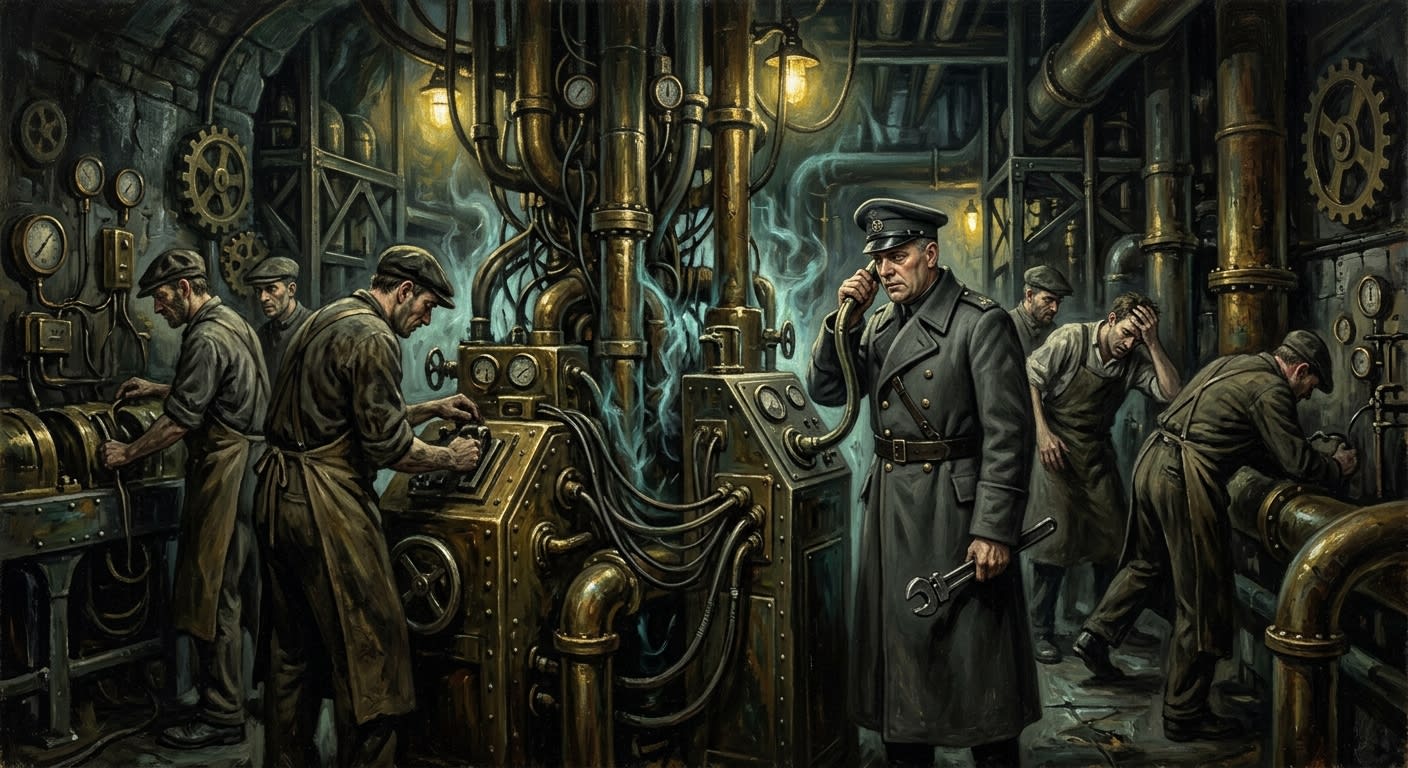
#On the Night the Pipes Learned to Lull
The Unhymn Infiltration of A.S. 163 began, as most disasters begin in a competent state, with a maintenance delay no one considered interesting enough to confess.
Bastion-Shipka's underworks had been coughing for three weeks. The southern resonance conduits — those pressurised fuel-and-vibration arteries by which bell-thumpers, ward plates, sermon horns, alarm plates, and the low civic hum of obedience were fed — showed pressure tremor in five gauges and line-singing in two more. The Diesel Resonance Plumbers requested replacement hymn-gaskets. The request passed through War, Engineering, Tithes, Orison, and a clerk in Strasbourg whose handwriting suggests either haste or contempt. The gaskets did not arrive.
A Plumber patched the delay with wax, wire, split rubber, and the professional blasphemy by which the Sagittal Line is kept intact. The line held. That was the trouble.
At third watch on the seventeenth of Ashfall, the pipes under the eastern barrack district began to hum in a cadence no schedule authorised. Sentries reported nothing. Bellwardens heard no external peal. The furnace room logged stable pressure, clean flow, acceptable thumper rhythm. Above them, three hundred and twelve soldiers, two ward clerks, nine cooks, and one Penitential Shadow slept through dawn bell, ration bell, muster horn, alarm strike, and a sergeant-major kicking a door until his boot split.
They breathed. They did not wake.
#On the Route of the Enemy Through Honest Metal
Syrion is commonly imagined as fog, pillow, delay, and ruinous comfort. This is a child's catechism with better penmanship than accuracy. Sloth does not only sit upon men until they stop moving. Sloth studies the chair, the floor, the bell-rope, the hinge, the schedule, the cup of stimulant beside the night officer's hand. At Shipka he learned the pipes.
The hostile tone did not enter through a gate. It rode the resonance line. The corroded gasket made a small ungoverned interval in the conduit pulse; the pulse produced a sympathy note; the sympathy note carried a sleep-cadence through the district's bell plates and thumper housings. Every alarm became a lullaby with official authority. Every ward hum repeated the same soft instruction: later.
The line passed beneath the Shipka rail quarter, near the culverts that fed the Reed Road inspection lamps, and through housings stamped by Engineering and blessed under the old Bells schedule. Its plates answered the same morning pattern that woke cooks, mule crews, ward clerks, and the Bellwardens assigned to south-wall alarm duty. The Enemy did not need a trumpet. It had the Synod's own plumbing.
The discovery belonged to a Clamp Runner named Ulric Senn (Unregistered), though his superiors wrote around him with graceful cowardice. Senn had been sent beneath the barracks to bleed an air pocket and found the line knocking back against his wrench in a pattern that matched no pressure chart. He placed his ear-horn to the conduit, listened for seven seconds, and drove the emergency stop-spike through the manifold casing with both hands.
The pipe screamed. The district woke.
The awakened soldiers did not rise refreshed. Some vomited black bile. Some wept because they had dreamed of standing in formation beneath a sun that never moved. Twelve could not speak above a whisper for nine days. One cook attempted to return to sleep with a cleaver in each hand and was restrained by men who later swore he had been smiling at someone behind them.
Casualty Appendix 7-D records ███ personnel who remained asleep after manifold severance. Pulse present. Breath present. Pupillary response absent. Choir stimulus failed. Reliquary wax applied to both ears produced ██████████████. Subjects transferred under sealed Mercy custody. No release records survive.
#On the Argument Afterward, Which Was More Vicious Than the Pipe
The Bureau of Engineering named corroded gaskets, poor maintenance access, deferred requisitions, and one illegal bypass. The Bureau of Doctrine named Syrionic interference. The Bureau of Orison named hostile cadence contamination. The Bureau of War named unacceptable garrison vulnerability. The Bureau of Tithes named excess replacement cost.
All were correct. This offended everyone.
The first public notice described the incident as a barrack fever aggravated by marsh vapours.
Corrected. No fever was found. The marsh was innocent in this instance, a novelty the Bureau recorded with some irritation. The cause was hostile acoustic intrusion through resonance infrastructure compromised by maintenance delay and seal degradation. Public notices retained the phrase marsh vapours for civic reassurance until A.S. 164.
The Plumbers argued that a resonance line is a machine, and machines become treacherous when starved of parts. Doctrine answered that a line carrying bells and sermons is a sacramental artery, and sacramental arteries become treacherous when handled by men whose faith smells of black diesel. Orison wanted every conduit retuned under licensed song. Engineering wanted access panels widened. War wanted three heads on spikes. Purity supplied seven, because Purity is generous when someone else is paying for timber.
The dead, if dead is the word permitted here, were given closed rites. The sleepers who woke were reassigned in pieces: some to rear sanitation duty, some to prayer rehabilitation, some to Irongate where their habit of refusing sleep was considered useful until it became contagious. Ulric Senn vanished into the promotion lists and reappeared years later as a District Resonance Plumber with a signature so hard it cut the paper.
#On the Edict That Solved the Wound by Selling Bandages Late
A.S. 164 gave the Synod its answer: the Seal Standardisation Edict. Every resonance line across the Line would be fitted with authorised hymn-gaskets tuned to reject Syrionic harmonic frequencies. Every gasket would be blessed, measured, stamped, logged, invoiced, inspected, re-logged, and installed only by licensed hands under approved cant.
The Edict worked. Let no cynic say otherwise. The specific Shipka infiltration pattern did not recur in that district.
The Edict also cost four times the prior seal schedule, arrived three months late to forward bastions, and created a counterfeit market before the ink dried on the enforcement copies. A false gasket that sealed was cheaper than a true gasket still travelling west of Munich. Plumbers used what kept the line alive. Purity immured suppliers. Tithes collected fines. Engineering filed emergency exceptions. Doctrine preached obedience over the new invoices.
#On the Doctrine Left in the Metal
The Unhymn Infiltration changed the theology of infrastructure. Before A.S. 163, a pipe was permitted to be dull. After Shipka, no pipe was dull. A conduit might carry fuel, vibration, bell-force, sermon breath, ward obedience, hostile cadence, sleep, sedition, or a clerk's career into a furnace pit. The Plumber's ear became a doctrinal instrument. The Harmonic Listener, once a greasy eccentric tolerated by Engineering and mocked by Bells, acquired the terrifying dignity of necessity.
The event also gave ugly cousinship to the Trench Sermon Mandate of A.S. 158, which was reread with sharper teeth. Doctrine had already forced Furnace Catechists into power installations after foreign harmonics troubled Shipka's generators. A.S. 163 proved the sermon was no decoration. Speech policed sound; sound policed machinery; machinery policed sleep. The chain was sacred because every link could be invaded.
Later training summaries state that the Unhymn Infiltration was wholly prevented by subsequent gasket reform.
Clarified. The A.S. 163 pattern was prevented. The Enemy, being discourteously inventive, has since attempted pipe-murmurs, line mimicry, sermon-feed drag, thumper delay, and one instance of a ward plate humming a soldier's childhood prayer until he walked into the marsh. Reform ends yesterday's heresy. Tomorrow files its own request.
Pale Chanters taught the Synod that a hymn could be murdered and returned wearing its face. Syrion taught Shipka that the face could appear on a pressure gauge. Since then every maintenance log on the southern Line contains a small blank box labelled responsive harmonic observed? Most Plumbers mark no. Some mark no with ink pressed deep enough to scar the page.
At Shipka, they still tell apprentices where Senn drove the spike. The casing was replaced, then preserved, then denied preservation because a punctured conduit is an improper relic. The rail quarter keeps a shaving of it in the Sump-Chapel (Unregistered) behind a cracked gauge glass, beside tokens for Saint Vellum of the Valve and the dead men of the pump-room. Men touch it before descent. Officially they touch nothing. Officially nothing happened beyond a corrected maintenance schedule.
The pipes hum under them anyway.