
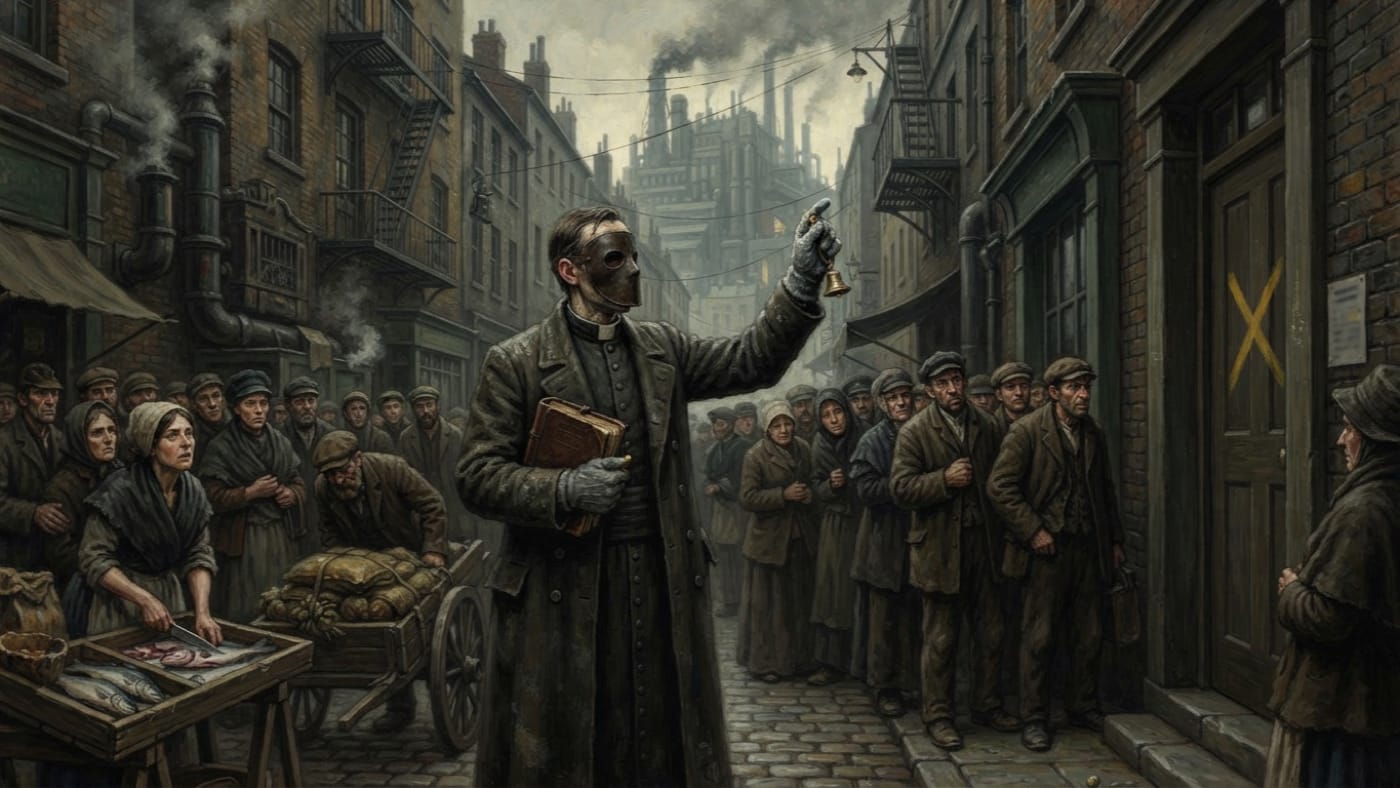
#On the District Vicar's Station
The Vicar walks where the bell cannot reach.
The ledgers use the title District Vicar when they want a Doctrine Street-Vicar to sound settled, parochial and entitled to a pew. The same officer appears in other columns as Doctrine Inspector or Creed Officer, depending on which clerk held the pen and how much ink the column could spare. The market has other names for the office. Chalk Priest is the polite one.
The title confers a district: a measured portion of markets, ration halls, school lanes, dock ramps, tenement courts and tavern thresholds, walked under licence from the Bureau of Doctrine. It confers no command over anyone wearing a better collar. The District Doctrine Officer, called Square Captain in the squares, holds a senior rank and is a separate creature. A Vicar who confuses the two will be corrected by the Square Captain first and the street second. The street is less courteous about punctuation.
The instruments are few: coded chalk, a seal token, correction slips, a token punch, a pocket bell or chime and a brine vial. The Vicar is known by collar or cord, by the seal token worn where it can be seen, by gloves gone grey with brine and cuffs gone pale with chalk. In riot-prone districts some wear half-masks. No one has issued the Vicar a sword, and the Bureau considers this a theological position.
#On the Square-Stop
The square-stop begins with a choice of ground. The Vicar picks the place where the most people will see the least warning: the fish stalls at midday, the mouth of a ration hall when the bread runs short, the school lane when the catechists release the children. The manual adds that a stop should always have an escape route. Even sanctity likes a back alley.
The Vicar takes control with a gesture or a chime. A gloved hand goes up and one clear note sounds. Barter dies mid-price. A cart halts with its wheel half over the gutter, and a coughing man swallows his cough because it now has an audience.
Then comes the line. The Vicar calls a phrase of the Eternal Creed and the square must answer it, whole and in cadence. The field booklet supplies what a patrol requires. The full written text remains under sealed custody, and I shall not be the clerk who reproduces it beside a herring barrel. Children are tested first, because adults follow when children comply. A child who refuses the line has put the Vicar on trial.
Tokens come next. The citizen's purity token carries the punches of attendance, confession and ration-hall proof. The Vicar's seal token carries only the Vicar's authority, and forgers have confused the two with some talent. A missing punch, a stale date or a seal rubbed smooth by anxious thumbs each invites a question.
After that the Vicar has three roads. Correction means a public recitation and a slip prescribing chapel attendance or a penance chore. Marking means chalk on the doorframe or storefront. Escalation means detention or referral to the chapel annex, where other offices keep other hours. Whichever road is taken, the Vicar logs the names flagged, the doors marked and the slips issued. A stop that goes unrecorded never occurred. The Creator sees all things but does not file returns.
#On the Mark Left Behind
Chalk speaks after you leave. The Corps teaches this as a proverb and practises it as policy.
A yellow mark on a lintel is a warning and nothing more. Conviction belongs to judges, heresy to inquisitors and possession to offices with heavier gloves. Any clerk who writes otherwise in my hearing will be re-catechised at the clerk's own expense.
The street reads the mark differently. Customers find another baker, and the neighbour stops lending salt. Attendance lists come to the Vicar from the Bureau of Records, and the address acquires a pencil note there that never quite rubs out. Tithe assessors and gatewardens notice the mark when dues are due and permits are sought. The household lives under it long after the Vicar has walked three streets on to mark another.
Professional taboo forbids marking a house without issuing a correction path. Here cruelty and political risk counsel the same restraint, which they seldom do. The slip names the recitation, the attendance or the chore. Completing it clears the household in the ledger, if not at the bakery.
The trade has its rot. Clean marks have been sold, and protected doors have been kept for a fee the trade calls chalk oil. Missing punches have gone unseen in exchange for favours. Easy stops at obedient corners have padded compliance counts. A clean door lies, runs the proverb. Novices learn it as a warning and auditors use it as a method.
#On Oren's Use
Every patrol opens with the brine wash. The Vicar wets the hands, taps the seal token, speaks the opening line of the Creed into the chime and dusts chalk across the gloves so the hands remember. The rite belongs to Saint Oren of the Corner, tolerated patron of the Corps.
District Vicars cite him after issuing correction slips, and the timing is instructive. By then the slip is written, the household named and the consequence fixed in ink. Only then does the Vicar murmur the name of a parish correction-clerk who, by the Cologne legend, mended a whole corner during the late Market Drift Years. He came back day after day and sang the Creed until the street answered. He made no arrest and carried no red chalk.
The Bureau has declined to settle whether Oren existed as the copies describe, which corner he stood on and what his relics are. The Corps has no need of a settled Oren. It needs one it can invoke at the moment its own office has done something he never did.
Oren founded nothing. The Corps was chartered under the Catechism Third Revision in A.S. 104, filed as SVP/104-7, and sent eleven Vicars into Cologne. The saint was adopted afterward, as saints are, once the machinery wanted an ancestor for display.
#On the Rationing of Shame
In A.S. 119 an unnamed Street-Vicar in the Trier market district marked fourteen doorframes red in a single afternoon. By midnight the marked families had become a crowd, and by dawn the Vicar was in the Moselle. The disturbances now filed as the Chalk Riots spread to Cologne, Halle and Strasbourg before the Bureau of Purity restored order. The Vicar's name has been expunged and stays expunged in these pages. The Moselle keeps the rest of that record.
The Bureau of Doctrine attributes the Trier disturbances of A.S. 119 to Rationalist agitation.
Revised to "excess of zeal in application of marking protocols," following the Bureau of Records finding that every participant held current purity tokens and unblemished confession records. The Great Deceiver was not consulted and receives no credit. The disturbances remain filed under "Seasonal Unrest (Devotional)."
In A.S. 120 the Bureau standardised the soft mark, a warning chalk that fades within hours. In riot-prone districts, Vicars were to walk with two militia of the Covenant Military, who were to be seen and stay silent, because noise inflames a crowd and silence only watches it. The fourteen doors were never codified as a threshold. Instead, informal practice limits a patrol to six doorframes unless justification is filed with the District Doctrine Office. Six is a custom with a form attached. A Vicar who files the form may mark a seventh.
Fast-fading chalk serves two parishes. Used under the reform, it is restraint. Bought in an alley, it is a favour with the evidence removed. The chalk cannot tell which hand applied it.
#On the Vicar's Own Examination
The Vicar is counted on stops made, corrections completed, attendance recovered, marks accurate, tokens compliant and riots incurred. The figures pass upward, and in time the Vicar who produced them is produced before a Codex Doubt Auditor.
Auditors recheck the marked doors and compare correction slips against chapel records. Those records come from the same scribes, catechists and confession clerks who fed the Vicar's lists in the first place. Auditors also interview the corrected. They begin with the mercy exceptions, the cases the Vicar chose not to escalate, because restraint leaves the thinnest paper and so earns the closest reading.
This is where the factions bleed. The Mercy Vicars favour quiet repair: a word in the ear, a whispered line restored, a mark delayed. Their files run thin and their audits run long. The Marking Vicars favour public shame. Their files run thick with chalk and grievance, and their names turn up more often in alley prayers. Both cite Oren, and each is right about him exactly as often as it suits them.
Then there is cadence. A crowd may give every word of the Creed correctly and still give it wrong: the breath shifts, the stress lands late, as if one throat were leading the rest from behind the teeth. The Vicar is trained to listen for the second voice. Diagnosing it is the work of the Cadence Examiner, whose chime and nerves are both specialist issue. The field instruction is plain: if the cadence feels wrong, end the stop and report it. Lingering out of courage is classed as a paperwork error.
#On Present Application
As of A.S. 201 the office persists because the alternative persists: private belief, market rumour, optional attendance, gang law and barter justice. The Vicar walks the school lane at dawn, the fish stalls at noon and the ration hall when the bread runs short. Chalk goes up, slips go out, and Oren's name is spoken over the ink.
The household keeps the mark and the auditor keeps the slip. The Vicar keeps the gloves wet and waits to be counted.