
#On the Afternoon at Trier
The Chalk Riots began in Trier in A.S. 119, in a market district of good tokens, current confession receipts, obedient shutters, and citizens who still believed a red mark on a neighbour's lintel was a warning rather than an invitation to arithmetic.
The unnamed Street-Vicar began his patrol after Prime. His field book survives in copy, since the original was found pulped by river water and, according to the Bureau of Records, by “hostile civic pressure.” He marked one household red for missed chapel-annex return. A second for stale attendance. A third for cadence variance. By the sixth door, the market had gone quiet. By the ninth, stall cloths were being folded. By the fourteenth, the entire street had learned a sum more powerful than the sermon: if fourteen clean families could be made uncertain in one afternoon, no white lintel was white by right.
The Vicar recorded the street as “silent, compliant.” Silence is a difficult substance for stupid men. It may mean reverence. It may mean fear. It may mean the district has stopped breathing so it can hear itself becoming a weapon.
By dusk the marked households had closed their doors. By midnight they had opened them again.
#On the Fourteenth Door
The Bureau's later reconstructions agree on the sequence and quarrel over the meaning, which is how one recognises a file written by cowards with tidy hands.
The first six markings drew witnesses. The next four drew relatives. The eleventh drew a confession clerk from the annex, who advised moderation and was ignored with the ecclesiastical politeness reserved for people who are right too early. The twelfth mark was placed on a baker's lintel. The baker's eldest daughter had returned a correction slip one day late because the chapel annex was closed for fumigation. The Vicar wrote non-compliance. The daughter began reciting in the doorway, perfectly, until her mother covered her mouth.
WITNESS DEPOSITION — TRIER ANNEX, FILE 119-CH/7 Witness states the fourteenth household presented current tokens. Witness states the Vicar said: “Current is not clean.” Witness states the crowd answered: ███████████████████████. Witness later recanted after Purity visit. Recantation wording matches three other files exactly.
The fourteenth door belonged to a widow whose husband had died hauling bell-bronze under a Bureau of Bells contract. She possessed, by all accounts, unblemished confession history. Her children knew the Creed. Her lintel received red because a neighbour had reported an unlicensed prayer spoken over soup. The prayer was later identified as orthodox, regional, and old. Regional oldness is always one clerk away from heresy.
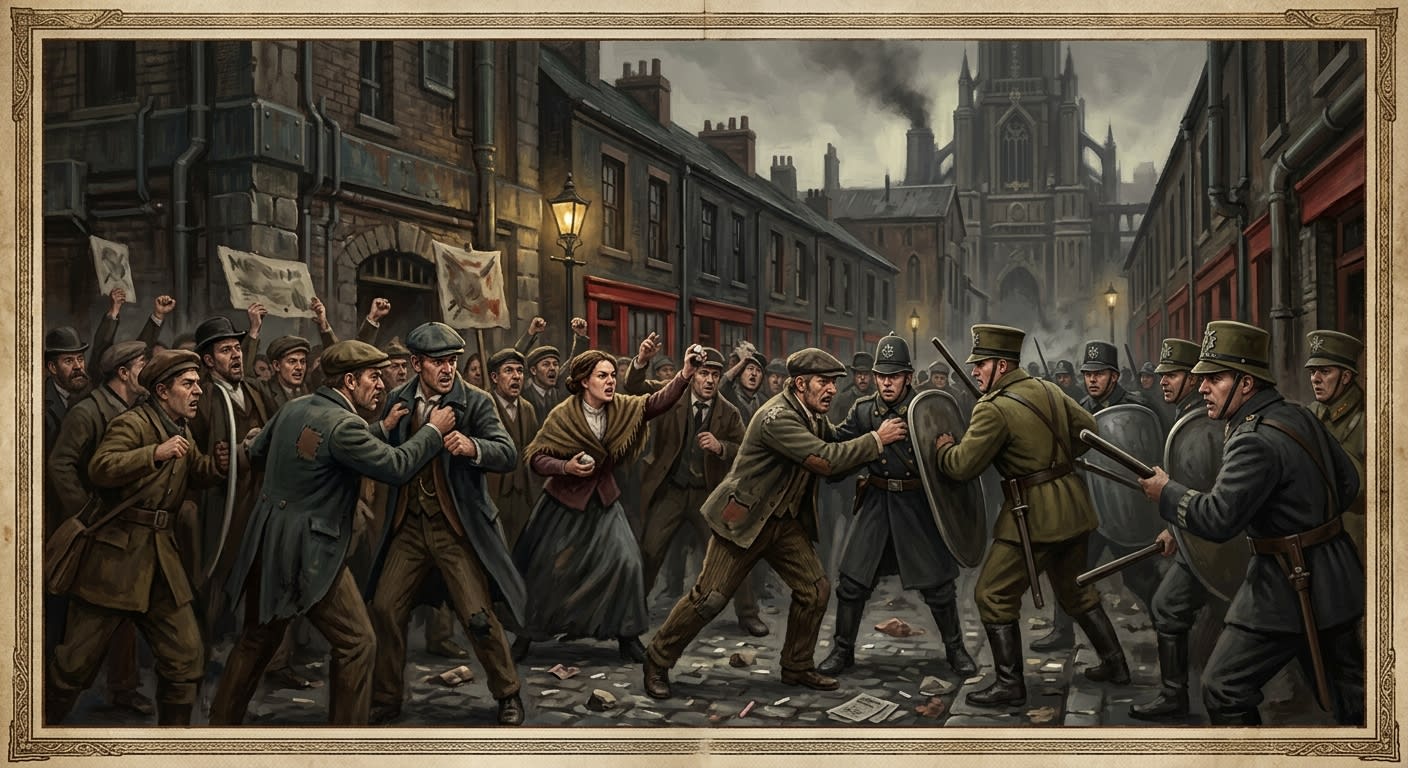
The crowd formed from families still obedient enough to be shocked by procedural excess. This is the detail romantics omit. These were registered people whose papers were in order, not Rationalist conspirators, demon-singers, tavern radicals, or gutter atheists rehearsing slogans under the moon.
Papers in order. Blood out of order.
#On the Body in the Moselle
By midnight the fourteen households had become one crowd. Their neighbours joined because fear is social before it is political. The annex clerk rang for assistance. The chime was taken from him and thrown into a gutter. Someone scraped chalk from the twelfth lintel with a kitchen knife. Someone else began grinding the fragments underfoot. A woman — the files preserve her as “female participant, clean records,” because names are dangerous when sympathy is possible — used her heel until the red dust mixed with mud.
The Vicar was found at dawn in the Moselle. “Found” is charitable. The body snagged against a mooring post below the fish steps, cassock twisted around one arm, field book sealed to the chest by river paste. His chalk case was empty. His tongue was intact, which disappointed the more lurid pamphleteers and relieved the Bureau, since mutilation would have made the affair look doctrinal.
Earlier circulars attributed the Trier disturbance to heretical agitation by elements sympathetic to Rationalist remnants.
Revised. Records review confirmed every identified participant held current purity tokens and unblemished confession records. The disturbance originated in enforcement excess by a lawful officer applying lawful tools beyond survivable proportion.
The first soldiers arrived after the body had already taught its lesson. Purity officers sealed the market, arrested thirty-one, released twelve, lost four names through clerical damage, and filed the missing names under Pending. Pending is a shallow grave with better stationery.
#On the Spread West and Upriver
Trier should have remained local. Most shame does. Yet the Street-Vicar system had been installed across the Rhineland with identical forms, identical chalk codes, identical chimes, identical little field books in which men wrote uncertain as if uncertainty were a stain they had discovered rather than one they had applied.
Cologne heard first. A yellow-marked brewer's quarter scraped its lintels clean before dawn patrol. Halle followed with what the Bureau called “coordinated devotional refusal,” meaning crowds recited the Creed correctly while blocking Vicars from reaching marked doors. Strasbourg, most humiliatingly, suffered three district disturbances inside the capital's own administrative shadow. One occurred within hearing of a Records annex. Clerks later testified they could not hear the crowd over the scratching of their own pens. This testimony was accepted because it flattered Records.
The Covenant was not yet formally attached to Vicar patrols, and the absence showed. Local watchmen wavered. Chapel guards protected annexes and abandoned markets. Purity restored order with arrests, baton charges, strategic mercy, and the great gift of letting frightened districts believe they had been heard while ensuring no official ear was damaged by the noise.
The riots lasted long enough to prove doctrine vulnerable, and ended quickly enough for doctrine to pretend it had never trembled.
#On the Name Given to Shame
The first classification was Seasonal Unrest (Devotional). Admire it. A riot had killed a Vicar and shaken four cities; Doctrine called it seasonal, unrest, devotional, as if the whole matter were a hymn with poor weather.
The word Insurrection was avoided because insurrection implies political meaning, and political meaning implies grievance, and grievance implies a human being may stand before the Bureau and say, “You did this.” Seasonal unrest belongs to nobody. Devotional unrest flatters the victim. The classification buried causality beneath incense.
The Chalk Riots were a spontaneous outbreak of anti-clerical disorder.
Corrected under Records protest. The outbreak was spontaneous only in the way powder is spontaneous after a fool kneels over it with a candle.
The Marking Vicars took the riots as martyrdom and instruction. The Mercy Vicars took them as proof that public shame breeds the thing it claims to prevent. Both factions lied with evidence in hand, which is the most respectable form of factionalism.
In District reports the phrases changed. Visible compliance recovery remained. Adverse crowd consolidation appeared. Reduced reputational shock appeared. Soft marking appeared. A vocabulary of fear entered the Corps dressed as reform.
#On the Soft-Marking Reform
A.S. 120 brought the reform that everyone now pretends was planned. Soft chalk. Fading marks. Escort norms. Two Covenant militia for riot-prone districts: visible, silent, decorative in the way a bayonet is decorative when polished for parade.
The fourteen-mark threshold was never written into law. It did not need to be. Every Vicar learned the number in training. Six red marks in one patrol may pass with justification. Seven draws review. Fourteen ceases to be a number; it becomes a river.
Soft marking did not soften power. It refined it. Yellow that fades before Compline still does its work before supper. A red mark reviewed by a District Doctrine Officer still stains the memory after rain takes the chalk. The reform reduced spectacle, not pressure; riot, not fear; embarrassment to the Bureau, not cruelty to the household.
It worked, which is the ugliest sentence in administration.
#On the Present Reading
As of A.S. 201, every Street-Vicar learns Trier before receiving a chalk case. The instructor names the fourteen doors. The recruits repeat the limit. The field book sample is passed hand to hand. The page has been copied so often that the ink strokes have acquired the confidence of scripture.
The Market Drift Years created the Corps. The Chalk Riots taught it proportion. The Echo protocols taught it suspicion. The Quiet Purges taught it obedience to its own auditors. A Street-Vicar now walks with all four lessons in his pocket, alongside the chime, the slips, and the chalk that looks harmless until placed against wood.
The Moselle keeps moving. This has been interpreted as mercy by poets and as disposal by practical men. The Bureau has filed both readings and taxed the paper.