
#On the Visible Wound
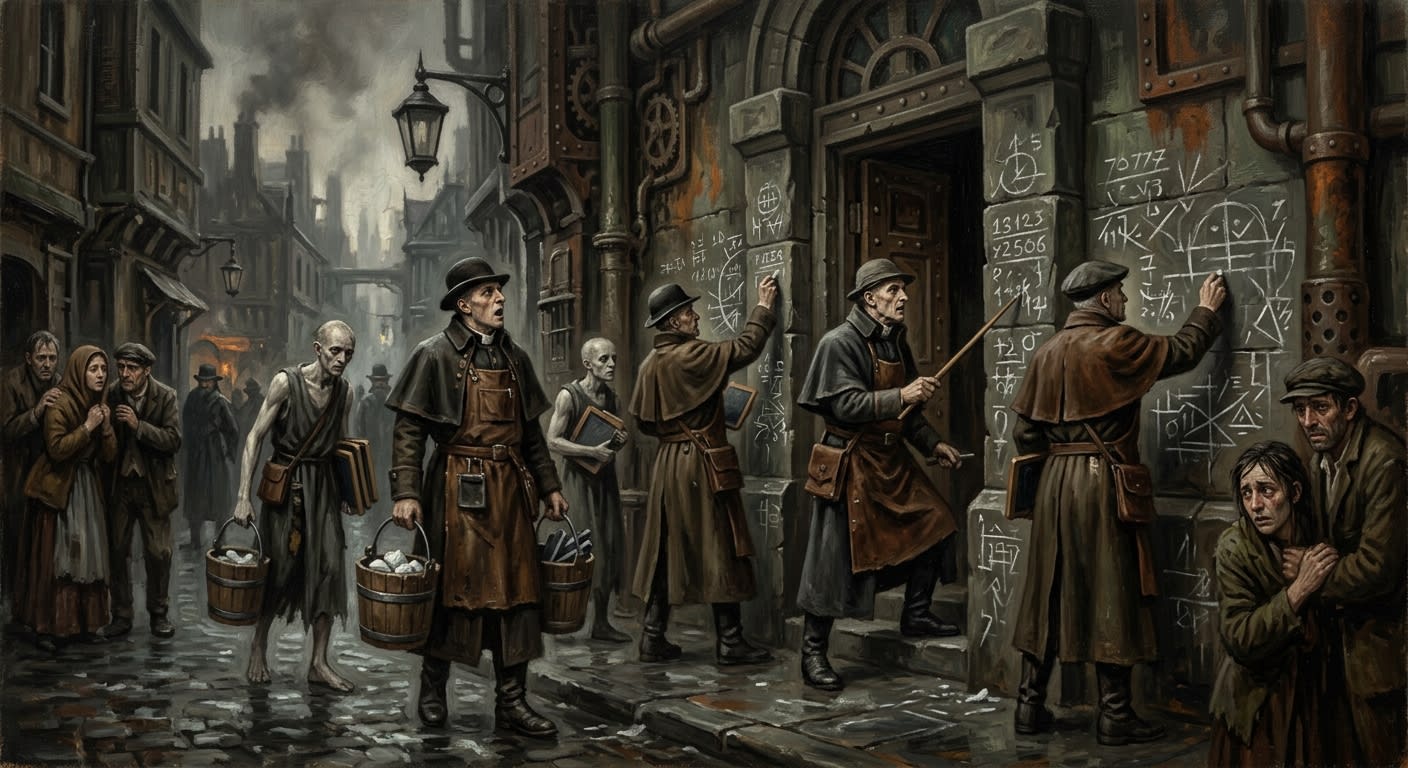
The Marking Vicars are the internal faction of the Doctrine Street-Vicar Corps, answerable through the Bureau of Doctrine who correct publicly: chalk marks, stamped slips, open recitation, the doorframe made into a small tribunal. Their doctrine is beautifully brutal. Mercy without consequence is permission. A whispered correction may save a blush; a yellow mark teaches the street.
They do not call themselves Marking Vicars. No faction with any instinct for survival names its own vice. In memoranda they appear as Visible Compliance Doctrine, reputational enforcement posture, chromatic civic correction, and other phrases bred in clerical darkness. The street calls them Chalk Priests, Red-Hands, Lintel Butchers, and worse things that rhyme in Cologne.
#On the Theology of Chalk
The chalk is a sacrament only in the vulgar sense, which is to say everyone treats it as one while the theologians argue over grammar. White means clean: attendance current, recitation sound, token proper. Yellow means watched: discrepancy, pending slip, suspect cadence, careless household, a whisper that has not yet ripened enough to feed Purity. Red means uncertain. Red is the little funeral held for a family's reputation before any corpse is supplied.
A Marking Vicar believes chalk speaks after the body leaves. He is correct. The Vicar cannot stand outside every bakery, every stairwell, every tenement door. Chalk can. The Vicar cannot whisper into every neighbour's ear that House Lenz missed three chapel annex appointments and the eldest son muttered the third article through his teeth. Chalk can. The Vicar cannot raise tithes, delay ration confidence, curdle marriage prospects, and make children cross the street without appearing to do any of it himself.
Chalk can.
The Marking school grew from the early Corps confidence after A.S. 104, when the first Cologne deployments learned that public faith required public theatre. The Market Drift Years had proved private belief too slippery for the Ledger's hand. Markets obey what markets can see. A doorframe is an argument placed at eye height.
Earlier District lectures described marking as “minor pastoral notation.”
Corrected. Marking is reputational punishment, ration pressure, doctrinal warning, and neighbourhood instruction. Pastoral notation is what cowards write when they want violence to sound like penmanship.
#On Procedure, Which Is the Proper Name of Cruelty
A Marking patrol begins like any Street-Vicar patrol: brine wash, seal token, pocket chime, chalk case checked by colour and count. The square-stop is selected for visibility. School gate at dawn. Ration queue at hunger-hour. Market lane when coin and pride are already exposed. The Vicar raises the hand. The little bell rings. Everyone becomes religious at once.
The call goes out; the Eternal Creed returns. The Marking Vicar listens for cadence failure, clipped vowels, over-loud piety, silence half a beat late, children prompted by mothers, men whose mouths move without breath. Then comes token inspection. A missing stamp earns a slip. A stale confession date earns yellow. A forged token belongs to Purity. A house with three returning slips and no annex signature receives red, and the street learns faster than any sermon could teach.
The slip is stamped in public. The chalk is applied in public. The recipient recites in public. The Marking Vicar writes the name in the field book while the neighbours pretend not to watch and watch with the hunger of saints at a relic case.
TRIER FIELD EXTRACT — A.S. 119 Doorframe 9: red. Doorframe 10: red. Doorframe 11: red. Doorframe 12: red. Doorframe 13: red. Doorframe 14: red. Crowd condition: “silent, compliant.” Later annotation by Records: “silence misread.” Body recovery status: unresolved.
#On the Moselle Lesson
The Chalk Riots are the Marking Vicar's wound and scripture. In A.S. 119, an unnamed Vicar in Trier marked fourteen doorframes red in one afternoon. By midnight the marked families had become a crowd. By dawn the Vicar lay in the Moselle, and his chalk was being ground into the cobblestones by a woman with clean confession records.
The Bureau filed the uprising under Seasonal Unrest (Devotional), because Doctrine preferred euphemism to confession. The Bureau of Records later noted that every participant held current purity tokens and unblemished chapel histories. The corrected attribution — excess of zeal in application of marking protocols — is one of those bureaucratic phrases in which an entire corpse has been folded.
A.S. 120 brought soft-marking reform. Chalk applied as warning would fade within hours. Riot-prone districts received two Covenant escorts, visible and silent. The fourteen-mark threshold was never codified; codification would have admitted that the fourteenth red door killed a Vicar. Practice limits a patrol to six doorframes without justification. Practice is law wearing cheaper shoes.
The Chalk Riots disproved the Marking school.
Amended. The Chalk Riots disproved incompetence at scale. The Marking school survived by learning to count below fourteen.
#On Their Hatred of Mercy
The Mercy Vicars offend Markers because they make correction private, and privacy is where heresy learns to breathe. A Mercy Vicar hears a bad line and steps close. A Marker hears a bad line and makes the crowd hear it too. The Mercy Vicar records restraint. The Marker records effect.
Their argument is conducted through quarterly compliance tables, since open theological dispute inside the Corps would amuse the wrong clerks. “Private correction success” means Mercy. “Visible compliance recovery” means Marking. “Adverse crowd consolidation” means some Marker frightened a market into remembering it had fists. “Under-escalated variance cluster” means some Mercy Vicar spared a household until Purity had to carry it out in pieces.
The Marker has one line that never fails in District meetings: a yellow chalk-mark on a doorframe has prevented more heresies than a thousand whispered corrections. The Mercy answer involves riot incidence, informant yield, and other phrases that prove compassion becomes tedious once clerks get hold of it.
#On Quota, Bribery, and the Red Hand
Marking is measurable, and measurable things attract quotas as corpses attract flies. Door marking accuracy. Correction completion rate. Attendance recovery. Token compliance. Riot incidence. The District Doctrine Office can rank a Vicar by how many households whiten after yellow, how many yellow after first slip, how many red become Purity matters, how many streets go quiet when the chime is lifted.
The corruptions are correspondingly legible. A Marking Vicar may sell white chalk to a protected household, red-chalk a rival's door, yellow-mark a bakery until its competitor pays in flour, or aim a patrol through a district because a Tithe Assessor needs pressure applied with plausible holiness. The clumsy ones are caught. The gifted ones produce numbers so handsome the Auditor blushes before burning them.
The street knows the game. Children lick yellow dots before rain can prove mercy, shopkeepers beg the Bureau of Records for delayed copies, and families pray the Bureau of Tithes has not seen the lintel before supper. Widows hang laundry over red lintels and claim domestic necessity. Bakers pay boys to shout “clean” outside white-marked doors. Markers call this resistance. I call it literacy.
#On Their Present Use
As of A.S. 201, the Marking Vicars remain indispensable because public doctrine must be public or it becomes opinion, and opinion is the little rat-hole through which every heresy enters wearing clean boots. A district governed by whispers alone learns that shame can be negotiated. A district governed by marks learns that the Ledger has eyes even in plaster.
The Corps needs the Marker as it needs the Mercy Vicar: one makes obedience visible, the other keeps visibility from becoming revolt. Between them lies the narrow street down which the Synod marches daily, bells ahead, auditors behind, citizens on either side watching the chalk dry.