
#On the Substance
The Doctrine of Cool Hatred instructs the soldier of the Church to kill without enjoying it. That is all of it. The chaplains, Confessors and the Bureau of Doctrine have spent generations elaborating that single sentence, and they have never improved it. Its text holds that righteous violence must be cold, calculated and passionless. The demon dies because duty requires its death. Hatred may not ask for it.
No council claims authorship of the teaching, and the Ledger records no year of promulgation. I have searched with the diligence of a man who would like his name on the first edition. The Doctrine has no founding. It has a purpose, which is older and more useful than a founding. It is standard chaplain instruction for every unit deployed to the Thracian sector, where Maldrake presses the plain north of Bastion-Constantinople and everyone who goes there comes back angry.
Grammarians object to the title. In my reading, a cool hatred is simply a hatred that has been filed. The Church cannot ask its soldiers to stop killing, and its artillery tables would object if it tried. It asks them to stop wanting to. One soldier pulls the trigger because the order came. Another pulls it because pulling it feels like collecting a debt. The bullet is the same in both cases, but each goes into a different ledger.
#On the Anger That Remains
Wrath's corruption starts with a wrong that really happened. A commander stole a soldier's rations. A widow's pension was refused on a clerical technicality. A brother was killed by his own battery's short rounds and the incident was logged as enemy action. The chaplain does not tell the soldier that these wrongs are imaginary. Chaplains who once tried that recruited for the other side more efficiently than any Flame-Tongue.
Maldrake's influence-demons can be seen as heat-shimmer in a corner or felt as pressure behind the sternum. They agree with the soldier, and their agreement is effective because it is accurate. They also give him something real. The strength is genuine, and so are the victories and the protection. Before the cultist becomes anything else, he is a hero, and for a while he is a hero honestly.
The Doctrine draws its line further on, at anger that outlives its cause. In that case the rage finishes with the man who wronged him and starts looking for someone else. A small slight becomes a capital offence. Friends begin to look like suspects. In the end the protector strikes the people he enlisted to protect, and he cannot explain why he did it. Chaplain instruction separates two things. Anger is a fact, and the soldier confesses it. Violence that has become its own purpose is an appetite, and the soldier must give it up.
The distinction matters because grief is not evidence of allegiance. The Bureau's catechism teaches that no demon can take a man's will. He chooses at every step, including after his body has begun to answer for those choices.
#On the Instruction of the Thracian Soldier
The Doctrine is taught through the body, because the body is where the trouble shows first.
Before deployment the soldier receives command discipline under the Bureau of War's protocols. He takes no action without orders and commits no violence without authorization. The theory is that structure contains rage the way a casing contains a charge. Before engagement there are breathing exercises, counted out under the chaplain's voice, and these are timed so that the breath and the trigger do not arrive together.
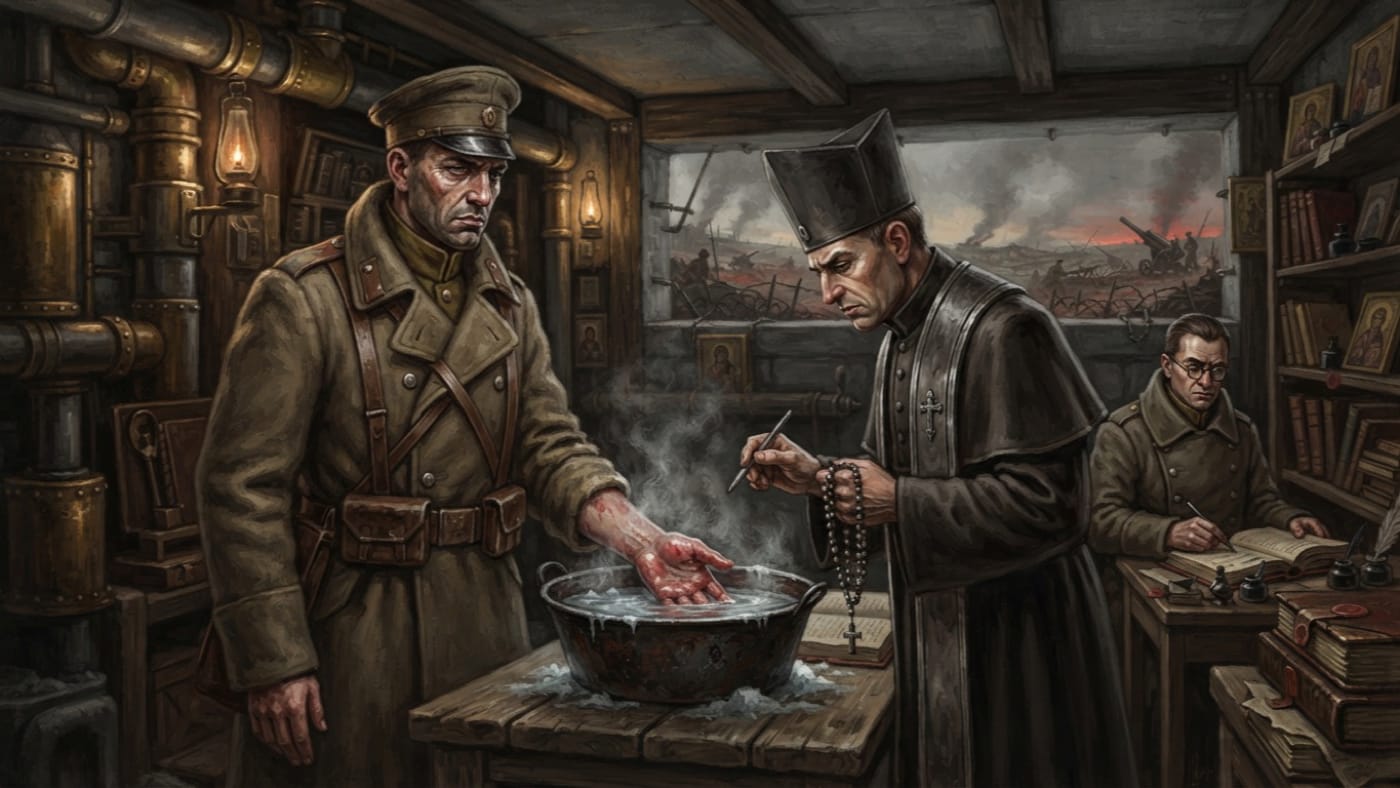
After engagement comes the basin. The cooling rituals use cold water, and ice or snow when the sector provides any, which it rarely does this close to the Iron Wastes. The soldier puts his hands into the water and the chaplain watches them. A hand that opens returns to duty. A clerk records the result. A hand that stays shut is noted, prayed over and watched again.
Then the soldier goes to the confessional screen. He speaks his angry thoughts there, along with his violent wishes and the name of the officer he would like to see under a slag-flow. The theory holds that rage spoken aloud is rage released. Some men walk out lighter. Others walk out knowing that a Confessor-Penal now holds their grudge in writing, which is a new grudge with a better filing system.
Units that show elevated aggression receive a rage fast, a period of enforced pacifism during which violence is forbidden for any reason, including defence. Those who cannot keep the fast are confined until the urge passes.
The chaplain must keep three registers apart. Ordinary anger is confessed and absolved. Behaviour comes next: a jaw that stays clenched through prayer, combat tension that never drains away, a man who picks a fight in the mess because the barracks have run out of enemies. That calls for restraint and closer watching. The third register is the body itself: scars that are warm years after closing, heat with no fever behind it, an ember-glow at the back of the eye, metal knitting into the skin of the palm. That is no longer a pastoral matter.
Survey Manual 44-F formerly advised "emotional neutrality" during Thracian exposure.
Corrected. Emotional neutrality is unavailable within range of Wrath phenomena. Current instruction requires cold obedience, confessed anger, and immediate restraint of any soldier whose hand remains clenched after prayer.
#On the Limits of Obedience
Passionlessness is an ideal. Field conditions are what the ideal meets in practice. A soldier who has watched his section dragged into a Forge-Beast, still screaming, still aiming, feels something whatever the syllabus says. The Bureau of Engineering conceded as much when it withdrew 44-F. The Doctrine survived the withdrawal because it never required a man to feel nothing. It requires him to keep whatever he feels from deciding what his rifle does.
The discipline that is meant to contain the fire also supplies it. Some men are ordered to hold their fire while their friends burn. Some are kept at the wire past their rotation because a requisition sat on the wrong desk. Some are fasted into pacifism while an aggrieved sergeant mocks them through the bars. The Synod produces injustice reliably and in bulk. Then it asks the injured to process that injustice coolly, on behalf of the institution that injured them. Maldrake has never needed to forge a grievance on the Thracian front. He collects ours as they come off the press.
Calm is not proof of cleanliness either. Maldrake's legions march in formation. His Crucible-Born lay ambushes and wait for them to work. A soldier who kills with quiet precision may be the Doctrine's best pupil, or he may be the case so far advanced that the heat has gone inward. The Bureau of Purity therefore cannot treat stillness as innocence, and the Doctrine cannot tell its graduates apart from its failures by temperature alone.
#On the Figures Published
According to the Bureau's own records, units schooled in the Doctrine of Cool Hatred have a transformation rate only marginally lower than units that never received the instruction. The Bureau publishes the marginal improvement and withholds the absolute figures. It will not say how many men stood at the basin, how many hands opened, or how many cohorts went north with the catechism and came back with warm scars.
I have filed for the figures. The form came back stamped, and nothing was attached to it.
The Doctrine still helps, and I record this without irony because the Ledger requires it. The cooling rituals do something against the small anger: the shove in the ration queue, the oath muttered at a sergeant, the fist that opens on the third breath. They do nothing against the deep rage, the anger that has outlived its cause and taken up residence. Most anger is small, so the Doctrine keeps its post. Most of the damage comes from the deep rage, so the post is lonely.
Beyond the Doctrine stands the policy. Some rage-fast confinements have become permanent, because the Bureau has no protocol for releasing a man whose hands have been clenched for three years. Soldiers who show physical transformation are executed at once, and the Bureau calls this mercy. The catechism still holds that such a man can choose differently, even with metal in his palm. The mutation may be permanent. The Bureau has no rehabilitation protocol, and that absence is an administrative fact. It has never been ratified as a theological one. The terminal classification belongs to the Bureau of War's manual. Whether it is true in the eyes of the Creator has not been submitted for countersignature.
#On the Present Application
In the present year the Doctrine is still delivered wherever the Church sends men toward Thrace. Chaplains deliver it in the northern outworks of Constantinople. They deliver it to the infantry escorts of Engineering survey parties before those parties walk out onto glass crust to measure a country that resents measurement. They deliver it to relief columns marching to the southern end of the Sagittal Line, where the far horizon glows red and the near one is the basin.
The water is cold and the soldier's hand is in it. The chaplain watches, and the clerk keeps the count. The hand either opens or it does not, and the Bureau records which, though it will not tell you the totals.