
#On the Siege Engine That Learned to Hate
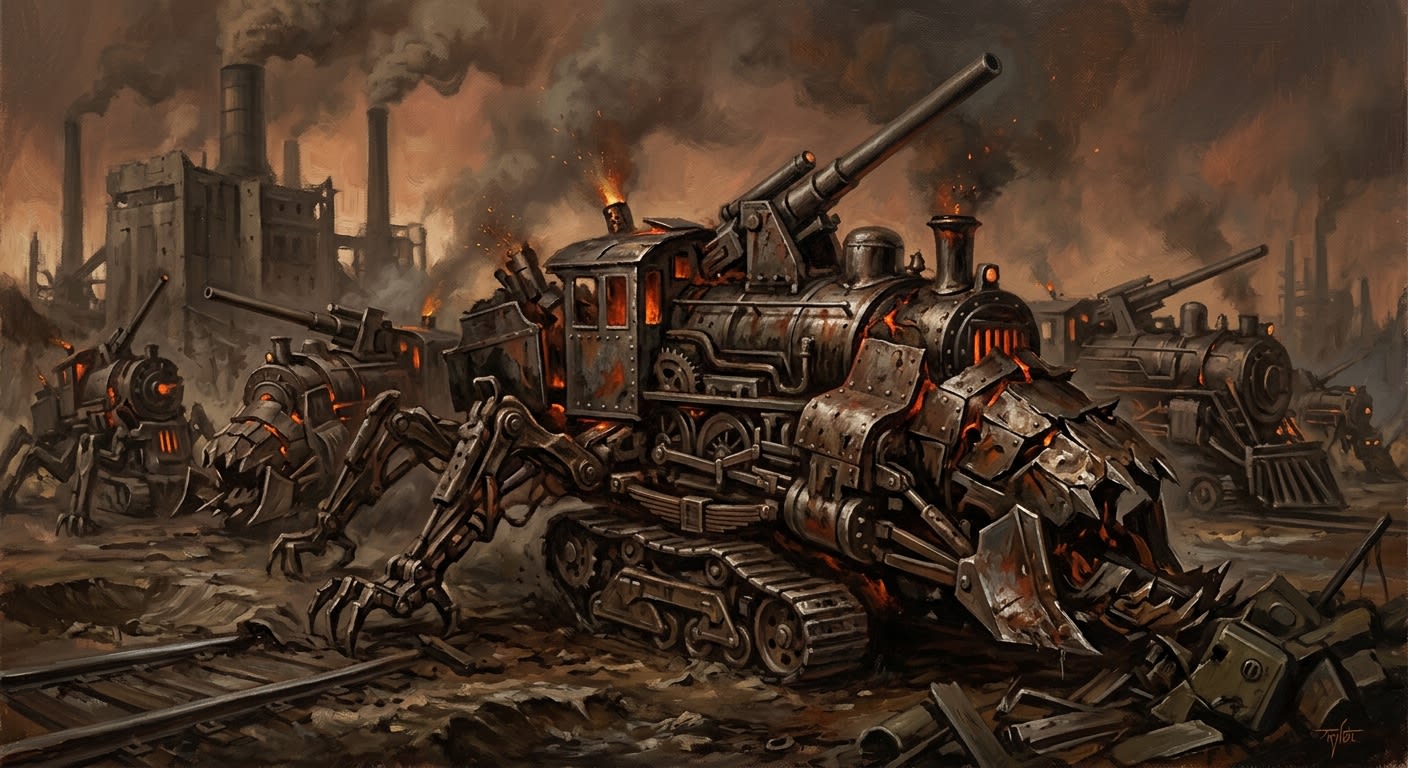
Forge-Beasts are captured engines given appetite: tanks, artillery tractors, gun-carriages, siege rams, rail crawlers, pressure frames, and other proud children of Engineering dragged into Maldrake’s heat until the machine forgets it was ever innocent of intention.
The field category appears simple. The comfort ends there. A Forge-Beast is neither beast nor machine in the comforting legal sense. It contains metal. It contains crew. It contains rage, sorcery, fused bone, and enough stolen Bureau design to make an engineer weep into his slide-rule. It walks, crawls, rolls, lurches, rams, fires, and remembers pressure. Its guns fire without ammunition when fury has replaced powder. Its plated hide takes cannon-fire until the rivets glow white. Its crew remains inside, melted into levers and firing beds, still screaming, still aiming, still performing their duties with an enthusiasm the original training manual did not request.
Their parentage belongs to the Iron Wastes of Thrace, where Maldrake has taught geography to smelt and memory to take bolts. Captured machines enter the heat. Some are driven in by Ember crews. Some are recovered from failed assaults. Some crawl back after abandonment, which is the kind of behaviour that causes Ordnance men to stop laughing at chaplains. In the Wastes, the distinction between salvage, corpse, and recruit loses force. Wrath has one question for all three: can you strike?
The answer, regrettably, is yes.
#On Their Making in the Iron Wastes
Maldrake does not understand technology as our engineers understand it. He does not care for tolerance, maintenance cycles, lubrication records, firing tables, serial discipline, or the fragile liturgy by which a bolt remains a bolt instead of a lawsuit. He understands the violence inside a thing. A cannon is stored thunder. A tank is anger under plate. A rail engine is force taught schedule. He takes the violence and gives it permission to continue after the operator would have stopped.
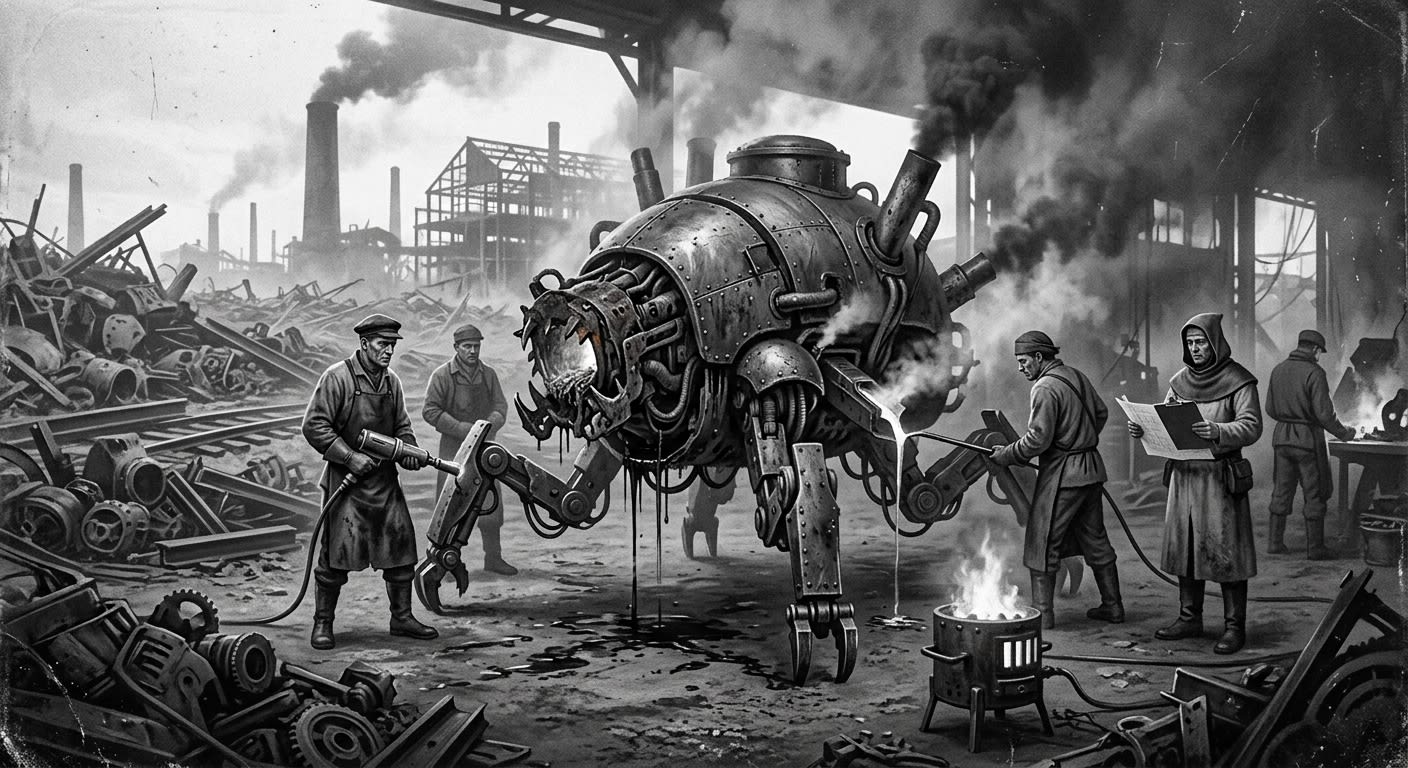
The making begins with capture. A gun position overrun on the Thracian approaches. A traction engine mired in slag mud. A siege tractor abandoned when its boiler priest died. A tank disabled outside Constantinople while its crew waited for recovery teams that never arrived because recovery teams dislike being recovered in pieces. Pyre-smiths come after the assault, hammering brands into plate, chaining the engine to teams of Ember-Soldiers, dragging it east by inches, yards, curses, and screams.
Inside the Wastes, the machine is heated beyond manufacture and short of melting. That interval is where Maldrake works. Crew bodies fuse with controls. Bone becomes linkage. Hands become trigger assemblies. Feet become brake teeth. Faces blister into viewing slits. The machine’s old motive system may remain, but it is never trusted alone. Legs are added: corpse-bundles hardened into pistons, scaffolds wrapped in tendon, iron hooves riveted beneath tank hulls, jointed struts made from artillery recoil arms and thighbones from animals no zoological office will claim.
Some Forge-Beasts retain their original shape. These are the merciful ones, because a soldier can identify a tank even when it is walking badly. Others are corrected by Wrath until function mocks ancestry: a field gun with six limbs and a throat, a bridge-laying engine that lays ribs, a rail crawler whose wheels have become grinding mouths, a siege ram whose head is a fused cluster of cannon muzzles breathing red. Engineering calls this adaptive corruption. Soldiers call it the bastard coming up the slope.
Early field handbooks described Forge-Beasts as “animated enemy siege engines.”
Corrected. “Animated” suggests external motion imposed upon dead matter. Forge-Beasts exhibit target selection, heat response, tactical bracing, obstacle preference, and post-impact adjustment. Dead matter does not learn where the gate sings thinnest.
The crew is not incidental. A Forge-Beast without crew-captives may function, but a crewed beast functions with obscene memory. It knows how a Synod gun deck breathes. It knows where loaders stand. It knows the panic rhythm of a traverse wheel jam. It knows the voice of an officer shouting range corrections, because that voice once belonged to the man whose ribs now brace the firing bed. The machine returns with its manual inside it, rewritten in meat.
#On Their Shapes and Field Signs
A Forge-Beast announces itself by heat before sound. Paint blisters on forward icons. Brass fittings sweat. Prayer flags stiffen and curl. Men taste pennies and burnt hair. Then comes the noise: more than roar, a working noise, a foundry argument inside a chest. Chains dragging. Plate flexing. Crew-throats screaming through pipes. Hooves striking stone in a rhythm too regular for animal panic and too angry for ordinary machinery.
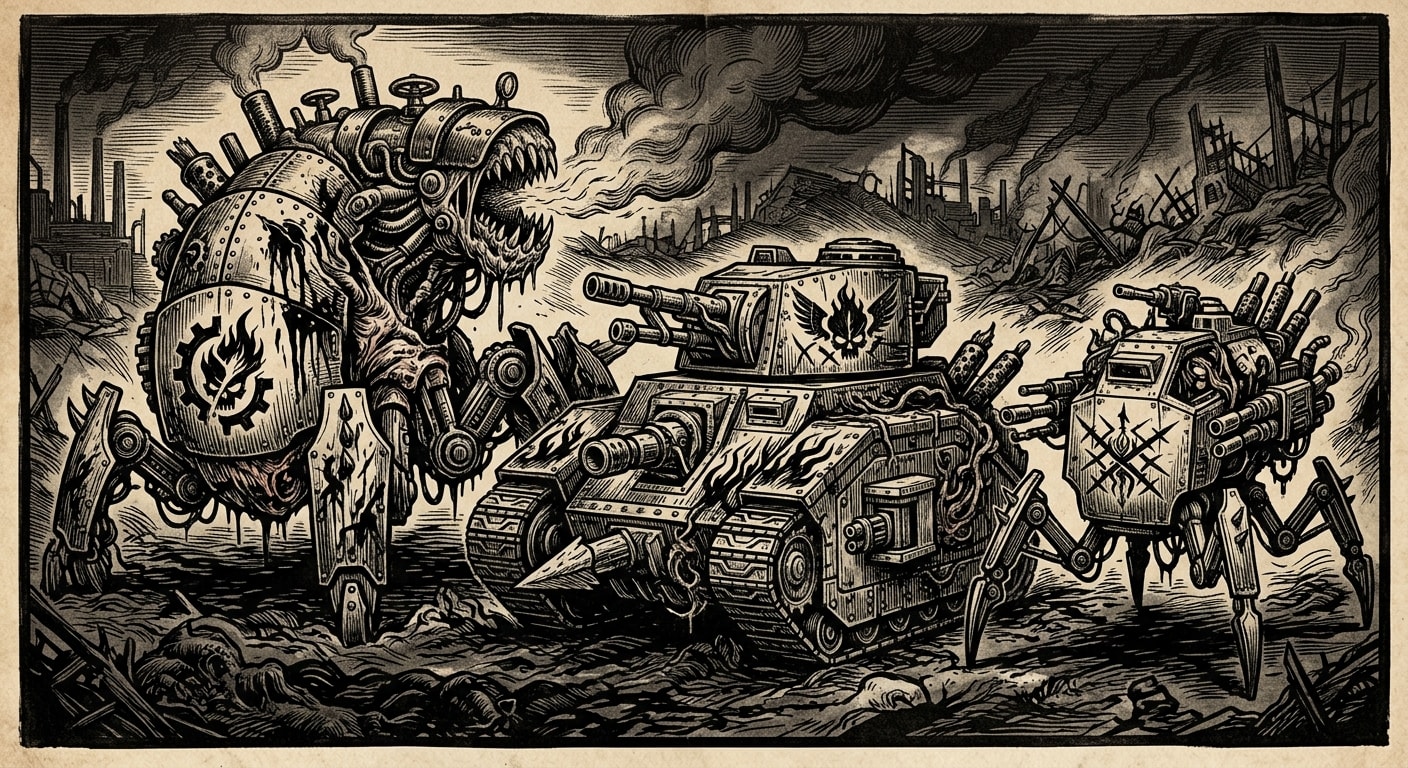
The common ram-beasts run low and broad. Their heads are iron blocks, cannon muzzles, boiler fronts, or chapel doors stolen from places that no longer have chapels. Their ribs show as furnace bars. Heat pulses through gaps in the plating. They strike gates with the timing of trained sappers, not cattle. Several reports from the southern gate action record impacts between Shield-Paladin brace-calls, where flesh relaxes for the half-breath discipline permits and Wrath is courteous enough to exploit.
Gun-beasts remain farther back until called forward. They settle on limb-struts, sink claws into slag or paving, and fire from barrels whose ammunition feed may be empty. The shot is rage condensed into impact: invisible heat, slag clots, shriek-bolts, pressure fists, and rounds that strike morale first. Men under Forge-Beast fire report shame, anger, old grudges, sudden hatred for officers, and the desire to leave cover and hit something with bare hands. This is classified as morale burn, though the phrase is too tidy for the thing. A tidy phrase is a small white cloth thrown over a corpse.
Carrier-beasts haul Hellbow frames, Hollowed cages, pyre-smith anvils, and slag-bow ammunition. These are slower, more useful, and more heavily guarded. Hellbow cohorts screen them with Ember-Soldiers and Gore-Slinger curtains. Pyre-smiths walk beside them, hammering cracked plates mid-assault, branding damaged limbs, shoving fresh corpses into gaps where piston and tendon disagree. A pyre-smith repairing a Forge-Beast under fire is a sight that persuades even optimists to respect enemy logistics.
Some Forge-Beasts carry bells. The bells are slag-throats shaped in parody of Orison metal: false bronze for false summons, hot-mouthed and doctrinally rude. Their peals do not summon prayer. They interrupt it. Chaplains report missed syllables, reversed antiphons, brace crews forgetting the second line of common trench hymns, and one entire gun crew reciting a childhood grievance against a tax clerk while loading anti-siege shells. The bell-beasts are rare. The Bureau of Bells denies professional offence. The denial has the stiffness of a man whose hat has been stolen in public.
#On Their Place in Maldrake’s Assault Order
Forge-Beasts are never thrown forward as dumb weight. This error killed enough officers that the Bureau has retired it into training examples, where mistakes go to become educational furniture.
In Maldrake’s common assault sequence, Gore-Slingers open the approach with incendiary filth. Hellbow fire follows, selecting access ways, bell platforms, powder stairs, and courage. Forge-Beasts close after the bolts. They exploit broken ground and make a second language of it. A gate cracked by slag fire receives a ram. A parapet thinned by choir-killer bolts receives a climbing beast. A trench clogged with Ash-Fodder corpses receives a crawler whose belly plates turn the dead into footing.
Behind or among them walk Hollowed columns. This pairing made the Vigil of the Hollowed infamous. On the 23rd of Argent, A.S. 170, Forge-Beasts struck the Sixth Ravelin after Hellbow volleys had found the unmanned curtain. Seven Hollowed reached the wall. Six detonated. The seventh listened and fell. One hundred and forty metres cracked into powder. Through the gap, Forge-Beasts pressed until the rubble became half stone, half iron, half the fused remains of things arithmetic cannot keep separate without becoming impious.
The beasts failed to pass Chamber 7 after the sealing. They burned the new wall. They struck it. They brought a siege ram whose iron bands had been baptized in heat and drove it at full charge. The ram split. The wall stood. This is why pilgrims kneel and why engineers check the same section every year with instruments they pretend are adequate. Faith sealed the breach. Cement assisted. Forty-seven people became load-bearing. The Forge-Beasts learned the taste of refusal.
At the older southern gate action, remembered in corrected files under pre-correction southern-anchor usage, Forge-Beasts rammed for three days and nights. The Seventh Southern-Anchor Cohort of Shield-Paladins held without rotation. Their shields fused at the rims. Their tongues carbonised. No corpse fell backward. The beasts struck at rhythm, waiting for the pause between brace-calls, battering the gate and the men behind the gate until both became one structure. The gate survived because the Paladins became a second gate, a solution Engineering would never have approved because Engineering dislikes materials that have mothers.
#On Captured Materiel and Bureau Shame
Every Forge-Beast is a battlefield indictment with legs. It says: you failed to destroy what you could not save. It says: your design was sound enough for Hell to retain. It says: the enemy has read your maintenance notes in the marrow of the men you left inside.
The Bureau of Engineering has requested, on nine occasions, that captured heavy materiel be destroyed before Maldrake can corrupt it. The Bureau of War has approved the request on nine occasions. Front-line units have complied on four. This gap includes more than negligence. Destroying a disabled siege engine under fire requires explosives, time, access, and a willingness to spend living men on the dignity of dead iron. Commanders prefer recovery. Recovery prefers delay. Delay, in the Thracian theatre, is a polite word for gift-wrapping.
Ordnance Circular 88-B (Unregistered) stated that “all disabled engines are to be rendered unusable before withdrawal where feasible.”
Clarified after three rendered engines returned as Forge-Beasts with their breeches sealed, wheels removed, and boilers punctured. “Unusable” by Synod standards remains usable by Wrath if impact, heat, or hatred can be extracted. Current directive requires denial by total destruction, brine saturation, bell-silencing, and confirmation that no crew remains fused to a functional command surface.
Front soldiers have developed private rules. Burn the serial plate. Break the name. Salt the breech. Remove the crew if you can. If you cannot, pray over them before the pyre and do not speak their names where the iron can hear. This last instruction appears in no manual because manuals dislike sounding superstitious. Manuals have not watched a corrupted gun turn toward the trench after someone called out the loader’s name.
RECOVERY FAILURE REPORT — THRACIAN APPROACH, A.S. 194 Engine designation: Saint Ivo-Pattern traction gun, Third Battery Crew status at abandonment: ███ confirmed alive Recovery party arrival: delayed by slag-river reroute Second contact: engine returned under hostile control, crew faces visible in pressure glass Transcript of audible pipe-voice: “██████, range corrected.” Officer who answered by name: deceased
The shame spreads beyond Engineering. Ordnance sees its barrels made heretical. War sees its evacuation timetables become enemy manufacture schedules. Records sees serials reappear after being written off. Doctrine sees the worst implication: if a machine may be corrupted through use, then intention has entered materiel, and every consecrated gun in the Synod’s arsenal begins to look less like equipment and more like a parishioner with recoil.
#On Countermeasures and Necessary Cruelties
The prescribed response is denial, distance, cooling, dismemberment, and silence. The order matters less than speed, but officers adore order because it gives dying men the illusion that minutes have hinges.
At range, Forge-Beasts are to be hit at joints, belly plates, crew-view slits, tendon bundles, and the places where corpse-struts enter iron. Brine shells cool and crack plate. Bell saturation disrupts slag-throat cadence. Reliquary shrapnel can sever command knots if fired close enough to make the gun crew eligible for posthumous neatness. Plain artillery works if enough of it arrives early. Plain artillery also becomes future Forge-Beast stock if abandoned, which is one of those jokes the Enemy tells by logistics.
At close quarters, the instruction is uglier. Get beneath the belly, plant a demolition charge, cut the heat tendon, wedge the brace pin, or drive a relic spike into the crew-heart if one is visible. Volunteers for this work are praised before assignment because after assignment praise becomes archival. Shield-Paladins may lock the head. Fusiliers target knees and slits. Orison choirs chant cold antiphons until throats tear. Chaplains carry brine, salt, and lists of names that must not be spoken aloud.
A silent Forge-Beast remains unsafe. Silence may mean command loss. Silence may mean listening. Silence may mean the crew has finally ceased to be crew and become something less courteous. Field teams wait for heat drop, bell response, brine hiss, and absence of eye-motion in any visible face. Then they wait again. Impatience has filled more casualty forms than cowardice.
The Bureau of Purity insists on witness presence for recovered remains. This is partly doctrinal and partly practical. Men cut friends from corrupted machines with poor judgment. A driver fused into a control nest may beg. A gunner whose jaw has become a vent may say his daughter’s name. A loader whose hands are now trigger forks may ask to be unhooked. Mercy, in such moments, must wear gloves and carry a hammer.
#On What They Teach
Forge-Beasts teach the Synod an unwelcome lesson: the war uses us twice if we permit it. First as makers, then as material. The beast coming up the slope is more than Maldrake’s invention. It is our gun, our armour, our fuel discipline, our crew drill, our proud stamped serial, our industrial genius dragged east and returned with a corpse inside the warranty.
This is why soldiers hate them differently. A Hollowed is pity and alarm. An Ember-Soldier is grief with a rifle. A Forge-Beast is insult. It takes what the Synod made to preserve order and proves that violence, once separated from Doctrine, can find another master without changing shape very much.
The Bureau of Doctrine teaches the Doctrine of Cool Hatred on the Thracian front: kill without pleasure, burn without rage, destroy without becoming the thing destroyed. Forge-Beasts make that doctrine difficult. Men who watch comrades pulled into controls do not feel cool. Men who hear a familiar voice through a vent do not hate cleanly. Men who see their battery return on corpse-legs want revenge, and revenge is the first warm room in Maldrake’s house.
As of A.S. 201, Forge-Beasts remain active in Thrace, the Iron Wastes, the Maldrake-Syrion Contact Zone, and the approaches to Bastion-Constantinople. They screen Hellbow batteries. They test gates. They retrieve our wreckage faster than we retrieve our wounded. They have not grown more numerous in public estimates, because public estimates have the good manners to flatter morale. Private estimates use heavier ink.
The standing order endures. Destroy before capture. Confirm cold. Do not answer if the machine speaks with a voice you loved.