
#On the Nature of the Evocation
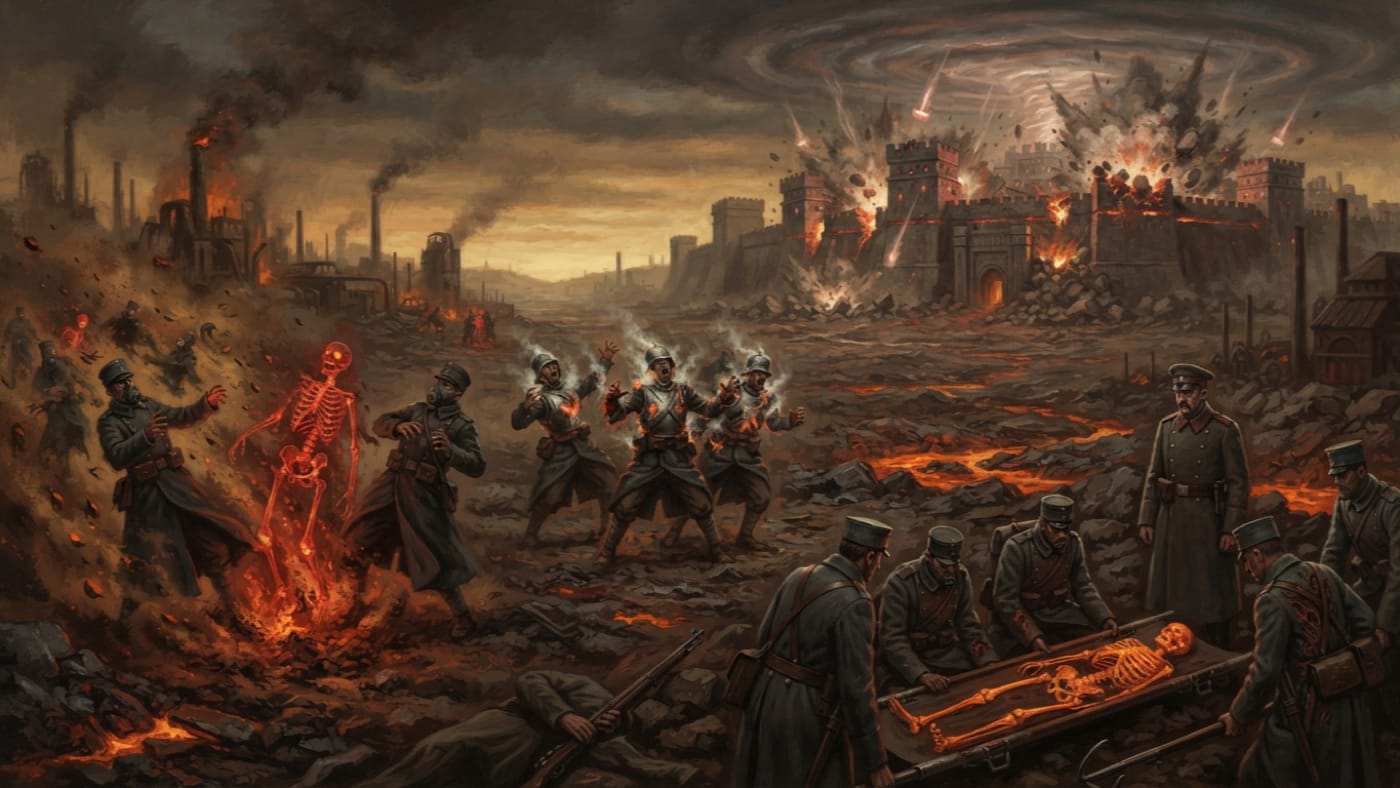
When a slag-storm catches a man in the open in the Iron Wastes, it peels him like fruit. What it leaves in the Thracian dark is his skeleton, still standing in the cinders and glowing red-hot. The burial detail has to wait for the bones to dim before it can touch them. That skeleton is the first exhibit in the Church's file on Forge Evocations, the school of sorcery belonging to Maldrake, Sin-General of Wrath. The catalogue in Miracles and Sorcery defines the school as molten rage hammered into spell-form. I have spent a career failing to improve on those six words.
Do not take the forge in the name too literally. Wrath takes violence and works it on the anvil until it turns into something violence was never meant to be, such as a blow with no arm behind it or heat with no fire under it. The record contains no academy for this art. It holds no syllabus, no rite of founding and no master of the school whose name the Ledger could strike out.
Doctrine files it with the rest of the Lie's arts. The mechanism is the same one a miracle uses: power drawn from beyond the mortal sphere through a material conduit. Doctrine assigns this power to the will of the Great Deceiver, while a miracle comes by the permission of the Creator. The Bureau of Doctrine holds the licence that tells the two apart. A sanctioned miracle bills its petitioners. Sorcery bills Creation, and the Iron Wastes show what Creation looks like once Wrath has run up the account.
#On Slag, Armour and the Air
The record certifies three manifestations. I keep them on separate folios because each one ruins something different.
The slag-storm ruins the ground and anything that walks on it. It rises from country already given over to slag-rivers, glassed soil and fused iron, and it carries cinder and molten grit on air that should not be able to carry them. Flesh comes away and the bone stays, glowing. Survey parties of the Bureau of Engineering have crossed the glass crust north of Bastion-Constantinople behind such storms. They report that the country is unchanged in every particular except its population. The record gives no temperature, no reach and no season for the storm. It gives the bones.
Earlier field handbooks described the matter of the Iron Wastes as "Thracian volcanic residuum."
Struck from public instruction, and the correction stands in this entry as it stands in the Wastes' own. Volcanic residuum does not rise into storms that pick men clean and leave the rocks around them alone. The discredited phrase is recorded here so that no quartermaster revives it to justify ordering the wrong boots.
The screaming armour ruins a soldier's faith in his kit. Within Wrath's reach, plate that is struck cries out like flayed skin. The record does not say whether the steel feels anything, but the man inside it certainly does. A company whose breastplates shriek at every glancing round soon flinches before the round arrives. A quartermaster can reissue a cuirass. He has no form for reissuing the nerve of a man who has heard his own armour scream.
The heat-hammer ruins walls and everything the walls were built to keep safe. It forms in the air itself, with no barrel, no crew and no shell that could be dug from the rubble and entered in an inventory. Its blows land as invisible fists. Their heat passes into the masonry and on through it, so that what lies behind the wall cooks inside its protection. The gunners of the Bureau of War are trained to answer a gun with a gun. Nobody has trained them to answer the sky.
#On the Thessaloniki Account
Thessaloniki is not a bastion of the Sagittal Line. It is a supply harbour in the seventh zone, on the Aegean, and the southern front lives on what passes through it. Two harbour-chain towers, Elder and Younger, stand on headland and spit with the reliquary chain hung between them. Forge-sorcery reached this coast at a moment the record declines to fix. The Siege of Thessaloniki carries no year. A.S. 201 is the year of this survey and has no other standing here. Any copyist who moves it onto the siege will be moved himself.
The account itself is brief. A famed evocation summoned a heat-hammer in the air above the city. It pounded the walls with invisible fists, blow after blow, until priests boiled alive in their sanctuaries. They died at altars consecrated to keep the Lie out, and the walls the Church had raised to shelter them held the heat in. The account names no caster and no engine. It records nothing about how long the blows fell, and it does not say whether the city held, fell or simply went on.
The rest belongs to the Choir-Mortar Campaigns. A single barrage of Choir-Mortars brought down five enemy sorcery towers. They collapsed into the city and entombed thousands of captive civilians who had been kept as sorcery fodder. Readers in a hurry confuse the towers, so I give the count once. The two harbour towers belong to the Synod and still stand. The five sorcery towers belonged to the enemy, and they fell.
The record never says the five towers produced the hammer, and it never says their fall silenced it. It says what the gunners aimed at and what came down. Any clerk who wants a tidy dispatch will join those facts with a therefore. I have struck that therefore from two drafts submitted to this office, and I will strike it from a third.
The city calls the collapse the Ash Wedding, and it whispers the name, since Purity keeps its ears open on the waterfront. The Bureau of Doctrine holds that the entombed were "willing offerings." I enter that as Doctrine's position, under Doctrine's seal.
#On the Wielder Becoming Material
The Ledger teaches that sorcery bills the world and spares the sorcerer. Wrath bills the world and then sends a second invoice to the hand.
Maldrake's sin should not be confused with anger. Anger is human, it passes, and sometimes it is righteous. A soldier whose grievance is real has not enlisted in anything by holding it. Wrath begins further on, where destruction becomes its own purpose and rage outlives the wrong that started it. At that point the man holding the weapon becomes the weapon. Wrath's influence finds the wronged and offers them strength and victory, and both gifts are real. Then it offers escalation, and the gifts do not stop coming.
The body keeps the account. Scars stay warm years after they close. There is fever with no sickness behind it, and hands that will not unclench after prayer. In the furthest cases metal knits into the palm. These marks belong to Wrath's wider influence. The record has not certified them as the particular price of casting an evocation, and I decline to draw a line the evidence has not drawn. A change in the flesh may be permanent. The catechism still teaches that no demon takes a man's will, so he keeps the power to choose differently with metal growing through his hand.
Several things are routinely filed under Forge Evocations by mistake, and the record keeps them apart. Forge-Pyre Bastion is a citadel. The Eternal Forges are mountain works where enslaved men and women pump the bellows until their lungs fill with ember. They are captives, and the Ledger owes them that word before it reaches for "cultist." The Crucible Cities remake servants into weapons. Forge-Beasts are Synodal machines captured and corrupted with their crews still inside. Their making is demonic and has nothing to do with engineering. All of these are related Wrath phenomena, and none of them is a certified evocation. Nor should anyone mistake Wrath's servants for frothing beasts. They march in formation, lay ambushes and wait for those ambushes to work.
#On Cold Obedience
Against the influence, the Church issues the Doctrine of Cool Hatred. Its teaching is that the soldier kills from duty and gives up any pleasure in the killing. It is drilled into him through command discipline, breathing counted under the chaplain's voice, the basin of cold water after engagement, angry thoughts spoken through the confessional screen, and rage fasts for units that show too much appetite. These measures help with the small anger, such as a shove in the ration queue or a fist that opens on the third breath. They do nothing for the deep rage that has outlived its cause.
The basin was designed for a man's temper. It was never meant to stop a hammer. No chaplain has yet proposed holding a basin of cold water up against the sky over Thessaloniki. The first to propose it will be posted somewhere with plenty of water and no sky.
The discipline also produces what it treats. Men are ordered to hold fire while their friends burn. Rotations overrun because a requisition sat on the wrong desk. Fasts are imposed by sergeants who make sport of the fasting. The Synod turns out grievances in bulk, then asks the aggrieved to process them coolly for the institution that caused them. Maldrake has never needed to forge a grievance on the Thracian front. Ours reach him already printed.
Those who show physical transformation are executed. The Bureau has no rehabilitation protocol on file, and that absence is an administrative fact. No council has ratified it as a theological one.
Counter-battery work is the remaining remedy, and Thessaloniki shows what it costs. The Choir-Mortars hit what they were aimed at. The bill was presented as the Ash Wedding. Nothing in the record shows that sanctified shellfire cancels an evocation automatically, and I have seen no ledger that would let a gunner assume it does.
#On Present Classification
As of this survey, Forge Evocations is a known school with three certified manifestations and no certified practitioner. It has no recorded first use. The Sundering of A.S. 45 marks when Maldrake and his Wastes appeared and says nothing about when the first hammer formed. Its mechanism is understood only as far as Doctrine's general formula reaches, and its remedies work only as far as a basin of water and a barrage of mortars can reach. The Bureau of War keeps the file open. The Bureau of Engineering keeps sending surveyors north. The Bureau of Doctrine keeps the licence.
The skeletons in the Wastes cool by themselves eventually. The Synod has never claimed credit for that, but it has entered them as recovered.